Golda Rush quit her job as a manager for Home Depot to start her own hair dressing
salon, Goldilocks. She gave up a salary of $40,000 per year, invested her savings of
$30,000 (which was earning 5 percent interest) and borrowed $10,000 from a close
friend, agreeing to pay 5 percent interest per year. In her first year, Golda spent $18,000
to rent a salon, hired a part-time assistant for $12,000 and incurred another $15,000 on
equipment and hairdressing material. Based on this information, what is the amount of
her implicit costs?
A) $80,000
B) $70,000
C) $42,000
D) $41,500
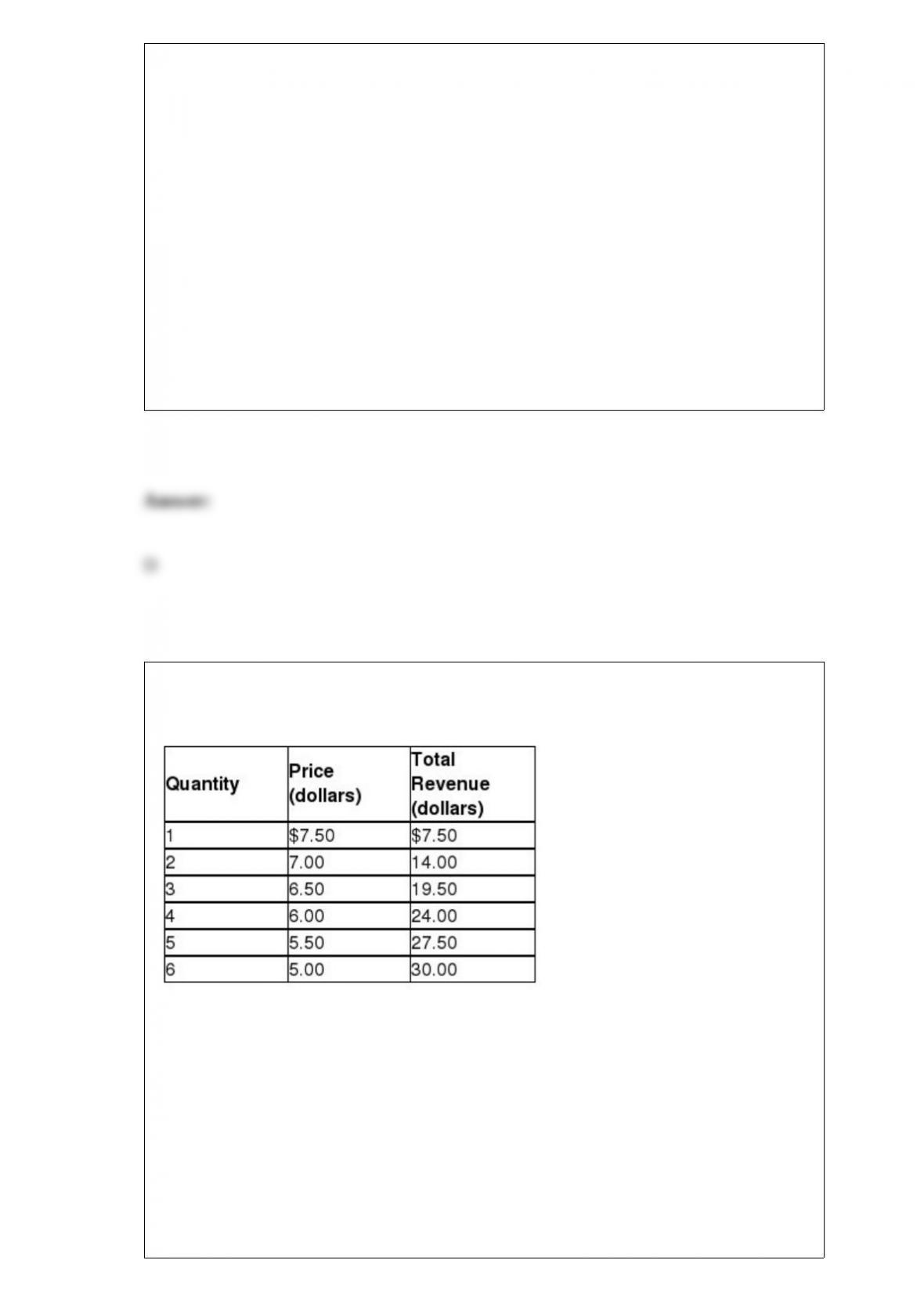
Table 13-1
What portion of the marginal revenue of the 4th unit is due to the output effect and what
portion is due to the price effect?
A) output effect = $24.00; price effect = $19.50
B) output effect = $6.50; price effect = $2.00
C) output effect = -$0.50; price effect = $5.00
D) output effect = $6.00; price effect = -$1.50

Which of the following would shift a nation’s production possibilities frontier outward?
A) discovering a cheap way to convert sunshine into electricity
B) an increase in demand for the nation’s products
C) a decrease in the unemployment rate
D) a law requiring workers to retire at age 50
Which of the following is an example of a “how much” decision?
A) Dinah’s Diner is only open for breakfast and lunch. Dinah is trying to decide
whether to open for dinner as well.
B) Zander has torn up his front yard and is debating whether to plant grass or install a
rock garden.
C) You received a nice birthday check from your grandmother and are deciding on
whether to spend it on a trip to New York or a trip to San Francisco.
D) Sergio quit his job to go back to school full time.

In order to be binding, a price ceiling
A) must lie above the free market equilibrium price.
B) must lie below the free market equilibrium price.
C) must coincide with the free market equilibrium price.
D) must be high enough for firms to earn a profit.
Workers who dislike risk
A) prefer to be paid monthly rather than weekly or daily.
B) prefer a piece-rate compensation system to a salary system.
C) prefer a salary system to a commission compensation system.
D) prefer to be paid a salary rather than a wage.
________ refers to the reduction in economic surplus resulting from not being in
competitive equilibrium.
A) Marginal cost
B) Producer atrophy
C) Deadweight loss
D) Economic shortage
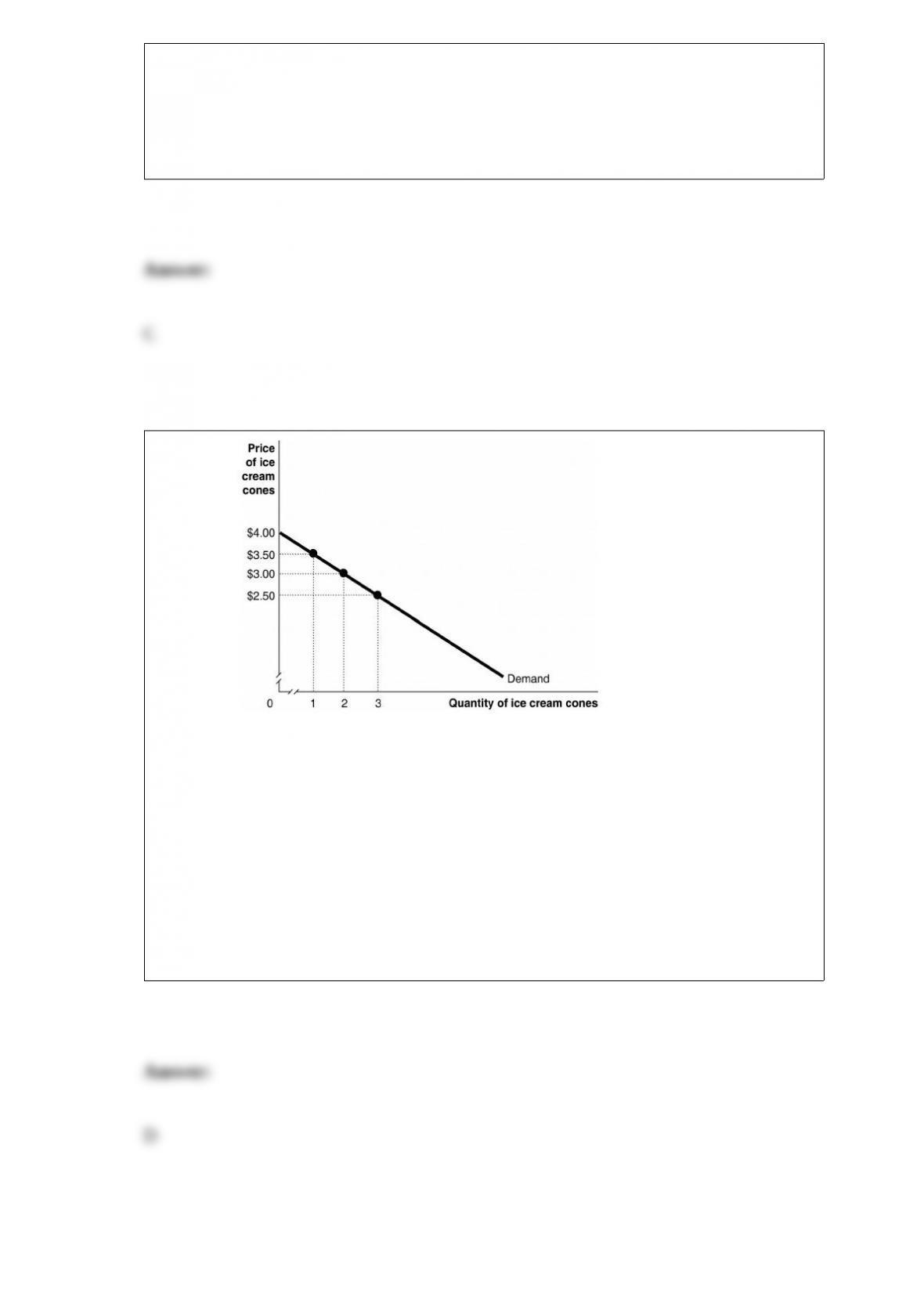
Figure 4-1 Figure 4-1 shows Kendra’s
demand curve for ice-cream cones.
If the market price is $3.00, what is Kendra’s consumer surplus?
A) $6.50
B) $5.50
C) $2.50
D) $0.50
Starbucks started out small in 1971, but by 1993 Starbucks was a national chain and
had coffeehouses in 38 countries. A key to the company’s success was the realization by
executives that
A) there was a demand for coffeehouses where consumers could sit and drink
high-quality coffee.
B) coffee prices would have to be cut in order for Starbucks to compete with other
stores that sold coffee.
C) they had to keep their stores open longer hours to attract a large number of
customers.
D) their stores should be located close to other stores that sold similar products.
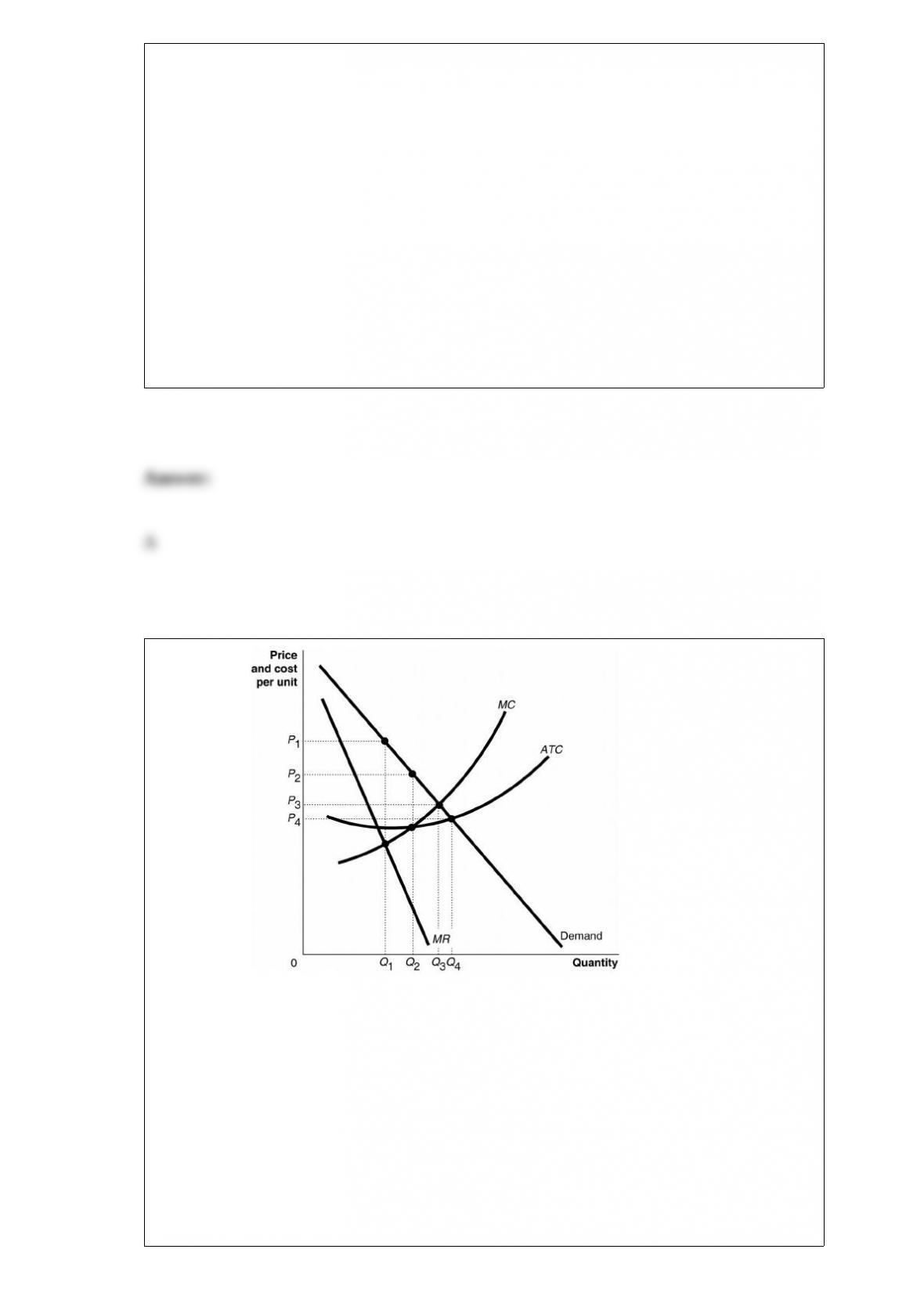
Figure 16-1
What is the price charged under perfect price discrimination?
A) P3
B) P4
C) a range of prices corresponding to the demand curve from P3 and above
D) a range of prices corresponding to the demand curve from P4 and above

If the marginal propensity to consume is 0.75, the marginal propensity to save is
A) 0.25.
B) 0.5.
C) 1.
D) 3.
A perfectly competitive firm cannot practice price discrimination because
A) a firm that breaks even in the long run cannot afford to engage in yield management.
B) it does not advertise; this prevents the firm from marketing its product to different
segments of the market.
C) each consumer in a perfectly competitive market has the same willingness to pay.
D) the firm can only charge the market price.

Labor productivity will increase if the ________ increases and ________.
A) quantity of capital per hour worked; technology improves
B) quantity of labor per unit of capital; technology improves
C) quantity of capital per hour worked; immigration increases while capital is fixed
D) quantity of labor per unit of capital; immigration increases while capital is fixed
What is the difference between an “increase in supply” and an “increase in quantity
supplied”?
A) There is no difference between the two terms; they both refer to a shift of the supply
curve.
B) There is no difference between the two terms; they both refer to a movement along a
given supply curve.
C) An “increase in supply” means the supply curve has shifted to the right while an
“increase in quantity supplied” means at any given price supply has increased.
D) An “increase in supply” means the supply curve has shifted to the right while an
“increase in quantity supplied” refers to a movement along a given supply curve in
response to an increase in price.