
The 10-year protection period from generic competition for drug manufacturers is a
form of
A) copyright.
B) trademark.
C) hallmark.
D) patent.
Commodity money
A) has value independent of its use as money.
B) has little to no value independent of its use as money.
C) is backed by a valuable commodity such as gold.
D) can be used to purchase commodities, but not services.
Table 1-2

Thuy Anh runs a small flower shop in the town of Florabunda. She is debating whether
she should extend her hours of operation. Thuy Anh figures that her sales revenue will
depend on the number of hours the flower shop is open as shown in the table above.
She would have to hire a worker for those hours at a wage rate of $16 per hour. What is
Thuy Anh’s marginal benefit if she decides to stay open for three hours instead of two
hours?
A) $0
B) $20
C) $25
D) $45
E) $70
If the MPC is 0.5, then a $10 million increase in disposable income will increase
consumption by
A) $2 million.
B) $5 million.
C) $15 million
D) $50 million.

Interdependence of firms is most common in
A) monopolistically competitive industries.
B) monopolistic industries.
C) monopolistically competitive and oligopolistic industries.
D) oligopolistic industries.
If the consumption function is defined as C = 7,250 + 0.8Y, what is the marginal
propensity to save?
A) 0.2
B) 0.8
C) 5.8
D) 9.1
Which of the following is not part of an oligopolist’s business strategy?

A) meeting worker health and safety standards required of all firms
B) deciding the level of total output of a new product
C) determining the amount of advertising a new product needs
D) setting the product’s price after considering what rivals will do
Suppose the United States has a Gini coefficient of 0.4 and Sweden has a Gini
coefficient of 0.25. Which of the following statements is true?
A) The distribution of income is more equal in the United States.
B) The distribution of income is more equal in the Sweden.
C) Income distribution is changing faster in the United States.
D) Without information on population, it is not possible to compare income distribution
between countries.
Which of the following statements is true about the U.S. economy?
A) Each year, many new jobs are created, but few existing jobs are destroyed, and the
unemployed find jobs quickly.
B) Each year, few new jobs are created, but few existing jobs are destroyed, keeping
unemployment low.
C) Each year, many new jobs are created and many existing jobs are destroyed.

D) Each year few jobs are created, and therefore it takes the unemployed a long time to
find a new job.
For a perfectly competitive firm, average revenue is equal to
A) marginal cost.
B) the market price.
C) total revenue.
D) average fixed cost.
Consider the market for nurses in a given city. In each of the following cases, explain
what happens to the equilibrium wage rate and the quantity of nurses hired. a. One of
the major hospitals in the city closes.
b. A record number of students graduate with bachelor’s degrees in nursing.
c. Traditionally, nursing is a field that attracts women. However, changes in access to
education and to the labor force participation rate by women have led to a greater
demand for the services of women in a wide range of occupations. The demand for
nurses, however, does not change.
d. Advances in medical technology reduce the amount of time physicians must spend
with patients in intensive care and increase the time that nurses spend with patients.

The ________ demonstrates the roles played by households and firms in the market
system.
A) production possibilities frontier
B) circular flow model
C) theory of comparative advantage
D) business cycle
If, as your taxable income decreases, you pay a smaller percentage of your taxable
income in taxes, then the tax is
A) regressive.
B) proportional.
C) progressive.
D) unfair.

You’re traveling in Ireland and are thinking about buying a new digital camera. You’ve
decided you’d be willing to pay $125 for a new camera, but cameras in Ireland are all
priced in euros. If the camera you’re looking at costs 115 euros, under which of the
following exchange rates would you be willing to purchase the camera? (Assume no
taxes or duties are associated with the purchase.)
A) 0.56 euros per dollar
B) 0.89 euros per dollar
C) 0.92 euros per dollar
D) You would purchase the new camera at any of the above exchange rates.
By the 2000s, an important market change occurred when investment banks became
significant participants in the secondary market for
A) mortgages.
B) Treasury securities.
C) corporate bonds.
D) currency.
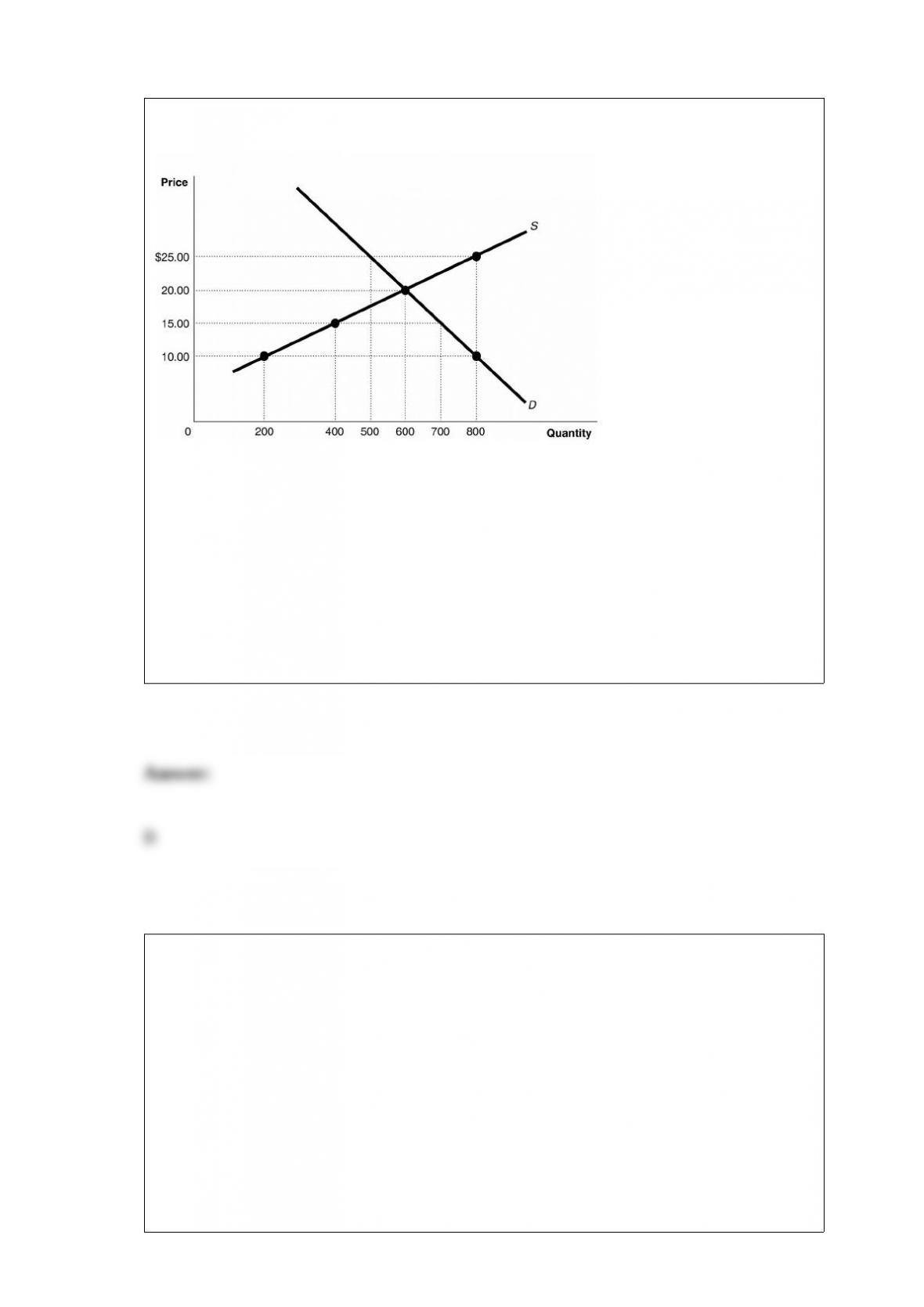
Figure 3-4
At a price of $25, how many units will be sold?
A) 400
B) 500
C) 600
D) 800
If the GDP deflator in the United States is 114, and the GDP deflator in Ukraine is 142,
which of the following changes would the theory of purchasing power parity predict?
(The Ukrainian currency is the hryvnia.)
A) The demand for the dollar will rise since the dollar is undervalued.
B) The demand for the dollar will fall since the dollar is overvalued.
C) The supply of the dollar will fall since the dollar is undervalued.
D) No prediction regarding changes in the demand or supply of the dollar can be made
without information on the exchange rate between the United States and Ukraine.

In 1991, Argentina decided to peg its currency (the Argentinean peso) to the U.S. dollar.
Most of Argentina’s trading, however, was with Brazil and Europe, not the United
States. What result would pegging the Argentinean peso to the U.S. dollar have on the
cost of imports from and exports to Brazil and Europe?
How does the principal-agent problem extend to managers and employees?
What are the three most important variables that cause the market supply curve of labor
to shift?
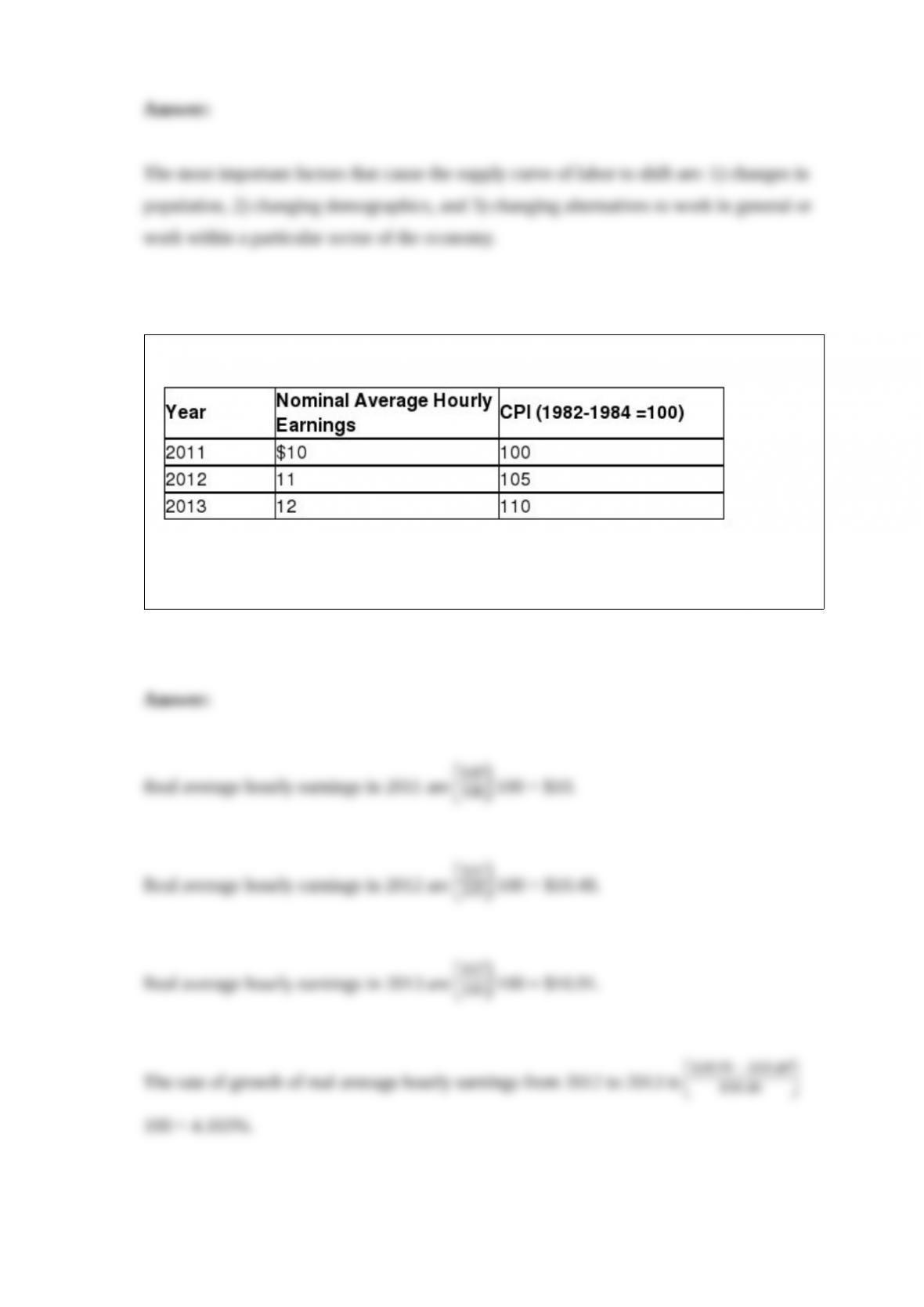
Table 9-22
Using the above table, calculate real average hourly earnings for 2011, 2012, and 2013.
Calculate the rate of growth of real average hourly earnings from 2012 to 2013.

What is the difference between physical capital and human capital?
What role do well functioning financial markets play in a market economy?