
1) the following cost data for a purely competitive seller:
refer to the above data. if product price is $60, the firm will:
a.shut down.
b.produce 4 units and realize a $120 economic profit.
c.produce 6 units and realize a $100 economic profit.
d.produce 3 units and incur a $40 loss.
2) the price elasticity of demand:
a.is infinitely large for a perfectly inelastic demand curve.
b.tends to be inelastic in high-price ranges and elastic in low-price ranges.
c.tends to be elastic in high-price ranges and inelastic in low-price ranges.
d.is the same at each price-quantity combination on a stable demand curve.
3) The equations for the demand and supply curves for a particular product are P = 10
.4Q and P = 2 + .4Q, where P is price and Q is quantity expressed in units of 100. After
an excise tax is imposed on the product the supply equation is P = 3 + .4Q.
Refer to the above information. The efficiency loss of this tax is:
A.$125.00.
B.$62.50.
C.$87.50.
D.$1.00.
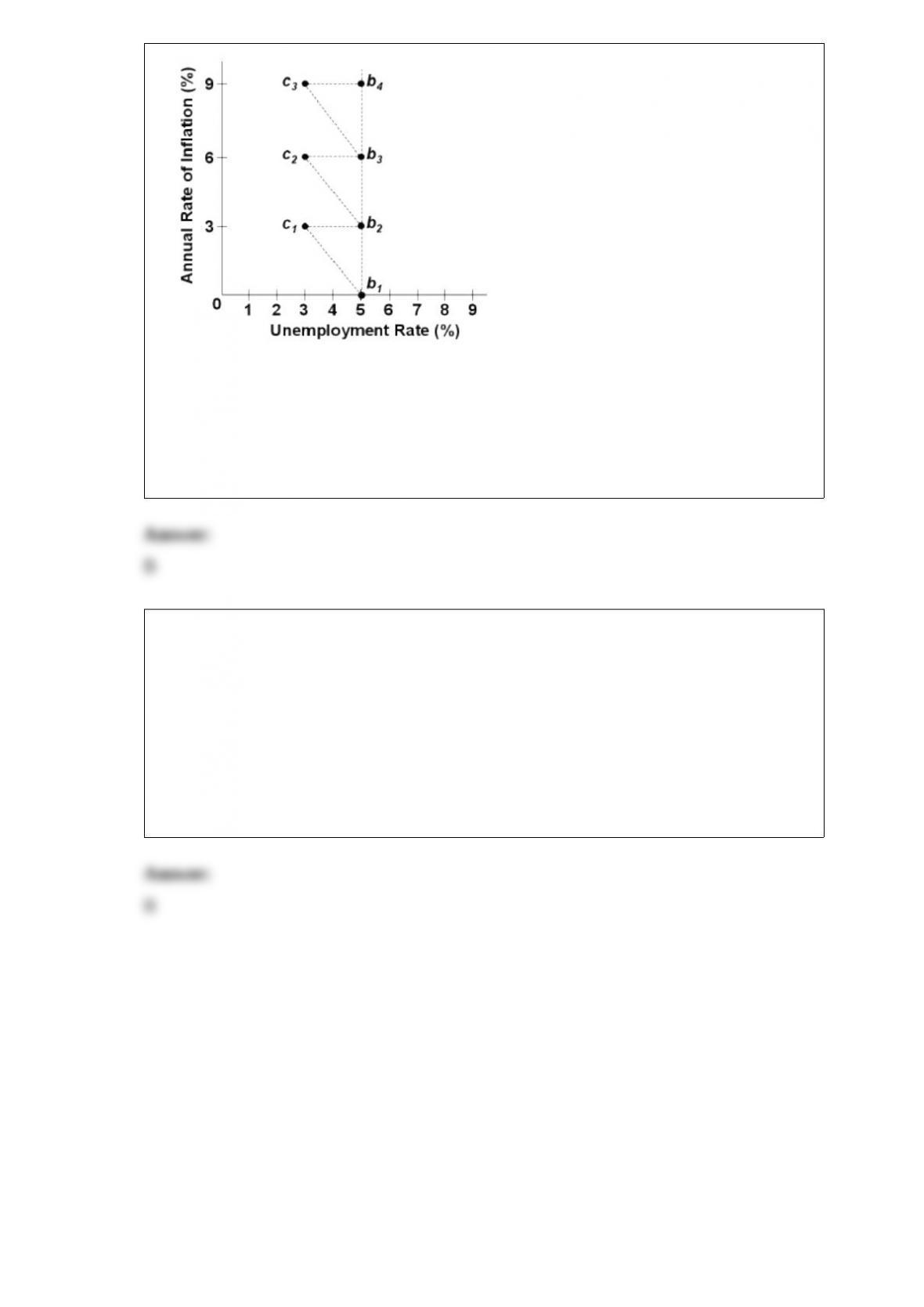
4)
Refer to the above diagram and assume the economy is initially at point b1. Which of
the following movements is consistent with the traditional Phillips Curve?
A.the movement from b1 to b2
B.the movement from b1 to c1
C.the movement from c1 to b2
D.the movement from b2 to b1
5) A farmer who has fixed amounts of land and capital finds that total product is 24 for
the first worker hired; 32 when two workers are hired; 37 when three are hired; and 40
when four are hired. The farmer’s product sells for $3 per unit and the wage rate is $13
per worker.
Refer to the above information. The marginal product of the second worker is:
A.24
B.8
C.5
D.1
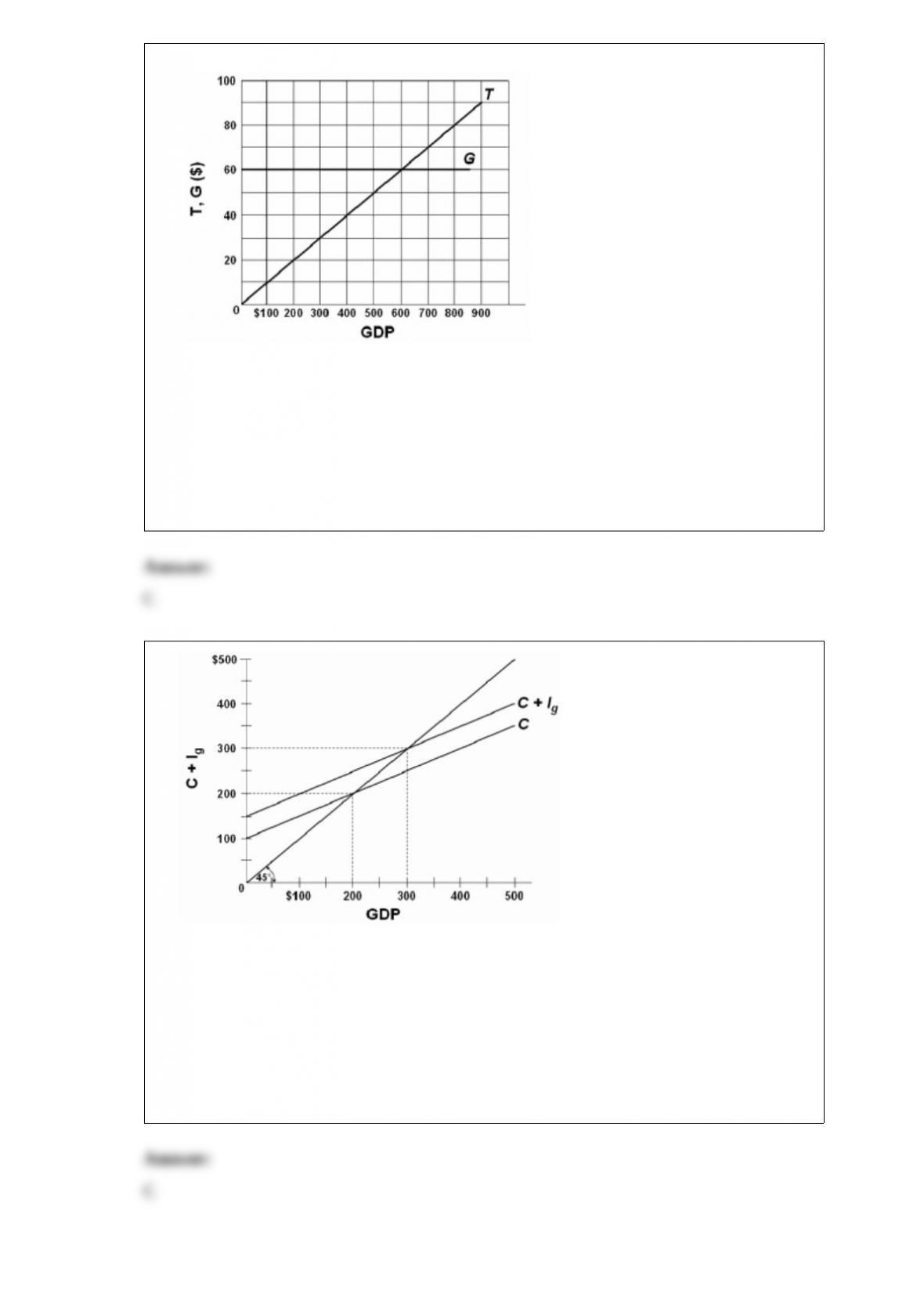
6)
Refer to the above diagram where T is tax revenues and G is government expenditures.
All figures are in billions of dollars. If the full-employment GDP is $400 billion while
the actual GDP is $200 billion, the actual budget deficit is:
A.$200 billion.
B.$20 billion.
C.$40 billion.
D.$60 billion.
7)
Refer to the above diagram for a private closed economy. At the $400 level of GDP:
A.aggregate expenditures exceed GDP with the result that GDP will rise.
B.consumption is $350 and planned investment is zero so that aggregate expenditures
are $350.
C.consumption is $300 and planned investment is $50 so that aggregate expenditures
are $350.
D.consumption is $300 and actual investment is $100 so that aggregate expenditures are
$400.
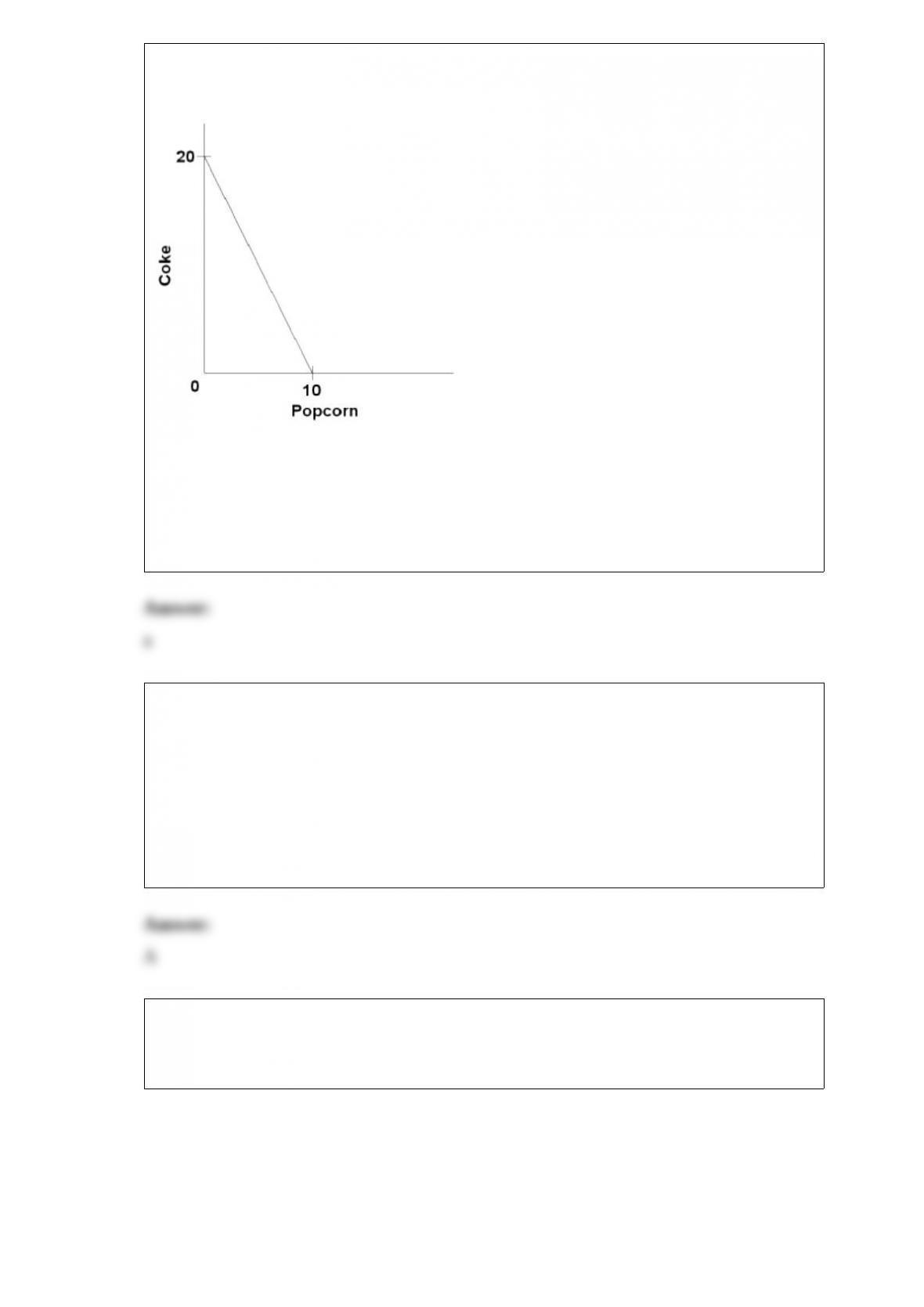
8)
suppose you have a money income of $10, all of which you spend on coke and popcorn.
in the above diagram, the prices of coke and popcorn respectively are:
a.$.50 and $1.00.
b.$1.00 and $.50.
c.$1.00 and $2.00.
d.$.40 and $.50.
9) The demand for loanable funds is downsloping:
A.because businesses find that more investments are profitable at low interest rates than
at high interest rates.
B.because households are willing to save more at high interest rates than at low interest
rates.
C.only when the nominal interest rate exceeds the real interest rate.
D.because the amount of profitable business investment varies directly with the interest
rate.
10) the following output data for a firm. assume that the amounts of all non-labor
resources are fixed.

refer to the above data. the marginal product of the sixth worker is:
a.180 units of output.
b.30 units of output.
c.15 units of output.
d.negative.
11) Suppose that real domestic output in an economy is 20 units, the quantity of inputs
is 10, and the price of each input is $4. Answer the following question(s) on the basis of
this information.
Refer to the above information. All else being equal, if the price of each input increased
from $4 to $6, productivity would:
A.fall from 2 to 3.
B.fall from .50 to .33.
C.rise from 1 to 2.
D.remain unchanged.
12) The market system does not produce public goods because:
A.there is no need or demand for such goods.
B.private firms cannot stop consumers who are unwilling to pay for such goods from
benefiting from them.
C.public enterprises can produce such goods at lower cost than can private enterprises.
D.their production seriously distorts the distribution of income.
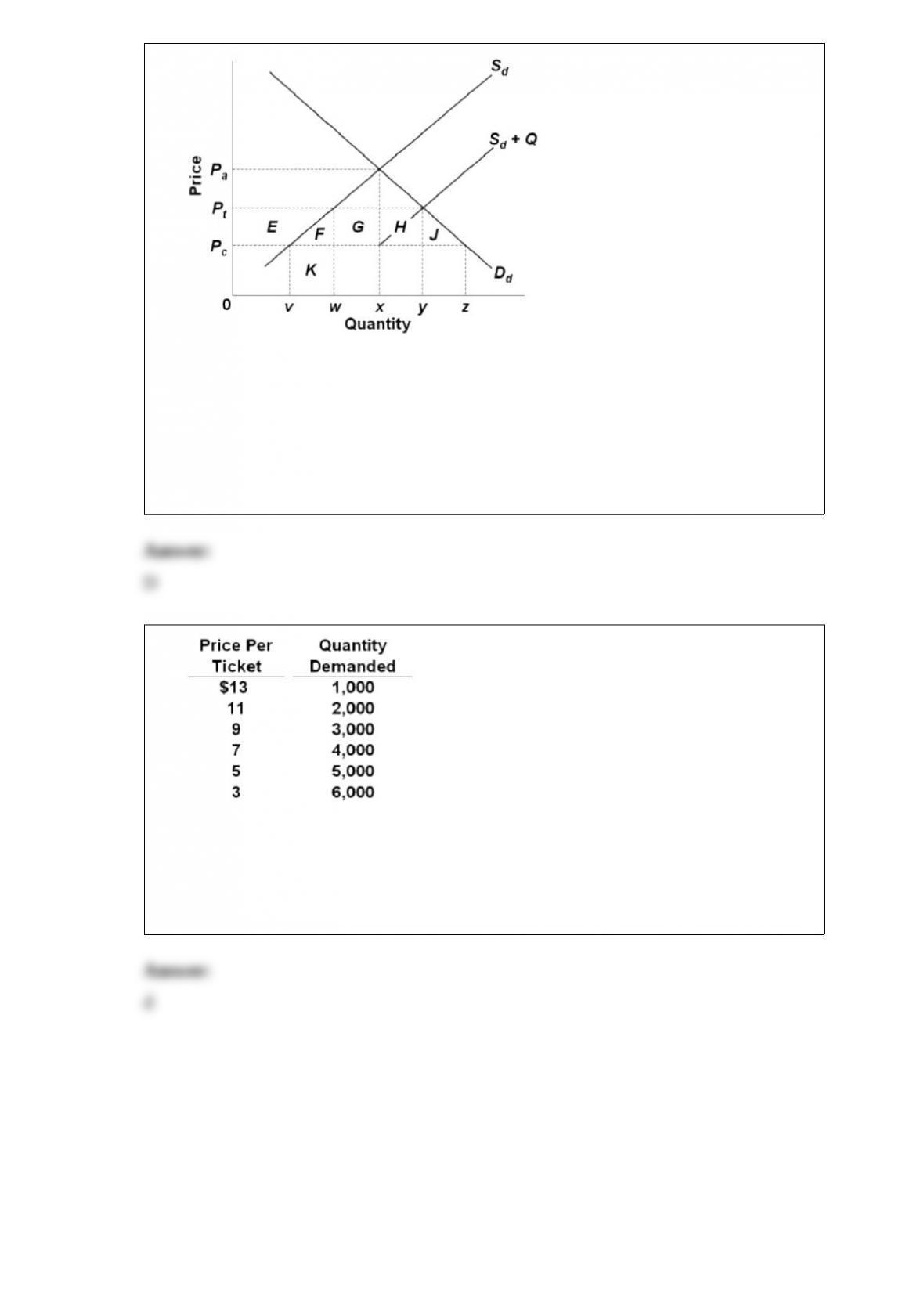
13)
Refer to the above diagram, where Sd and Dd are the domestic supply and demand for a
product and Pc is the world price of that product. Sd + Q is the product supply curve
after an import quota is imposed. A tariff of Pc Pt or an import quota of wy will:
A.have the same effect on the volume of imports.
B.have the same effect on domestic price.
C.have the same effect on the revenues of domestic producers.
D.do all of these.
14)
refer to the above information. over the $5-$3 price range, demand is:
a.perfectly elastic.
b.perfectly inelastic.
c.elastic.
d.inelastic.