For a perfectly competitive firm, a decrease in the price of the product it sells will shift
a. the demand curve of its product to the left.
b. the demand curve of its product to the right.
c. its MRP curve to the left.
d. its MRP curve to the right.
e. b and c
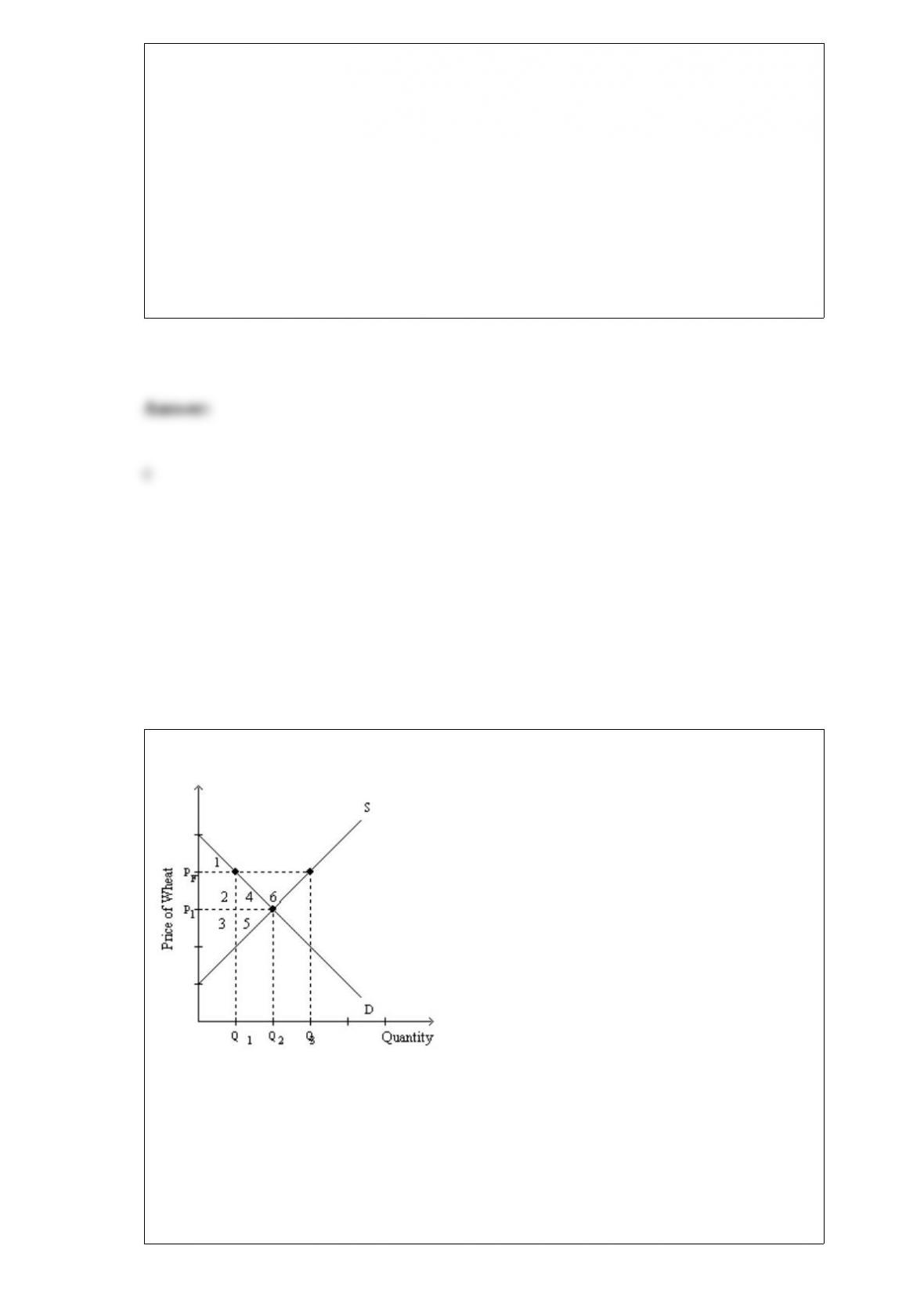
Exhibit 4-8
Suppose that wheat producerslobby the government for a price floor and receive
one.This price floor is set at PF.What is the change in the total surplus at the price floor,
compared to at the equilibrium price?
a. There was a gain in total surplus equal to (area 1 + 2 + 3)

b. There was a gain in total surplus equal to (area 1 + 2 + 3 + 4 + 5)
c. There was a loss in total surplus equal to (area 4 + 5)
d. There was a loss in total surplus equal to (area 4 + 5 + 6 )
Public choice theory predicts candidates will
a. speak in specific instead of general terms.
b. modify their positions to become more like their opponent, if polls show they are not
doing as well as their opponent.
c. call themselves right-wingers or left-wingers, not middle-of-the-roaders.
d. label their opponents as too middle-of-the-road.
e. all of the above
If the demand for a good is currently elastic, then
a. the percentage change in quantity demanded of the good is greater than the
percentage change in price of the good.
b. the percentage change in quantity demanded of the good is less than the percentage
change in price of the good.
c. the percentage change in quantity demanded of the good is equal to the percentage
change in price of the good.

d. quantity demanded of the good is not responsive to changes in the price of the good.
The market demand curve for a given product may be downward sloping even if no
person in that market has a downward sloping demand curve.
a. True
b. False
Exhibit 25-10
Suppose that the letter grade earned on a test for each student in a class depends upon
how well he/she does relative to other students in the class.This exhibit shows a
prisoner’s dilemma setting for two representative students in the class, George and
Gina.

If George and Gina are in a prisoner’s dilemma setting, they are likely to end up in box
___________ in the diagram.
a. 1
b. 2
c. 3
d. 4
In long run equilibrium, a monopolistic competitive firm’s price will
a. exceed ATC, but equal MC.
b. exceed both MC and ATC.
c. be less than both MC and ATC.
d. exceed MC, but equal ATC.
Which of these statements is false?
a. There are no fixed costs in the long run.
b. Total costs are equal to total fixed costs plus total variable costs.
c. In the short run, all inputs are fixed inputs.

d. A fixed cost is a cost that does not change as output changes.
If a monopolist practices perfect price discrimination, then it will have
a. a greater total revenue and sell a greater output than if it were not practicing price
discrimination.
b. a smaller total revenue and sell a smaller output than if it were not practicing price
discrimination.
c. the same total revenue but sell a larger output than if it were not practicing price
discrimination.
d. the same total revenue but sell a smaller output than if it were not practicing price
discrimination.
Rich has $100,000 and Poore has $1,000. Which of these statements is most strongly
supported by the theory of consumer choice?
a. An extra dollar given to Rich is worth less to him than his 100,000th dollar.
b. An extra dollar is worth less to Rich than it is to Poore.
c. An extra dollar is worth less to Poore than it is to Rich.
d. Rich’s 1,000th dollar is worth more to Rich than Poore’s 1,000th dollar is worth to
Poore.
e. Rich’s 100,000th dollar is worth to Rich exactly what Poore’s 1,000th dollar is worth
to Poore.

The theory of monopolistic competition assumes
a. the production of a slightly differentiated product.
b. significant barriers to entry.
c. many buyers and sellers.
d. a and c
e. all of the above
The antitrust legislation that declares illegal “unfair methods of competition in
commerce” is
a. the Sherman Act.
b. the Clayton Act.
c. the Federal Trade Commission Act.
d. the Robinson-Patman Act.

A consequence of a negative externality is that social costs __________ private costs,
and the socially optimal level of output __________.
a. equal; is not equal to social costs or private costs
b. do not equal; is obtained
c. do not equal; is not obtained
d. equal; is obtained
e. equal; is not obtained
The prisoner’s dilemma game illustrates rational decisions made by individuals which
lead to a jointly efficient outcome.
a. True
b. False
As interest rates decrease, present values __________, and firms will buy __________
capital goods.
a. increase; fewer
b. decrease; fewer

c. increase; more
d. decrease; more