1) import quotas are:
a.maximum limits on the quantity or total value of specific products imported to a
nation.
b.excise taxes or duties placed on imported products.
c.licensing requirements, unreasonable quality standards, and the like designed to
impede imports.
d.government payments to domestic producers to reduce the world prices of exported
goods.
2) Profit-maximizing extraction companies will attempt to:
A.extract resources as quickly as possible.
B.delay extraction as long as possible.
C.find rates of extraction that maximize the flow of profits over time.
D.extract resources at a constant rate every year to minimize price fluctuations.
3)
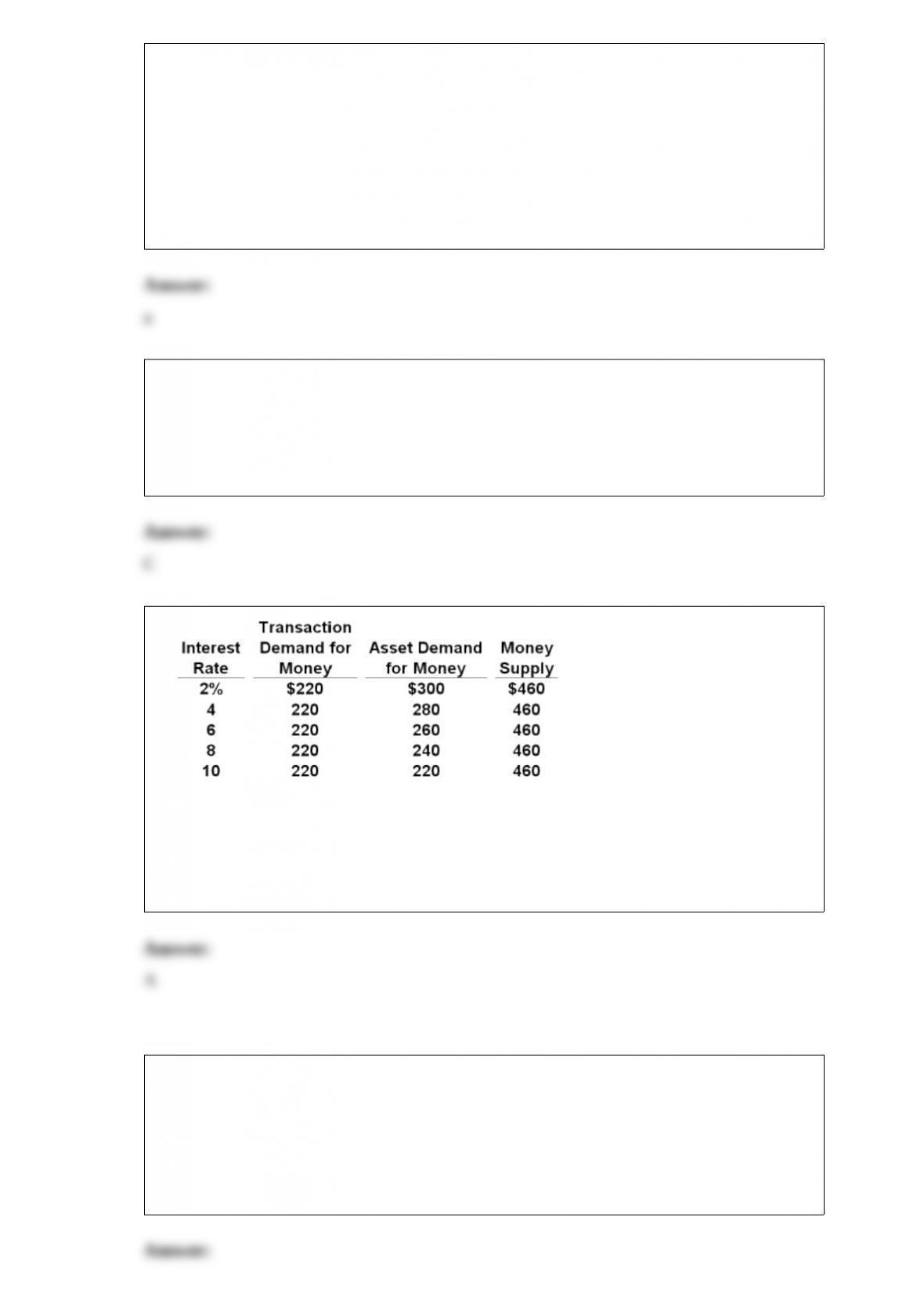
All else equal, the transaction demand for money in the above table would increase if:
A.nominal GDP increased.
B.the interest rate fell.
C.the supply of money increased.
D. the economy’s MPC declined.
4) “Earmarks” refer to:
A.the additional votes that must be taken when a voting paradox occurs.
B.taxes that redistribute wealth or income from one income group to another.
C.authorized expenditures that benefit a narrow, specifically designated group, that are
included in more comprehensive spending legislation.
D.legislation focused on correcting negative externalities.

5) In a nation’s balance of payments, which one of the following items is always
recorded as a positive entry?
A.goods imports
B.changes in foreign currency reserves
C.U.S. purchases of assets abroad
D.exports of services
6) If a firm is hiring variable resources D and F in perfectly competitive input markets,
it will minimize the cost of producing any level of output by employing D and F in such
amounts that:
A.the price of each input equals its MP.
B.MPD = MPF.
C.MPD/PD = MPF/PF.
D.MPD/PF = MPF/PD.
7) The traditional monetary rule is the idea that:
A.the annual rate of increase in the money supply should be equal to the potential
annual growth rate of real GDP.
B.the annual rate of increase in the money supply should be equal to the long-term
increase in the price level.
C.an expansionary fiscal policy should always be accompanied by an easy monetary
policy.
D.monetary policy only affects the economy 6 to 9 months after the money supply is
changed.
8) In the table below are the demand and supply schedules for beer in thousands of
cases in a state.
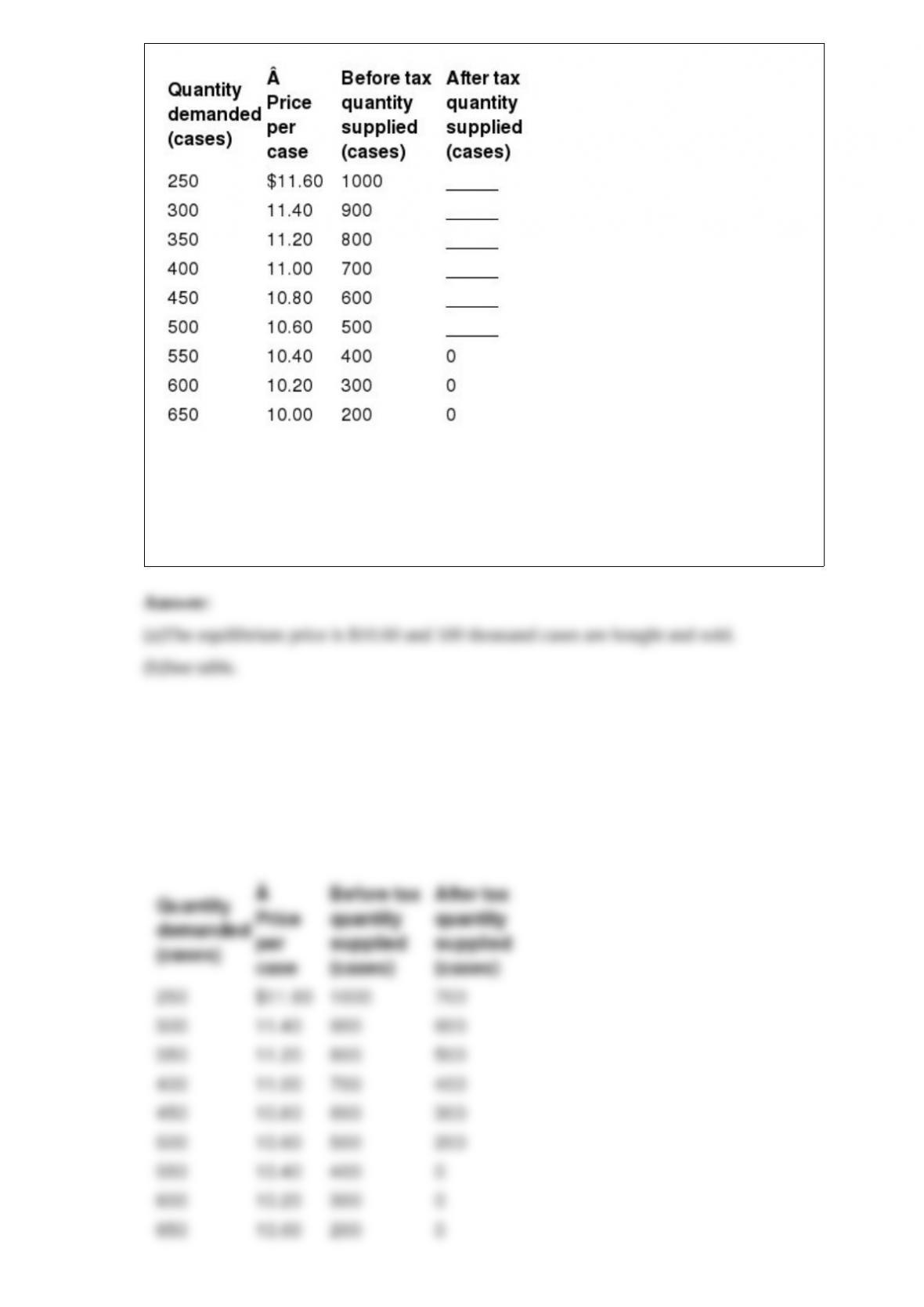
(a)What is the equilibrium price and quantity before a tax is imposed?
(b)If state government now imposes an excise tax of $0.60 per case of beer, what is the
after-tax supply schedule?
(c)What is the equilibrium price of beer after the tax is imposed? How much of the
$0.60 is borne by the buyer and how much by the seller?
9) with a downsloping demand curve and an upsloping supply curve for a product, a
decrease in resource prices will:
a.increase equilibrium price and quantity.
b.decrease equilibrium price and quantity.
c.decrease equilibrium price and increase equilibrium quantity.
d.increase equilibrium price and decrease equilibrium quantity.
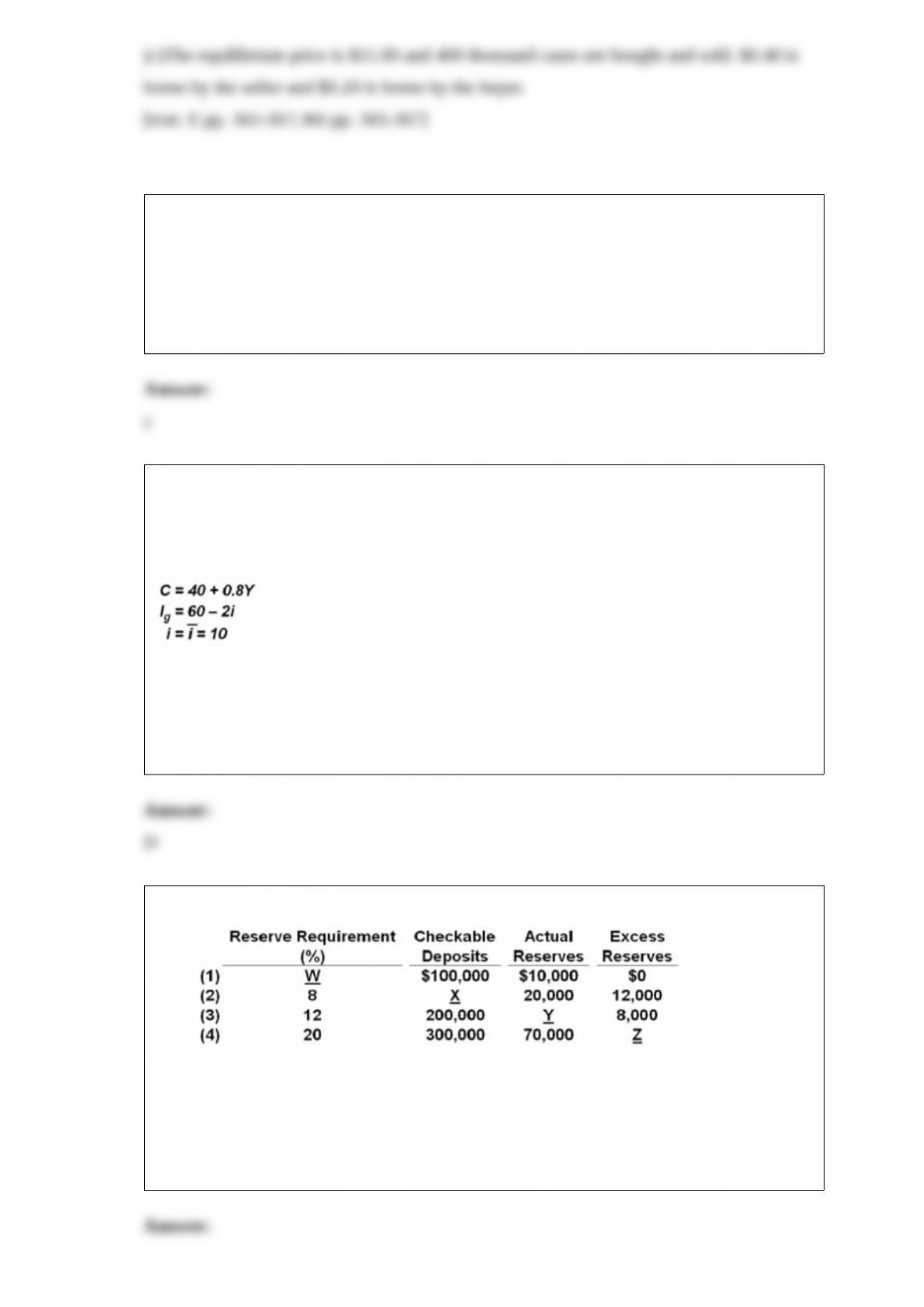
10) (Advanced analysis) Answer the next question(s) on the basis of the following
information for a private closed economy where C is consumption, Y is the gross
domestic product, Ig is gross investment, and i is the interest rate:
Refer to the above information. The equilibrium level of GDP in this economy is:
A.$240.
B.$300.
C.$360.
D.$400.
11)
Refer to row 3 in the above table. The number appropriate for space Y is:
A.$24,000.
B.$32,000.
C.$48,000.
D.$96,000.
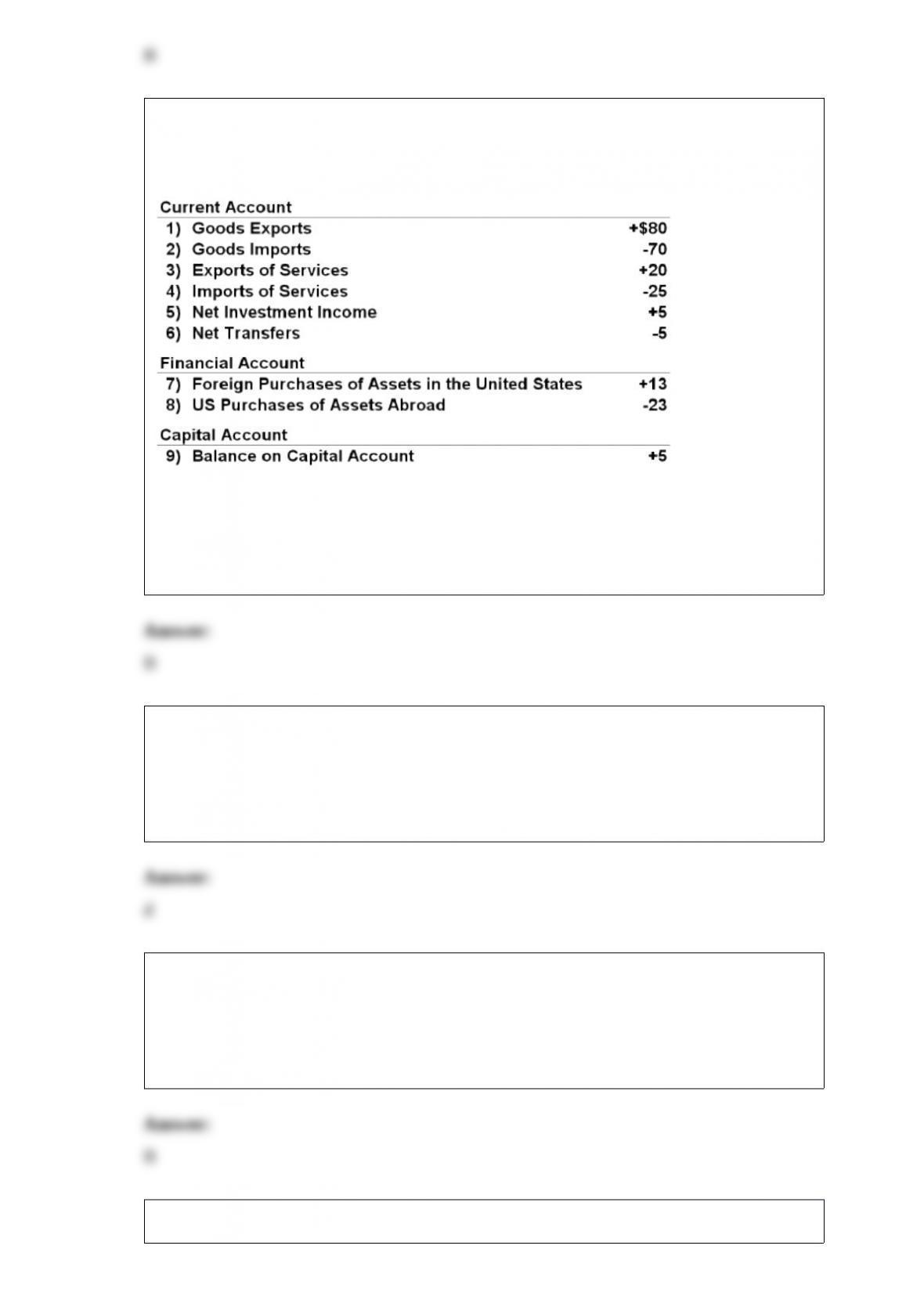
12) The following 2006 balance of payments data (+ and -) for the hypothetical nation
of Zabella. All figures are in billions of dollars.
Refer to the above data. Zabella’s balance on goods and services shows a:
A.$5 billion deficit.
B.$5 billion surplus.
C.$10 billion surplus.
D.$15 billion deficit.
13) the supply curve of a pure monopolist:
a.is that portion of its marginal cost curve which lies above average variable cost.
b.is the same as that of a purely competitive industry.
c.is its average variable cost curve.
d.does not exist because prices are not “given” to a monopolist.
14) Increases in the productivity of labor result partly from:
A.the law of diminishing returns.
B.improvements in technology.
C.reductions in wage rates.
D.increases in the quantity of labor.
15) In recent years the United States has:

A.exported more services abroad than it has imported.
B.had a small goods trade surplus with Japan.
C.had a large goods trade surplus with the rest of the world.
Dfallen to third behind Japan and Germany in the list of leading export nations
(absolute volume basis).
16) assume an economy is operating at some point on its production possibilities curve,
which shows civilian and military goods. if the output of military goods is increased,
the output of civilian goods:
a.will remain unchanged.
b.may be either increased or decreased.
c.must be decreased.
d.must also be increased.