
1) The Lorenz curve is a graph that relates income to household spending.
2) Profits are the primary ‘success indicator” for firms in a centrally planned economy.
3) When the total product is at its maximum level, the marginal product is zero.
4) When you deposit money at a bank, the bank will normally turn around and lend
most of it to a borrower.
5) If the price of a good increases, it will tend to make the MU-to-P ratio for the good
rise and the good becomes more attractive to the buyer.
6) Laissez-faire capitalism limits the government’s economic functions to the following,
except:
A.Protecting private property rights
B.Establishing a legal environment to enforce contracts among individuals
C.Preventing individuals and firms from coercing others
D.Setting prices of individual goods and services
7)
Refer to the given figure. If the relevant saving schedule were constructed:

A.saving would be minus $20 billion at the zero level of income.
B.aggregate saving would be $60 at the $60 billion level of income.
C.its slope would be 1/2.
D.it would slope downward and to the right.
8) Which of the following is considered a potential solution to some regulatory capture?
A.Bringing industry experts into the regulatory process.
B.Creating a standard set of regulations for all industries.
C.Deregulation of the industry.
D.Government subsidies for firms in the industry.
9) Other things equal, if more firms enter a monopolistically competitive industry:
A.the demand curves facing existing firms would shift to the right.
B.the demand curves facing existing firms would shift to the left.
C.the demand curves facing existing firms would become less elastic.
D.losses would necessarily occur.
10)
Refer to the above table, which shows the ranked preferences of voters for three
alternative projects, with “1” being the top preference. This situation illustrates the
voting inconsistency where a majority of voters prefer the:
A.Stadium over the park, the park over the jail, and the jail over the stadium
B.Park and jail over the stadium, and the jail over the park
C.Stadium over the jail, the jail over the park, and the park over the stadium
D.Stadium and jail over the park, and the park over the jail
11) Suppose a competitive firm in both the factor and product markets is using inputs
such that the marginal product of labor is 16 and the price of labor is $4 per unit, while
the marginal product of capital is 12 and the price of capital is $3 per unit. At the
maximum profit equilibrium point, the price of the product is:

A.$3
B.$4
C.$.25
D.Between $3 and $4
12) Interest groups result when people:
A.In a certain zip code vote together
B.Who share strong preferences on a choice band together
C.Do not all vote in elections
D.Do not have strong preferences on the issues to be voted on
13) Myrna borrows $500 at an annually compounded interest rate of 8 percent that she
will repay at the end of 10 years. How much will be required to pay off the loan at the
end of 10 years?
A.$900.
B.$962.85.
C.$1,079.46.
D.$1,123.21.
14) The Clayton Act prohibits the acquisition of ____________ of competing
corporations when the acquisition would lessen competition; the Celler-Kefauver Act
prohibits the acquisition of ____________ of one firm by another firm when the
acquisition would lessen competition.
A.Stocks; assets
B.Assets; stocks
C.Stocks; customers
D.Stocks; bonds
15) Beginning in 1990, the Federal government:
A.Decreased the annual immigration quota from 700,000 to 500,000
B.Increased the annual immigration quota from 500,000 to 700,000
C.Increased the annual immigration quota from 250,000 to 500,000
D.Increased the annual immigration quota from 500,000 to 1 million

16) Which of the following is most likely to be an indication of higher unemployment?
A.An increase in real GDP
B.An increase in nominal GDP
C.A decrease in real GDP
D.A decrease in nominal GDP
17)
Refer to the graph above. As the consumer equilibrium point to shifts from point a to
point b:
A.The consumer’s purchase of good 2 decreases even though its price stays constant
B.The slope of the budget line decreases because the price of good 1 increased
C.The marginal utility of good 1 increases and the marginal utility of good 2 decreases
D.The consumer’s total utility decreases
18) A commercial bank has checkable-deposit liabilities of $50,000 and a
required-reserve ratio of 20 percent. What is the amount of required reserves?
A.$10,000
B.$50,000
C.$250,000
D.$1 million
19) The Romer and Romer 2010 paper in the American Economic Review found that
tax changes that are made to promote long-run growth or to reduce an inherited budget
deficit tend to result in:
A.A strong positive relationship between taxes and output GDP
B.A weak positive relationship between taxes and output GDP
C.An uncertain correlation between taxes and output GDP
D.A strong negative relationship between taxes and output GDP

20) Which of the following statements is an explanation for the law of increasing
opportunity costs?
A.Many economic resources are better at producing one product rather than another
B.The economy is employing all of its available resources
C.In any economy, the state of technology is changing and resources are variable
D.The economy is achieving productive efficiency by producing goods at the least cost
21) Which of the following is correct?
A.MPC + MPS = APC + APS.
B.APC + MPS = APS + MPC.
C.APC + MPC = APS + MPS.
D.APC – APS = MPC – MPS.
22)
Refer to the graph above. What could cause the consumer equilibrium point to shift
from point a to point b?
A.The consumer’s income increased
B.The price of good 1 decreased
C.The price of good 1 increased
D.The consumer’s income decreased
23) “Deficit spending” refers to a situation where the government:
A.Spends borrowed funds
B.Collects more tax revenues than it spends
C.Does not need to borrow funds
D.Is spending less than the year before
24) Answer the next questions based on the following consolidated balance sheet for the
commercial banking system. Assume the required reserve ratio is 25%. All figures are
in billions of dollars.

(a)What is the amount of excess reserves in this commercial banking system?
(b)What is the maximum amount that the money supply can be expanded?
(c)If the reserve ratio fell to 25%, what is now the maximum amount that the money
supply can be expanded?
25) Explain how the prices of related goods also affect demand.
26) An airline is flying between two cities. The airline has the following costs
associated with the flight:
The airline has an average of 40 passengers paying an average of $200 for this flight.
Do you think the airline should be flying between the two cities? Evaluate from a
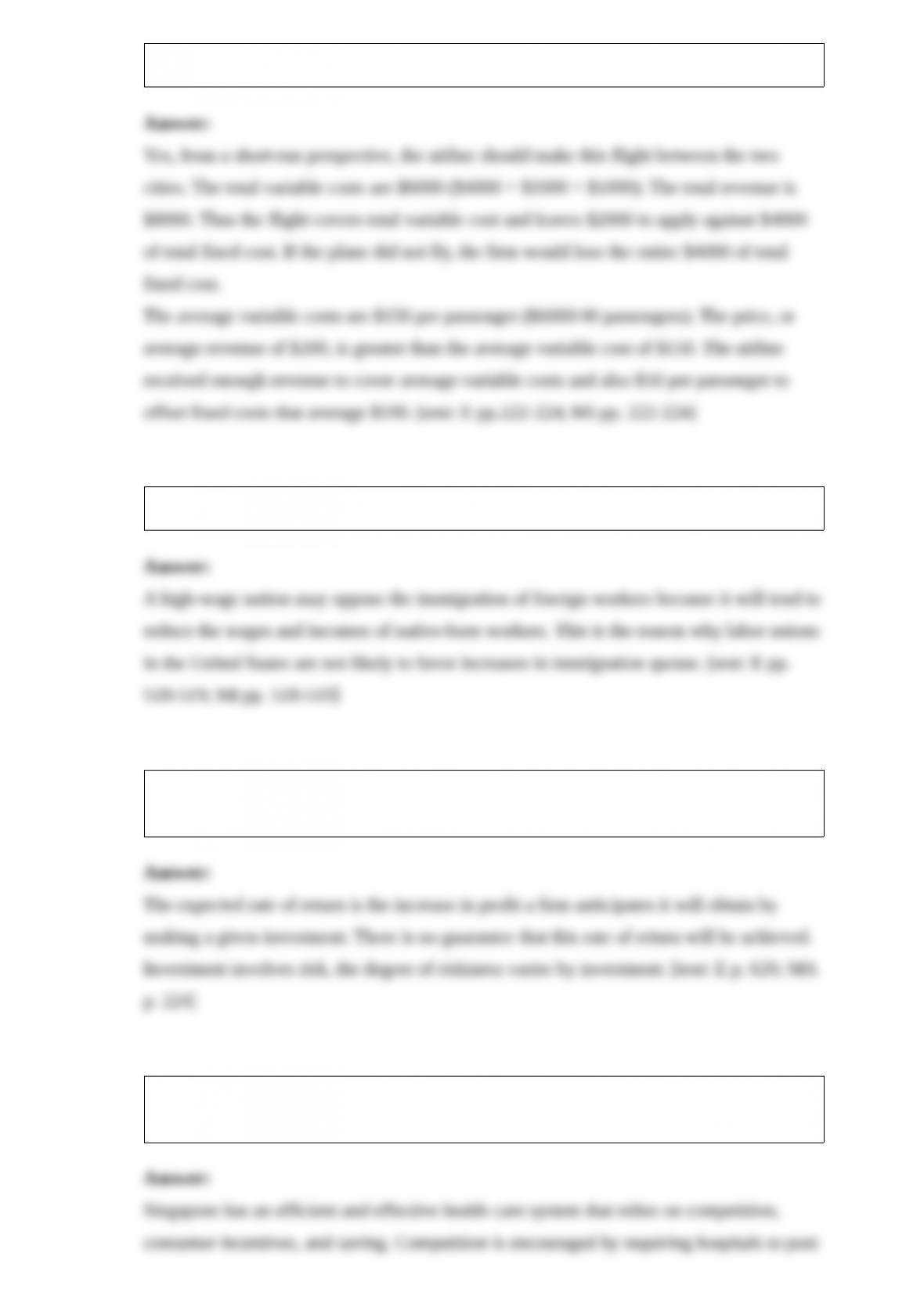
short-run perspective.
27) Why would a high-wage nation oppose immigration?
28) The expected rate of return is a guaranteed rate of return on an investment.
Evaluate.
29) Explain how Singapore delivers good quality health care with significantly less
spending than the United States.
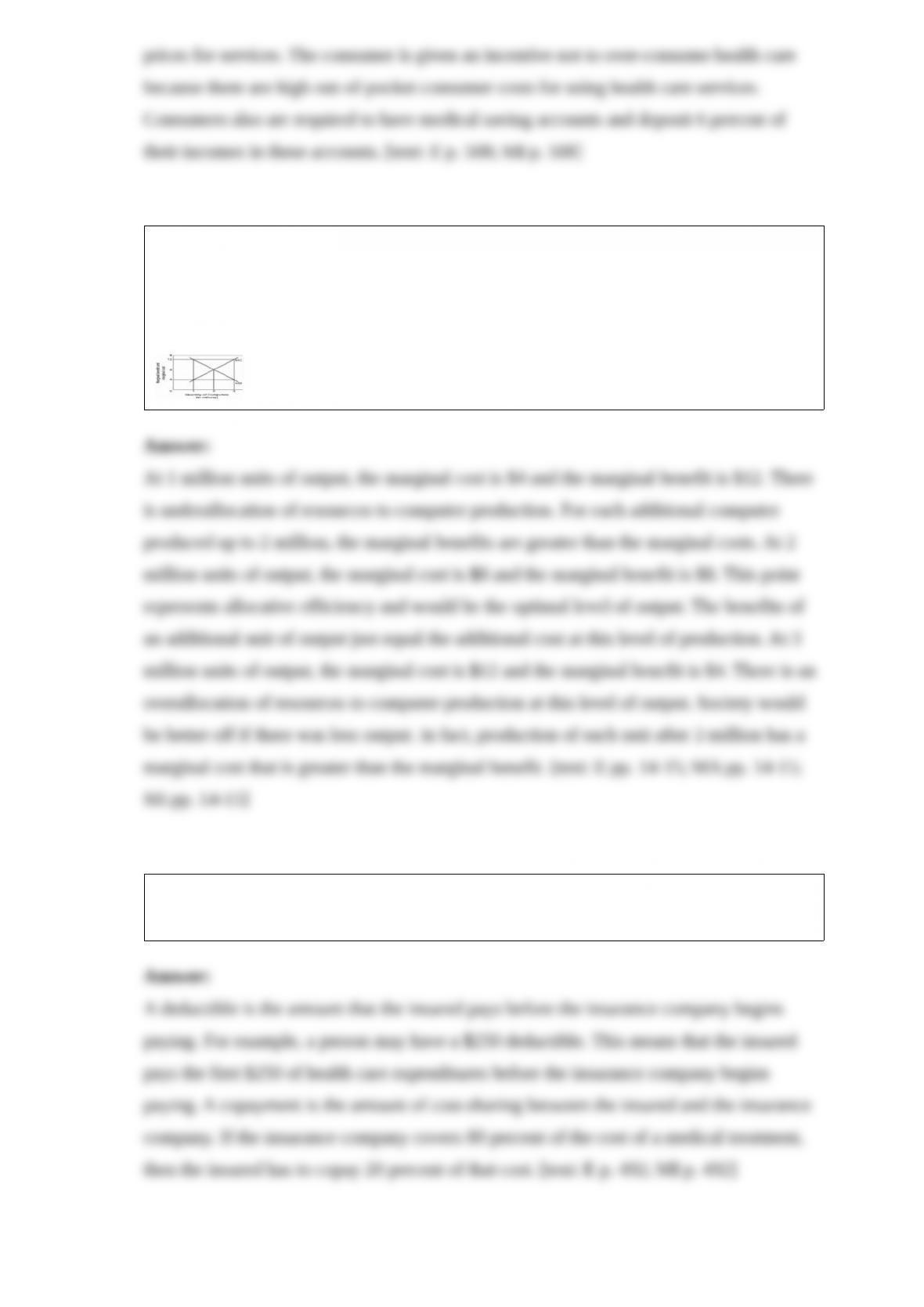
30) In the following graph, explain the relationship between marginal cost and marginal
benefit at 1 million units of output, 2 million units of output, and 3 million units of
output for the production of computers. In your explanation discuss the overallocation
of resources, underallocation of resources, and optimal allocation of resources for the
production of computers.
31) What is the difference between a deductible and a copayment as it applies to
medical insurance?
32) How will an increase in income affect the budget line for two goods, all other things
equal? How does an increase in the price of one good affect the budget line for two
goods, all other things equal?
33) Why can’t indifference curves intersect?