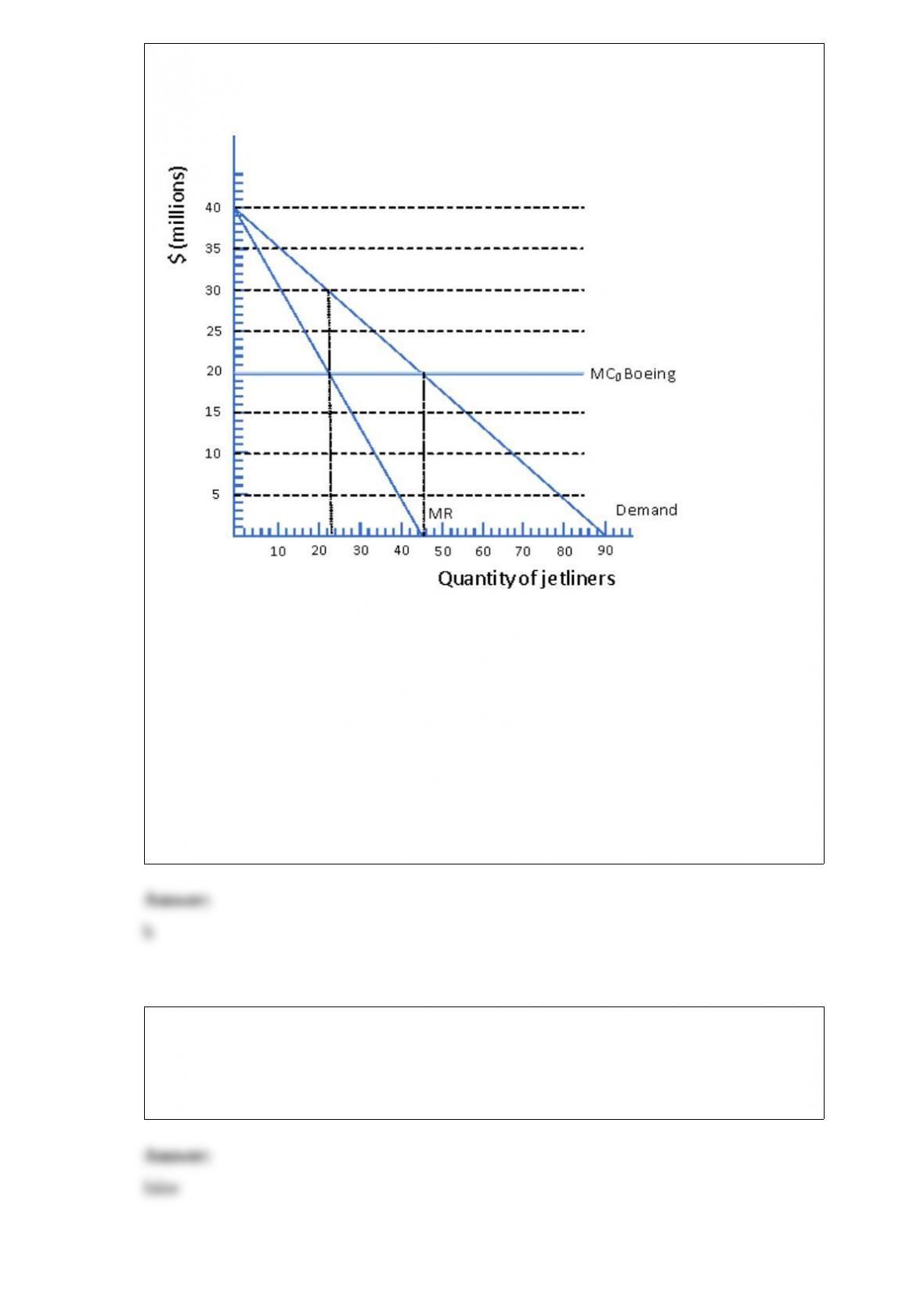
1) figure 6.4japanese market for jetliners
consider the japanese market for jetliners as depicted in figure 6.5.suppose lone
producer of jetliners in the world is boeing and boeing faces a constant marginal cost of
$20 million per jetliner but now a european manufacturer, airbus, begins
production.airbus faces the same marginal cost as boeing but the european government
provides airbus with a subsidy of $8 million per jetliner produced.as a result of the
competition, boeing leaves the japanese market leaving airbus as a monopoly.how many
jetlines will airbus produce and what price will they sell them for?
a.23, $30 million
b.32, $26 million
c.23, $26 million
d.32, $30 million
2) with arbitrage, a trader attempts to purchase a foreign currency at a low price and, at
a later date, resell the currency at a higher price in order to make a profit.
a.true
b.false

3) east asian economies have performed well by
a.obtaining foreign technology
b.remaining open to international trade
c.investing in their people
d.all of the above
4) given an open economy with high capital mobility and floating exchange rates,
suppose an expansionary monetary policy is implemented to combat recession. the
initial and secondary effects of the policy
a.cause aggregate demand to increase, thus strengthening the policy’s expansionary
effect on real output
b.cause aggregate demand to decrease, thus eliminating the policy’s expansionary effect
on real output
c.have conflicting effects on aggregate demand, thus weakening the policy’s
expansionary effect on real output
d.have conflicting effects on aggregate demand, thus strengthening the policy’s
expansionary effect on real output
5) the most important (in terms of dollar value) type of foreign exchange transaction by
u.s. banks is the:
a.spot transaction
b.forward transaction
c.swap transaction
d.option transaction
6) as an economy opens up to international trade, domestic prices:
a.become lower
b.become more aligned with international prices
c.stabilize
d.none of the above; what will happen cannot be predicted
7) which industrialization policy used by developing countries places emphasis on the
comparative advantage principle as a guide to resource allocation?
a.export promotion
b.import substitution
c.international commodity agreements
d.multilateral contract
8) according to the infant-industry argument, temporary tariff protection granted to an
infant industry will help it become competitive in the world market; when international
competitiveness is achieved, the tariff should be removed.
a.true
b.false
9) the price-specie-flow mechanism illustrated why nations could not maintain trade
surpluses or trade deficits over the long run.
a.true
b.false
10) most developing countries have chosen to allow their currencies to float
independently in the foreign exchange market.
a.true
b.false
11) the benefits of international trade accrue in the forms of lower domestic prices,
development of more efficient methods and new products, and a greater range of
consumption choices.
a.true

b.false
12) if a “large” country levies a tariff on an imported good, its overall welfare increases
if the monetary value of the tariff’s consumption effect plus protective effect exceeds
the monetary value of the terms-of-trade effect.
a.true
b.false
13) the developing nations are most of those in africa, asia, north america, and western
europe.
a.true
b.false
14) eli heckscher and bertil ohlin are associated with the theory of comparative
advantage that stresses differences in:
a.income levels among countries
b.tastes and preferences among countries
c.resource endowments among countries
d.labor productivities among countries
15) suppose the exchange rate between the u.s. dollar and the japanese yen is initially
90 yen per dollar. according to purchasing-power parity, if the price of traded goods
rises by 5 percent in the united states and 15 percent in japan, the exchange rate will

become:
a.72 yen per dollar
b.81 yen per dollar
c.99 yen per dollar
d.108 yen per dollar