1) An increase in price causes an increase in total revenue when demand is
a.elastic.
b.inelastic.
c.unit elastic.
d.All of the above are possible.
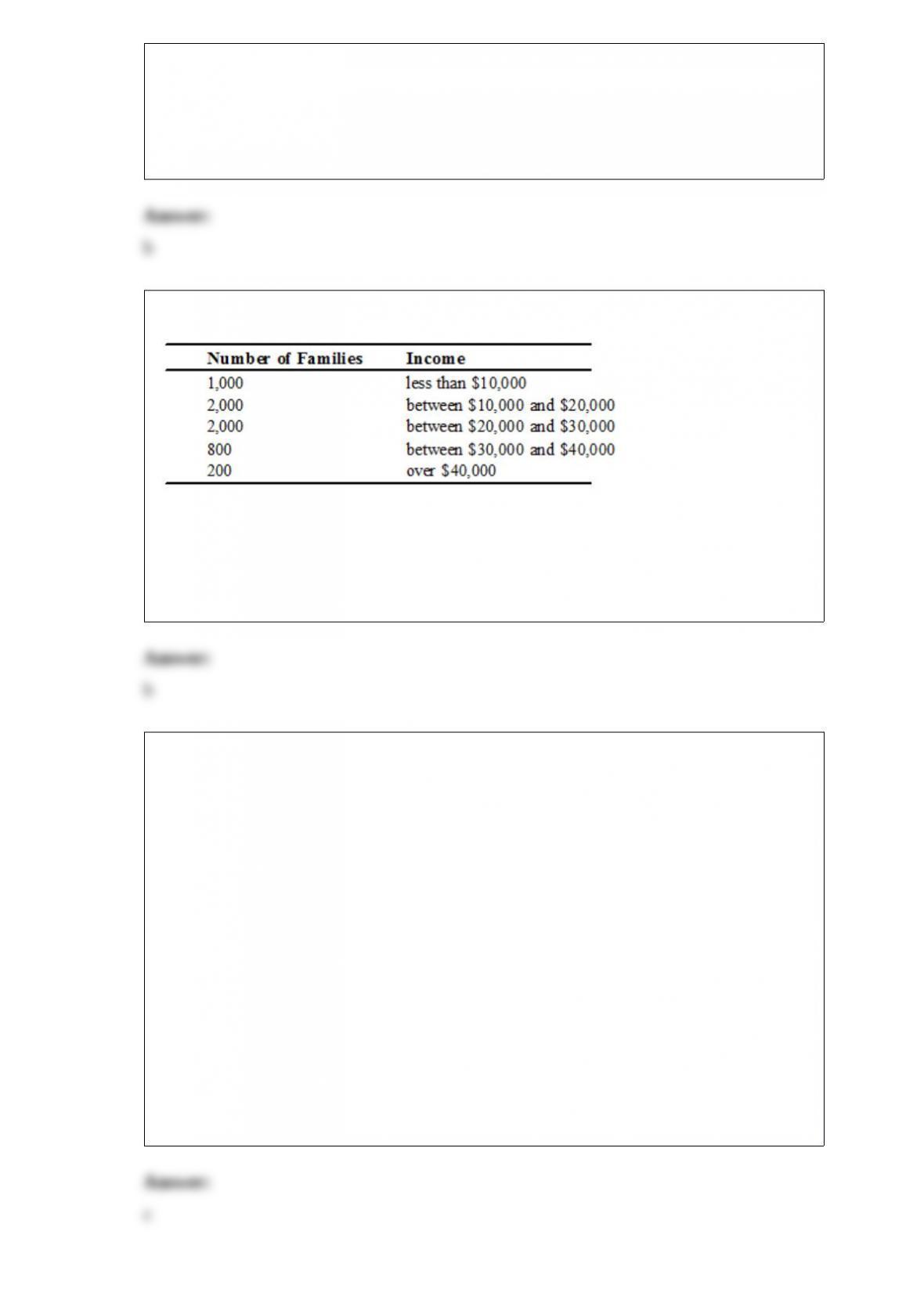
2) The distribution of income for Dismal is as follows:
If the poverty rate in Dismal is 50 percent, what is the poverty line in Dismal?
a.$10,000.
b.$20,000.
c.$30,000.
d.$40,000.
3) The production of methamphetamine (meth) is a social problem in the Midwest.
Iowa is considering two potential programs: Operation Methbust would increase the
number of sheriffs’ deputies to search out and destroy methamphetamine labs.
Operation Say No to Meth would increase the training required of public school
teachers so that they could better educate students about the health risks of using meth.
Assuming that each program were successful, which of the following statements is
correct?
a.Both Operation Methbust and Say No would reduce the equilibrium quantity and
increase the equilibrium price of meth.
b.Both Operation Methbust and Say No would increase the equilibrium quantity and
reduce the equilibrium price of meth.
c.Both Operation Methbust and Say No would reduce the equilibrium quantity of meth;
Operation Methbust would increase the equilibrium price, whereas Say No would
reduce the equilibrium price of meth.
d.Both Operation Methbust and Say No would reduce the equilibrium price of meth;
Operation Methbust would reduce the equilibrium quantity, whereas Say No would
increase the equilibrium quantity of meth.
4) A tradeoff exists between a clean environment and a higher level of income in that
a.studies show that individuals with higher levels of income pollute less than
low-income individuals.
b.efforts to reduce pollution typically are not completely successful.
c.laws that reduce pollution raise costs of production and reduce incomes.
d.employing individuals to clean up pollution causes increases in employment and
income.
5) Government intervention always reduces monopoly deadweight loss.
a.True
b.False
6) A firm is a price taker
a.only when the market is perfectly competitive.
b.only when the market is perfectly competitive or monopolistic.
c.only when the market is perfectly competitive or monopolistically competitive.
d.when the market is perfectly competitive, monopolistically competitive, or
monopolistic.
7) On a 100-acre farm, a farmer is able to produce 3,000 bushels of wheat when he
hires 2 workers. He is able to produce 4,400 bushels of wheat when he hires 3 workers.
Which of the following possibilities is consistent with the property of diminishing
marginal product?
a.The farmer is able to produce 5,600 bushels of wheat when he hires 4 workers.
b.The farmer is able to produce 5,800 bushels of wheat when he hires 4 workers.
c.The farmer is able to produce 6,000 bushels of wheat when he hires 4 workers.
d.Any of the above could be correct.
8) The ability-to-pay principle claims that a person should pay taxes according to
a.the level of public education that the person has received throughout his lifetime.
b.how many government services that person will receive.
c.how well that person can shoulder the tax burden.
d.the level of debt that the person has.

9) In the circular-flow diagram,
a.firms are buyers in the markets for goods and services.
b.households are sellers in the markets for the factors of production.
c.firms are sellers in the markets for factors of production and in the markets for goods
and services.
d.dollars that are spent on goods and services flow directly from firms to households.
10) Education is heavily subsidized through public schools and government
scholarships. This subsidization of education reflects the fact that
a.a negative externality requires a subsidy to move the market equilibrium closer to the
social optimum.
b.the social cost of education exceeds the private cost of education.
c.the social value of education exceeds the private value of education.
d.the market-equilibrium quantity of education exceeds the optimal quantity of
education.
11) Before considering any public project, the government should
(i)compare the total cost and total benefits of the project.
(ii)conduct a cost-benefit analysis.
(iii)infer that citizens who vote for a project are willing to pay equally for it.
a.(i) only
b.(ii) only
c.(i) and (ii) only
d.(i), (ii), and (iii)
12) If the price elasticity of supply is 2 and the quantity supplied decreases by 6%, then
the price must have decreased by 3%.
a.True
b.False
13) Which of the following explains why soccer players make millions of dollars in
Europe but do not in the United States?
a.discriminatory rules established by the government
b.compensating wage differentials for living in Europe
c.discriminatory preferences on the part of US sports fans for other sports
d.efficiency wages paid to European players to enhance on-field performance
14) A normal good is one
a.the average consumer chooses to consume at a normal level.
b.the average consumer chooses to consume over other similar goods.
c.for which an increase in income increases consumption of the good.
d.for which an increase in income decreases consumption of the good.
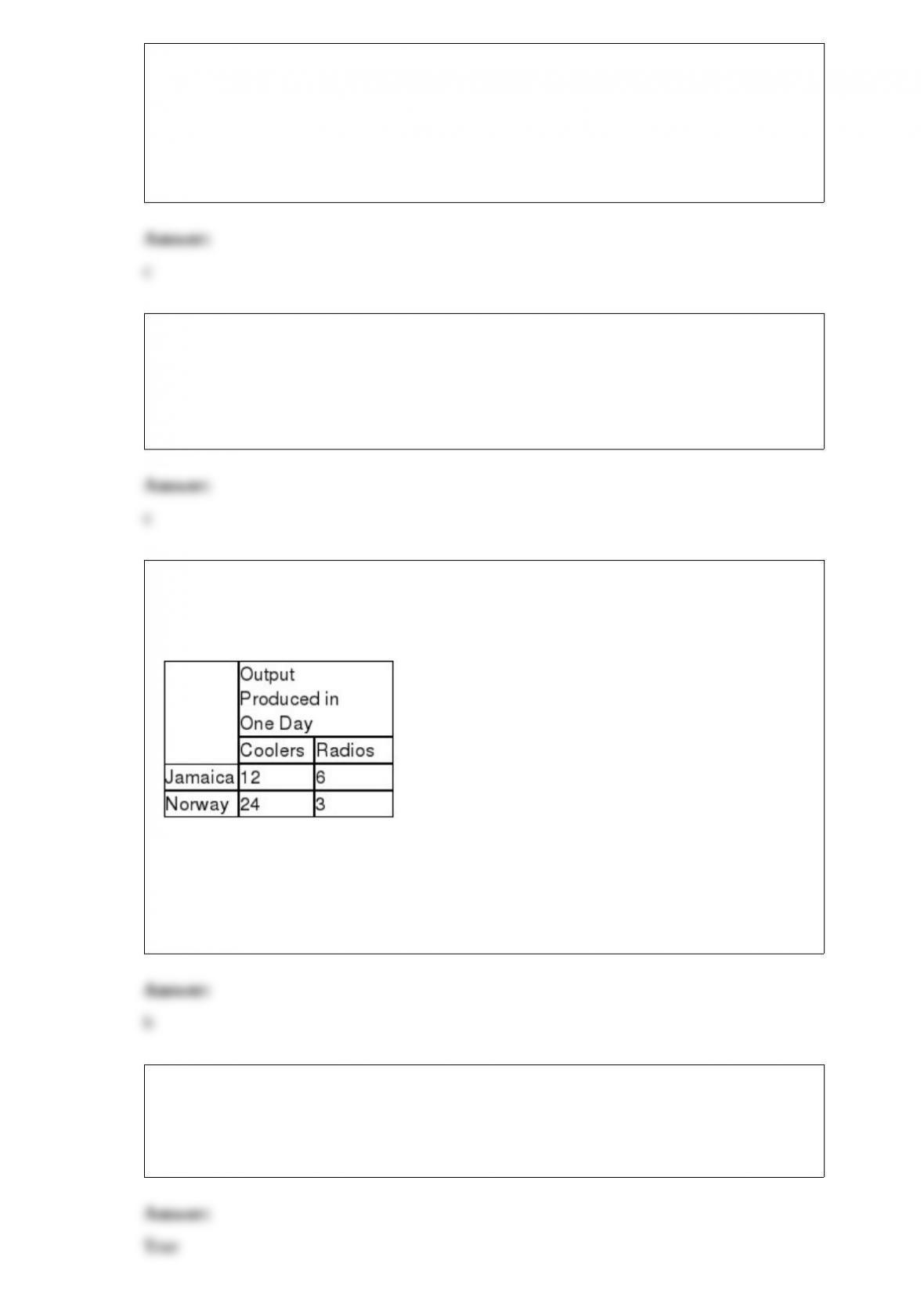
15) Assume that Jamaica and Norway can switch between producing coolers and
producing radios at a constant rate. The following table shows the number of coolers or
number of radios each country can produce in one day.
Jamaica should specialize in the production of
a.coolers and Norway should specialize in the production of radios.
b.radios and Norway should specialize in the production of coolers.
c.both goods and Norway should specialize in the production of neither good.
d.neither good and Norway should specialize in the production of both goods.
16) The proper level of government intervention is unclear when dealing with a
monopoly.
a.True
b.False
17) Assume, for Vietnam, that the domestic price of textiles without international trade
is higher than the world price of textiles. This suggests that, in the production of
textiles,
a.Vietnam has a comparative advantage over other countries and Vietnam will import
textiles.
b.Vietnam has a comparative advantage over other countries and Vietnam will export
textiles.
c.other countries have a comparative advantage over Vietnam and Vietnam will import
textiles.
d.other countries have a comparative advantage over Vietnam and Vietnam will export
textiles.
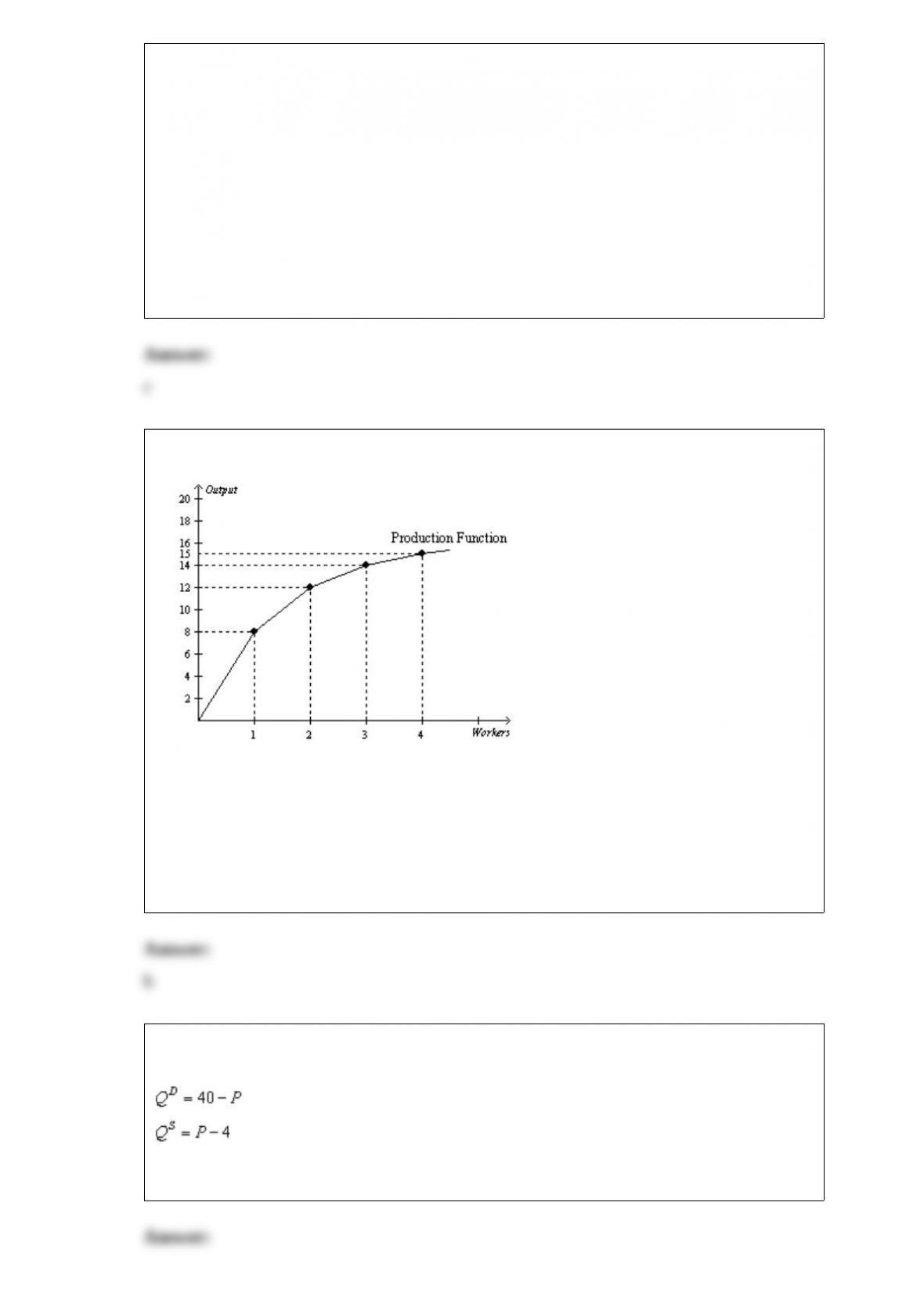
18) Figure 18-3
Refer to Figure 18-3. Suppose that the price of the output is $20. What is the value of
the marginal product of the fourth worker?
a.$1
b.$20
c.$280
d.$300
19) Scenario 7-2
Suppose market demand and market supply are given by the equations:
Refer to Scenario 7-2. How much is total producer surplus at the equilibrium price in
this market?