
1) The benefits-received principle of taxation is most evident in:
A.inheritance taxes.
B.excise taxes on gasoline.
C.the personal income tax.
D.the corporate income tax.
2) A patent on a new product benefits the firm securing it by:
A.limiting the direct imitation of the product by rivals for many years.
B.enabling the firm to retain “trade secrets” about the product.
C.reducing the firm’s legal expenses.
D.increasing the speed of diffusion of the new product.
3) The first commercial introduction of transparent tape is an example of:
A.innovation.
B.invention.
C.creative destruction.
D.diffusion.
4) If government increases its purchases by $15 billion and the MPC is 2/3, then we
would expect the equilibrium GDP to:
A.increase by $30 billion.
B.increase by $45 billion.
C.decrease by $35 billion.
D.increase by $50 billion.
5) the following cost data for a purely competitive seller:
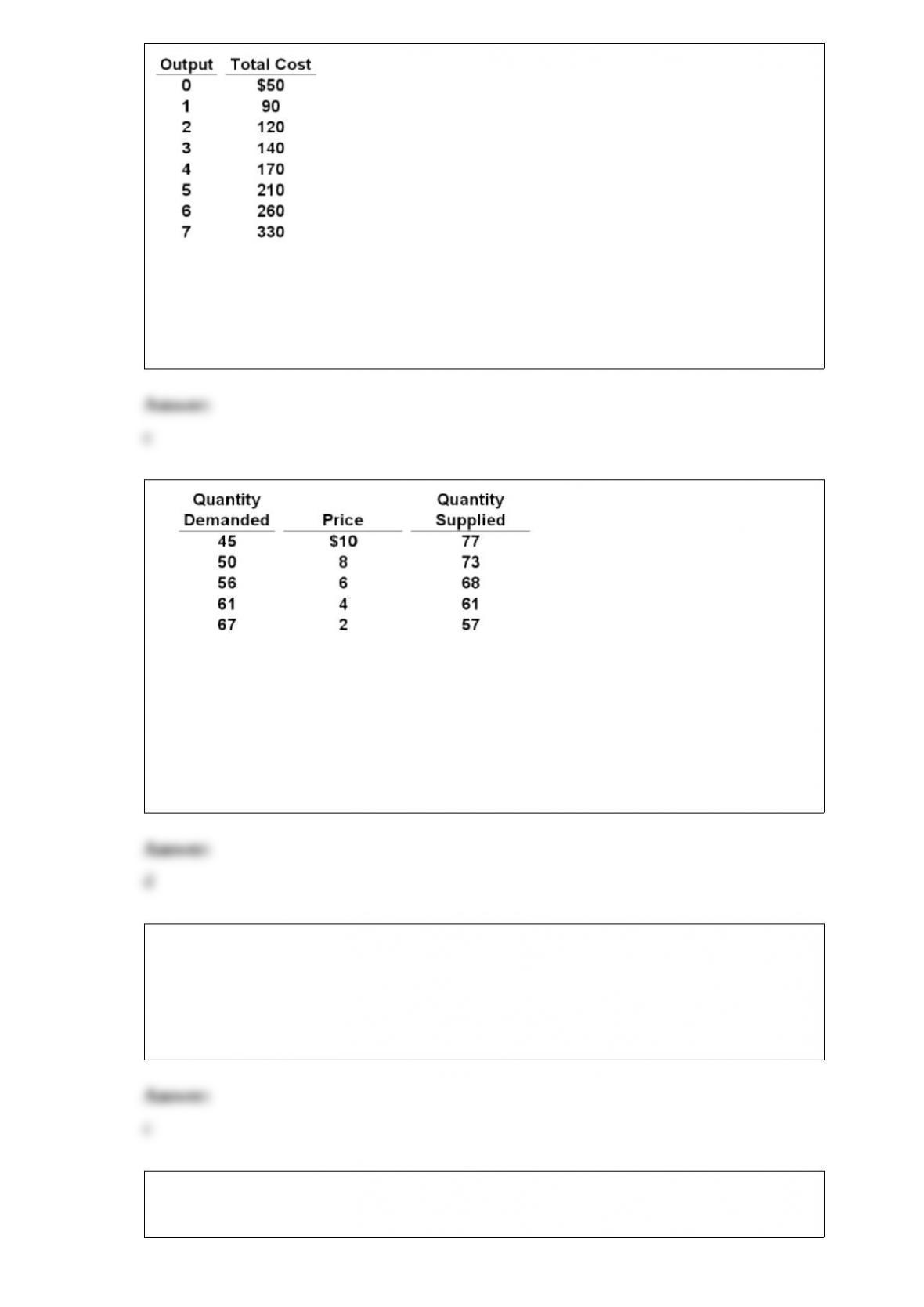
refer to the above data. if product price is $60, the firm will:
a.shut down.
b.produce 4 units and realize a $120 economic profit.
c.produce 6 units and realize a $100 economic profit.
d.produce 3 units and incur a $40 loss.
6)
refer to the above data. suppose quantity demanded increased by 12 units at each price,
changing the equilibrium price in a direction and an amount for you to determine. over
that price range, supply is:
a.perfectly elastic.
b.perfectly inelastic.
c.elastic.
d.inelastic.
7) economists argue that in treating patients:
a.physicians should use any test or procedures that might help the patient.
b.health care should not be rationed by physicians because it is an entitlement or right.
c.both benefits and costs should be taken into account by physicians.
d.physicians should use any test or procedure whose marginal benefit is positive.
8) the following production possibilities data for landia and scandia:
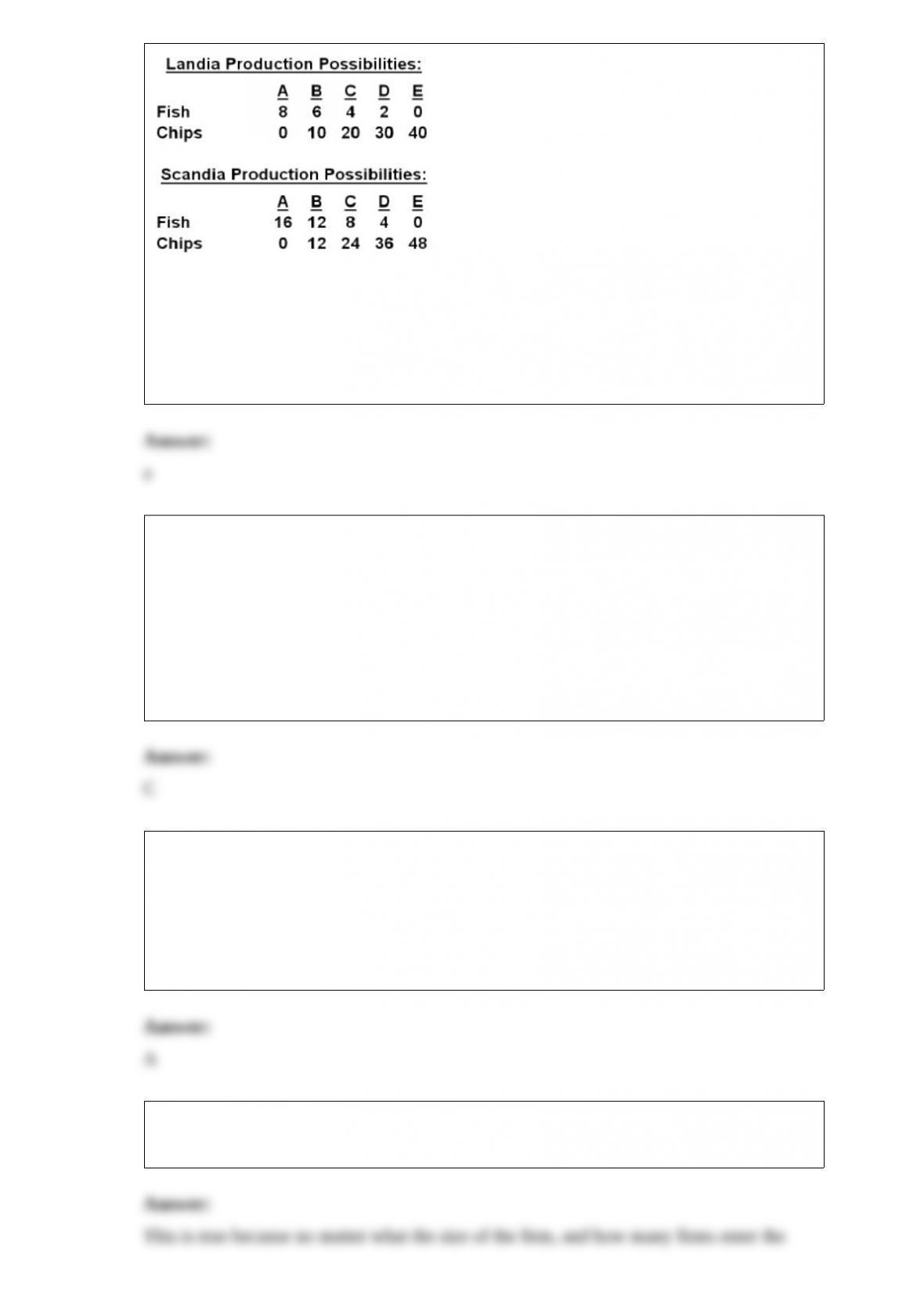
refer to the above data. which of the following would be feasible terms of trade between
landia and scandia?
a.1 fish for 4 chips
b.1 fish for 6 chips
c.1 fish for 7 chips
d.2 fish for 4 chips
9) Suppose that real domestic output in an economy is 20 units, the quantity of inputs is
10, and the price of each input is $4. Answer the following question(s) on the basis of
this information.
The per unit cost of production in the economy described above is:
A.$.50.
B.$1.
C.$2.
D.$5.
10) When aggregate demand declines, the price level may remain constant, at lease for
a time, because:
A.firms individually may fear that their price cut may set off a price war.
B.menu costs rise.
C.price cuts tend to increase efficiency wages.
D.product markets are highly competitive.
11) The long-run industry supply curve in a constant-cost industry graphs as a
horizontal line. Explain.

12) Summarize the four supply factors in economic growth.
13) Is saying that there is growing income inequality just another way of saying that the
rich are getting richer, and the poor are getting poorer? Explain your answer.
14) What are the three functions that a commodity must fulfill to be useful as money?
15) Define wealth. What is the effect of increase in wealth on the consumption and
saving schedules?

16) Explain two ways inefficiencies associated with majority voting may get resolved.