
1) the mr = mc rule:
a.applies only to pure competition.
b.applies only to pure monopoly.
c.does not apply to pure monopoly because price exceeds marginal revenue.
d.applies both to pure monopoly and pure competition.
2) assume that a consumer purchases products a, b, and c in quantities such that the last
dollar spent on each yields the same marginal utility and the consumer’s income is
totally spent. we can conclude that:
a.total utility is being minimized.
b.production costs are being minimized.
c.marginal utility exceeds total utility.
d.total utility is being maximized.
3) If a nation has a current account surplus and it does not have to make any inpayments
or outpayments of official reserves, it must have a:
A.surplus in its capital and financial account.
B.balance of payments deficit.
C.balance of payments surplus.
D.deficit in its capital and financial account.
4) suppose an excise tax is imposed on product x. we would expect this tax to:
a.increase the demand for complementary good y and decrease the demand for
substitute product z.
b.decrease the demand for complementary good y and increase the demand for
substitute product z.
c.increase the demands for both complementary good y and substitute product z.
d.decrease the demands for both complementary good y and substitute product z.
5) The twelve Federal Reserve Banks:
A.are owned and operated by the U.S. Treasury.
B.were created in 1776.
C.hold the reserve deposits of commercial banks.

D.are also known as national banks.
6) A competitive employer is using labor in such an amount that labor’s MRP is $10 and
its wage rate is $8. This firm:
A.should hire more labor because this will increase profits.
B.should hire more labor, although this may either increase or decrease profits.
C.is currently hiring the profit-maximizing amount of labor.
D.is selling its product in an imperfectly competitive market.
7) mexican imports of u.s. goods:
a.create a supply of pesos.
b.create a supply of dollars.
c.reduce the demand for dollars.
d.have no effect on the peso-dollar exchange rate.
8) suppose that an economy’s labor productivity rose by 3 percent and its total
worker-hours remained constant between year 1 and year 2. we could conclude that this
economy’s:
a.capital stock increased.
b.real gdp increased.
c.production possibilities curve shifted inward.
d. natural resource base expanded.
9) official unemployment statistics:
a.understate unemployment because individuals receiving unemployment compensation
are counted as employed.
b.understate unemployment because discouraged workers are not counted as
unemployed.
c.include cyclical and structural unemployment, but not frictional unemployment.
d.overstate unemployment because workers who are involuntarily working part time are
counted as being employed.
10) the price elasticity of demand for beef is about 0.60. other things equal, this means
that a 20 percent increase in the price of beef will cause the quantity of beef demanded
to:
a.increase by approximately 12 percent.
b.decrease by approximately 12 percent.
c.decrease by approximately 32 percent.
d.decrease by approximately 26 percent.
11) If actual reserves in the banking system are $8,000, checkable deposits are $70,000,
and the legal reserve ratio is 10 percent, then excess reserves are:
A.zero.
B.$1,000.
C.$2,000.
D.$500.
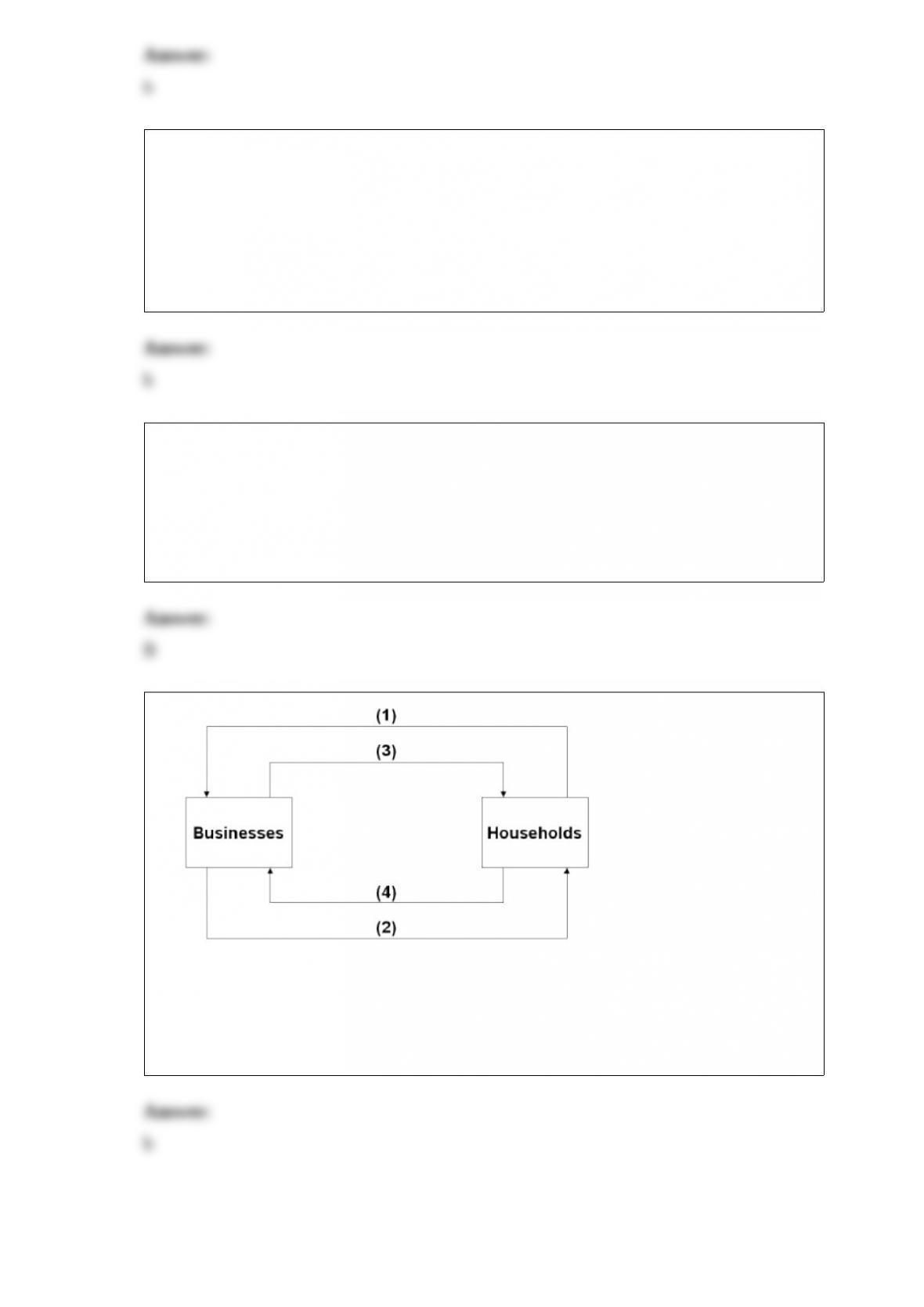
12)
refer to the above diagram. arrows (3) and (4) represent:
a.goods and services respectively.
b.incomes and consumer expenditures respectively.
c.resources and goods respectively.
d.consumer expenditures and income respectively.
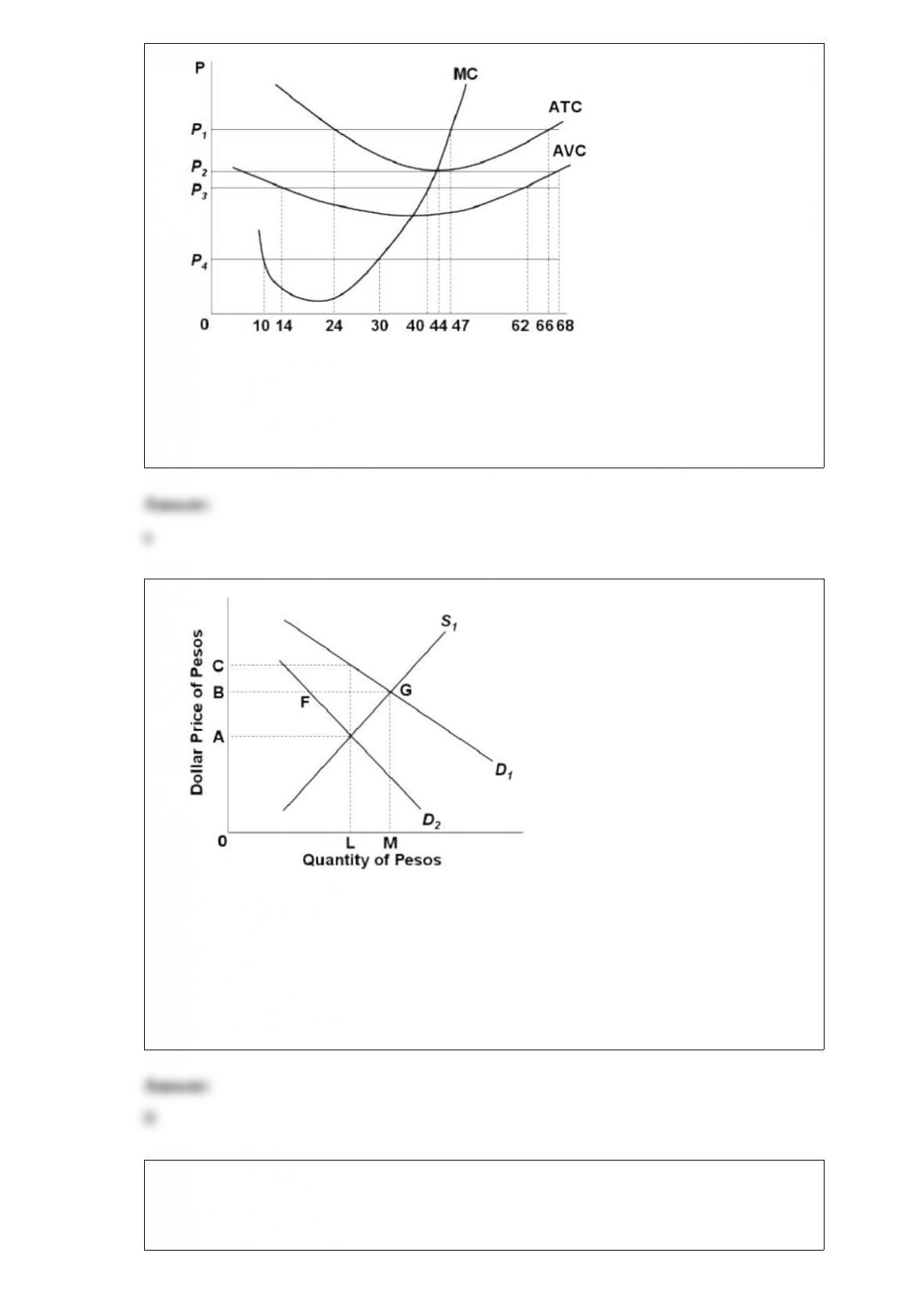
13)
refer to the above diagram. at p4, this firm will:
a.shut down in the short run.
b.produce 30 units and incur a loss.
c.produce 30 units and earn only a normal profit.
d.produce 10 units and earn only a normal profit.
14)
Refer to the above diagram. The initial demand for and supply of pesos are shown by
D1 and S1. Suppose the United States reduces its imports of Mexican goods, shifting its
demand for pesos from D1 to D2. Under a system of freely floating exchange rates:
A.gold would flow from Mexico to the United States.
B.the peso price of dollars would rise from 1/B pesos equals $1 to 1/A pesos equals $1.
C.a problem of rationing a shortage of pesos would arise in the United States.
D.the dollar price of pesos would increase to C dollars equals 1 peso.
15) To determine the velocity of money you would need to know:
A.nominal GDP and real GDP.
B.the money supply and the price level.

C.nominal GDP and the money supply.
D.nominal GDP and the interest rate.
16) A contractionary fiscal policy is shown as a:
A.rightward shift in the economy’s aggregate demand curve.
B.rightward shift in the economy’s aggregate supply curve.
C.movement along an existing aggregate demand curve.
D.leftward shift in the economy’s aggregate demand curve.
17) edith is buying products x and y with her money income. suppose her budget line
shifts rightward (outward). this might be the result of:
a.the prices of x and y increasing while her money income remains constant.
b.her money income decreasing while the prices of x and y remain constant.
c.her money income increasing more than proportionately to increases in the prices of x
and y
d.none of these.