1) “Government failure” is a prominent topic in:
A.public choice theory.
B.Keynesian economics.
C.socialist theory.
D.behavioral economics.
2) The political technique called logrolling:
A.always increases economic efficiency.
B.always decreases economic efficiency.
C.involves trading votes to secure favorable outcomes that otherwise would be rejected.
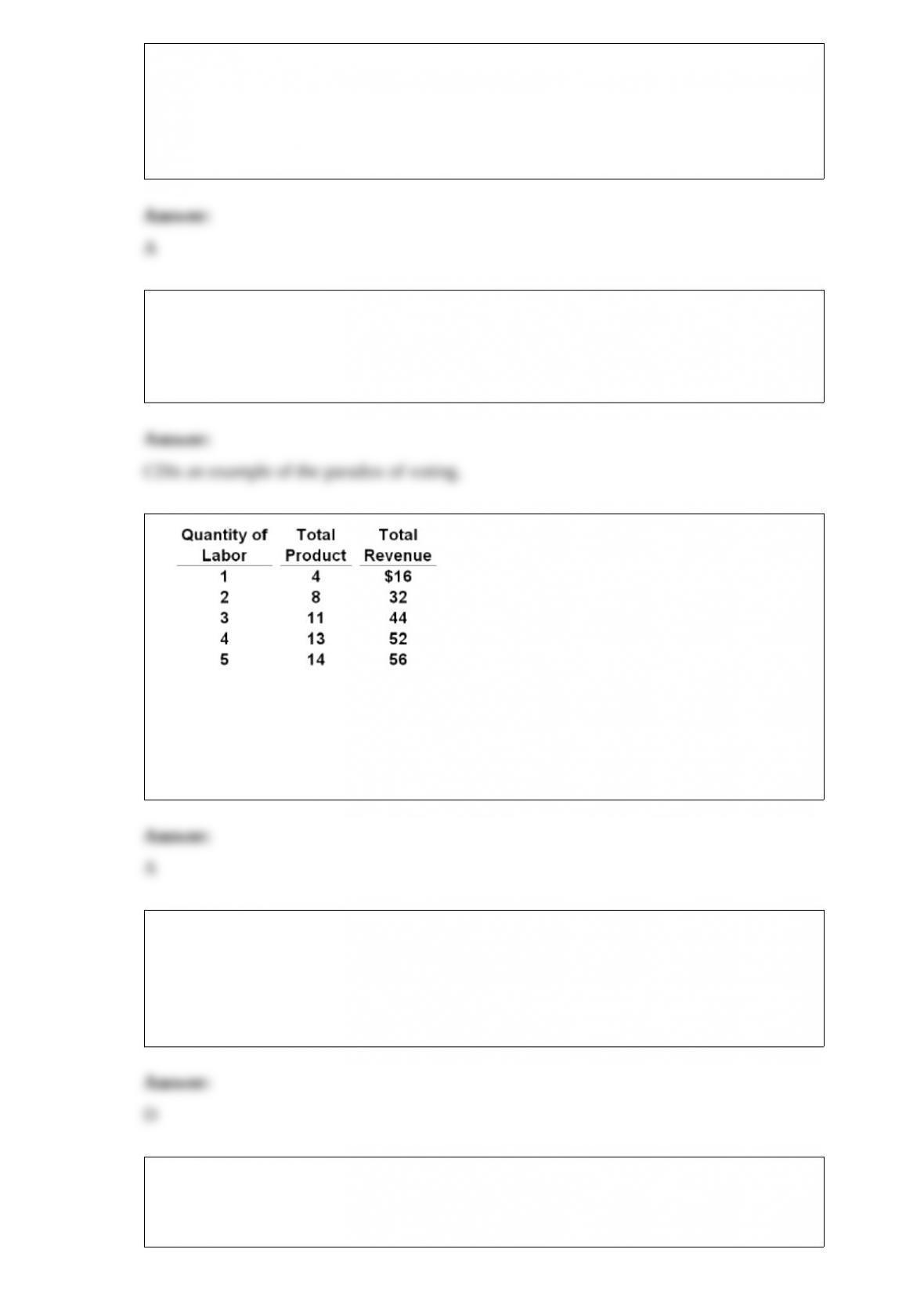
3)
Refer to the above data. The marginal revenue product of the fourth worker is:
A.$8.
B.$52.
C.$2.
D.$4.
4) Twenty-two states currently (2007) have:
A.prohibitions against unionization by state employees.
B.compulsory union membership in the public sector.
C.laws outlawing lockouts in labor disputes.
D.right-to-work laws.
5) Suppose a savings and loan association has checkable deposits of $500,000 and the
legal reserve ratio is 10 percent. If the institution has excess reserves of $4,000, then its
actual reserves are:
A.$46,000.
B.$50,000.
C.$54,000.
D.$4,000.
6) when the percentage change in price is greater than the resulting percentage change
in quantity demanded:
a.a decrease in price will increase total revenue.
b.demand may be either elastic or inelastic.
c.an increase in price will increase total revenue.
d.demand is elastic.
7) If a nation imposes tariffs and quotas on foreign products, the immediate effect will
be to:
A.reduce the rate of domestic inflation.
B.increase efficiency in the world economy.
C.increase domestic output and employment.
D.reduce domestic output and employment.
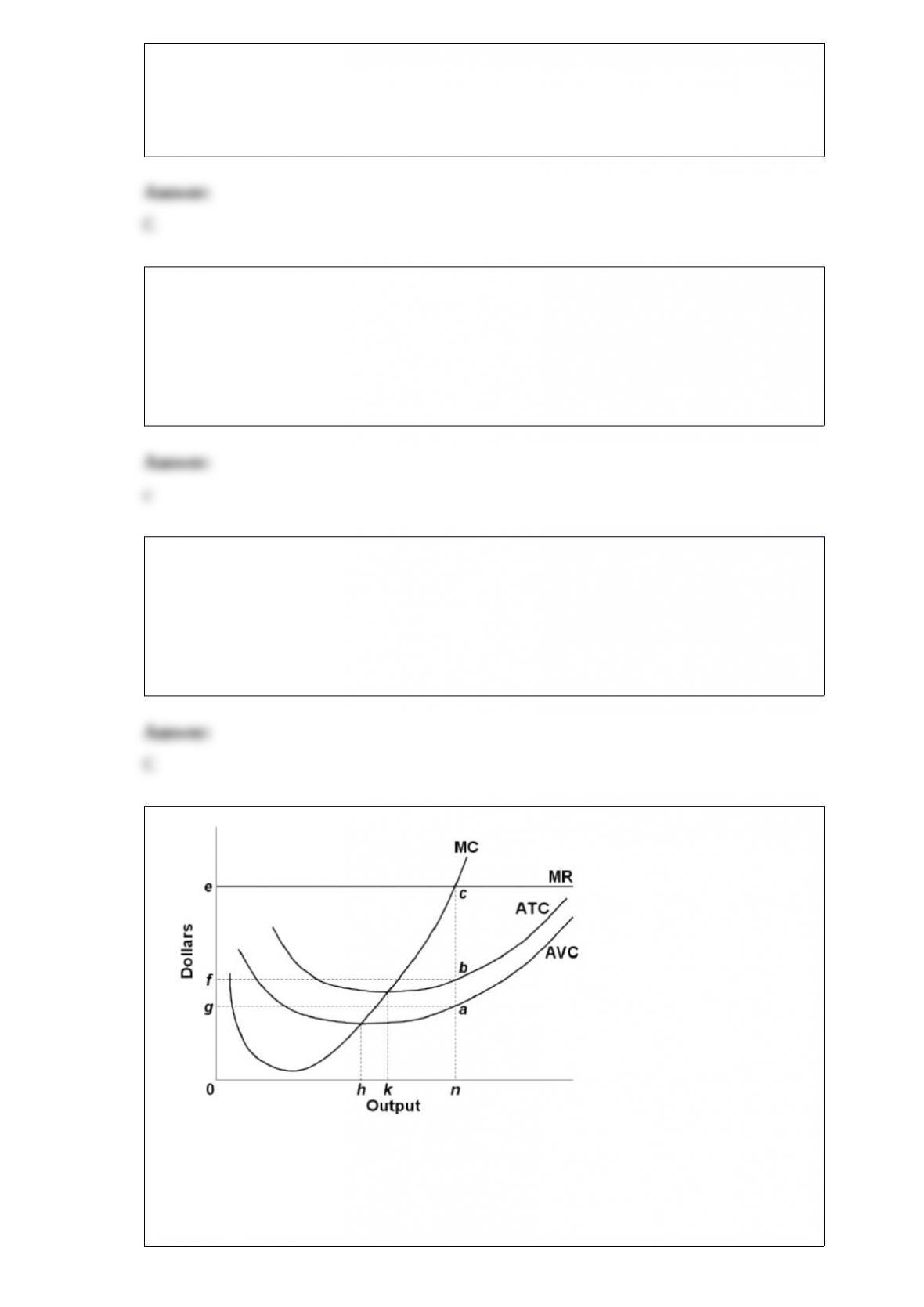
8)
refer to the above diagram. the profit-maximizing output:
a.is n
b.is k
c.is h
d.cannot be determined from the information given.

9) When the elasticity coefficient for resource demand is greater than one, resource
demand is:
A.inelastic.
B.elastic.
C.unit elastic.
D.perfectly inelastic.
10) behavioral economists use the concept of time inconsistency to explain why:
a.younger workers save more for retirement than older workers.
b.humans have an instinct for variety.
c.students would be willing to pay to delay the final exam the day before the exam, but
not earlier in the term.
d.people like to eat brightly colored m&ms.
11) which of the following statements is correct?
a.the united states’ exports and imports are smaller absolutely, but larger as a percentage
of gdp, than other nations’.
b.a number of other nations have exports and imports that are absolutely larger than
those of the united states.
c.the united states’ exports and imports are absolutely larger than any other nation’s, but
the exports and imports of many other nations are a larger percentage of their gdps.
d.the united states’ exports and imports are larger absolutely and as a percentage of gdp
than any other nation’s.
12) What is the tradeoff in the extraction of nonrenewable resources?
13) Explain what allocative efficiency is and how it is achieved in pure competition.
14) The determinants of aggregate demand determine the location of the aggregate
demand curve. Explain three of the four basic determinants of aggregate demand.
15) Explain how process innovation reduces cost and increases profits. How does this
innovation affect the firms total product curve and average cost curve?
16) Explain the equation of exchange.