1) economics involves marginal analysis because:
a.most decisions involve changes from the present situation.
b.marginal benefits always exceed marginal costs.
c.marginal costs always exceed marginal benefits.
d.much economic behavior is irrational.
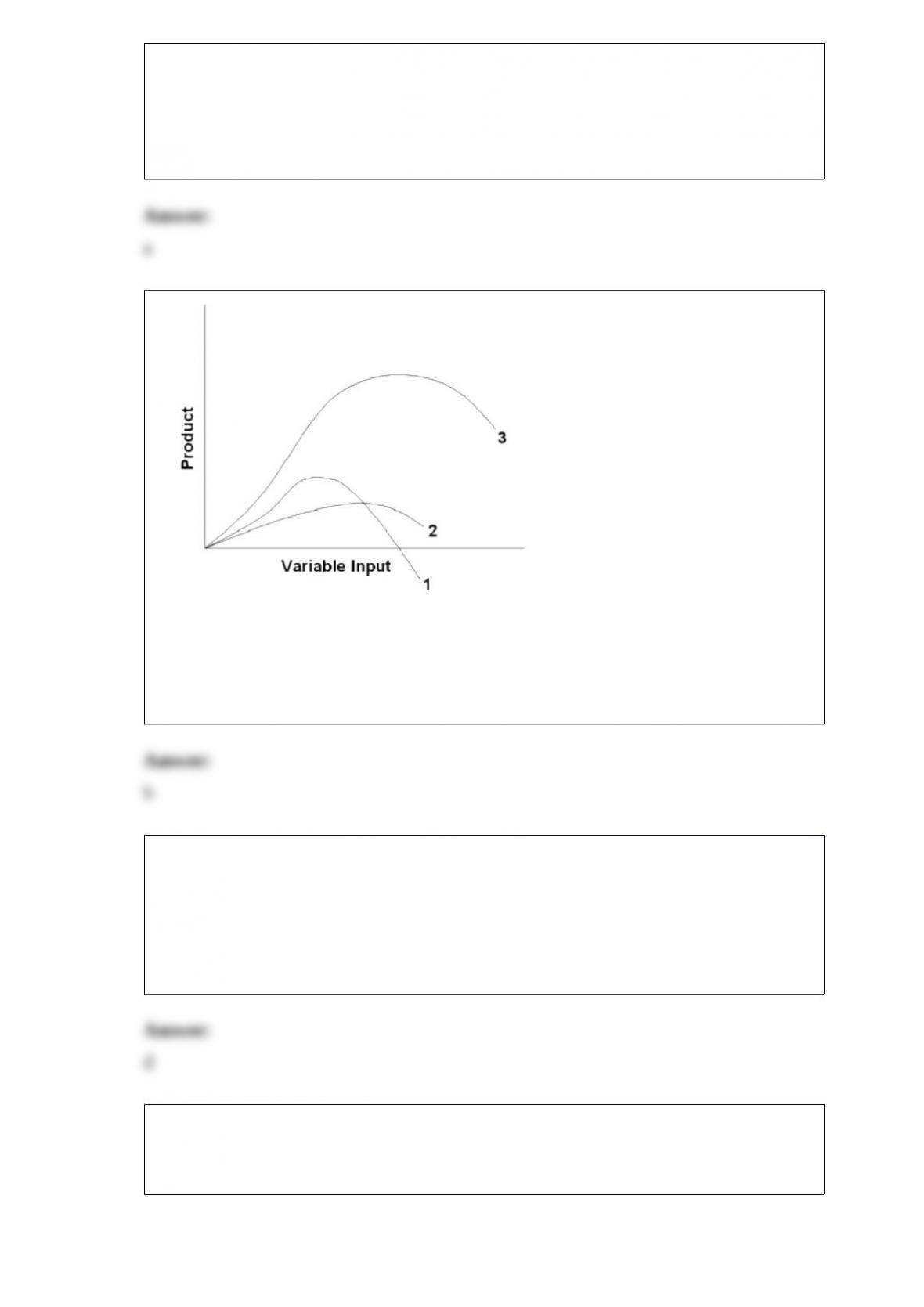
2)
in the above diagram curves 1, 2, and 3 represent the:
a.average, marginal, and total product curves respectively.
b.marginal, average, and total product curves respectively.
c.total, average, and marginal product curves respectively.
d.total, marginal, and average product curves respectively.
3) which of the following countries has the largest number of immigrants, as a
percentage of the labor force (as of 2004)?
a.japan
b.switzerland
c.united states
d.australia
4) the following table applies to a purely competitive industry composed of 100
identical firms.
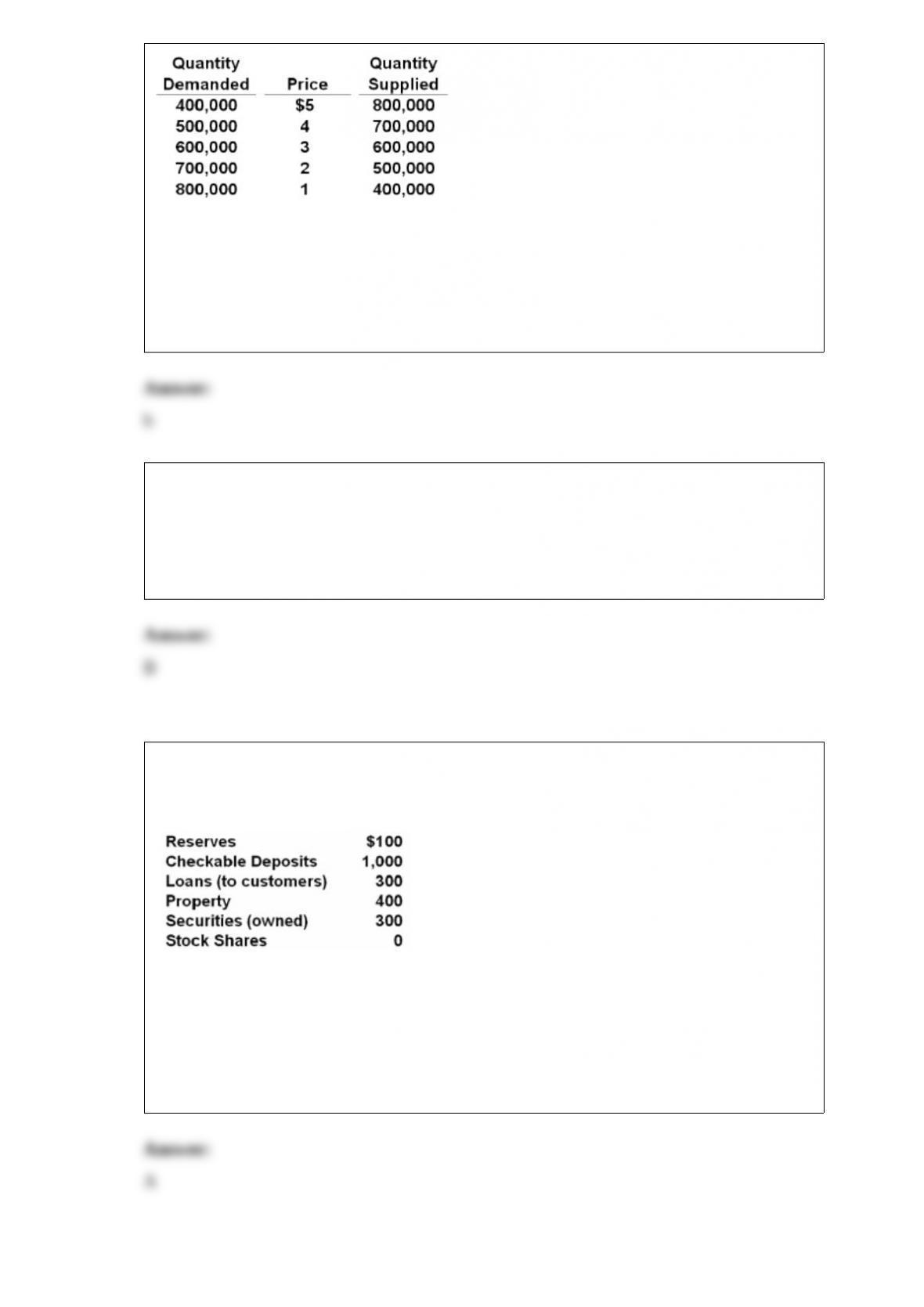
refer to the above table. if each of the 100 firms in the industry is maximizing its profit
and earning only a normal profit, each must have an average total cost of:
a.$2.
b.$3.
c.$4.
d.$5.
5) A restrictive monetary policy is designed to shift the:
A.aggregate demand curve rightward.
B.aggregate demand curve leftward.
C.aggregate supply curve rightward.
D. aggregate supply curve leftward.
6) The following information for the Moolah Bank.
Assume that the listed amounts constitute this bank’s complete set of accounts.
Moolah’s:
A.assets are $1100.
B.liabilities are $1100.
C.net worth is $300.
D.profit is $1000.
7) Over the past decade, total and per capita water use in the United States have:
A.both increased.
B.leveled off and fallen, respectively.
C.fallen and leveled off, respectively.
D.increased and fallen, respectively.
8) The demand for a resource depends primarily on:
A.the supply of that resource.
B.the demand for the product or service that it helps produce.
C.the price of that input.
D.the elasticity of supply of substitute inputs.
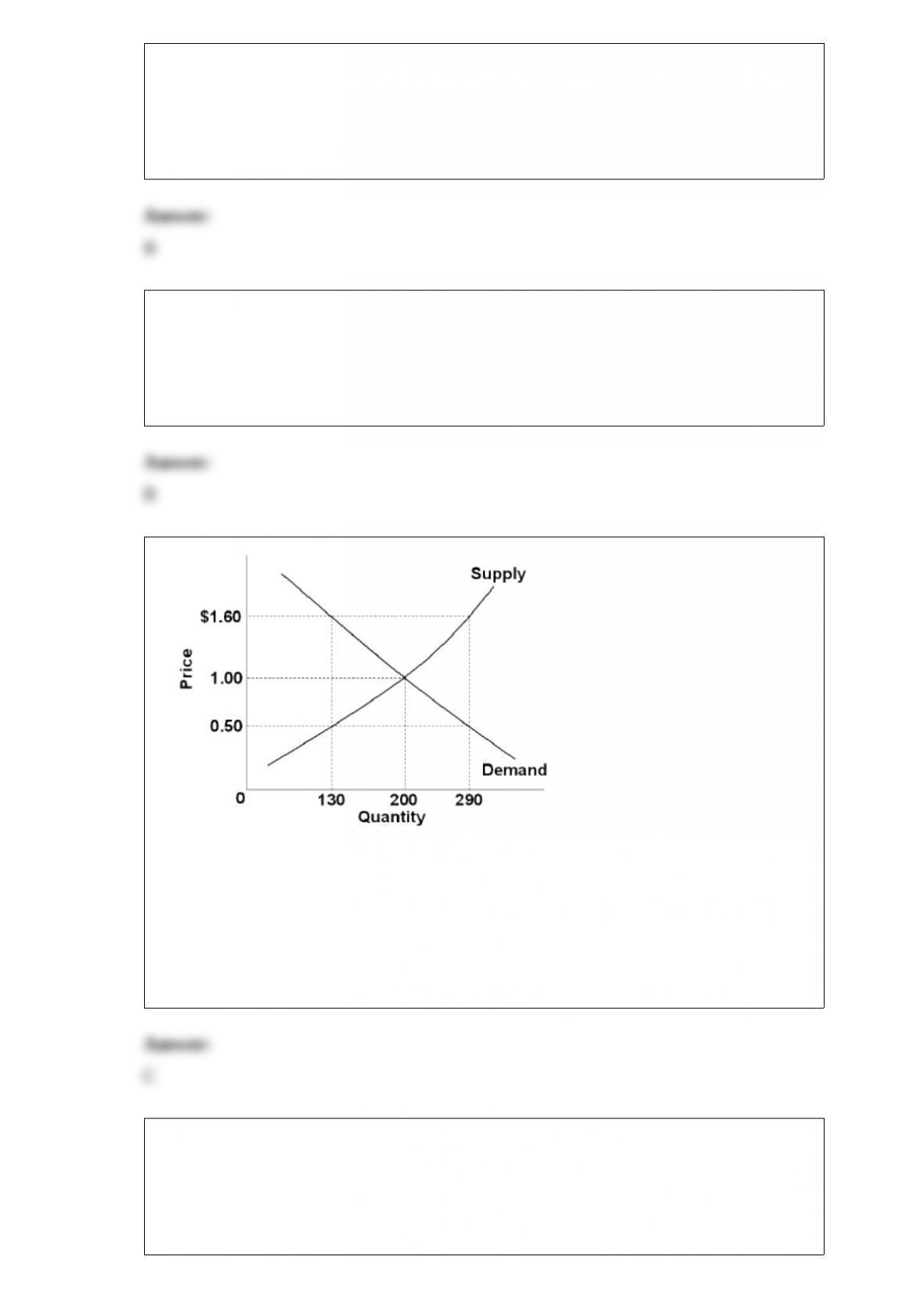
9)
Refer to the above diagram showing the domestic demand and supply curves for a
specific standardized product in a particular nation. If the world price for this product is
$1.60, this nation will experience a domestic:
A.shortage of 160 units, which it will meet with 160 units of imports.
B.shortage of 160 units, which will increase the domestic price to $1.60.
C.surplus of 160 units, which it will export.
D.surplus of 160 units, which will reduce the world price to $1.00.
10) given the annual rate of economic growth, the “rule of 70” allows one to:
a.determine the accompanying rate of inflation.
b.calculate the size of the gdp gap.
c.calculate the number of years required for real gdp to double.
d.determine the growth rate of per capita gdp.
11) In a private closed economy _____ investment is equal to saving at all levels of
GDP and equilibrium occurs only at that level of GDP where _____ investment is equal
to saving.
A.planned; actual
B.actual; planned
C.gross; net
D.net; gross
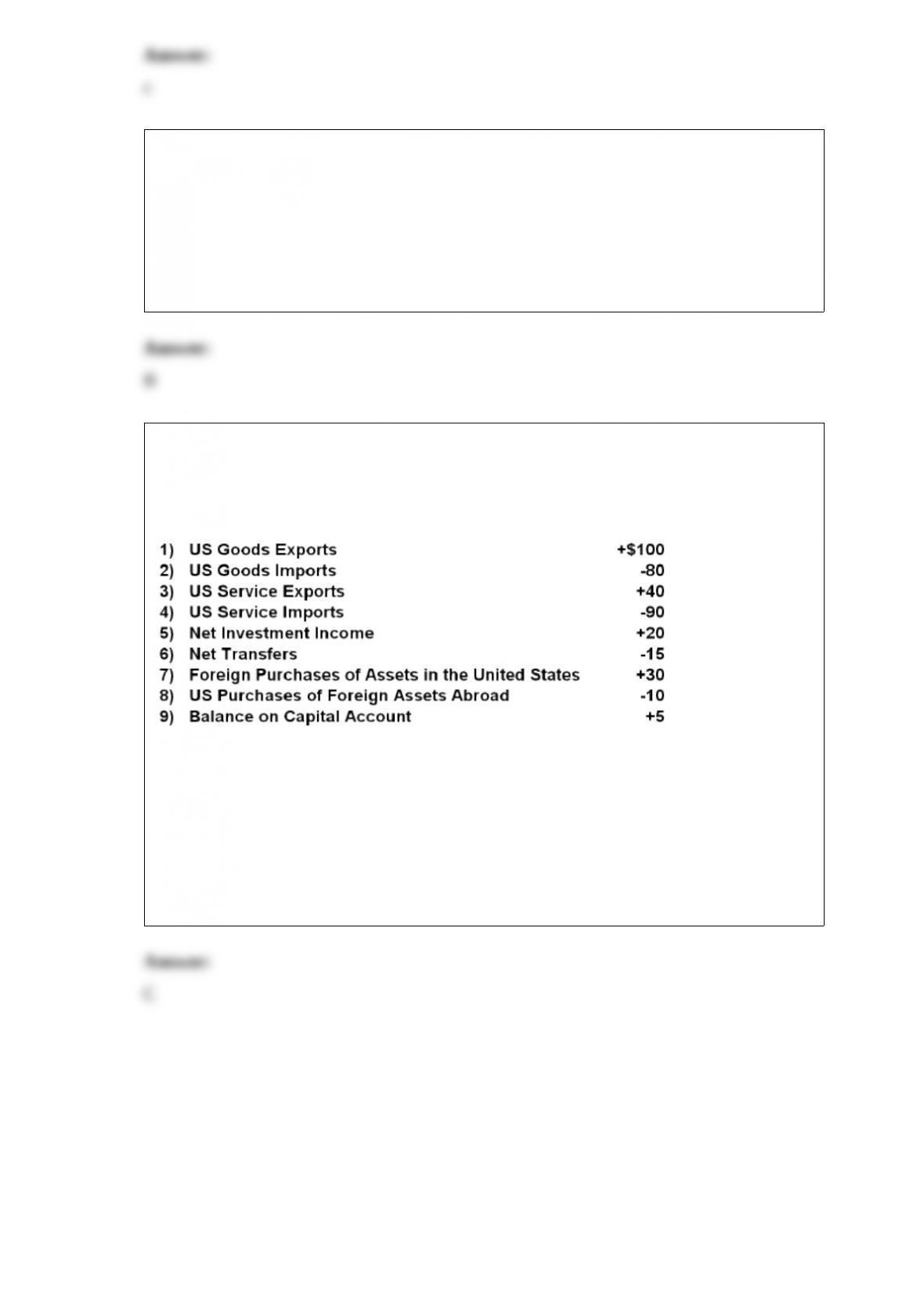
12) The following table contains hypothetical data for the 2010 U.S. balance of
payments. Answer the next question(s) on the basis of this information. All figures are
in billions of dollars.
Refer to the above data. Item (6) indicates that:
A.the United States used $15 billion of its international monetary reserves to balance its
international payments.
B.the United States provided $15 billion of foreign aid to developing nations.
C.Americans provided a net amount of $15 billion in remittances to the rest of the
world.
D.Americans received a net amount of $15 billion in remittances from the rest of the
world.