
We should expect to see home construction activity decrease when interest rates
increase.
a. True
b. False
The accounting identity for the economy’s factor payments can be written as ____.
a. GDP = wages + interest + rents + profits
b. GDP = consumption + investment + government + intermediate goods + net exports
c. GDP = wages + interest + rents + net exports
d. GDP = wages + interest + rents + saving + investment
Which of the following is the most open economy?
a. Germany
b. the Netherlands
c. the United States
d. Japan

e. Canada
If a firm has a U-shaped long-run average cost curve,
a. its fixed cost rises as output rises.
b. it must have increasing returns to scale at low levels of production and decreasing
returns to scale at high levels of production.
c. it must have increasing returns to each input at low levels of production and
decreasing returns to each input at high levels of production.
d. the firm can maximize its output by operating at the point of minimum long-run
average cost.
Centrally planned economies use free-market systems for their production planning.
a. True
b. False

The laissez-faire free-market system is
a. an ideal of perfection.
b. one that leaves no room for improvement.
c. unmatched by any other system for allocative efficiency.
d. All of the above are correct.
In a planned economy the concept of efficiency is
a. more important than in a market economy.
b. less important than in a market economy.
c. not important at all.
d. as important as in a market economy.
Adam Smith’s book, one of the first systematic treatments of economics, was entitled

a. The Plan of the Ages.
b. The General Theory of Money, Taxes, and Income.
c. The Wealth of Nations.
d. Principles of Economics.
e. Concepts in Moral Philosophy.
In the United States, the distribution of income after the income tax is ____ the
distribution of income before the income tax.
a. slightly less equal than
b. about as equal as
c. slightly more equal than
d. a great deal more equal than
Figure 22-6
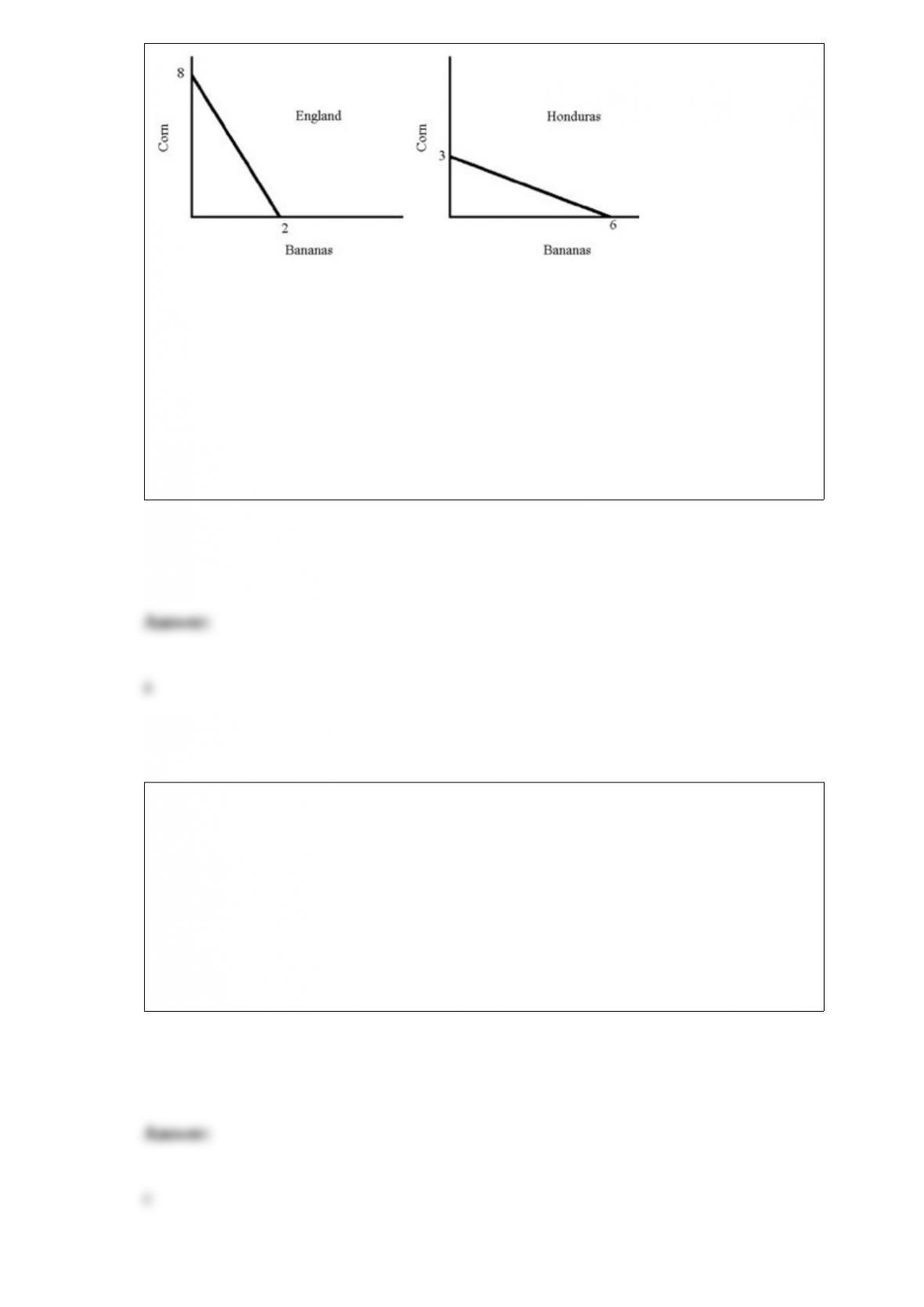
From the graph in Figure 22-6, the opportunity cost of a unit of bananas is
a. 4 units of corn for England; 1/2 unit of corn for Honduras.
b. 1/4 unit of corn for England; 2 units of bananas in England.
c. 8 units of corn in England; 3 units of corn in Honduras.
d. 4 units of corn in England; 12 units of corn in Honduras.
Between the years of 2001 and 2003, what happened to the structural deficit?
a. It declined rapidly.
b. It fell steadily.
c. It increased steadily.
d. It remained fairly constant.

Unemployment insurance is often criticized because workers can extend the amount of
time they are unemployed and thus increase the cost of the program. This phenomenon
is best described as
a. rent-seeking behavior.
b. moral hazard.
c. free riding.
The relationship between consumption and disposable income is such that as
a. consumption rises, disposable income falls.
b. disposable income rises, consumption rises.
c. disposable income rises, consumption falls.
d. disposable income rises, saving falls.
Which of the following acts prohibited predatory pricing?
a. Robinson-Patman Act
b. Tunney Act
c. Clayton Act

d. Sherman Act
In 2013, which of the following countries spent the most on Research and
Development?
a. China
b. Germany
c. Japan
d. the U.S.
Monopolistically competitive markets feature high barriers to entry.
a. True
b. False

Which of the following does not determine the position and shape of a society’s PPF?
a. physical resources
b. price level
c. skills and technology
d. past construction of factories and research
When salaries are paid more frequently, the velocity of money speeds up because
individuals hold more cash.
a. True
b. False
The method of financing the Social Security system until 1983 is best described as
a. trust fund.
b. excise tax.
c. indirect tax.

d. “pay as you go.”
Although pollution is caused by a failure of the market, many economists believe that
the best way to protect the environment is to utilize the price mechanism.
a. True
b. False
Economic principles suggest that we should focus on balancing the budget rather than
balancing aggregate supply and aggregate demand.
a. True
b. False

During the debate on the stimulus package in 2009 and 2010, Republicans argued in
favor of increased government spending as opposed to tax cuts based in part on the
impact government spending would have on aggregate supply.
a. True
b. False
The structural deficit is determined by established expenditure-transfer policies and tax
rates and is independent of the current level of GDP.
a. True
b. False
To fight inflation, the government may
a. decrease aggregate demand, which will also lead to lower unemployment rates.
b. increase aggregate demand, which will also lead to lower unemployment rates.
c. increase aggregate demand, which will also lead to higher unemployment rates.
d. decrease aggregate demand, which will also lead to higher unemployment rates.

If the dollar rises in value compared to other currencies, what will happen in the United
States?
a. an increase in aggregate demand
b. an increase in aggregate supply
c. a decrease in aggregate supply
d. an increase in the U.S. price level
The short-run average cost curve shows the lowest possible average cost corresponding
to each output level, assuming that all inputs are variable.
a. True
b. False

An import quota on a product normally does all of the following except
a. reduces the volume of that product traded.
b. raises the price in the importing country.
c. increases the price everywhere.
d. reduces the price in the exporting country.
The Justice Department and the Federal Trade Commission are likely to oppose mergers
a. that seem likely to increase efficiency.
b. that create a larger firm with economies of scale in a contestable market.
c. which will help one of the merging firms out of financial difficulties.
d. which threaten to reduce competition.
Corporations must always pay dividends to their shareholders.
a. True
b. False

If AD increases at a faster rate than AS, the result will be
a. demand-side inflation.
b. supply-side inflation.
c. falling prices.
d. stable prices.
U.S. exports:
a. rise as our GDP rises, and fall as our GDP falls
b. fall as our GDP rises, and rise as our GDP falls
c. are insensitive to our GDP
d. have no relation to our GDP

As a share of GDP, U.S. spending on education is:
a. comparable to that of other wealthy nations in the OECD
b. about 26% higher than the average of wealthy nations in the OECD
c. about 26% lower than the average of wealthy nations in the OECD
d. rising slowly, but steadily
In contrast to the United States, countries like Japan and Germany have
a. higher rates of saving and investment.
b. higher rates of saving but lower rates of investment.
c. lower rates of saving but higher rates of investment.
d. lower rates of saving and investment.