
The aggregate production function is an equation that shows the relationship between
________ and ________.
A) the inputs employed by firms; the maximum output firms can produce with those
inputs
B) the inputs employed by an individual firm in an economy; the average of the inputs
employed by all firms in an economy
C) the output produced by an individual firm in an economy; the average of the output
produced by all firms in an economy
D) the average level of capital used in production in an economy; the average level of
labor used in production in an economy
Hector’s wealth is zero, he expects to work for another 45 years at a constant salary of
$80,000 and live for another 60 years. If Hector receives a $20,000 bonus during his
first year of work and he completely smooths consumption over his lifetime, his
marginal propensity to consume out of a transitory increase in income is
A) 0.004
B) 0.017
C) 0.075
D) 0.75

Table 2.1
2012 2013
Quantity Price Quantity Price
Table 1 gives quantities and prices for each good produced in a simple economy in 2011
and 2012.
Refer to Table 2.1. GDP in 2012 is
A) $190.00.
B) $199.50.
C) $215.00.
D) $267.50.
The M1 measure of the money supply equals
A) currency in circulation.
B) currency in circulation plus checking account deposits.
C) currency in circulation plus checking account deposits plus traveler’s checks.
D) currency in circulation plus checking account deposits plus traveler’s checks plus
savings deposits.

A Phillips curve shows the short-run relationship between
A) potential GDP and real GDP.
B) the nominal interest rate and the real interest rate.
C) tax rates and tax revenues.
D) the unemployment rate and the inflation rate.
Suppose the current exchange rate between the Mexican peso and the U.S. dollar is 12
pesos = $1. Mexico’s GDP in dollars would be greater if the purchasing power parity
exchange rate was used to convert pesos to dollars if you could buy the same goods in
the United States with ________ as you can in Mexico with ________.
A) $1; 12 pesos
B) $10; 150 pesos
C) $100; 900 pesos
D) $1,000; 20,000 pesos

On average, expansions in the United States have become ________, and recessions
have become ________ since 1950.
A) longer; longer
B) longer; shorter
C) shorter; longer
D) shorter; shorter
Suppose the economy is initially in equilibrium where real GDP equals potential GDP
and the inflation rate is at the target rate. Other things equal, a housing boom will cause
aggregate expenditures to increase, which will result in a new, short-run equilibrium. To
return GDP to its potential level, the inflation rate will adjust. With adaptive
expectations, this will result in
A) an increase in aggregate demand and an increase in the inflation rate.
B) a decrease in aggregate supply and an increase in the inflation rate.
C) a decrease in aggregate demand and a decrease in the inflation rate.
D) an increase in aggregate supply and a decrease in the inflation rate.
A combination of high inflation and recession, usually resulting from a supply shock, is
known as
A) hyperinflation.
B) disinflation.
C) stagflation.
D) depression.
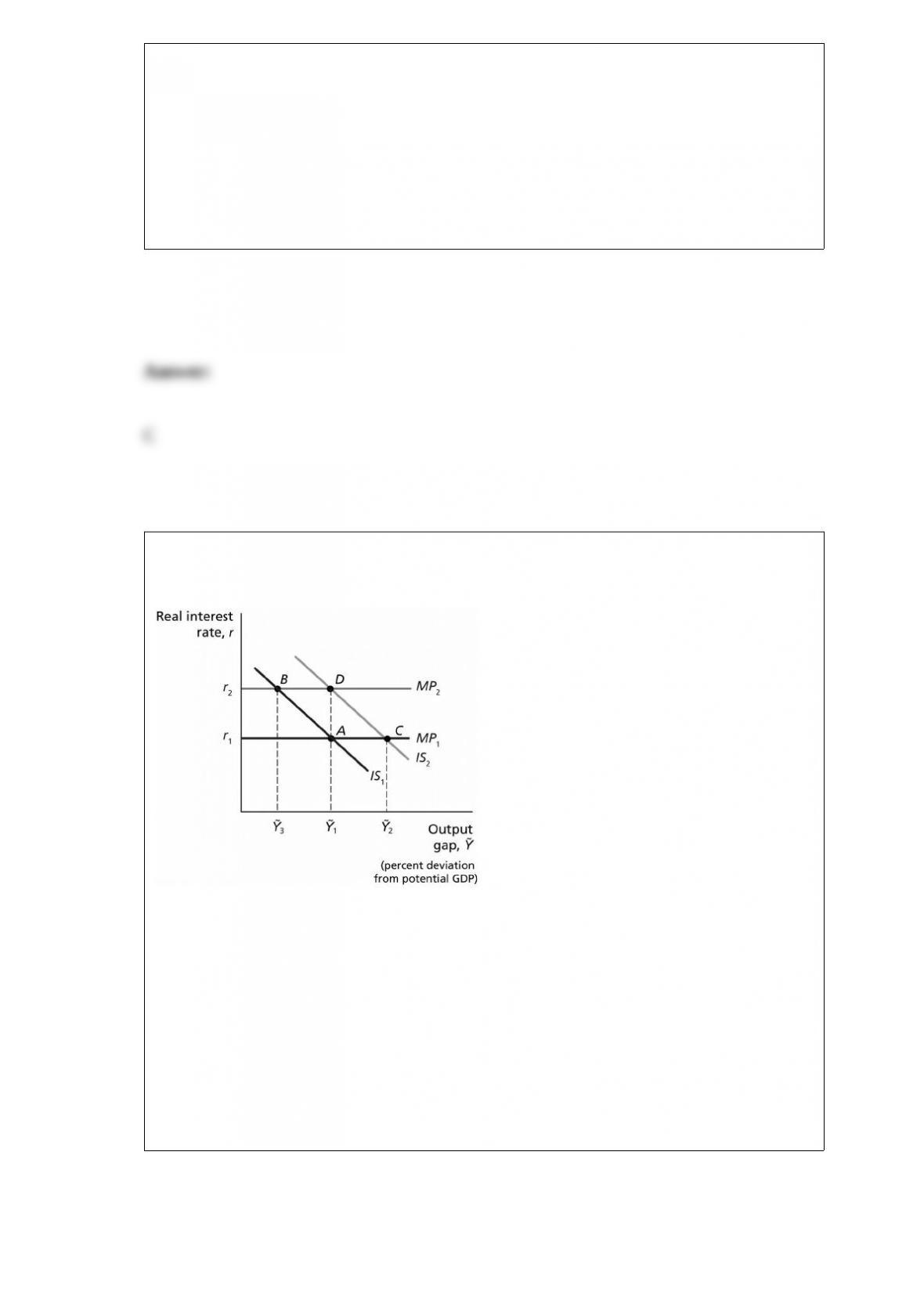
Figure 10.7
Refer to Figure 10.7. A movement from point A to point D could be caused by
A) a positive demand shock accompanied by an increase in the default-risk premium.
B) a decrease in consumer confidence accompanied by a decrease in the expected rate
of inflation.
C) a negative demand shock accompanied by an increase in the target interest rate.
D) an increase in consumer confidence accompanied by a decrease in the term premium
investors expect in the future.
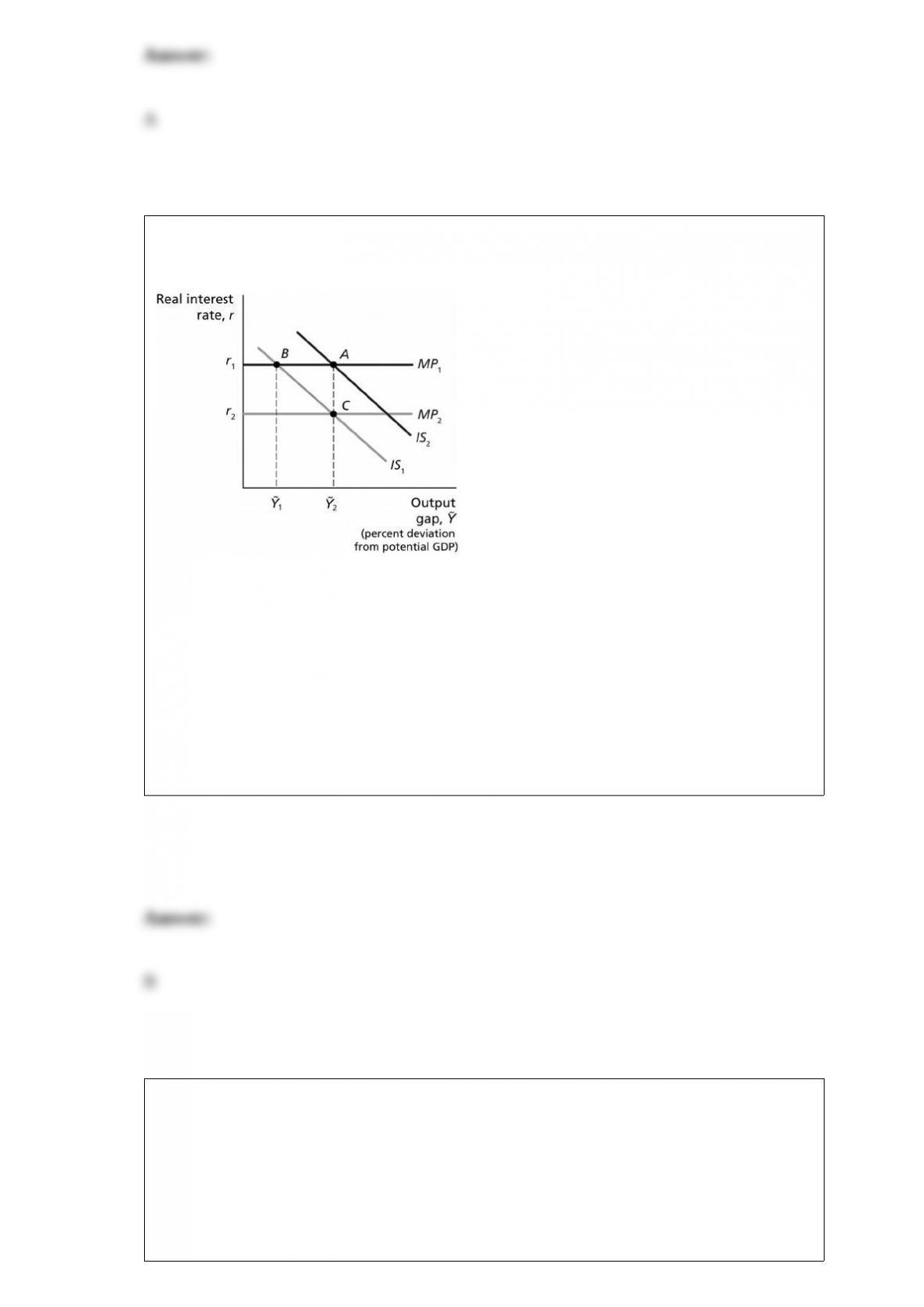
Figure 13.1
Refer to Figure 13.1. All else equal, if the economy is in a recession, expansionary
fiscal policy would result in a movement from
A) point A to point B.
B) point B to point A.
C) point B to point C.
D) point C to point B.
If the nominal exchange rate between the dollar and the euro is $1 = €0.70, and the
price of an 8.4 oz. can of Red Bull is $1.75 in the United States and €1.40 in Germany,
the real exchange rate between the dollar and the euro is
A) 25 cans of Red Bull in Germany per can of Red Bull in the United States.
B) 80 cans of Red Bull in the United States per can of Red Bull in Germany.

C) 875 cans of Red Bull in Germany per can of Red Bull in the United States.
D) 56 cans of Red Bull in Germany per can of Red Bull in the United States.
All else equal, if the demand for labor increases and the supply of labor does not
change, the equilibrium real wage will ________ and the equilibrium quantity of labor
will ________.
A) increase; increase
B) increase; not change
C) decrease; decrease
D) not change; increase
A recession tends to cause the federal budget deficit to ________ because tax revenues
________ and government spending on transfer payments ________.
A) increase; rise; falls
B) decrease; rise; falls
C) increase; fall; rises
D) decrease; fall; rises

The economy is considered to be at full employment when
A) the frictional unemployment rate is zero.
B) the structural unemployment rate is zero.
C) the cyclical unemployment rate is zero.
D) the unemployment rate is zero.
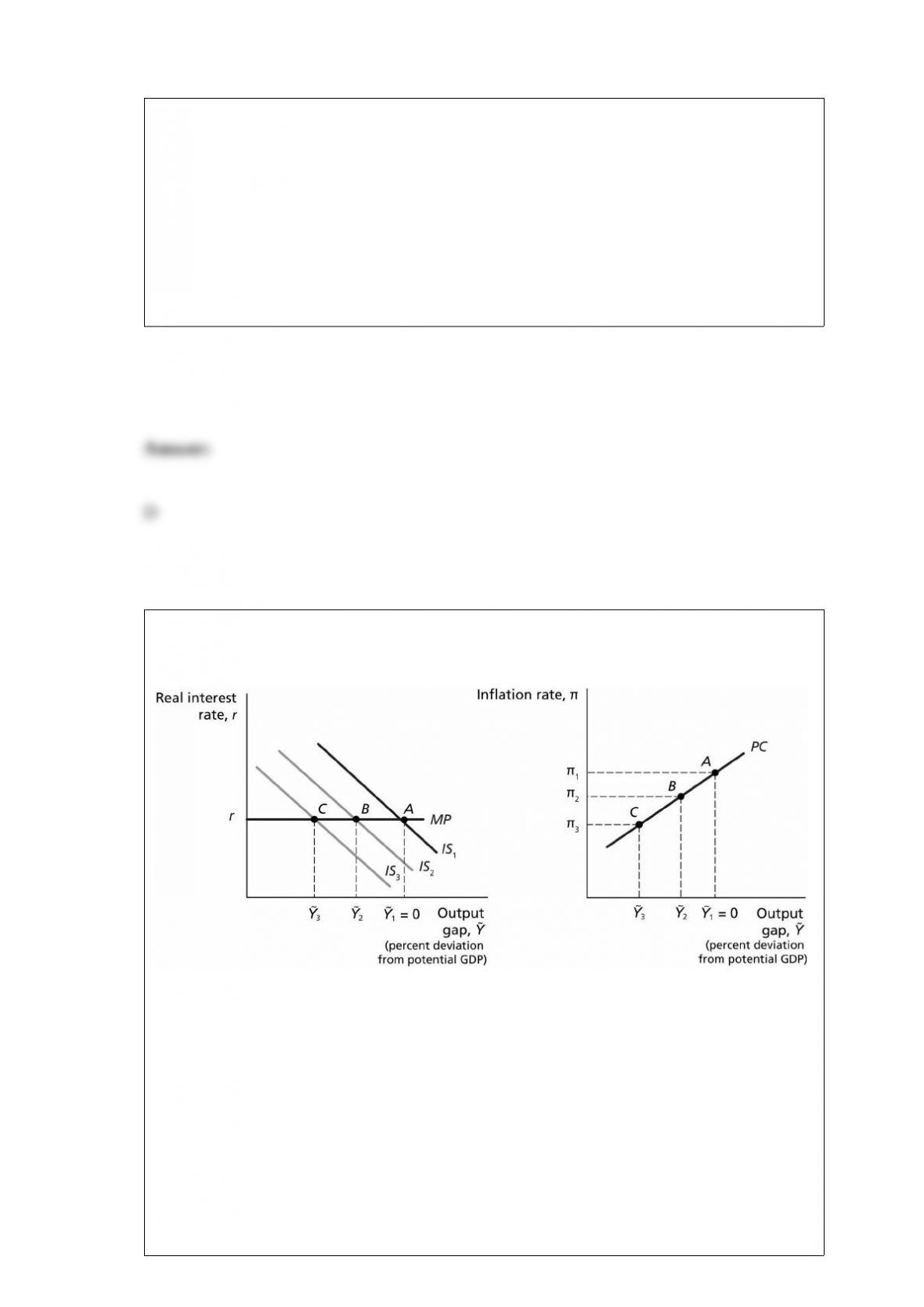
The housing market crash that accompanied the 2007-2009 recession has had severe
negative effects on the U.S. economy. Since December 2008, the target federal funds
rate has been 0.0-0.25%. Assuming the Fed keeps the real interest rate constant, a
recovery in the housing market would cause the ________, and the output gap would
________.
A) MP curve to shift up; become less negative
B) MP curve to shift down; become more negative
C) IS curve to shift to the left; become more negative
D) IS curve to shift to the right; become less negative

In today’s economy, dollar bills serve as money because
A) people have confidence that others will accept them as money.
B) they are backed by gold.
C) they have a value as a commodity independent of their use as money.
D) they can be redeemed for gold by the Federal Reserve.
An increase in interest rates
A) increases the prices of existing financial assets.
B) increases the prices of existing financial assets and of newly-issued financial assets.
C) reduces the prices of existing financial assets.
D) reduces the prices of existing financial assets and of newly-issued financial assets.
Assume that the Fed has a target inflation rate of 2% and that the values for how much
the nominal target federal funds rate responds to a deviation of inflation from its target,
g, and how much the nominal target federal funds rate responds to real GDP, h, are both
0.5. According to the Taylor rule, if inflation increases by 6%, the Fed should increase
the target nominal federal funds rate by
A) 3%.
B) 4%.
C) 6%.
D) 9%.
Figure 14.1
Refer to Figure 14.1. Other things equal, a decrease in government spending on
infrastructure projects is best represented as a movement from
A) point A to point B.
B) point C to point A.
C) point C to point B.
D) point B to point C.
For each of the following scenarios, state the short-run effect on the AS curve.
a. The price level decreases.
b. Lower inflation is expected in the future.
c. Worker productivity declines.
d. Oil prices increase.
e. The size of the labor force decreases.
If you take out a mortgage with a nominal interest rate of 8% and you expect the
inflation rate to be 2%, but the actual inflation rate turns out to be 8%, then you end up
paying a real interest rate of
A) 0%.

B) 1%.
C) 2%.
D) 6%.
Sammy is willing to lend Oscar $625 today so Oscar can purchase a new set of tires for
his pickup truck. Oscar agrees to pay the loan back plus 5% interest in one year. What is
the future value of this loan?
A) $595.24
B) $656.25
C) $750.00
D) $812.50
An increase in the real interest rate in the United States will cause net capital outflows
to ________ and cause the dollar to ________ relative to other currencies.
A) increase; appreciate
B) increase; depreciate
C) decrease; appreciate

D) decrease; depreciate
In the Cobb-Douglas production function, the index of the overall level of efficiency of
transforming capital and labor into real GDP is called
A) total factor productivity.
B) allocative efficiency.
C) the marginal efficiency index.
D) the transformation allocation of inputs.
If oil prices decrease,
A) the short-run aggregate supply curve will shift down.
B) the long-run aggregate supply curve will shift to the left.
C) the short-run aggregate supply curve will shift up.
D) the long-run aggregate supply curve will shift to the right.

All of the following new construction projects are examples of fixed investment
spending except
A) a dental office.
B) a manufacturing factory.
C) a public library.
D) a shopping center.
The Chinese economic reforms of 1978 opened China to international trade and
investment. These reforms gave China access to new capital and technology, which
A) allowed China to decrease its capital-labor ratio and increase labor productivity.
B) increased China’s total factor productivity and standard of living.
C) accelerated Chinese productivity to a level where Chinese real GDP per capita is
now on par with that in the United States.
D) rapidly increased productivity in China and convinced Chinese officials to expand
the reforms to include complete privatization of its financial system.
Which of the following is not a consequence of hyperinflation?
A) The price level grows in excess of hundreds of percentage points per year.
B) Hyperinflation causes an economy to suffer slow growth.
C) Money loses value so rapidly that individuals and firms stop holding it.
D) Money’s function as a medium of exchange is enhanced.
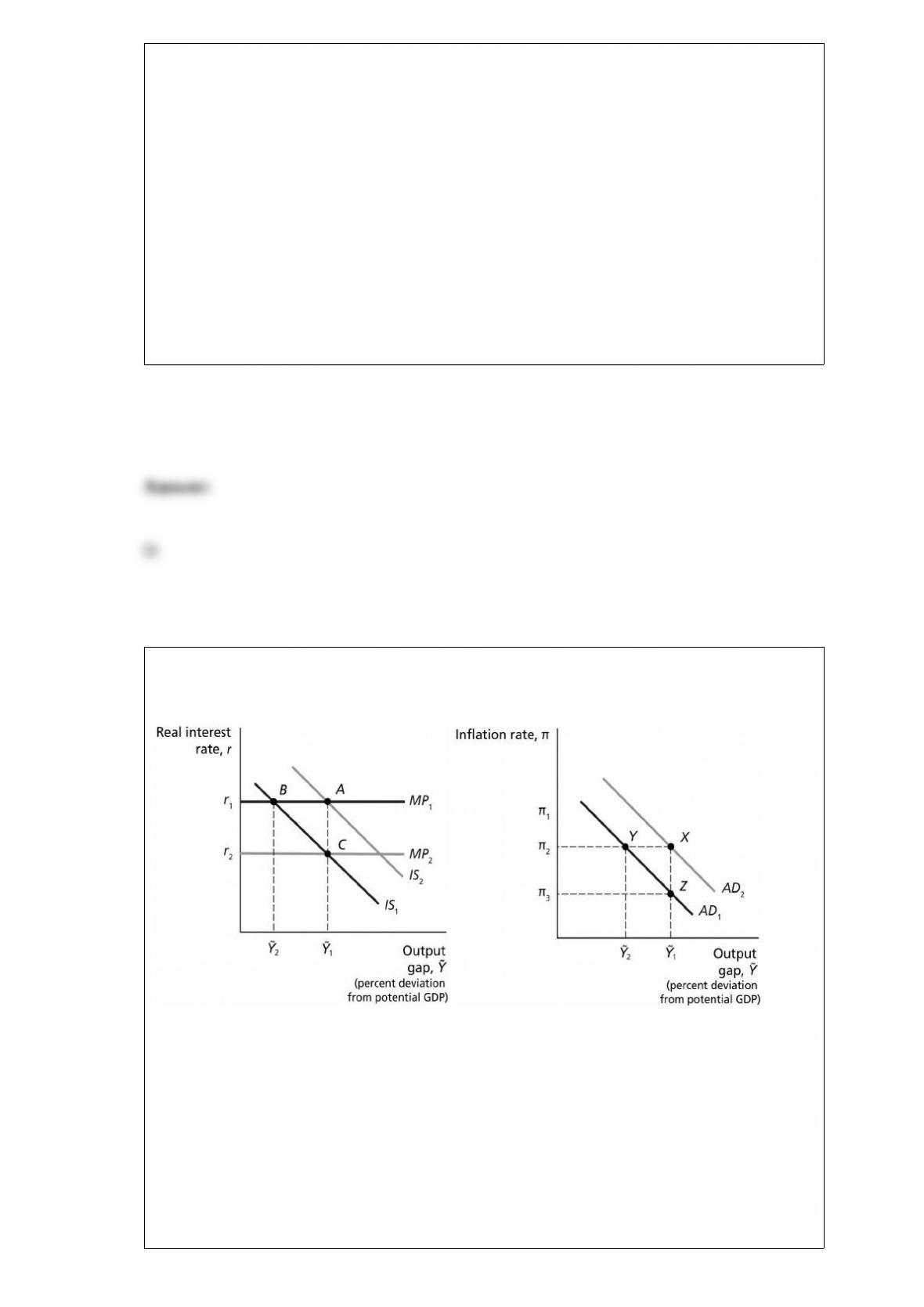
Figure 13.2
Refer to Figure 13.2. Assume the economy is initially in equilibrium with real GDP
equal to potential GDP. Other things equal, if the economy enters a recession and the
government underestimates the severity of the recession when implementing fiscal
policy, the output gap will ________ and the rate of inflation will ________ than if the
government had correctly estimated the recession’s severity.
A) decrease less; decrease less
B) decrease more; decrease more
C) decrease more; decrease less

D) not change; not change
Suppose the economy is initially in short-run equilibrium and the Fed decreases the
nominal money supply. If the price level remains constant, real GDP will ________
relative to potential GDP and the real interest rate will ________.
A) increase; increase
B) increase; decrease
C) decrease; increase
D) decrease; decrease
From the Keynesian perspective, when during a recession the quantity supplied is
greater than the quantity demanded in the market for some goods and services, there is
A) a decline in potential GDP.
B) a decline in potential GDP relative to real GDP.
C) a decline in real GDP relative to both nominal GDP and potential GDP.
D) a decline in real GDP relative to potential GDP.