1) (Consider This) Which of the following nations has implemented policies that pay
women to have additional children?
A.Russia.
B.France.
C.Italy.
D.All of these nations.
2) an industry comprised of a small number of firms, each of which considers the
potential reactions of its rivals in making price-output decisions is called:
a.monopolistic competition.
b.oligopoly.
c.pure monopoly.
d.pure competition.
3) a large negative gdp gap implies:
a.an excess of imports over exports.
b.a low rate of unemployment.
c.a high rate of unemployment.
d.a sharply rising price level.
4) in which of the following cases would real income rise?
a.nominal income rises by 8 percent, and the price level rises by 10 percent.
b.nominal income rises by 2 percent, and the price level remains unchanged.
c.nominal income falls by 4 percent, and the price level fall by 4 percent.
d.real income will rise in all of the above cases.
5) The equations for the demand and supply curves for a particular product are P = 10
.4Q and P = 2 + .4Q, where P is price and Q is quantity expressed in units of 100. After
an excise tax is imposed on the product the supply equation is P = 3 + .4Q.
Refer to the above information. The efficiency loss of this tax is:
A.$125.00.
B.$62.50.
C.$87.50.
D.$1.00.
6) Which of the following statements is correct?
A.There is clear evidence that unions have increased the average level of real wage
rates for all workers.
B.When fringe benefits are taken into account, the overall compensation of union and
nonunion workers is equal.
C.Approximately 10 percent of all work time is lost annually because of strikes.
D.Featherbedding means that unions may require employers to hire unneeded workers.
7) How many commercial banks are now operating in the United States?
A.about 140,000
B.about 7,300
C.about 11,000
D.about 6,300
8) Countercyclical discretionary fiscal policy calls for:
A.surpluses during recessions and deficits during periods of demand-pull inflation.
B.deficits during recessions and surpluses during periods of demand-pull inflation.
C.surpluses during both recessions and periods of demand-pull inflation.
D.deficits during both recessions and periods of demand-pull inflation.
9) Complete the following table assuming that (a) MPS = 1/3, (b) there is no
government and all saving is personal saving.
10) Conspiracies to fix prices are:
A.illegal under the Clayton Act.
B.illegal under the Celler-Kefauver Act.
C.per se violations of the antitrust laws.
D.more tolerated by government today than two or three decades ago.
11) The poverty rate for African-Americans is:
A.greater than for any other racial or ethnic group.
B.below that for whites.
C.considerably lower than that for Hispanics.
D.below that for persons 65 years of age or older.
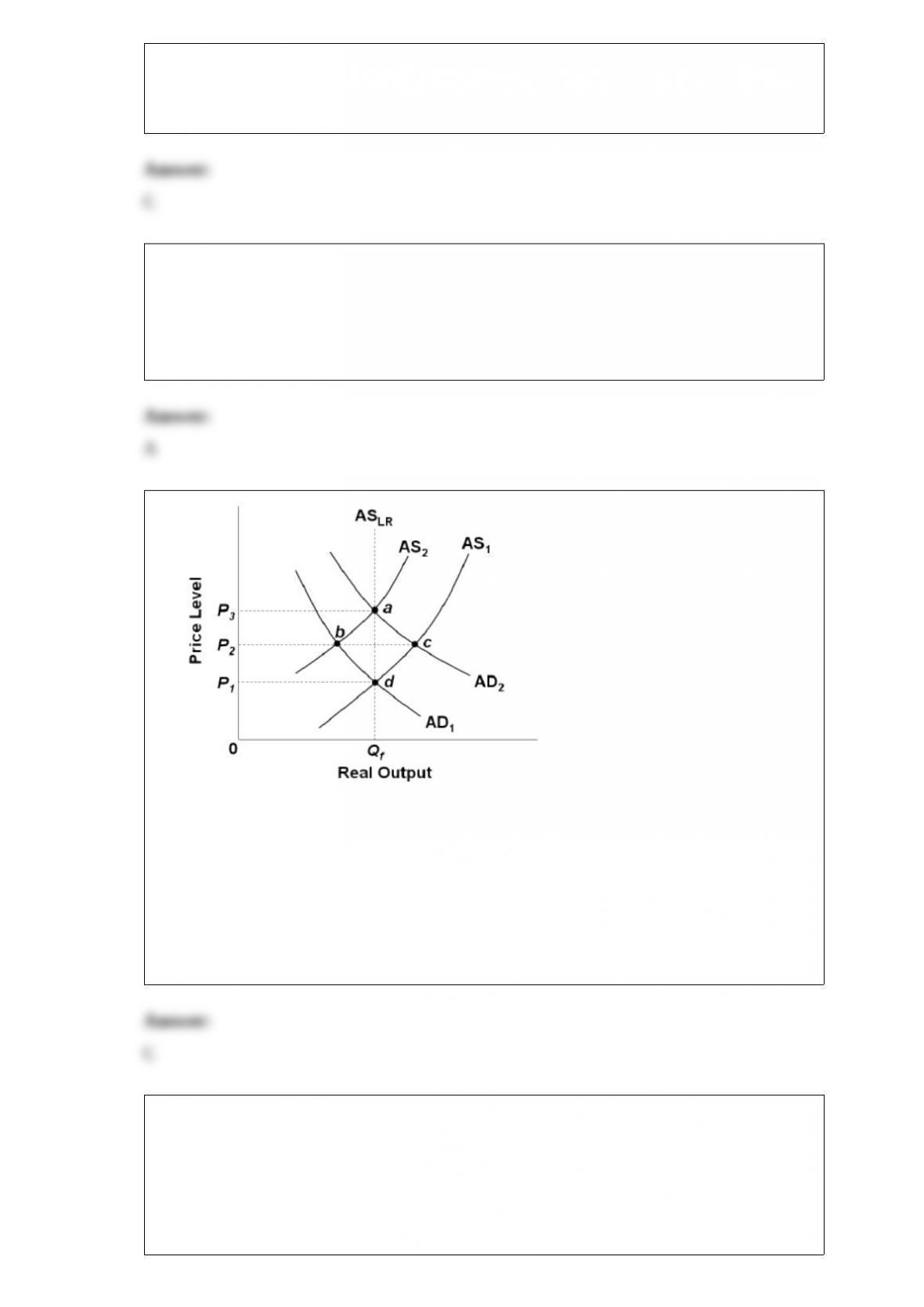
12)
Refer to the above diagram. The initial aggregate demand curve is AD1 and the initial
aggregate supply curve is AS1. In the long run, the aggregate supply curve is vertical in
the diagram because:
A.nominal wages and other input prices are assumed to be fixed.
B.real output level Qf is the potential level of output.
C.price level increases produce perfectly offsetting changes in nominal wages and other
input prices.
D.higher than expected rates of actual inflation reduce real output only temporarily.
13) Defenders of social regulation point out that:
A.social regulation is a better alternative than unregulated natural monopoly.
B.critics who stress the high administrative and compliance costs of social regulation
underestimate the social benefits that the regulations produce.
C.the number of regulatory agencies has declined over the past two decades.
D.social regulations reduce product prices.
14) which one of the following statements is correct?
a.relative scarcity is no longer a central idea in economics because we are in an age of
abundance.
b.most production possibilities curves are convex to the origin.
c.the production possibilities curve shows society’s preferences for consumer goods
relative to capital goods.
d.the central concept underlying the production possibilities curve is that of limited
resources.
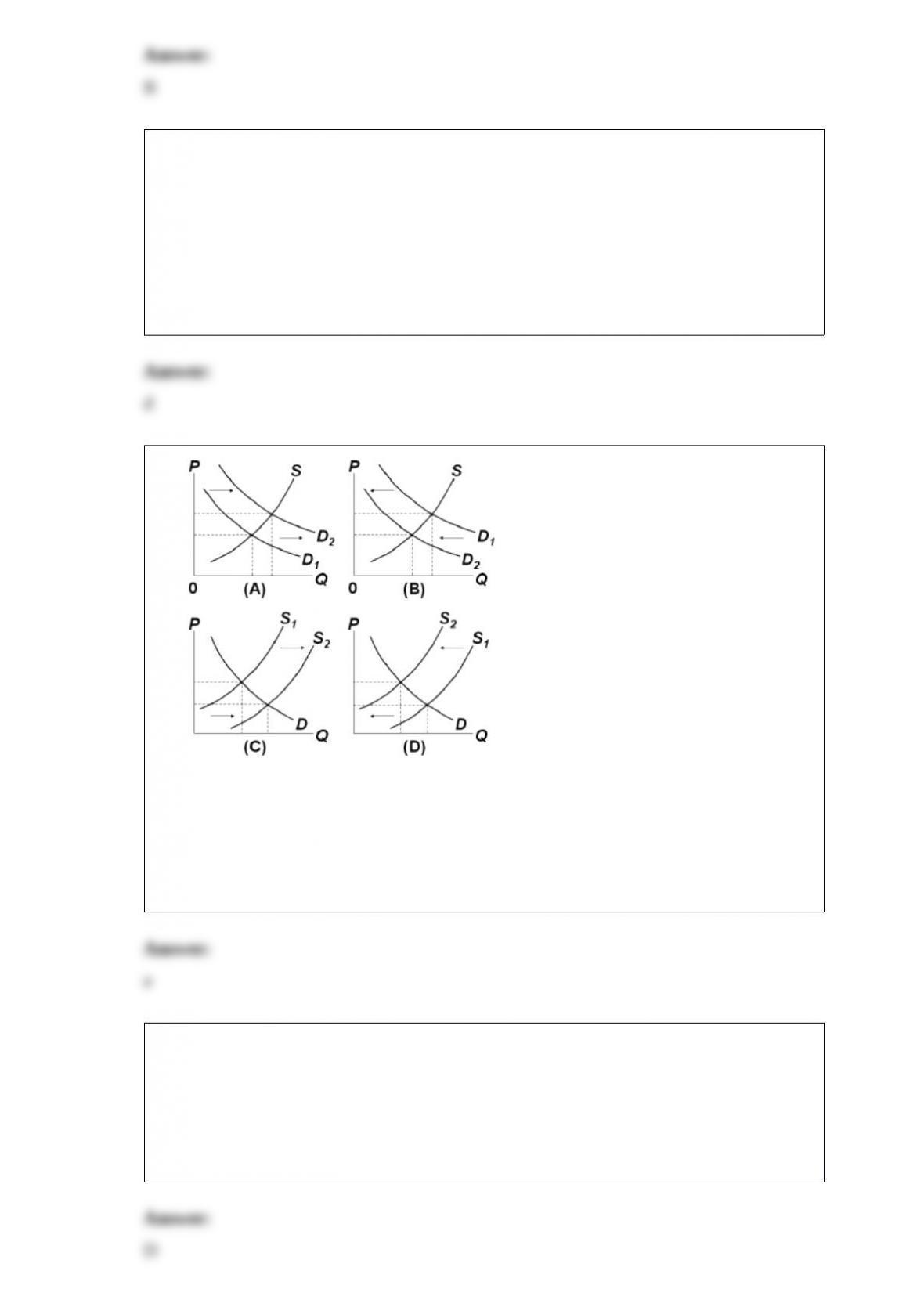
15)
which of the above diagrams illustrate(s) the effect of a decline in the price of personal
computers on the market for software?
a.a only.
b.a and d
c.b only.
d.d only.
16) The sale of government bonds by the Federal Reserve Banks to commercial banks
will:
A.increase aggregate supply.
B.decrease aggregate supply.
C.increase aggregate demand.
D. decrease aggregate demand.
17) Use the table below that shows the rate of return and R&D spending for a
hypothetical firm. Assume the interest-rate cost of funds is 8%.
(a)What is the optimal amount of R&D expenditures? At this amount, what will be the
marginal cost and what will be the marginal benefit of R&D spending?
(b)Now assume that the interest-rate cost of funds rises to 12%. What will be the
optimal amount of R&D spending? For this amount of R&D spending, what will be the
marginal cost and what will be the marginal benefit (expected rate of return)?
(c)Now assume that the interest-rate cost of funds falls to 6%. What will be the optimal
amount of R&D spending? For this amount of R&D spending, what will be the
marginal cost and what will be the marginal benefit (expected rate of return)?
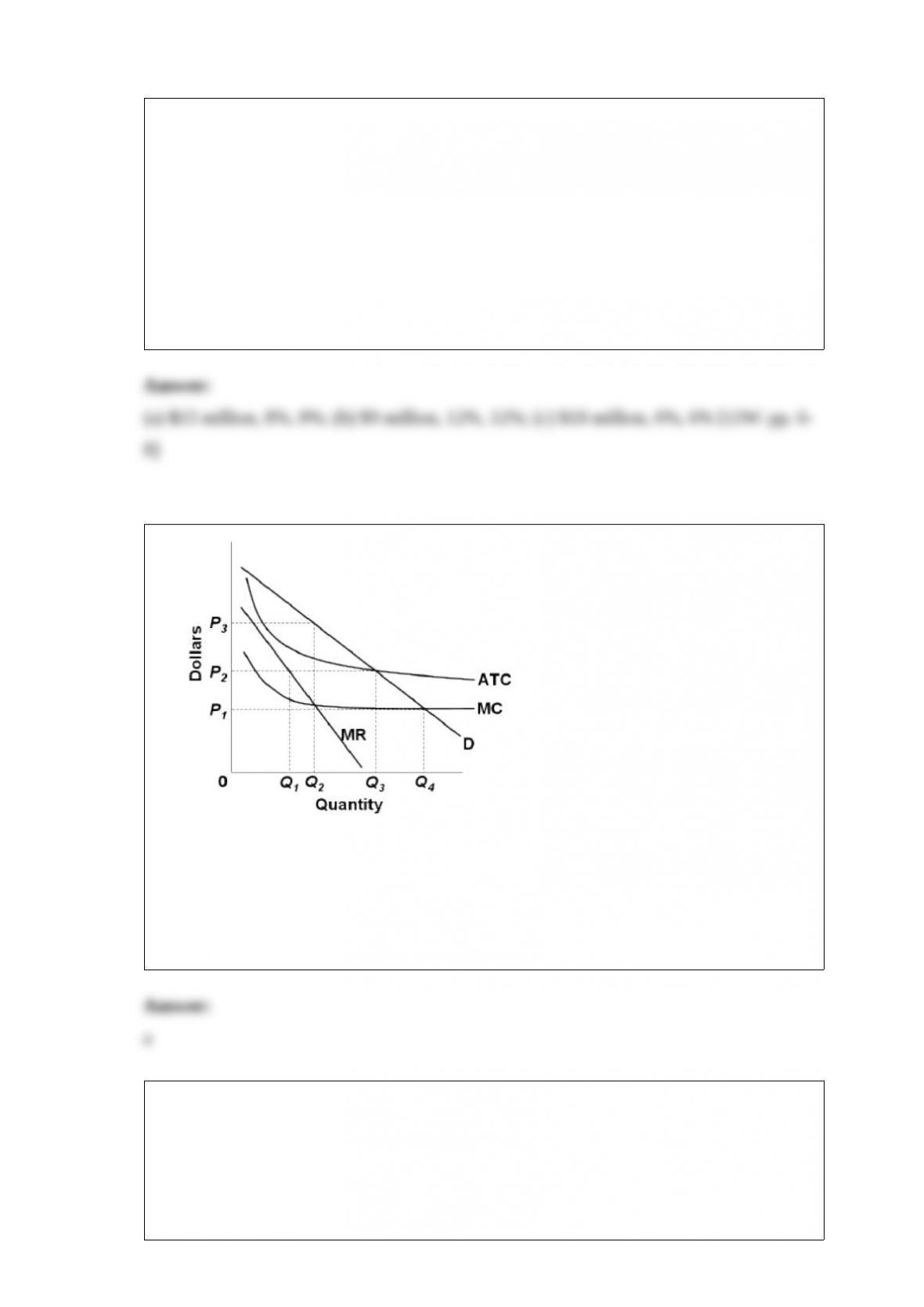
18)
refer to the above diagram for a natural monopolist. if a regulatory commission were to
set a maximum price of p3, the monopolist would:
a.maximize profits.
b.increase output beyond the profit-maximizing level.
c.reduce output below the profit-maximizing level.
d.be unable to make a normal profit.
19) Price fixing:
A.is prohibited by Section 7 of the Clayton Act.
B.is a per se violation of the antitrust laws.
C.may be either legal or illegal depending on whether or not it produces above-normal
profits.
D.is illegal under terms of the Federal Trade Commission Act.