
Which type of business is the most difficult to set up?
A) sole proprietorship
B) partnership
C) corporation
D) There is no difference in the difficulty of establishment.
Workers in industries protected by tariffs and quotas are likely to support these trade
restrictions because
A) they do not want to offend their employers who want them.
B) politicians lobby to convince workers the restrictions will make them better off.
C) they believe the restrictions will protect their jobs.
D) they don’t understand that the restrictions will threaten their jobs.
The five most important variables that determine the level of consumption are
A) disposable income, wealth, expected future income, price level, and interest rate.
B) wealth, savings account balances, checking account balances, stock portfolio
balances, and bond portfolio balances.
C) government purchases, interest rates, income, taxes, and transfers.

D) government purchases, saving account balances, wealth, interest rates, portfolio
balances.
All else equal, if the supply of veterinarians continues to increase while the population
of dogs and cats continues to decline, the incomes of veterinarians will
A) increase.
B) decline.
C) remain unchanged.
D) be indeterminate.
One criticism of the Fed’s quantitative easing policy is that a prolonged period of low
interest rates could lead to speculative bubbles. Some economists argued that as interest
rates fell and prices of long-term Treasury bonds rose, financial markets were
experiencing a “Treasury bubble.” These economists
worried that investors, banks, other financial firms, and pension funds were
underestimating the likelihood that long-term interest rates would eventually ________,
causing substantial ________ in the prices of Treasury bonds.
A) rise; declines
B) rise; increases
C) fall; declines
D) fall; increases

In economics, the accumulated skills and training that workers have is known as
A) human capital.
B) entrepreneurship.
C) physical capital.
D) innovation.
The price elasticity of demand for beef is estimated to be 0.60 (in absolute value). This
means that a 20 percent increase in the price of beef, holding every thing else constant,
will cause the quantity of beef demanded to
A) decrease by 12 percent.
B) decrease by 26 percent.
C) decrease by 32 percent.
D) decrease by 60 percent.
In 2012, foreign purchases of U.S. corporate stocks and bonds
A) doubled.
B) fell.
C) grew at a faster pace than foreign investment in U.S. government bonds.
D) grew at a faster pace than foreign investment in U.S. corporate bonds.
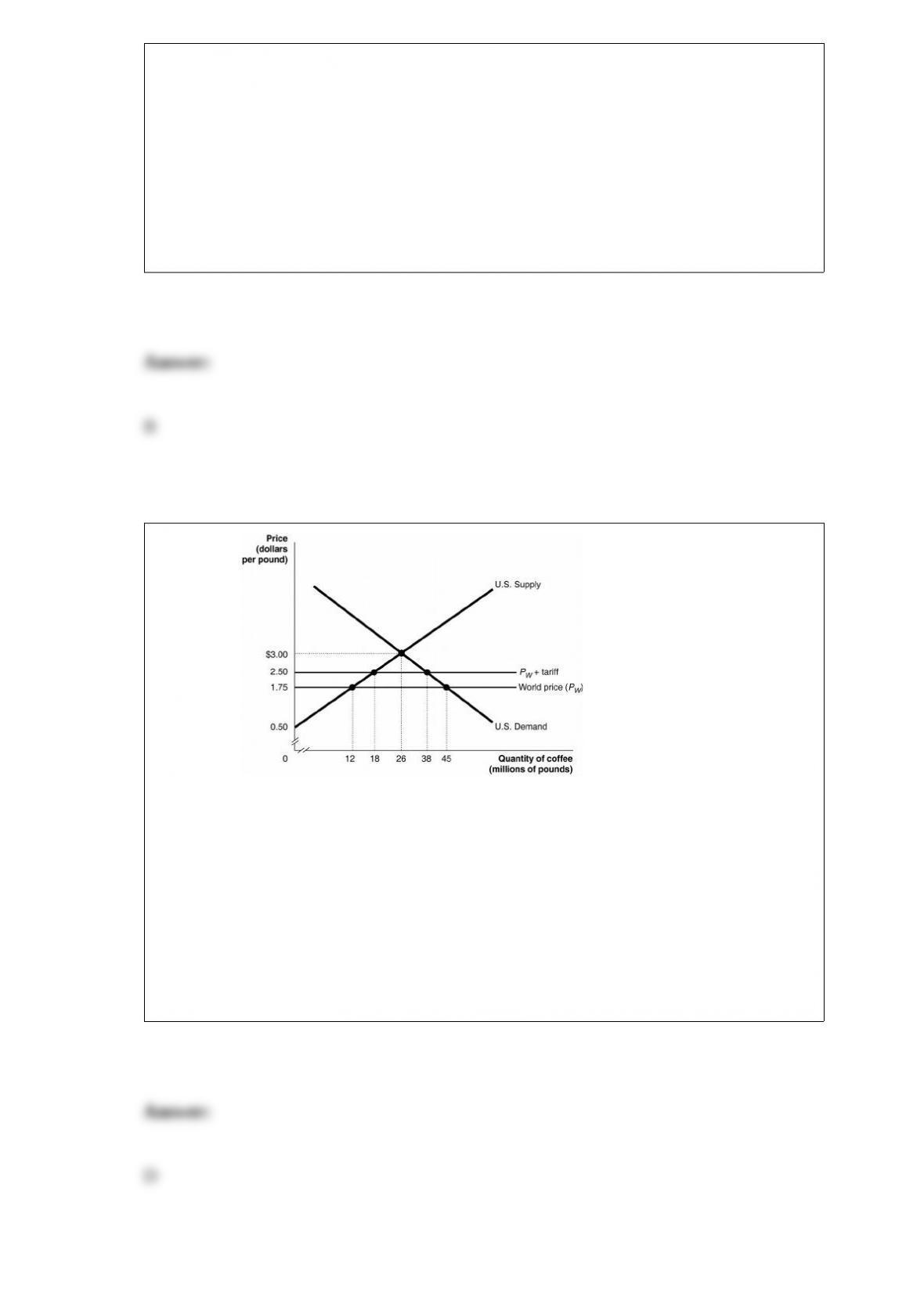
Figure 7-2 Suppose the U.S. government
imposes a $0.75 per pound tariff on coffee imports. Figure 7-2 shows the impact of this
tariff. With the tariff in place, the United States consumes
A) 18 million pounds of coffee.
B) 20 million pounds of coffee.
C) 26 million pounds of coffee.
D) 38 million pounds of coffee.

Which of the following is not an advantage of risk pooling?
A) By insuring large groups as opposed to individuals, health insurance providers
reduce adverse selection.
B) It gives very sick people in the group the same access to health care and to pay the
same premiums as healthy individuals.
C) It is easier for an insurance company to estimate the average number of claims likely
to be filed under a group policy than it is to predict the number of claims likely to be
filed under an individual policy.
D) Individuals who are insured and therefore do not have to pay the full cost of health
care services may be inclined to overuse those services.
Under which of the following circumstances would private saving be positive in a
closed economy?
A) Y = $10 trillion
C = $5 trillion
TR = $2 trillion
G = $2 trillion
public saving = $1 trillion
B) Y = $9 trillion
C = $5 trillion
TR = $1 trillion
G = $1 trillion
public saving = $3 trillion
C) Y = $8 trillion
C = $2 trillion
TR = $4 trillion
G = $2 trillion
public saving = $4 trillion
D) Y = $6 trillion
C = $2 trillion
TR = $8 trillion
G = $3 trillion
public saving = $1 trillion
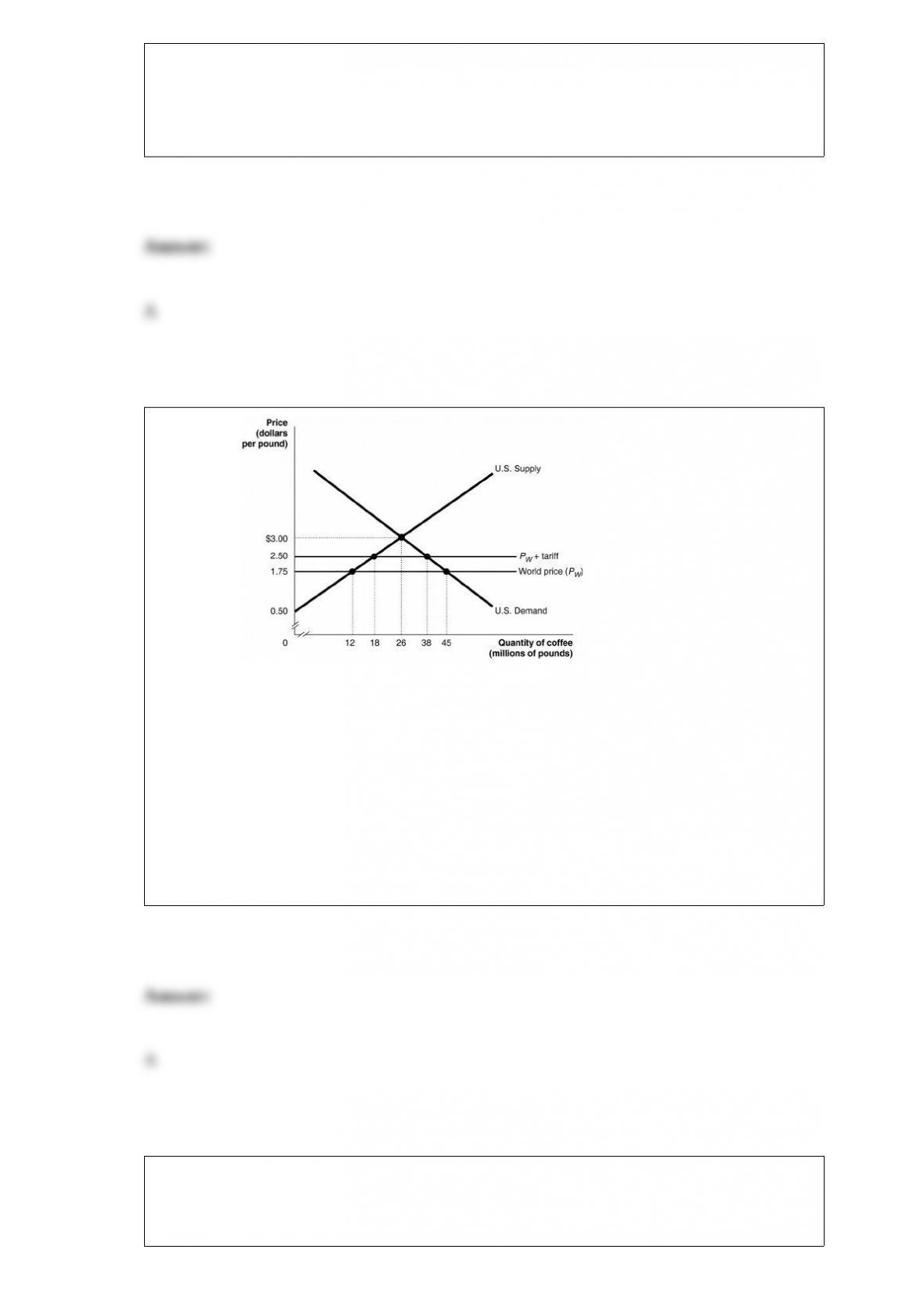
Figure 7-2 Suppose the U.S. government
imposes a $0.75 per pound tariff on coffee imports. Figure 7-2 shows the impact of this
tariff. The increase in domestic producer surplus as a result of the tariff is equal to
A) $11.25 million.
B) $18 million.
C) $32.5 million.
D) $45 million.
A goal of market-based reforms of the health care system is to give patients an incentive
to pay more attention to the prices of medical services. This would tend to ________
economic efficiency by ________ the costs of medical services
A) increase; increasing
B) increase; decreasing
C) decrease; increasing
D) decrease; decreasing
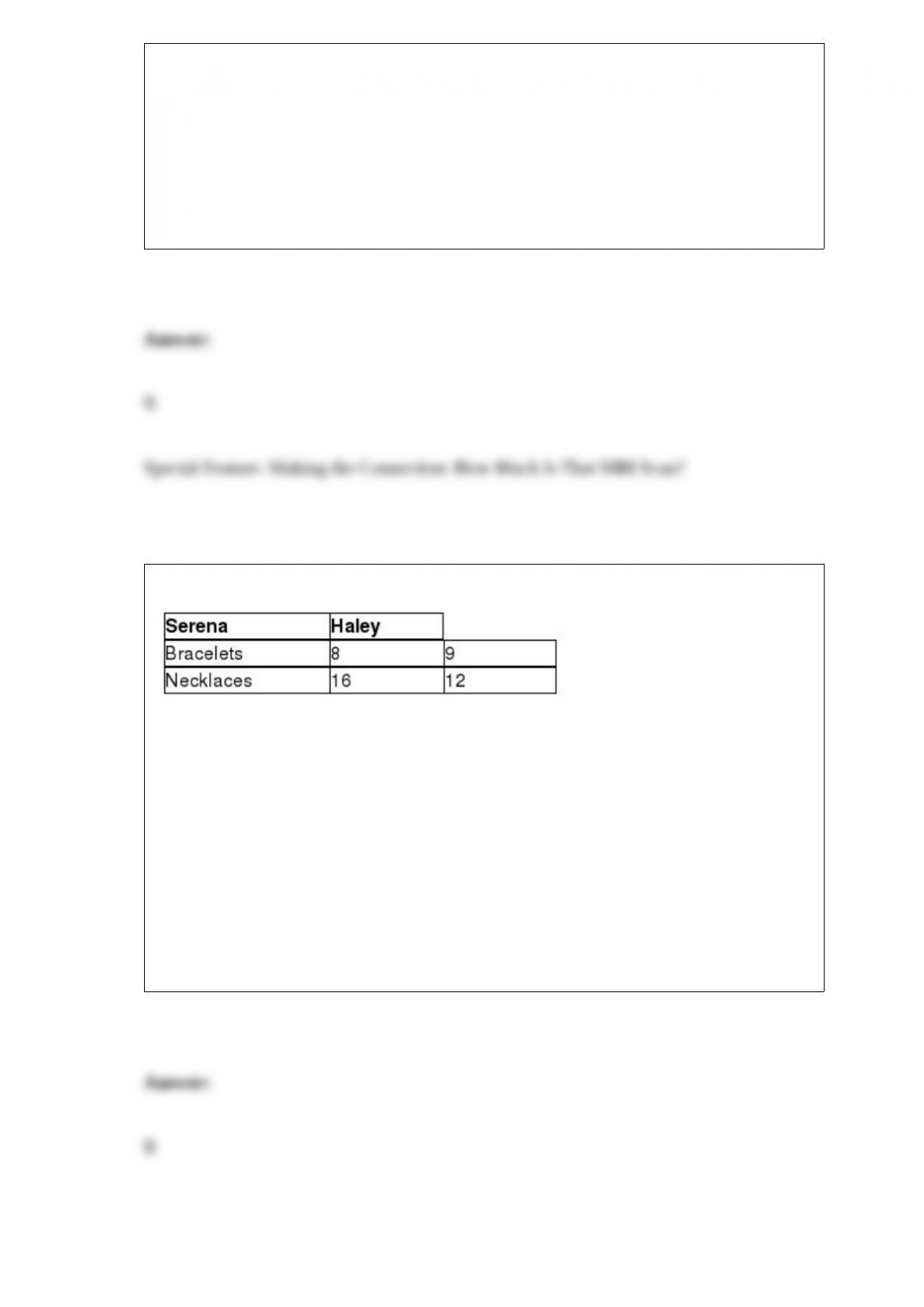
Table 2-6
Table 2-6 shows the output per week of two jewelers, Serena and Haley. They can either
devote their time to making bracelets or making necklaces.
What is Serena’s opportunity cost of making a necklace?
A) 2 necklaces
B) 1/2 of a bracelet
C) 1/2 of a necklace
D) 3/4 of a bracelet

The majority of dollars spent by government prior to the Great Depression was
spending at the ________ level. In the post-World War II period, two-thirds to three
quarters of all dollars spent by government in the United States are spent at the
________ level.
A) federal; state and local
B) state and local; federal
C) state and local; state
D) local; state
In economics, money is defined as
A) the total value of one’s assets in current prices.
B) the total value of one’s assets minus the total value of one’s debts, in current prices.
C) the total amount of salary, interest, and rental income earned during a year.
D) any asset people generally accept in exchange for goods and services.
Some economists who use the public choice model to explain the ways government
intervenes in the economy believe that regulatory capture results when an agency or
commission is given authority over a particular industry or product. Which of the
following is the best example of regulatory capture?
A) The Food and Drug Administration (FDA) has increased the time and expense
pharmaceutical firms incur to receive approval to market a new drug.

B) A federal government agency hires more employees than it requires to regulate an
industry because it does not seek to minimize costs or maximize the agency’s profits.
C) The head of an agency is required to testify before Congress because Congress
controls the size of the agency’s budget. Congress “captures” the agency because of its
budget authority.
D) Firms that were regulated by the Interstate Commerce Commission (ICC) attempted
for many years to influence the ICC’s actions.
Firms in a small economy planned that inventories would grow over the past year by
$300,000. Over that year, inventories actually grew by $400,000. This implies that
A) aggregate expenditure that year was less than GDP that year.
B) there was an unplanned decrease in inventories that year.
C) there was a planned decrease in inventories that year.
D) aggregate expenditure that year was equal to GDP that year.