
The price of a gallon of gasoline was $0.35 in 1972 when the CPI equaled 0.418. The
cost of a gallon of gasoline was $2.25 in 2005 when the CPI equaled 1.68. The real cost
of a gallon of gasoline between 1972 and 2005:
A. increased.
B. decreased.
C. remained constant.
D. may have either increased or decreased.
When a consumer must take some sort of additional action to receive a lower price, the
consumer is being subjected to:
A. “bait and switch” sales tactics.
B. perfect price discrimination.
C. the “hurdle” method of price discrimination.
D. the “rebate and wait” method of price discrimination.

A central bank that attempts to achieve a zero rate of inflation:
A. cannot achieve price level stability in the long run.
B. increases the risk of deflation.
C. can occasionally achieve negative real interest rates.
D. makes it easier for real wages to be reduced without cutting nominal wages.
The benefits of economic growth are _____, while the costs of economic growth are
_____.
A. increased output per person; too small for concern
B. increased output per person; the consumption sacrificed in exchange for capital
formation
C. increased output per person; less future consumption
D. more current consumption; less future consumption
Shel and Fran are neighbors. They work at the same firm and hold the same title. Shel
finds that when Fran’s consumption rises, Shel feels worse off. Fran feels the same way
about Shel’s consumption. Fran has bought a new Jaguar (a luxury car), and shortly
thereafter, Shel bought a new Mercedes (also a luxury car). Shel and Fran seem to be:

A. making independent rational consumption decisions.
B. unaware of the other’s actions.
C. involved in a positional arms race.
D. imposing external benefits on each other.
Macroland produces dishes and glassware. Before trade, a set of dishes sells for $100
and a set of glasses sells for $50. When Macroland opens to trade, foreign demand for
domestically produced china is strong, raising the price of a set of dishes to $125. But
foreign competition reduces the demand for domestically produced glasses, so they now
sell for $25 a set. Assuming workers cannot move between industries, the wages of
workers producing dishes will ______ and the wages of workers producing glasses will
____.
A. increase; increase
B. increase; not change
C. increase; decrease
D. decrease; increase
Suppose two demand curves intersect and so have a point in common. At that point,
demand shown by the steeper curve will be _______ the flatter curve.
A. more elastic than
B. less elastic than
C. as elastic as
D. more likely to be unit elastic than
Which of the following is an example of frictional unemployment?
A. Dora lost her job when the textile factory closed. She does not have skills to work in
another industry and has been unemployed for over a year.
B. Marsha was laid off from her job with the airline because the recession has reduced
the demand for airline travel. She expects to get her job back when the economy picks
up.
C. George is an unskilled worker who mows lawns in the summer, but is unemployed
the rest of the year.
D. Hector looked for a job for five weeks after finishing college. He turned down
several jobs that didn’t fit his skills, but now has a job that requires the expertise he
gained in college.

Two reasons savers keep deposits at banks are to:
A. secure mortgages and to purchase stocks.
B. earn a return on their savings and to facilitate making payments.
C. lower interest rates and to increase the money supply.
D. equalize loan supply and demand and to earn interest.
Capital goods are
A. long-lived goods used for producing other goods and services.
B. the end products of production.
C. publicly provided.
D. excluded from GDP.
In exchange for a share of the revenues earned on campus, State U has granted
CheapFizz the exclusive right to sell soft drinks in the student union and in vending
machines on campus. Prior to the deal, three soft drink companies sold beverages on
campus; now no other soft drink company is allowed to sell its products on campus.
The beneficiaries of this deal is/are _______.
A. the students at State U
B. State U
C. State U and CheapFizz
D. CheapFizz
The money demand curve will shift to the right if:
A. the nominal interest rate increases.
B. real income increases.
C. ATM machines are introduced.
D. the price level decreases.
The following table provides data for an economy in a certain year. __
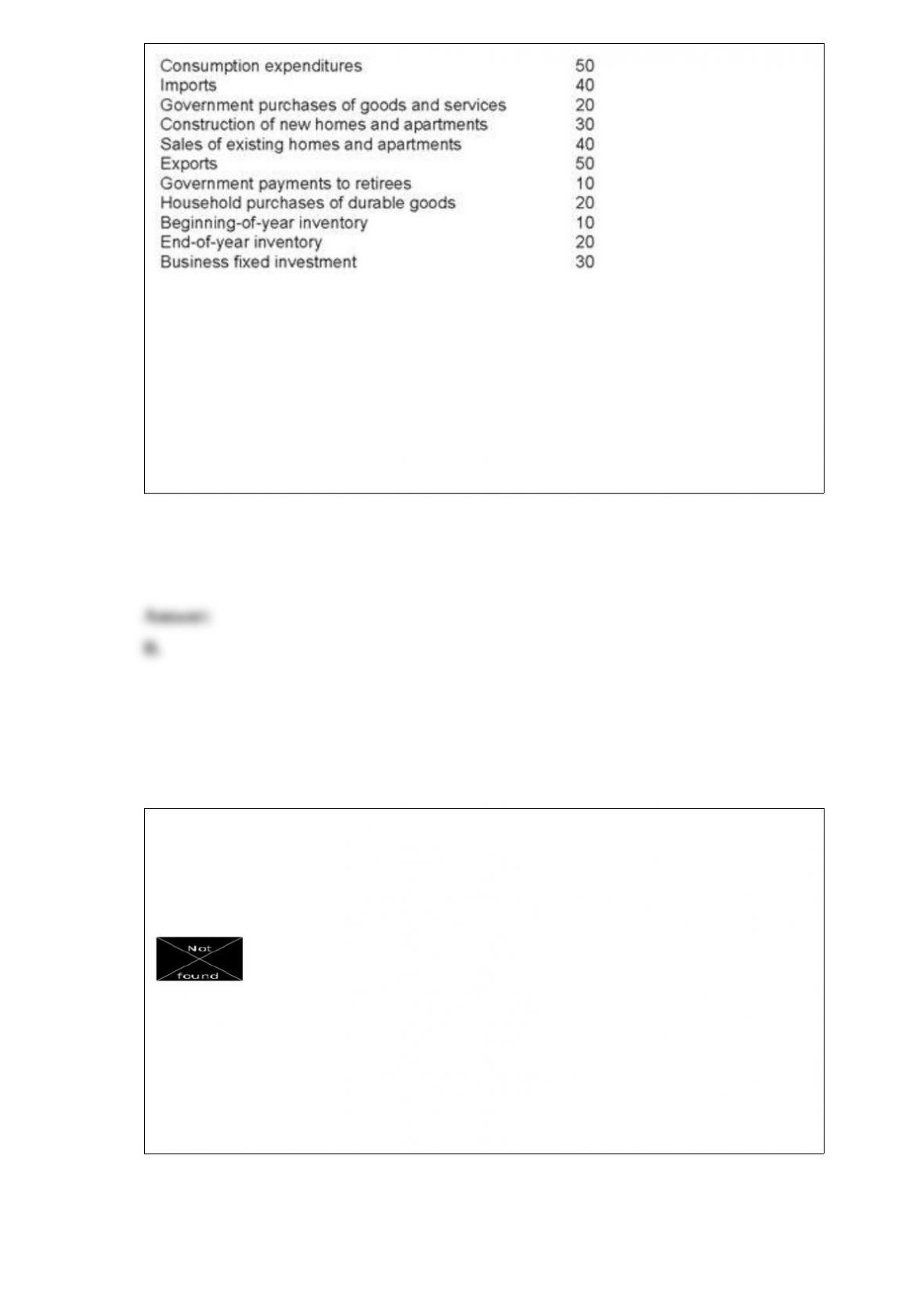
Given the data in the table, how much did households spend on nondurables and
services?
A. 20
B. 30
C. 50
D. 70
P-TV and QRS-TV are trying to decide whether to air a sit-com or a reality show in a
given time slot. Viewers like both sit-coms and reality shows, but sitcoms are more
expensive to produce than reality shows since real actors need to be hired. QRS-TV
makes its decision first, and then P-TV observes that choice before making its decision.
Both stations know all of the information in the decision tree below.
Suppose QRS-TV enters into an agreement with P-TV that gives QRS-TV the exclusive
right to air a reality show during this time slot. QRS-TV would have to pay P-TV
______ in order to persuade P-TV to enter into this agreement.
A. at least $10 million
B. nothing
C. at least $5 million
D. more than zero, but less than $5 million
You have noticed that there is a persistent shortage of teachers in an inner-city school
district in your state. Based on this observation, you suspect that:
A. the wage for teachers at those schools is higher than at other schools in the state.
B. the wage for teachers at those schools is lower than the equilibrium wage.
C. there is an excess supply of teachers.
D. the reservation price among teachers is lower than for other professions.
Generally, on a linear two-good production possibilities curve, the opportunity cost of
the good measured on the vertical axis is:
A. one minus the opportunity cost of the good measured on the horizontal axis.
B. the reciprocal of the opportunity cost of the good measured on the horizontal axis.
C. the absolute value of the slope of the production possibilities curve.
D. the negative of the opportunity cost of the good measured on the horizontal axis.

The four components of planned aggregate expenditure are:
A. spending on domestic goods, domestic services, foreign goods, and foreign services.
B. spending on durable goods, inventory investment, government debt, and net exports.
C. consumption, planned investment, government transfers, and net interest.
D. consumption, planned investment, government purchases, and net exports
According to the equilibrium principle:
A. unregulated markets tend to reach equilibrium prices and quantities without
government regulation.
B. once a market has reached equilibrium, price will not change.
C. collective action cannot improve on individual action.
D. market equilibrium exploits all opportunities for individual gain, but may not exploit
gains possible through collective action.
High rates of saving today contribute to ______ in the future.
A. higher tax rates
B. more unemployment
C. a higher standard of living
D. more capital gains
The income-expenditure multiplier arises because one person’s additional spending
becomes another person’s additional income that will generate additional:
A. spending.
B. autonomous expenditure.
C. menu costs.
D. cyclical unemployment.
Regarding specialization, it is generally true that:
A. more specialization is always better.
B. less specialization is always better.
C. specialization imposes costs as well as benefits.
D. more specialization is always worse.
The table below describes the relationship between the number of workers hired by a
call center each hour and the number of calls the call center can make each hour. The
call center has only 1 telephone. The telephone costs the firm $5/hour (regardless of
how many calls are made), and each worker is paid $10 per hour.
Average variable cost is minimized when output is approximately:
A. 6 units.
B. 16 units.
C. 22 units.
D. 24 units.
If the marginal cost of treating an illness is zero, then the optimal amount of treatment
to receive is the amount:
A. for which the marginal benefit of treatment is zero.
B. that makes the patient is as healthy as possible.
C. for which the average benefit of treatment is zero.
D. for which the total benefit of treatment is zero.
Which of the following is an example of an investment in physical capital?
A. A firm trains workers to operate new machinery.
B. A firm pays for workers to take college classes.
C. A chemical firm employs chemists to develop new chemicals.
D. A firm purchases new equipment for a manufacturing process.
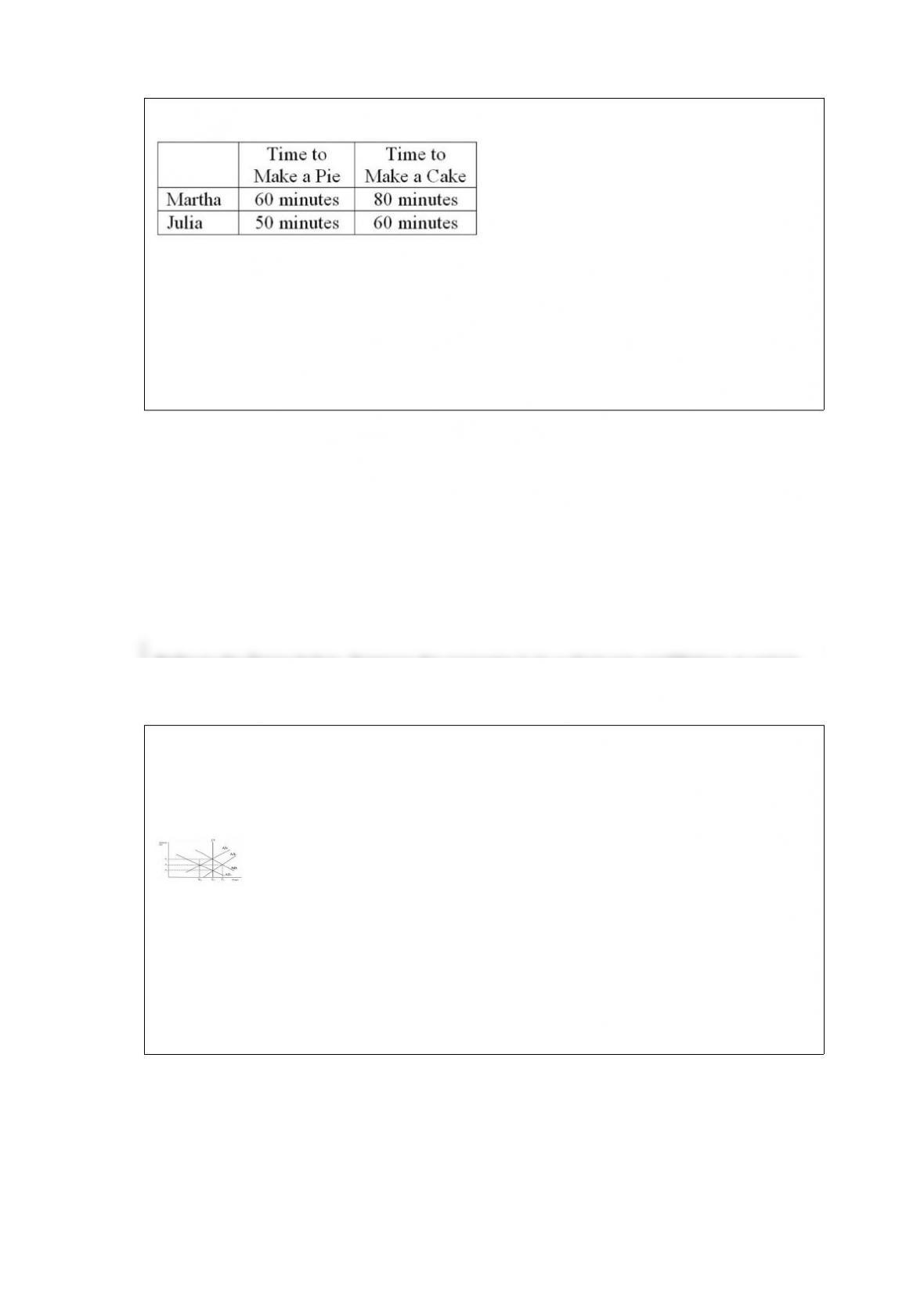
Refer to the table below. Julia’s opportunity cost of making a pie is:
A. 60 cakes
B. 6 cakes
C. 6/5 of a cake
D. 5/6 of a cake
Refer to the figure below. Suppose the economy is in a short-run equilibrium at output
Y1 and inflation rate π2. The economy is currently experiencing ______, and the correct
monetary policy response to this situation, to return the economy to potential GDP, is to
______.
A. a recessionary gap; raise taxes
B. an expansionary gap; cut taxes
C. a recessionary gap; increase the money supply
D. an expansionary gap; decrease the money supply

Suppose a borrower and lender agree to an interest rate on a loan when inflation is
expected to be 6%. The borrower would benefit the most if which of the following
inflation rates actually occurred?
A. 0%
B. 3%
C. 6%
D. 9%
Suppose Sandy is moving to Washington, D.C. for a year-long job working for the
government. She has decided to rent one of two apartments. Both apartments cost
$1,000 per month and are identical except for the fact that one is a monthly rental and
the other has a year-long lease. Which of the following best explains why Sandy might
pick the year-long lease?
A. There is no good reason for Sandy to pick the year-long lease because the two
apartments are identical.
B. Sandy might worry that if she picks the monthly rental, she will get kicked out if the
landlord finds someone willing to pay more than $1,000 per month.
C. Sandy might worry that if she picks the monthly rental, she will have to move if she
finds another apartment for less than $1,000 per month.
D. There is no good reason for Sandy to pick the year-long lease because the monthly
rental allows her more flexibility.

According to the textbook, if students are graded on a curve so that each student’s grade
depends upon their performance relative to other students, the resulting positional arms
race are partially offset by social norms that:
A. encourage everyone to study hard.
B. discourage studying by labeling hard-working students as “nerds”.
C. award only the very top performers.
D. encourage people to save money for college.
If the income-expenditure multiplier equals 4, and a 1 percent increase in the real
interest rate reduces autonomous spending by 100 units, then a 1,000 unit recessionary
gap can be eliminated by ______ the real interest rate by ______ percent.
A. increasing; 10.0
B. increasing; 4.0
C. increasing; 2.5
D. decreasing; 2.5