
1) Alice and Betty’s Production Possibilities in one 8hour day.
Alice’s Production Possibilities FrontierBetty’s Production Possibilities Frontier
a.Alice’s opportunity cost of 1 pizza is 1/2 of a pitcher of lemonade and Betty’s
opportunity cost of 1 pizza is 2/3 of a pitcher of lemonade.
b.Alice’s opportunity cost of 1 pizza is 1 pitcher of lemonade and Betty’s opportunity
cost of 1 pizza is 3 pitchers of lemonade.
c.Alice’s opportunity cost of 1 pizza is 2 pitchers of lemonade and Betty’s opportunity
cost of 1 pizza is 1.5 pitchers of lemonade.
d.Alice’s opportunity cost of 1 pizza is 400 pitchers of lemonade and Betty’s
opportunity cost of 1 pizza is 450 pitchers of lemonade.
2) Economists study how people make decisions.
a.True
b.False
3) Last month, sellers of good Y took in $100 in total revenue on sales of 50 units of
good Y. This month sellers of good Y raised their price and took in $120 in total
revenue on sales of 40 units of good Y. At the same time, the price of good X stayed the
same, but sales of good X increased from 20 units to 40 units. We can conclude that
goods X and Y are
a.substitutes, and have a cross-price elasticity of 0.60.
b.complements, and have a cross-price elasticity of -0.60.
c.substitutes, and have a cross-price elasticity of 1.67.
d.complements, and have a cross-price elasticity of -1.67.
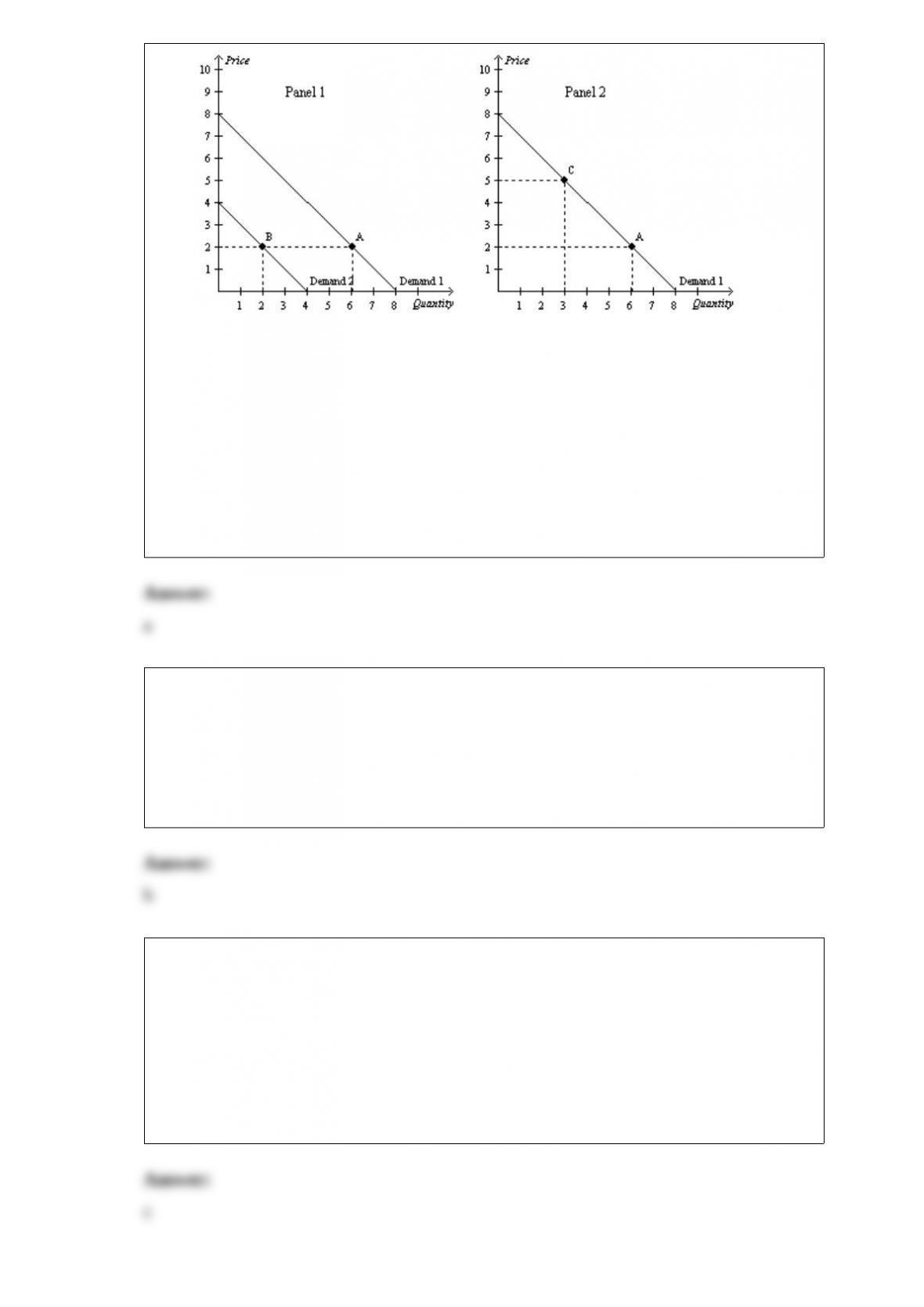
4)
Suppose that the federal government is concerned about obesity in the United States.
Congress is considering two plans. One would require “junk food” producers to include
warning labels on all junk food. The other would impose a tax on all products
considered to be junk food. If the warning labels are successful, we could illustrate the
plan as producing a movement from
a.Point A to Point B in Panel 1
b.Point B to Point A in Panel 1
c.Point A to Point C in Panel 2
d.Point C to Point A in Panel 2
5) Whenever a perfectly competitive firm chooses to change its level of output, its
marginal revenue
a.increases if MR < ATC and decreases if MR > ATC.
b.does not change.
c.increases.
d.decreases.
6) Bert faces a progressive tax structure that has the following marginal tax rates: 0
percent on the first $10,000, 10 percent on the next $10,000, 15 percent on the next
$10,000, 25 percent on the next $10,000, and 50 percent on all additional income. If
Bert earns $75,000, what is his average tax rate?
a.20 percent
b.25 percent
c.30 percent
d.36.67 percent

7) The U.S. government protects fish, a common resource, by
a.subsidizing the fishing industry.
b.heavily taxing competing industries.
c.selling fishing licenses and regulating fish lengths.
d.None of the above is correct.
8) In a market with 1,000 identical firms, the short-run market supply is the
a.marginal cost curve above average variable cost for a typical firm in the market.
b.quantity supplied by the typical firm in the market at each price.
c.sum of the prices charged by each of the 1,000 individual firms at each quantity.
d.sum of the quantities supplied by each of the 1,000 individual firms at each price.
9) In his book, An Inquiry into the Nature and Causes of the Wealth of Nations, Adam
Smith credits economies of scale to
a.competition.
b.opportunity costs.
c.specialization.
d.incentives.
10) Allowing an inventor to have the exclusive rights to market her new invention will
lead to
(i)a product that is priced higher than it would be without the exclusive rights.
(ii)desirable behavior in the sense that inventors are encouraged to invent.
(iii)higher profits for the inventor.
a.(i) and (ii) only
b.(ii) and (iii) only
c.(i) and (iii) only
d.(i), (ii), and (iii)
11) It once took 90 percent of our population to grow our food. It now takes only 3
percent of the population to grow our food. Which of the following statements is true?
a.This loss of jobs has been detrimental to our economy.
b.The government should provide subsidies to encourage more people to become

farmers.
c.This reduction in the number of farmers explains the increase in the price of food.
d.This is progress because freed-up labor is used to produce other goods.