1)
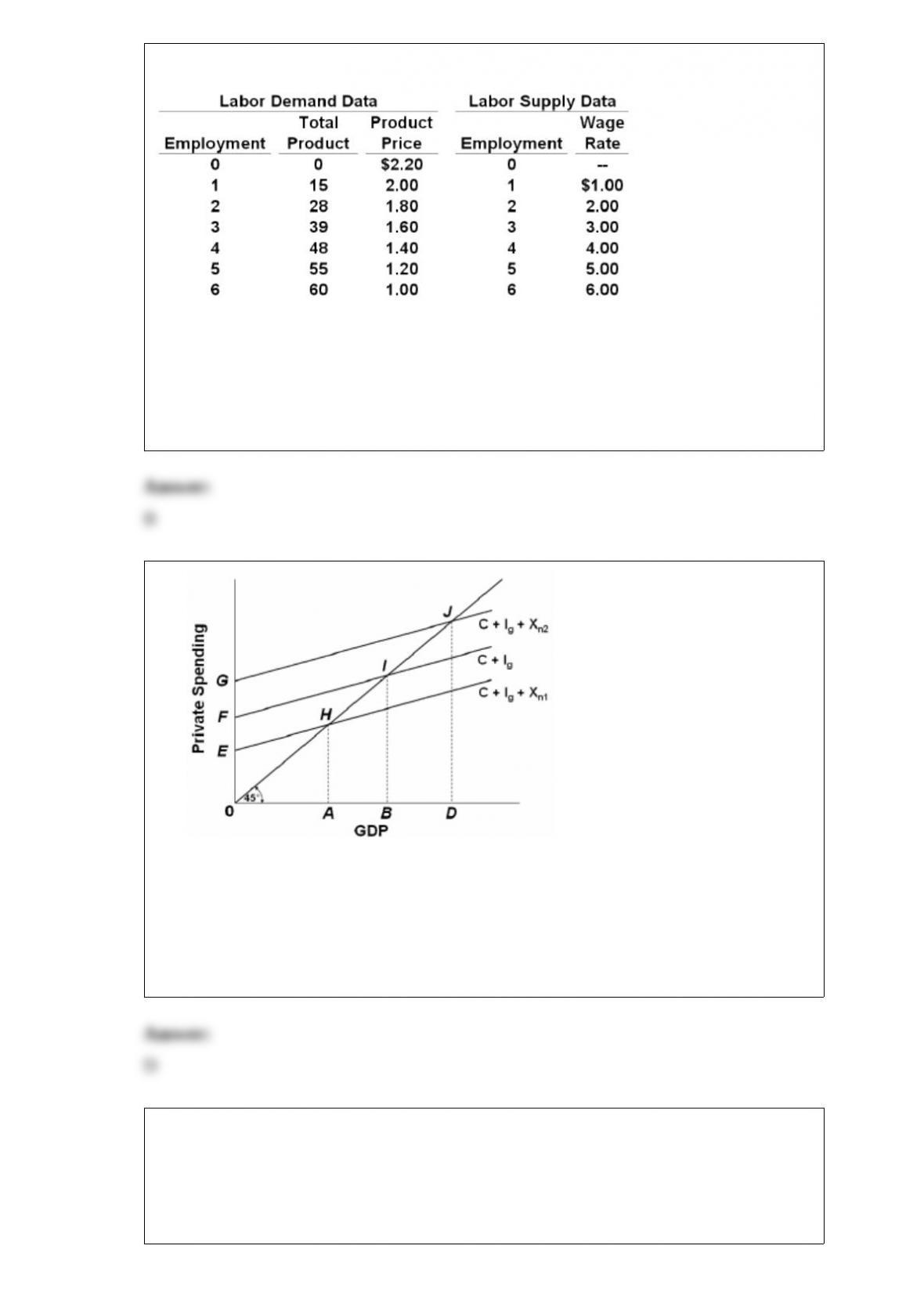
Refer to the above data. What will be the profit-maximizing selling price of the
product?
A.$1.40
B.$1.60
C.$1.80
D.$2.00
2)
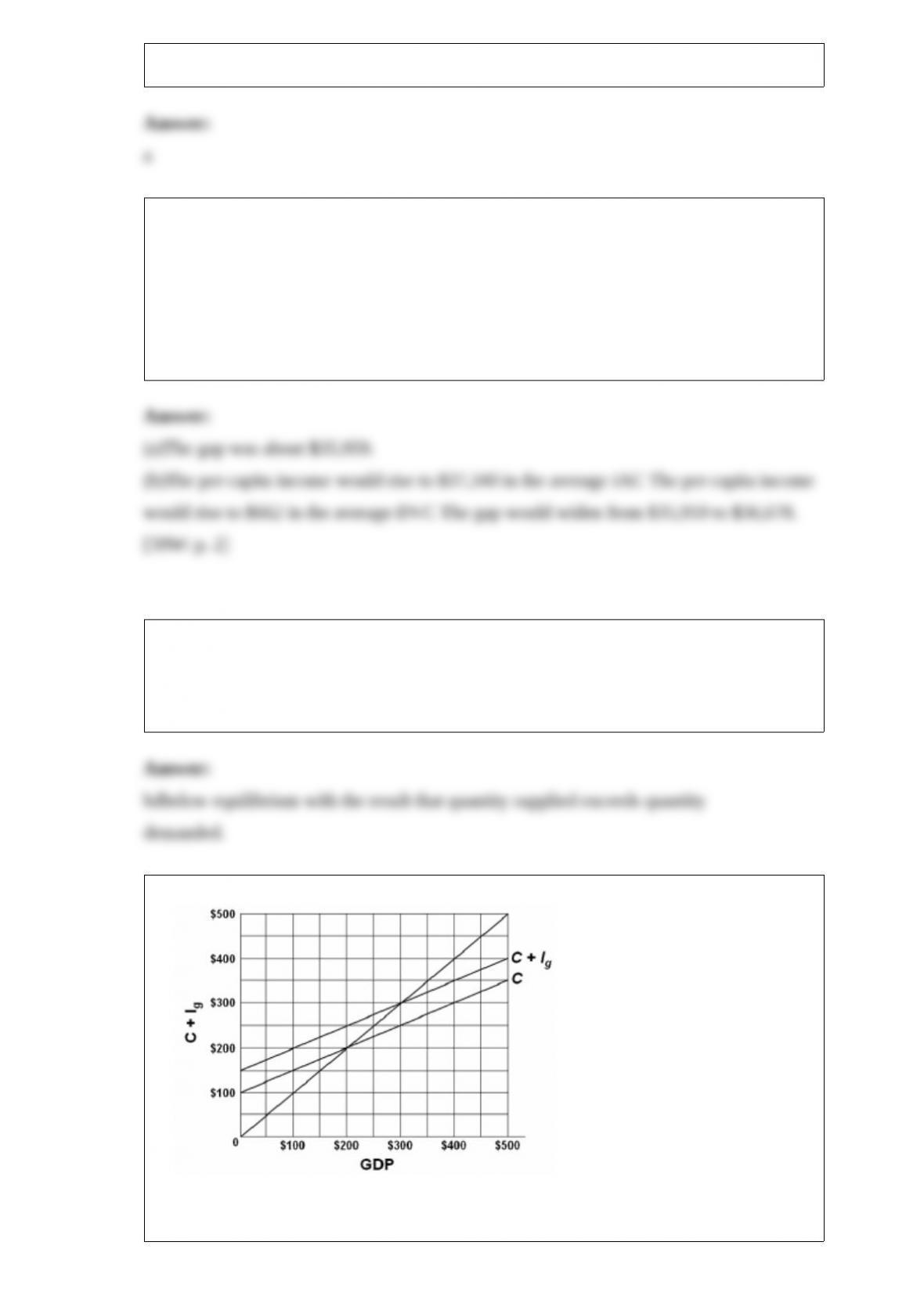
Refer to the above diagram. The change in aggregate expenditures as shown from (C +
Ig + Xn1) to (C + Ig + Xn2) will produce:
A.a decrease in real GDP.
B.an inflationary expenditure gap if 0D is this nation’s full-employment level of GDP.
C.an increase in real GDP if 0A is this nation’s full-employment level of GDP.
D.an inflationary expenditure gap if 0B is this nation’s full-employment level of GDP.
3) suppose you go to a doctor but your health insurance plan reimburses you for only 80
percent of the bill. this is an example of:
a.a copayment.
b.a deductible.
c.monopsony power.
d.a deferred benefit plan.
4) In 2004 the real per capita income in the average industrially advanced country was
about $36,608 per year. The average in low-income developing countries was about
$649 per year.
(a)What is the gap in the average standards of living?
(b)If real per capita income were to grow at a rate of 2% during a year in both the
average industrially advanced and the average developing country, what would happen
to the standard of living in each country and the gap in the standard of living?
5) a surplus of a product will arise when price is:
a.above equilibrium with the result that quantity demanded exceeds quantity supplied.
b.above equilibrium with the result that quantity supplied exceeds quantity demanded.
c.below equilibrium with the result that quantity demanded exceeds quantity supplied.
6)
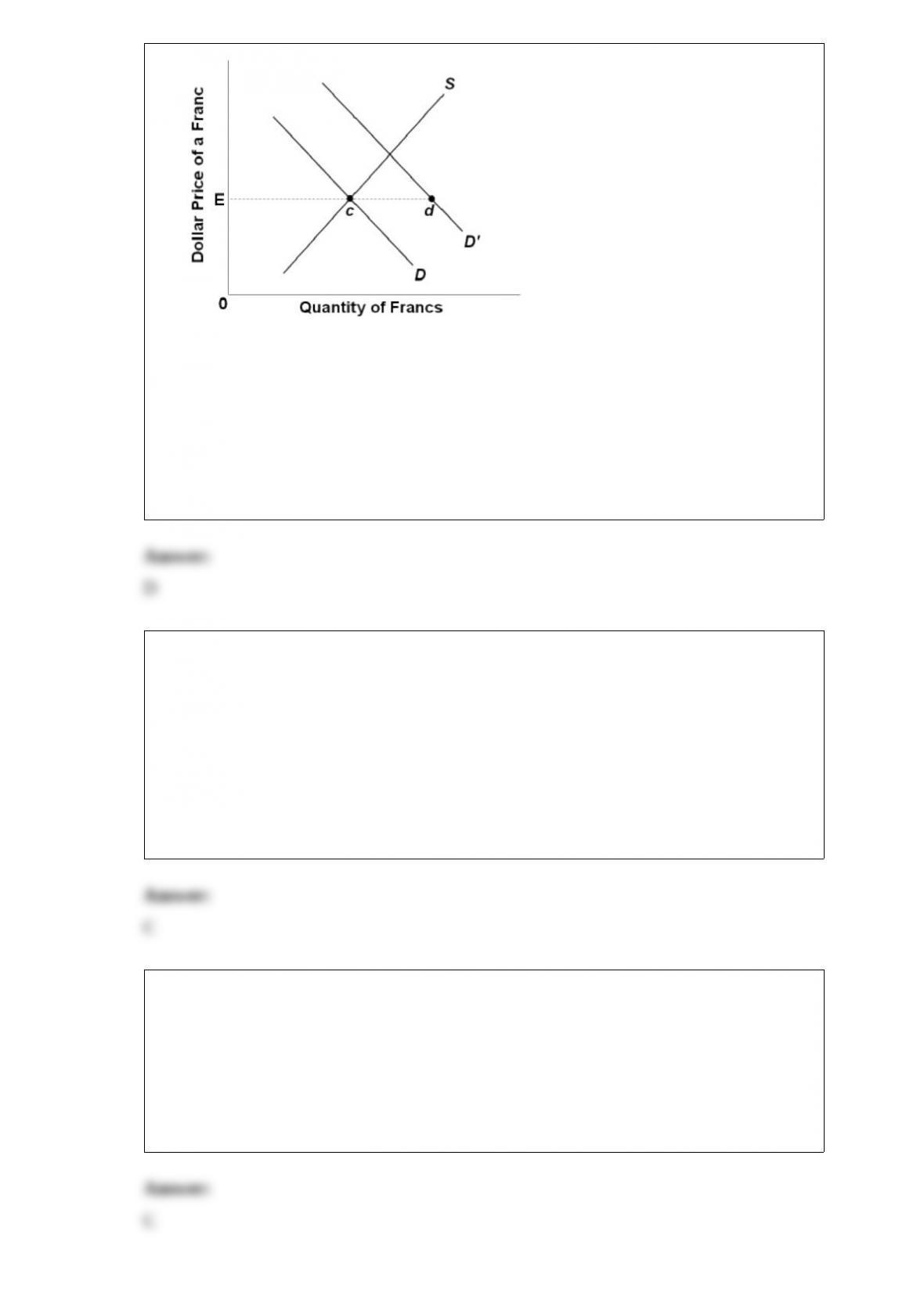
Refer to the above diagram for a private closed economy. The $400 level of GDP is:
A.that output at which saving is zero.

B.too high because consumption exceeds investment.
C.unstable because aggregate expenditures exceed GDP.
D.unstable because aggregate expenditures are less than GDP.
7) Firms whose central business is providing individual account shares of collections of
stocks, bonds, or both are known as:
A.insurance companies.
B.thrifts.
C.commercial banks.
D.mutual funds companies.
8) Other things equal, if $100 billion of government purchases (G) is added to private
spending (C + Ig + Xn), GDP will:
A.increase by $100 billion.
B.increase by less than $100 billion.
C.increase by more than $100 billion.
D.fall by $100 billion.
9) In the extended analysis of aggregate supply, the long-run aggregate supply curve is:
A.vertical and the short-run aggregate supply curve is horizontal.
B.horizontal and the short-run aggregate supply curve is vertical.
C.horizontal and the short-run aggregate supply curve is upward sloping.
D.vertical and the short-run aggregate supply curve is upward sloping.
10) False advertising and the misrepresentation of products were made illegal by the:
A.Federal Trade Commission Act.
B.Wheeler-Lea Act.
C.Sherman Act.
D.Clayton Act.
11)
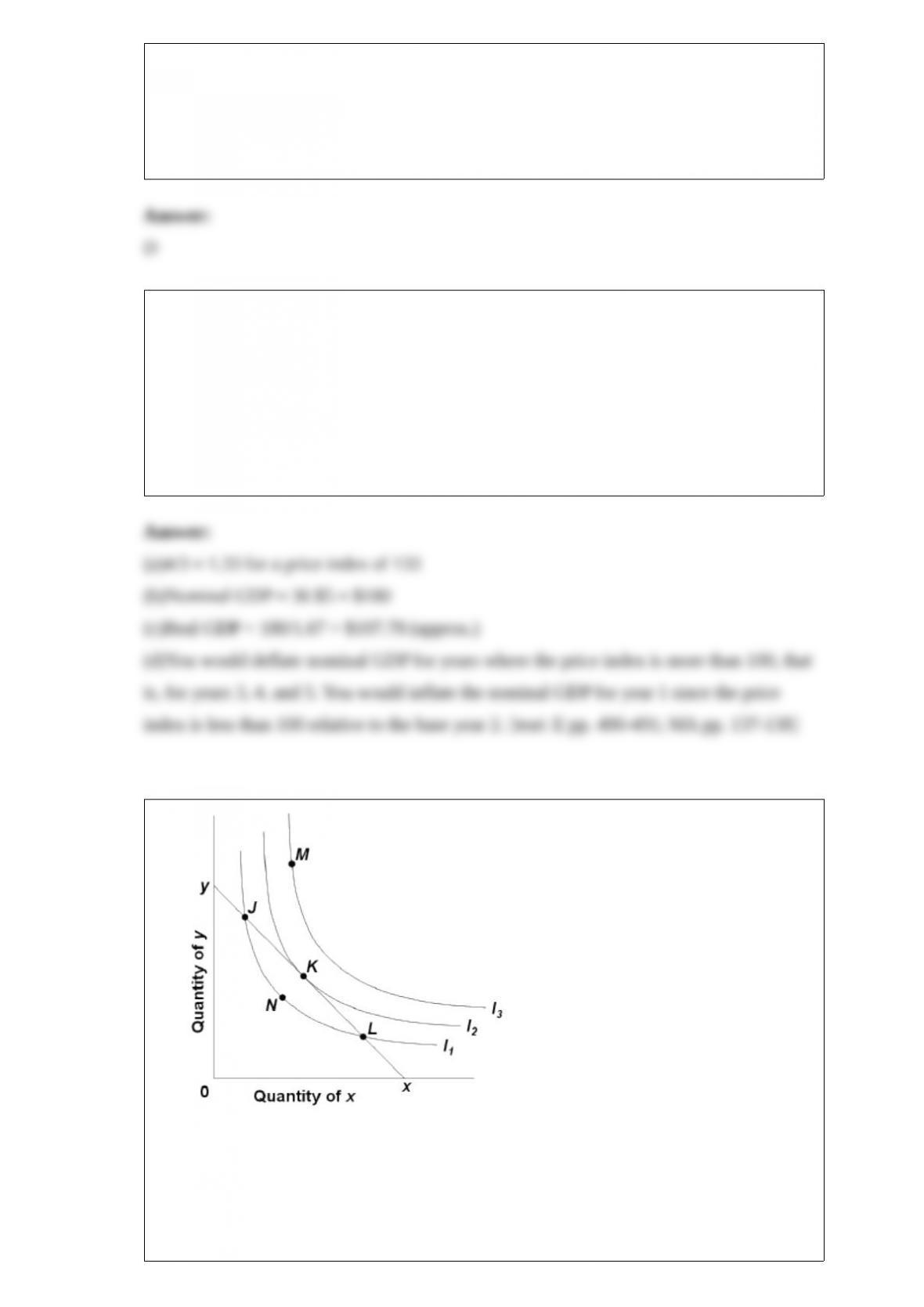
Refer to the above diagram where D and S are the United States’ demand for and supply
of Swiss francs. At the equilibrium exchange rate, E, the United States’ balance of
payments is in equilibrium. Under a system of flexible exchange rates, the shift in
demand from D to D’ will:
A.ultimately reduce U.S. exports and raise U.S. imports.
B.cause the dollar to appreciate.
C.cause the Swiss franc to depreciate.
D.cause the dollar to depreciate.
12) Which of the following is incorrect?
A.As the U.S. price level rises, U.S. goods become relatively more expensive so that
U.S. exports fall and U.S. imports rise.
B.As the price level falls, the demand for money declines, the interest rate declines, and
interest-rate sensitive spending increases.
C.When the price level increases, real balances increase, businesses and households
find themselves wealthier and therefore increase their spending.
D.Given aggregate demand, an increase in aggregate supply increases real output and,
assuming downward flexible prices, reduces the price level.
13) Economic discrimination puts the economy inside its production possibilities curve
because discrimination:
A.redistributes income from low-paid to high-paid persons.
B.promotes present consumption rather than production of capital goods.
C.arbitrarily blocks women and certain minorities from higher-productivity, higher
wage jobs and thus keeps the economy from producing its maximum output.
D.often causes inflation, which reduces the nation’s real output.
14) Actual investment is:
A.gross investment less replacement investment.
B.the ratio of planned investment to unintended increases in inventories.
C.unintended increases in inventories less planned investment.
D.planned investment plus unintended increases in inventories.
15) The next four questions refer to the following price and output data over a five-year
period for an economy that produces only one good. Assume that year 2 is the base
year.
(a)If year 2 is the base year, give the price index for year 3.
(b)Give the nominal GDP for year 4.
(c)What is the real GDP for year 4?
(d)Tell which years you would deflate nominal GDP and which years you would inflate
nominal GDP in finding real GDP.
16)
refer to the above diagram where xy is the relevant budget line and i1, i2, and i3 are
indifference curves. the equilibrium position for the consumer is at:
a.any point on xy
b.point m
c.point k
d.point j
17) Inflation in the U.S. economy tends to be:
A.a finite, one-time event resulting from a shock.
B.ongoing, as increases in aggregate demand outpace increases in aggregate supply.
C.a finite, one-time event as the Fed actively works to eliminate all inflation.
D.ongoing, as aggregate supply is continually shifting to the left.
18) For which one of the following goods would we need to sum individual demand
curves vertically to obtain the total demand curve?
A.frozen yogurt
B.bubble gum
C.microwave popcorn
D.courts of law
19) What is the Council of Economic Advisers?
20) In a recent recession the losses sustained by the developing countries through a
decline in raw-material prices by far outweighed any foreign aid given over several
years. Explain.
21) Contrast and give examples of international trade and international asset
transactions.
22) The benefits of unimpeded immigration exceed the costs. Do you agree?
23) How can the United States compete successfully with relatively low-wage nations
such as India and China?
24) What is the difference between average, total, and marginal revenue? What is the
shape of the total and marginal revenue curves for the individual competitive firm?
25) What is meant by economies of scale and what is the importance of this concept to
economic growth?
26) How does monopoly compare with pure competition in terms of price, output, and
efficiency?
27) Explain the difference between a movement along the consumption schedule and a
shift in the consumption schedule.
28) An investments rate of return is inversely related to its price. Explain.