
Most of the pressure for a monetary growth rule has disappeared because since 1980,
A) the relationship between movements in the money supply and movements in real
GDP and the price level have become much stronger.
B) the relationship between movements in the money supply and movements in real
GDP and the price level have become much weaker.
C) the relationship between movements in interest rates and movements in real GDP
and the price level have become much stronger.
D) the relationship between movements in interest rates and movements in real GDP
and the price level have become much weaker.
The Federal Reserve’s narrowest definition of the money supply is
A) M0.
B) M1.
C) M2.
D) M3.
The Fed uses a “core” price index, one that excludes food and energy prices to measure
inflation. It does so because
A) food and energy are inelastic goods and consumers will buy them regardless of their
price.

B) it wants to avoid the blame for high gasoline prices causing inflation.
C) food and energy prices have wide swings that are not related to the causes of general
inflation.
D) food and energy prices do not change all that much during the short run, so are
irrelevant to the calculation of inflation.
The GDP deflator is equal to
A) real GDP divided by nominal GDP.
B) nominal GDP divided by real GDP, multiplied by 100.
C) nominal GDP divided by real GDP.
D) real GDP divided by nominal GDP, multiplied by 100.
When Dr. Goldfinger decides on the companies in which he will invest, a ________
issue is being addressed.
A) microeconomic
B) macroeconomic
C) positive economic
D) normative economic

Who receives the goods and services produced in the United States depends largely on
A) how income is distributed.
B) how the goods and services are produced.
C) what goods and services are produced.
D) government redistribution.
What is outlet bias?
A) the tendency for households to spend more money over time
B) the tendency for households to spend their money at discount stores as prices rise
C) the tendency for the quality of products to improve over time even though the CPI
does not measure changes in quality
D) the tendency for consumers to purchase newer, more technologically advanced
products even though they have higher prices

Why might firms pay wages that are above the equilibrium wage in a market?
A) to increase the productivity of their workers
B) to reduce the unemployment rate
C) to encourage workers to form labor unions
D) to reduce profit
According to the short-run Phillips curve, the unemployment rate and the inflation rate
are
A) unrelated.
B) positively related.
C) negatively related.
D) unaffected by monetary policy.
If a country has a fixed exchange rate,
A) the equilibrium exchange rate in that market does not respond to changes in supply
and demand for currency.
B) central banks have more control over real GDP in the economy.
C) central banks must buy and sell their holdings of currencies to maintain a given
exchange rate.
D) the exchange rate is allowed to fluctuate in response to changes in the supply and
demand for currency.
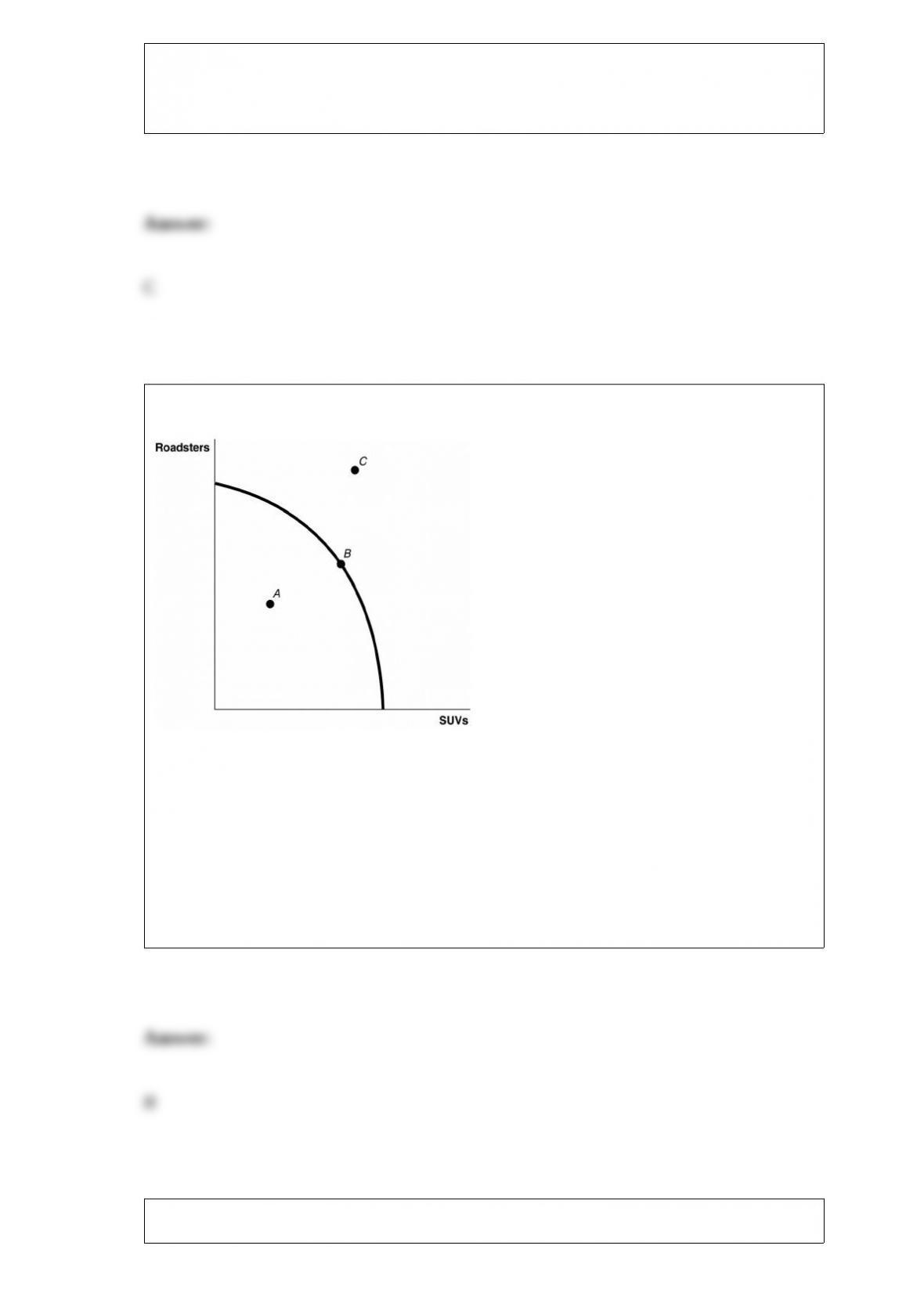
Figure 2-1
Refer to Figure 2-1. ________ is (are) technically efficient.
A) Point A
B) Point B
C) Point C
D) Points B and C
When the market value of the dollar rises relative to other currencies around the world,

we say that
A) the dollar has appreciated.
B) the dollar has depreciated.
C) the demand for dollars has increased.
D) the supply of dollars has increased.
Reducing the marginal tax rate on income will
A) reduce the tax wedge faced by workers and increase labor supplied.
B) raise the return to entrepreneurship and encourage the opening of new businesses.
C) increase the after-tax return on saving, and encourage saving.
D) All of the above are correct.
Ceteris paribus, an increase in the current or actual rate of inflation will cause
A) the short run Phillips curve to shift upward.
B) the unemployment rate to decrease (a movement along the short run Phillips curve).
C) the long run Phillips curve to shift leftward.
D) expectations of future inflation rates to be revised downward.

In the early 1900s, Henry Ford revolutionized the automotive manufacturing industry
by instituting the assembly line. What impact did the assembly line method for
producing automobiles have on the per-worker production function for Ford?
A) It became flatter.
B) It shifted up.
C) It shifted down.
D) It became linear.
If real GDP per capita in the United States is $8,000, what will real GDP per capita in
the United States be after 5 years if real GDP per capita grows at an annual rate of
3.2%?
A) $8,520
B) $9,280
C) $9,365
D) $10,560