
1) economic profit in the long run is:
a.possible for both a pure monopoly and a pure competitor.
b.possible for a pure monopoly, but not for a pure competitor.
c.impossible for both a pure monopolist and a pure competitor.
d.only possible when barriers to entry are nonexistent.
2) cost-of-living adjustment clauses (colas):
a.invalidate the “rule of 70.”
b.apply only to demand-pull inflation.
c.increase the gap between nominal and real income.
d.tie wage increases to changes in the price level.
3) the system that measures the economy’s overall performance is formally known as:
a.national income accounting
b.business cycle measurement
c.gdp assessment
d.final output and income statistics
4) the percentage of u.s. adults with a high school education or above has:
a.remained constant since the 1960s.
b.risen from 8 percent in 1960 to 29 percent in 2007.
c.risen to over 90 percent in the twenty-first centure.
d.risen from 41 percent in 1960 to 86 percent in 2007.
5) (Advanced analysis) Assume the saving schedule for a private closed economy is S =
-20 + 0.2Y, where S is saving and Y is gross domestic product. The multiplier for this
economy is:
A.3.
B.4.
C.5.
D.10.

6) the price elasticity of demand of a straight-line demand curve is:
a.elastic in high-price ranges and inelastic on low-price ranges.
b.elastic, but does not change at various points on the curve.
c.inelastic, but does not change at various points on the curve.
d.1 at all points on the curve.
7) which of the following is not considered to fall under government’s function of
redistributing income?
a.transfer payments
b.taxation
c.antimonopoly laws
d.minimum wage laws
8) if a nation’s real gdp is growing by 5 percent per year, its real gdp will double in
approximately:
a.22 years.
b.20 years.
c.14 years.
d.8 years.
9) In general, the:
A.number of firms in the industry is far more important than the industry’s scientific
character and extent of technological opportunities.
B.greater is an industry’s concentration ratio, the higher its R&D expenditures in
relation to sales.
C.industry’s scientific character and extent of technological opportunities often is more
important than the industry’s concentration ratio.
D.higher the industry’s interest cost of borrowing funds for R&D, the greater is the
industry’s progressiveness.
10) the marginal tax rate is:
a.less than the average tax rate when a tax is progressive.
b.calculated by dividing total taxes paid by one’s total taxable income.
c.the percentage of one’s total income that is paid in taxes.
d.the percentage of an increment of income that is paid in taxes.
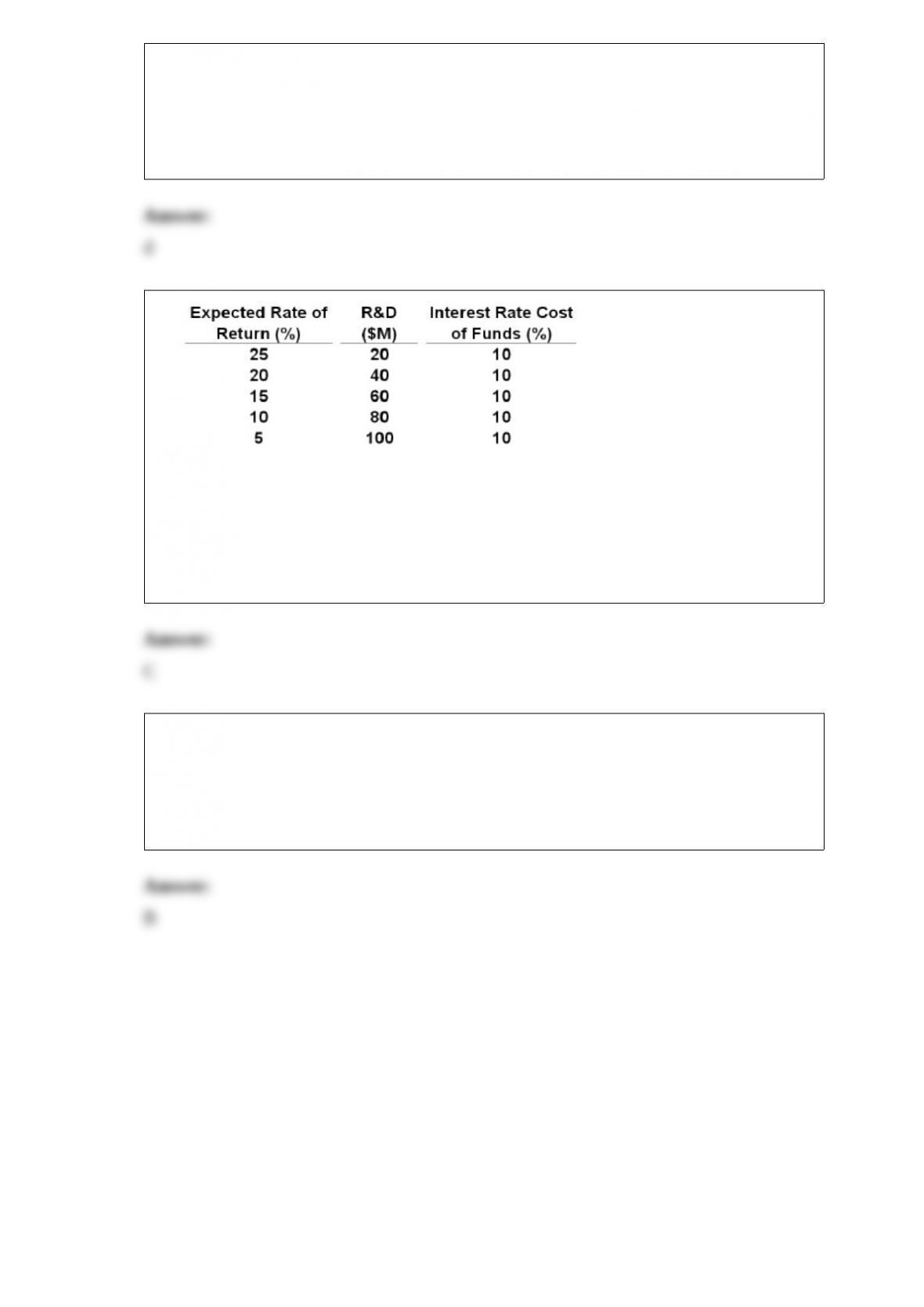
11)
If we plotted the above data on a graph with R&D expenditures on the horizontal axis,
the:
A.interest-rate-cost-of-funds-curve would be a vertical line.
B.interest-rate-cost-of-funds-curve would slope downward.
C.expected-rate-of-return-curve would slope downward.
D.expected-rate-of-return-curve would be a horizontal line.
12) An example of a public good is:
A.broadband Internet access.
B.homeland defense.
C.a baseball.
D.a lawn mower.
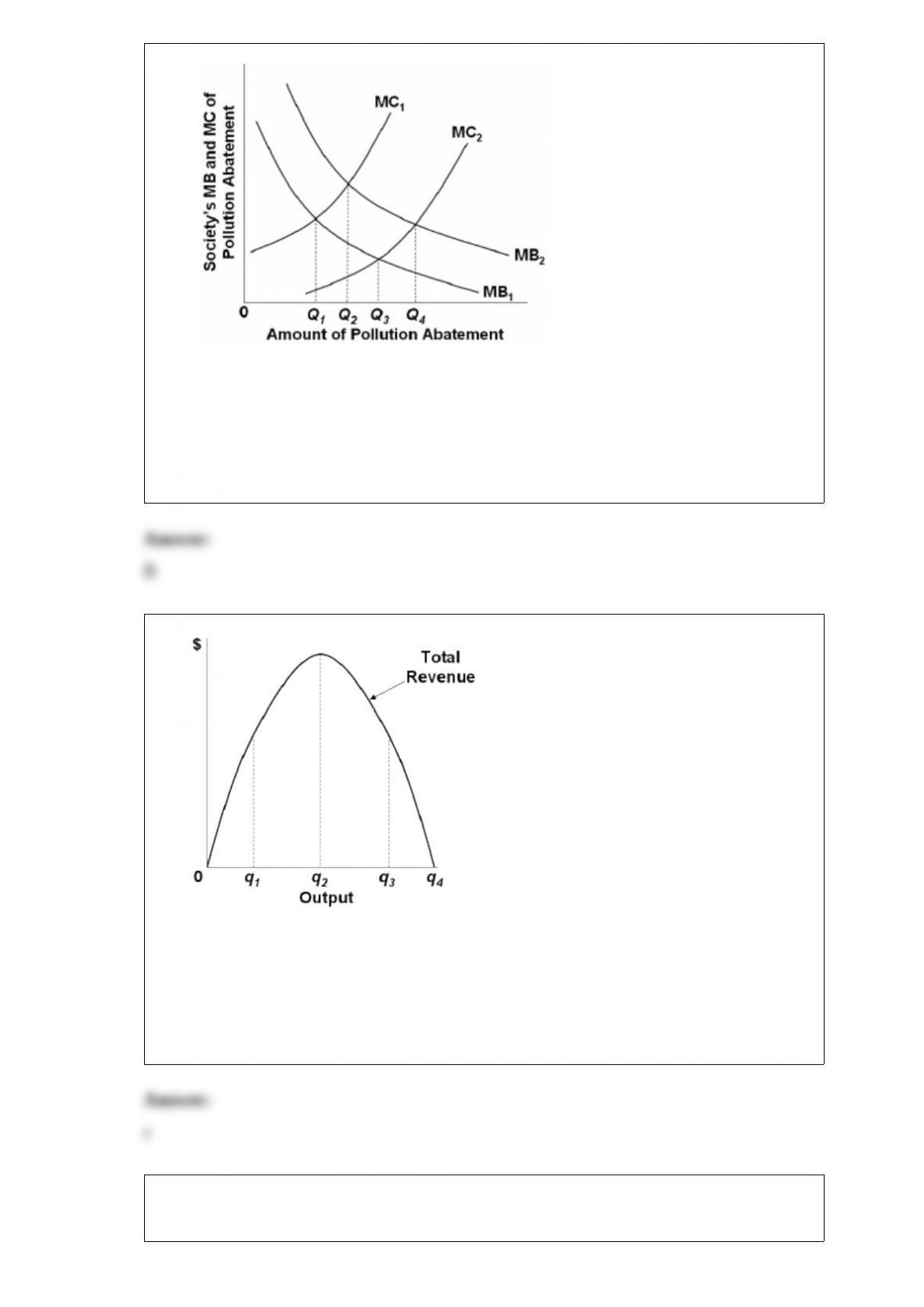
13)
Refer to the above diagram. Which one of the following might shift the marginal cost
curve from MC1 to MC2?
A.major new studies strongly linking cancer to pollution
B.improved technology for reducing pollution
C.a change in consumer tastes from services to manufactured goods
D.an increase in the price of recycled goods
14)
refer to the above diagram for a nondiscriminating monopolist. the profit-seeking
monopolist will:
a.always produce at output q2.
b.always produce more than q2.
c.never produce an output larger than q2.
d.never produce an output larger than q1.
15) the owners of a firm face unlimited liability for the firm’s debts in:
a.a corporation.
b.a partnership, but not in a proprietorship.
c.a proprietorship, but not in a partnership.
d.both a proprietorship and a partnership.
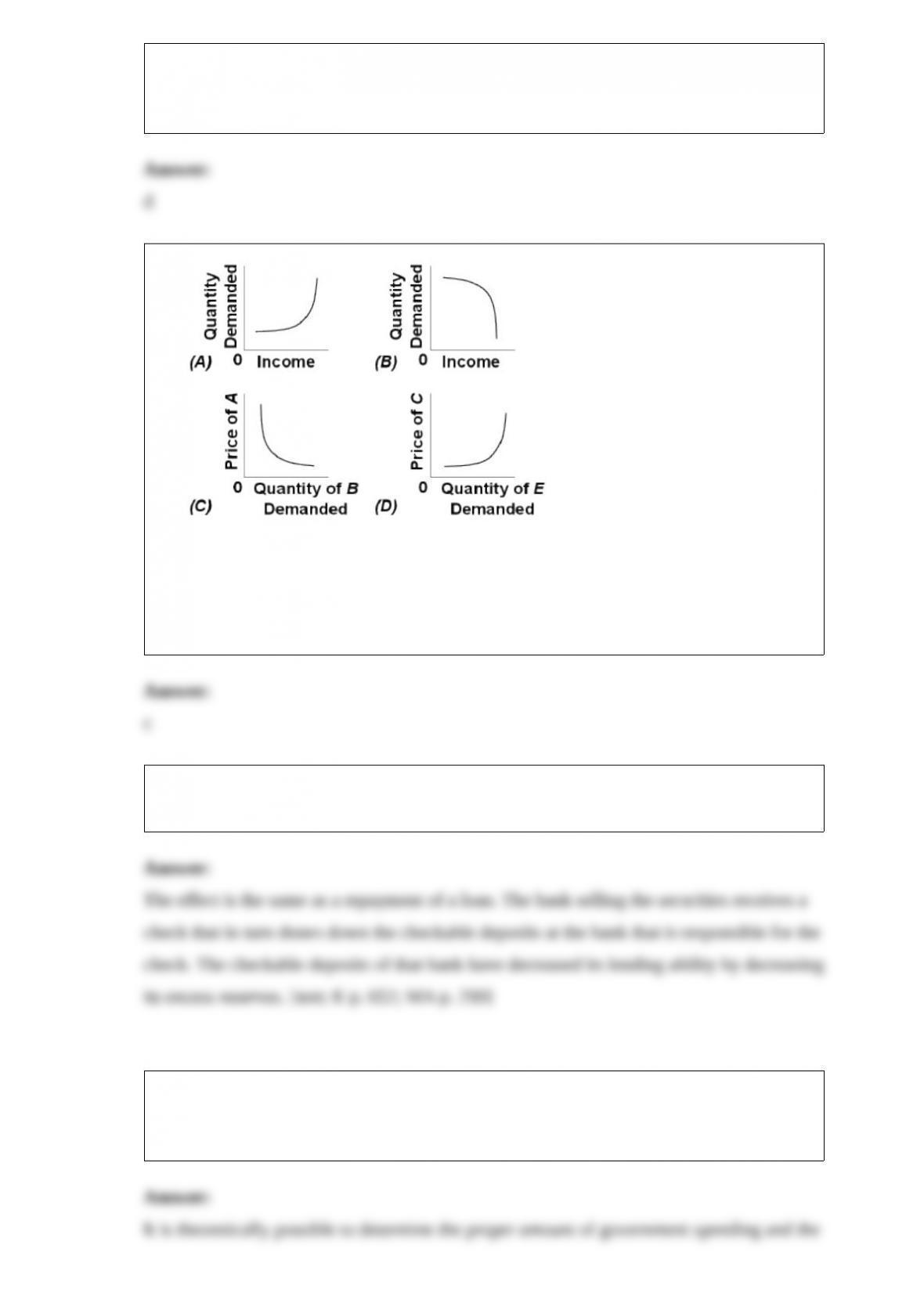
16)
refer to the above diagrams. the case of complementary goods is represented by figure:
a.a
b.b
c.c
d.d
17) What is the effect on the money supply when a commercial bank sells government
securities to the public?
18) Can economic analysis precisely determine the proper levels of government
spending and taxation? In your answer explain the problems in using cost-benefit
analysis.

19) Assume that an economy has 2000 workers, each working 3000 hours per year. The
average real output per worker-hour is $10. What will the total output or real GDP be?
Explain.
20) Both Federal Reserve Banks and commercial banks buy and sell government
securities, but for substantially different reasons. Explain.

21) How are technological advance and capital formation related?
22) Use the case of electrical power generation to explain why the energy resource
inputs that are used are sometimes low-cost and other times high-cost.
23) What is the World Trade Organization and what is it seeking to get adopted?

24) A consumer makes purchases of an existing product A such that the marginal utility
is 40 and the price is $ The consumer also tries a new product B and at the current level
of consumption it has a marginal utility of 72 and a price of $24. What does the
utility-maximizing rule suggest that this consumer should do?
25) Explain how changes in relative real interest rates affect the value of a nations
currency.
26) Give three different examples of rent-seeking behavior.