
Economist Steve Landsburg has pointed out that Ebenezer Scrooge’s change in behavior
from miser to spender might actually be detrimental to the economy because
A) Scrooge’s miserly saving helped contribute to the production of investment goods
rather than consumption goods.
B) Scrooge was happiest when he was saving money, and happiness is the key to
economic growth.
C) saving has to be greater than consumption for the economy to grow.
D) Scrooge’s consumption habits were more detrimental to the environment than were
his earlier saving habits.
A bank’s liabilities are
A) things owned by or owed to the bank.
B) things the bank owes to someone else.
C) a measure of the bank’s net losses.
D) included as part of the bank’s reserves.
Monetarism is a school of thought put forth by Milton Friedman. He argued that the
economy would most likely
A) be below potential GDP.
B) be at potential GDP.

C) be unstable.
D) be above potential GDP.
The Fed
A) can easily distinguish the minor ups and downs of the economy from a recession.
B) can have difficulty distinguishing the minor ups and downs of the economy from a
recession.
C) always times its policy responses correctly.
D) can easily determine if a drop in production means a recession is inevitable.
What is the Congressional act, enacted in 1933 and repealed in 1999, which prevented
financial firms from being both commercial banks and investment banks?
A) the Sarbanes-Oxley Act
B) the Glass-Steagall Act
C) the Taft-Hartley Act
D) the Cellar-Kefauver Act

The aggregate expenditure model focuses on the short-run relationship between
________ and ________.
A) real spending; real GDP
B) unemployment; inflation
C) nominal spending; nominal GDP
D) planned inventories; unplanned inventories
A nonmonetary opportunity cost is called a(n) ________, while a cost that involves
spending money is called a(n) ________.
A) accounting cost; explicit cost
B) implicit cost; explicit cost
C) accounting profit; economic profit
D) normal rate of return; asset
The price of domestic goods in terms of foreign goods is referred to as

A) the nominal exchange rate.
B) the relative inflation rate.
C) the current account balance.
D) the real exchange rate.
In the past two decades the United States lost its comparative advantage in automobiles
to Japan. What factor was most responsible for the development of Japan’s comparative
advantage in automobiles?
A) Japanese firms excelled in process technology.
B) Japan has abundant supplies of labor.
C) Japanese firms benefited from external economies.
D) Japan has abundant supplies of natural resources needed to produce automobiles.
Figure 4-9
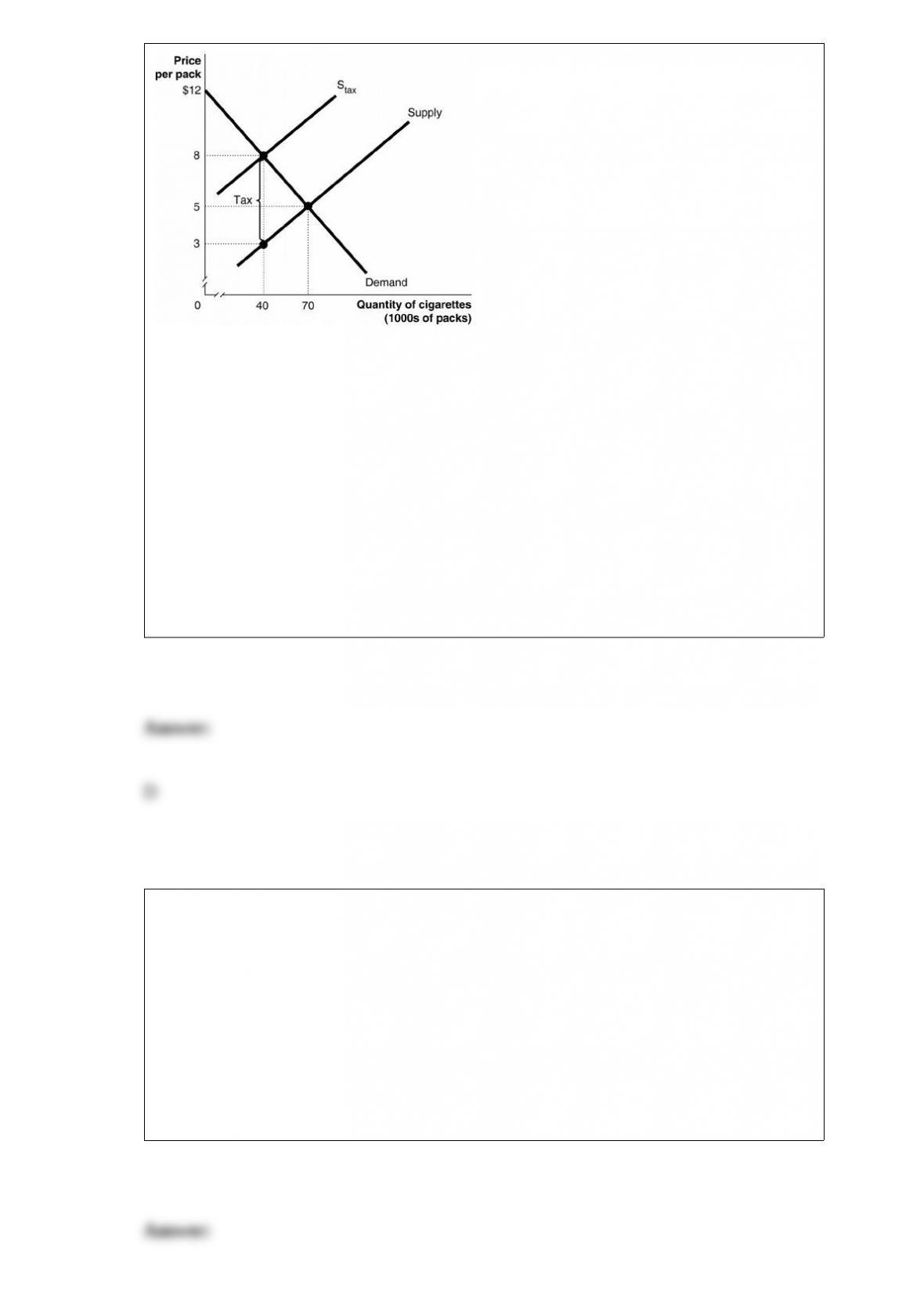
Figure 4-9 shows the market for cigarettes. The government plans to impose a unit tax
in this market.
Refer to Figure 4-9. For each unit sold, the price sellers receive after the tax (net of tax)
is
A) $12.
B) $8.
C) $4.40.
D) $3.
If there is currently a surplus of dollars, which of the following would you expect to see
in the foreign exchange market?
A) The dollar will appreciate.
B) The dollar will depreciate.
C) There will be a decrease in the demand for dollars.
D) There will be a decrease in the supply of dollars.
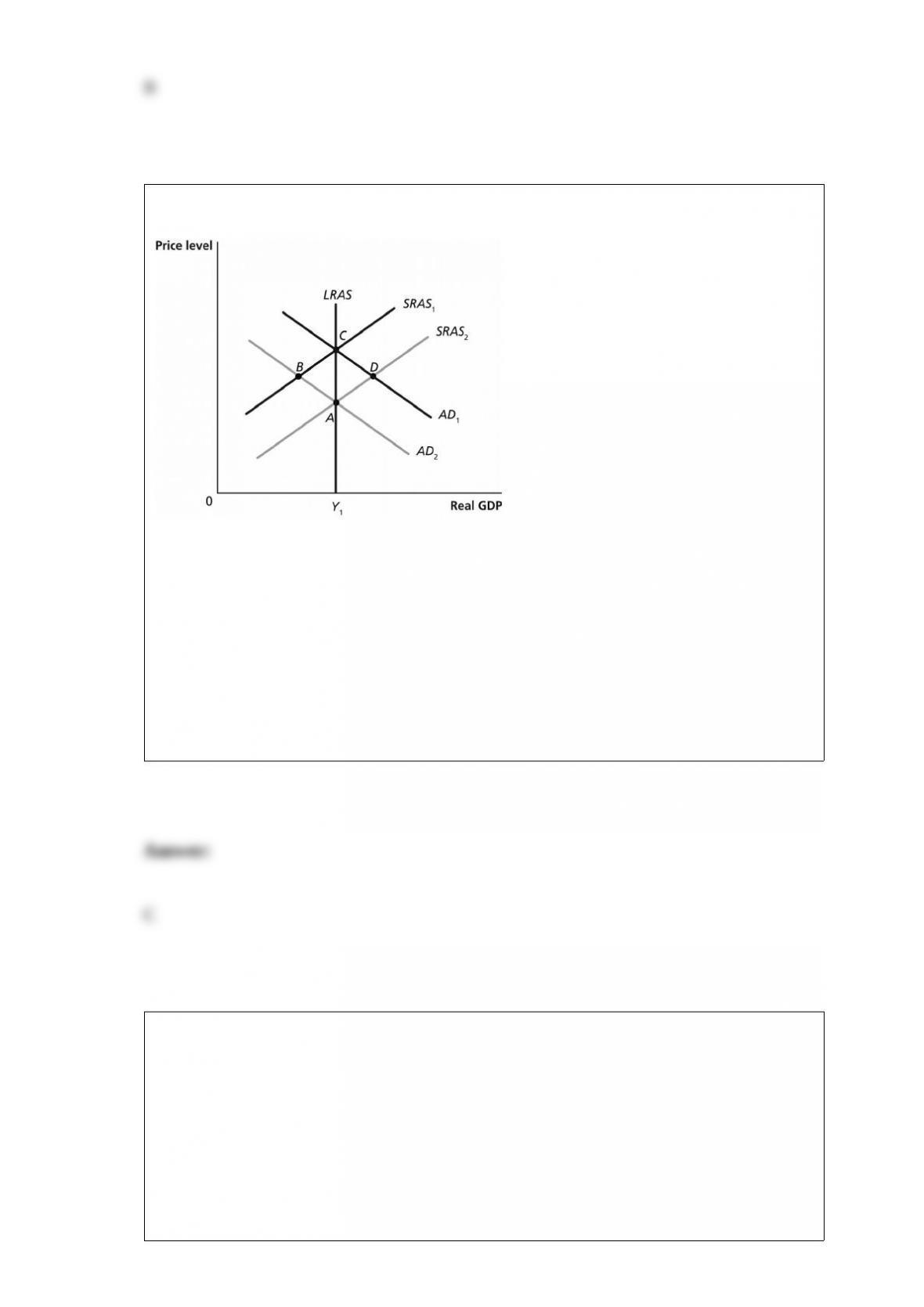
Figure 13-3
Refer to Figure 13-3. Suppose the economy is at point A. If government spending
increases in the economy, where will the eventual long-run equilibrium be?
A) A
B) B
C) C
D) D
Automobiles and many other products are differentiated. As a result
A) different countries may each have a comparative advantage in producing different
types of automobiles.
B) consumers of automobiles have difficulty deciding what type of imported
automobile to buy.
C) the quality of imported automobiles is less than it could be.

D) we see countries specializing completely in the production of automobiles.
On average, people in low-income countries ________ than people in high-income
countries.
A) have a longer life expectancy
B) are subject to a lower infant mortality rate
C) are shorter
D) are exposed to fewer severe diseases
Scenario 1-1
Suppose a cigar manufacturer currently sells 1,500 cigars per week and makes a profit
of $3,000 per week. The plant foreman observes, “Although the last 500 cell cigars we
produced and sold increased our revenue by $7,500 and our costs by $7,000, we are
only making an overall profit of $3,000 per week so I think we need to cut back on
production.
Refer to Scenario 1-1. Had the firm not produced and sold the last 500 cigars, would its
profit be higher or lower, and if so by how much?
A) Its profit will be $500 higher.
B) Its profit will be $1,000 higher.
C) Its profit will be $500 lower.
D) Its profit will be $1,500 lower.
Following the September 11, 2001, terrorist attacks, the managers of many hotels
expected a prolonged period of reduced travel and responded by laying off workers and
postponing or canceling new construction. Isadore Sharp, the chairman and CEO of
Four Seasons Hotels, decided to
A) continue expanding and was able to maintain or enhance the company’s market
share.
B) continue expanding and the company ended up losing significant market share.
C) curtail expansion plans, and by significantly cutting back on expansion was able to
maintain the company’s market share.
D) curtail expansion plans and the company ended up losing significant market share.
Suppose when the price of hybrid automobiles rises, consumers buy fewer hybrid
automobiles. This implies that
A) there is a positive relationship between hybrid automobile prices and quantities
purchased by consumers.
B) there is a negative relationship between hybrid automobile prices and quantities
purchased by consumers.
C) there is a direct relationship between hybrid automobile prices and quantities
purchased by consumers.
D) there is a one-to-one relationship between hybrid automobile prices and quantities
purchased by consumers.
How does expansionary monetary policy affect net exports?
A) Expansionary monetary policy increases exports and reduces imports.
B) Expansionary monetary policy reduces exports and increases imports.
C) Expansionary monetary policy increases exports and increases imports.
D) Expansionary monetary policy reduces exports and reduces imports.