If the price of a product is expected to increase in the future, the supply today will
increase.
In monopolistic competition, if a firm produces a highly desirable product relative to its
competitors, the firm will be able to raise its price without losing any customers.
If a firm experiences positive technological change, it is able to produce more output
using the same inputs.
One reason why many low-income countries experience low rates of growth is because
of low rates of saving and investment in those countries.
In an open economy, the relationship between GDP (Y) and expenditures is Y = C + I +
G.
A virtuous cycle refers to the development of new products that follows when a
monopoly earns economic profits.
A monopsony is a term used to refer to a firm that is the sole seller of a good or service.
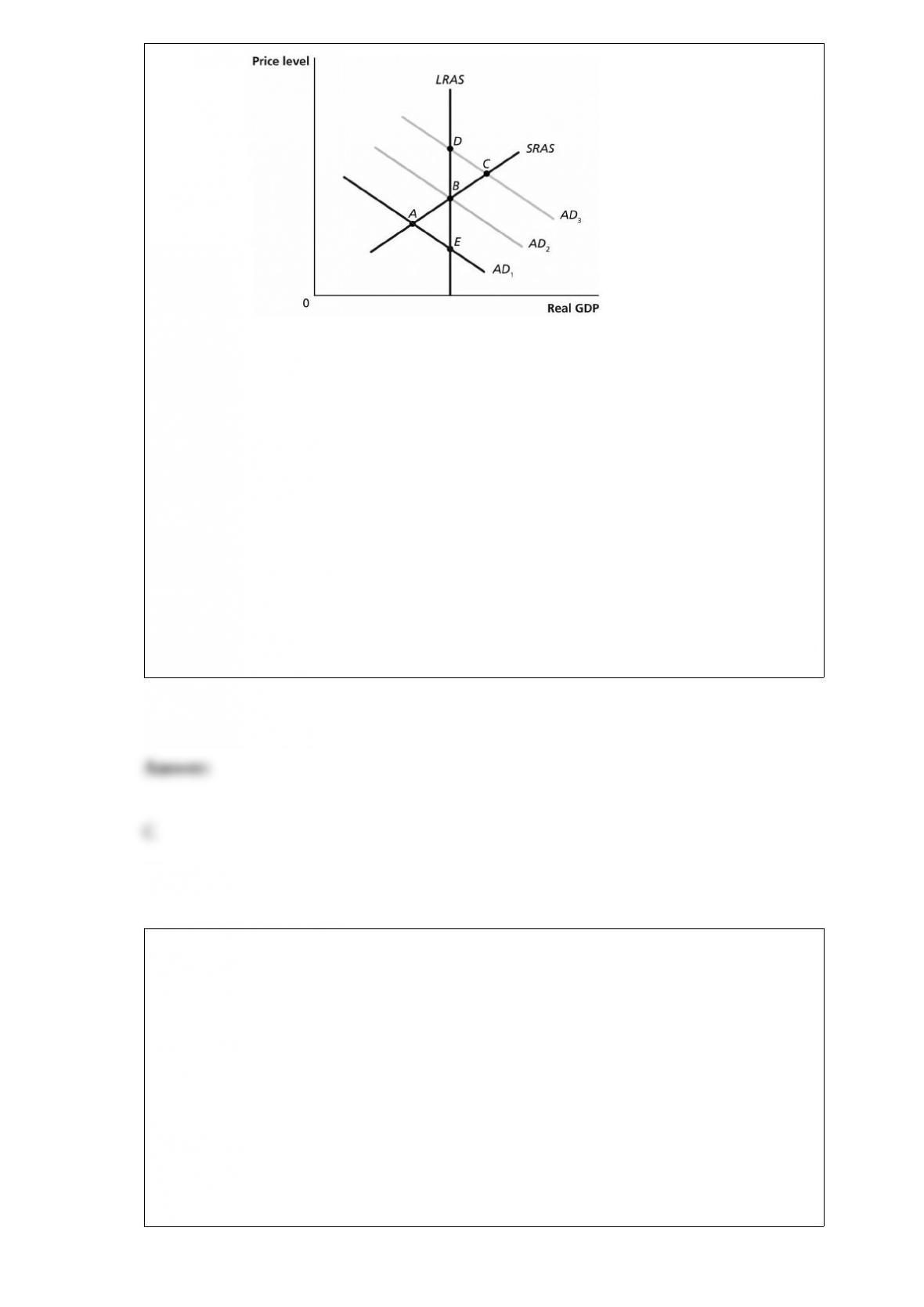
Figure 26-7
Suppose the economy is in short-run equilibrium above potential GDP, the
unemployment rate is very low, and wages and prices are rising. Using the static AD–AS
model in the figure above, the correct Fed policy for this situation would be depicted as
a movement from
A) A to B.
B) B to C.
C) C to B.
D) A to E.
E) C to D.
From an economic perspective, price discrimination is desirable because
A) the increase in profits is more than offset by the loss in consumer surplus, resulting
in a net increase in economic surplus.
B) it enables firms to increase profits with no loss in economic surplus, and in turn, this
could provide firms with incentives to engage in beneficial product innovation.
C) the increase in profits results in higher corporate tax revenues received by the
government which could be used to subsidize consumption for low-income individuals.
D) it redistributes wealth from wealthy consumers to highly innovative firms.
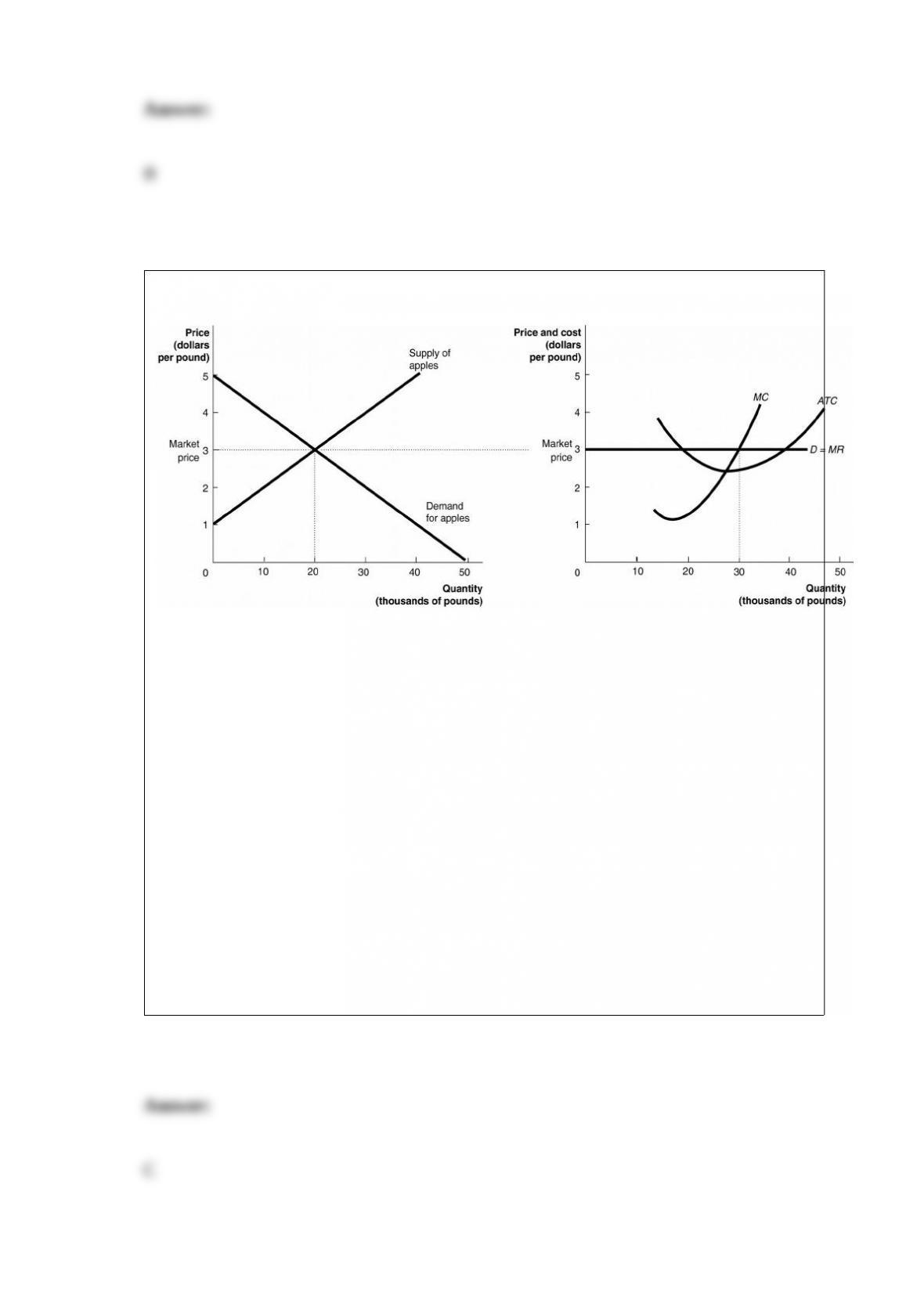
Figure 12-17
The graphs in Figure 12-17 represent the perfectly competitive market demand and
supply curves for the apple industry and demand and cost curves for a typical firm in
the industry.
Which of the following statements is true?
A) The current market price is $3, but the firm will be able to increase the price in the
future.
B) The current market price is $3, but the price will fall in the long run as a result of a
decrease in demand.
C) The current market price is $3, but the price will fall in the long run as new firms
enter the market.
D) The current market price is $3, but the price will increase in the future as the market
demand increases.
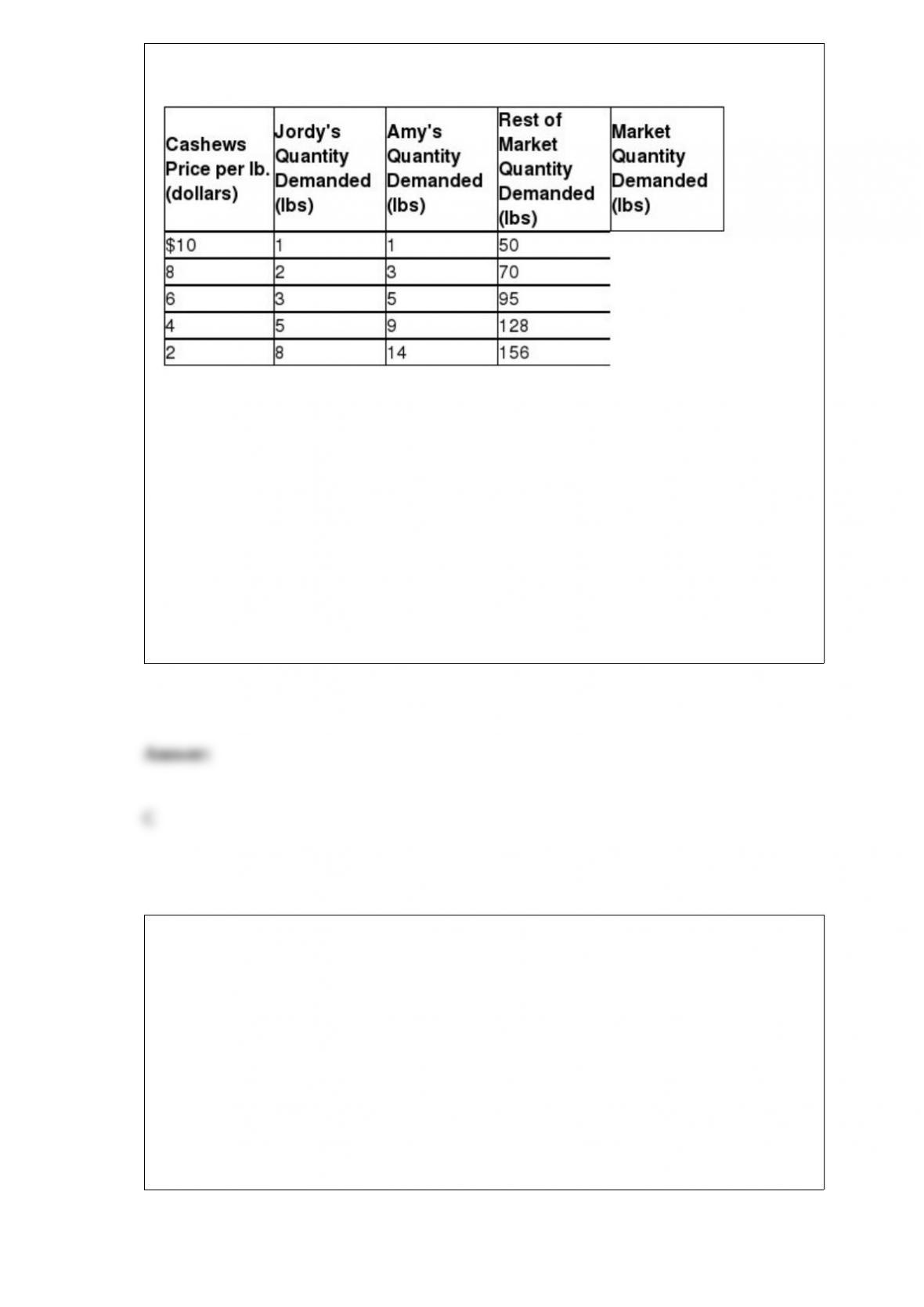
Table 3-2
The table above shows the demand schedules for cashews of two individuals (Jordy and
Amy) and the rest of the market. At a price of $6, the quantity demanded in the market
would be
A) 87 lbs.
B) 95 lbs.
C) 103 lbs
D) 215 lbs.
If a firm expects that the price of its product will be lower in the future than it is today
A) the firm has an incentive to increase supply now and decrease supply in the future.
B) the firm has an incentive to decrease supply now and increase supply in the future.
C) the firm has an incentive to increase quantity supplied now and decrease quantity
supplied in the future.
D) the firm will not change supply until it knows for certain what will happen to its
price.

Why are laws aimed at regulating monopolies called “antitrust” laws?
A) The rise of large firms (e.g., Standard Oil) in the late 1800s in the United States
caused consumers to lose trust in private business.
B) “Trust” was a word in Old English that meant monopoly in the Middle Ages.
Therefore, “antitrust” is a term that means “against monopoly.”
C) In the late 1800s, firms in several industries formed trusts; the firms were
independent but gave voting control to a board of trustees. Antitrust laws were passed to
regulate these trusts.
D) In the late 1800s, firms in several industries formed trusts; they were called “trusts”
because when corporate officials were questioned about their business they would clam
that business was good for the country and that they should trusted.
Suppose at the going wage rate of $20 per hour, firms can hire as many hours of
janitorial services as it desires. If any firm tries to lower the wage rate to $19, it will not
be able to hire any janitor. What does this indicate about the supply curve for janitorial
services?
A) Supply is unit-elastic.
B) Supply is perfectly elastic.
C) Supply is perfectly inelastic.
D) Supply is relatively inelastic.

Which of the following is motivated by an equity concern?
A) Some states have transferred funds to food bank programs in order to increase
benefits to lower-income families.
B) Following the implementation of subsidies for energy conservation, household
demand for rooftop solar panels increased quite significantly in California.
C) The United Network for Organ Sharing advocates a system of rationing scarce
kidneys that would favor young patients over old in an effort to wring more life out of
donated organs.
D) The United States offers patent protection to pharmaceutical manufacturers to
prevent others from duplicating their products.
All of the following occur whenever a government taxes a product except
A) the quantity consumed of that product falls.
B) the price of that product rises.
C) the marginal benefit of the last unit sold exceeds the marginal cost of producing it.
D) there will be no excess burden if the government’s tax revenue is sufficiently large to
offset the deadweight loss.

Which of the following is an example of rent seeking behavior?
A) Apple earned large profits from the development and sale of the iPhone.
B) Amazon introduced the Kindle to compete with Sony’s Digital Reader. Amazon was
motivated by the desire to earn profits from the Kindle but also increased the choice of
digital music players available to consumers.
C) U.S. sugar firms convinced Congress to impose a quota on imports of sugar.
D) Recent increases in cigarette taxes faced little opposition from voters, many of
whom were rationally ignorant with respect to the tax.
The principle of opportunity cost is that
A) in a market economy, taking advantage of profitable opportunities involves some
money cost.
B) the economic cost of using a factor of production is the alternative use of that factor
that is given up.
C) taking advantage of investment opportunities involves costs.
D) the cost of production varies depending on the opportunity for technological
application.
As word processing on personal computers expanded, sales of typewriters began to
disappear. Which of Porter’s competitive forces does this event demonstrate?
A) the threat of competition from new entrants

B) bargaining power of suppliers
C) bargaining power of buyers
D) competition from substitute goods or services
What is the Congressional act, enacted in 1933 and repealed in 1999, which prevented
financial firms from being both commercial banks and investment banks?
A) the Sarbanes-Oxley Act
B) the Glass-Steagall Act
C) the Taft-Hartley Act
D) the Cellar-Kefauver Act
If Marlowe obtains 9 units of utility per dollar spent on apples and 6 units of utility per
dollar spent on oranges, then Marlowe
A) is maximizing total utility.
B) should buy more apples and fewer oranges.
C) should buy more oranges and fewer apples.
D) should buy fewer oranges and fewer apples.

Since lower-income people spend a larger proportion of their incomes on groceries than
do higher-income people, if grocery stores were required by law to charge a 10-cent fee
for disposable bags, this fee could be considered a
A) proportional tax.
B) progressive tax.
C) regressive tax.
D) income tax.
The demand for loanable funds has a ________ slope because the lower the interest
rate, the ________ number of investment projects are profitable, and the ________ the
quantity of loanable funds demanded.
A) negative; greater; greater
B) negative; greater; lesser
C) negative; lesser; greater
D) positive; lesser; lesser
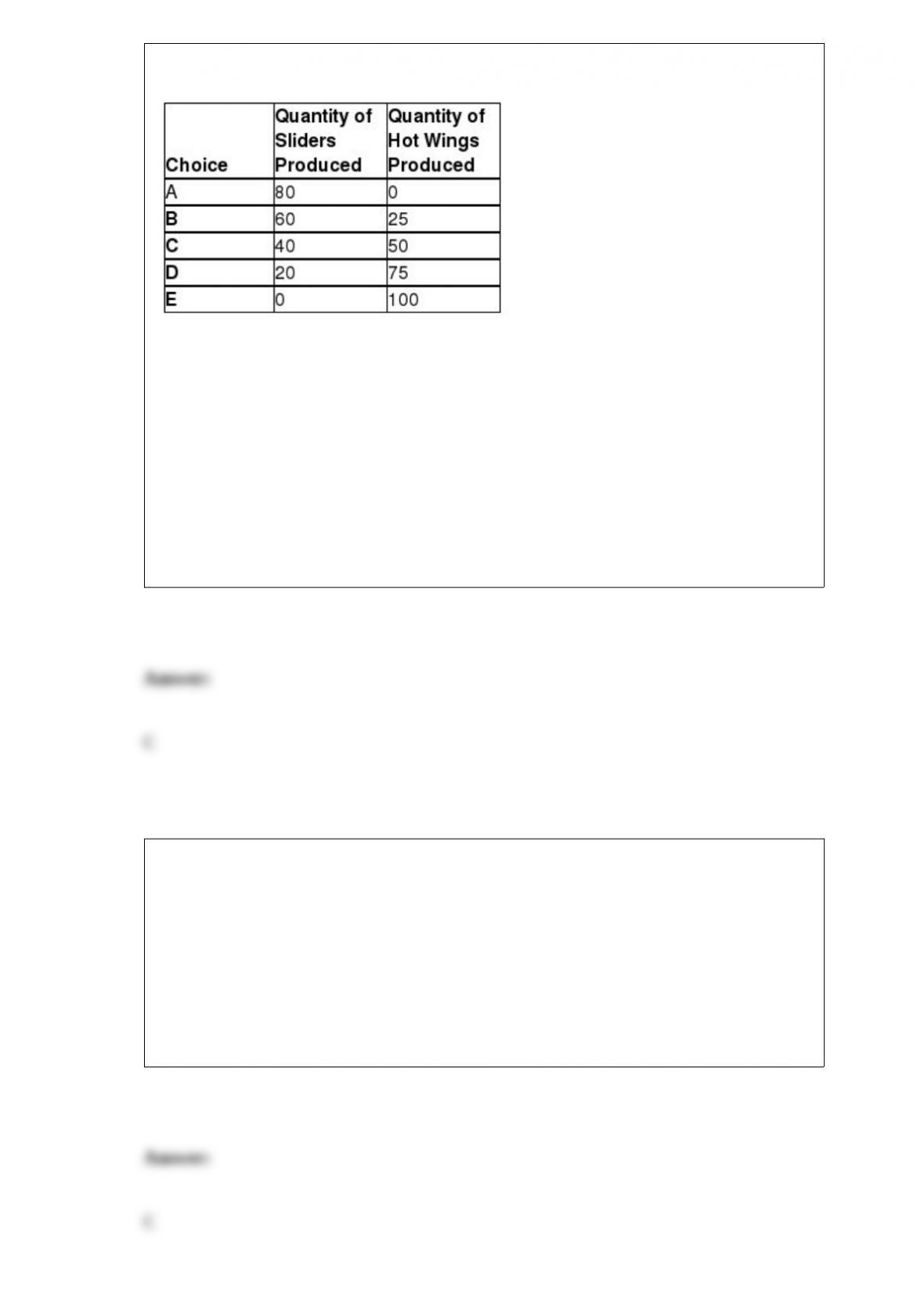
Table 2-4 Production Choices for Dina’s Diner
Assume Dina’s Diner only produces sliders and hot wings. A combination of 60 sliders
and 50 hot wings would appear
A) along Dina’s production possibilities frontier.
B) inside Dina’s production possibilities frontier.
C) outside Dina’s production possibilities frontier.
D) at the vertical intercept of Dina’s production possibilities frontier.
For the monopolistically competitive firm,
A) Price (P) = Marginal Revenue (MR) = Average Revenue (AR).
B) P = MR > AR.
C) P = AR > MR.
D) P > MR = AR.
Which of the following is an example of adverse selection?
A) The odds of a fire rise after a building is insured because the person with fire
insurance is likely to pay less attention to fire hazards.
B) Someone who did not install fire alarms and a sprinkler system in a building he
owns buys insurance for the building.
C) Someone with automobile insurance drives more recklessly than someone without
insurance.
D) People prefer to buy new cars rather than used cars.
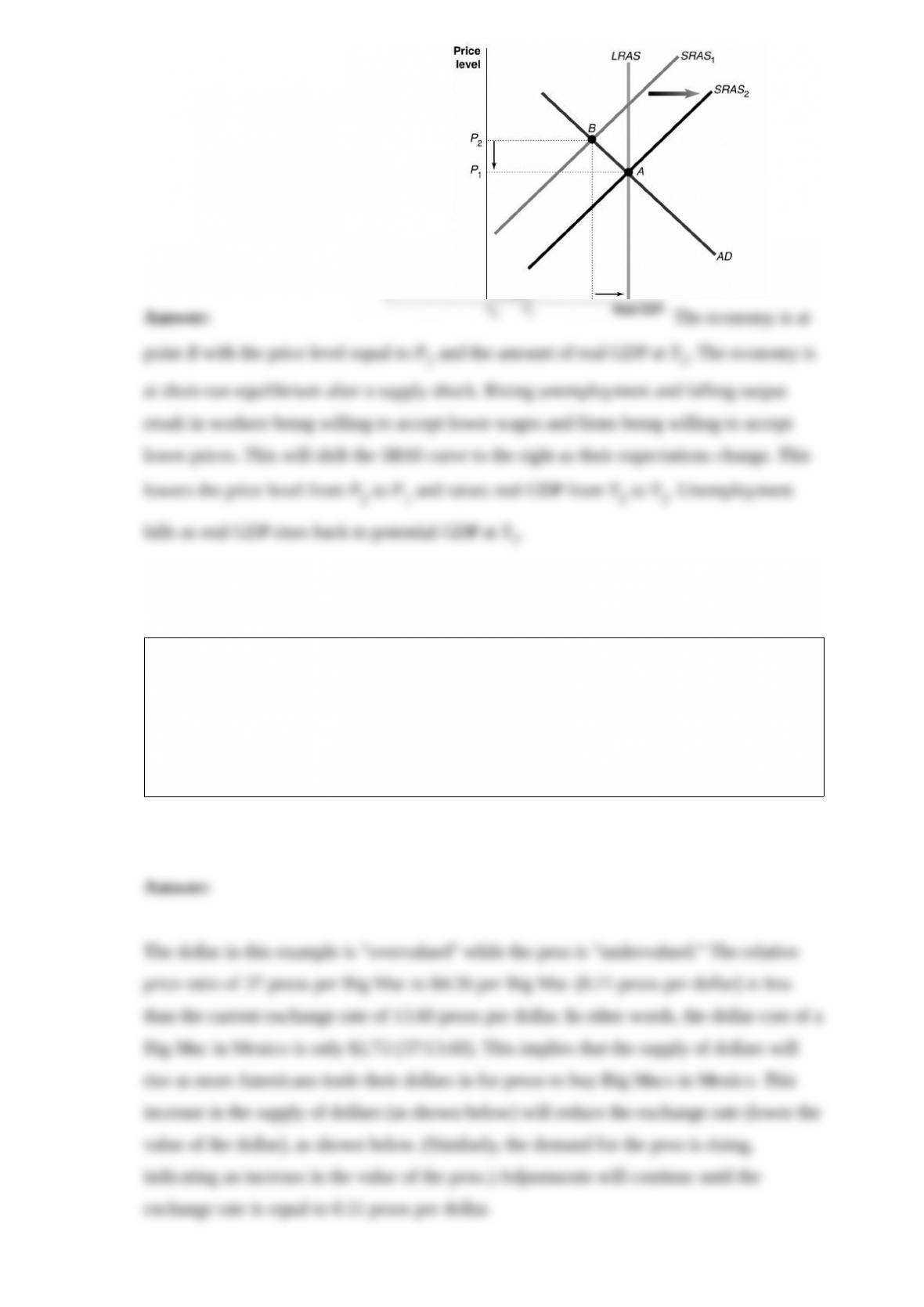
How would you expect the Fed to respond to a negative supply shock in the economy?
Using the aggregate supply and demand model, illustrate what happens in the long run
when the economy suffers a supply shock. Begin your analysis by assuming the
economy has suffered the supply shock in the short run, but has not yet adjusted to it in
the long run.
The “Big Mac Theory of Exchange Rates” tests the accuracy of purchasing power
parity theory. In July 2013, the Economist reported that the average price of a Big Mac
in the United States was $4.56. In Mexico, the average price of a Big Mac at that time
was 37 pesos. If the exchange rate between the dollar and the peso was 13.60 pesos per
dollar, how would purchasing power parity predict the exchange rate will change in the
long run? Support your answer graphically.
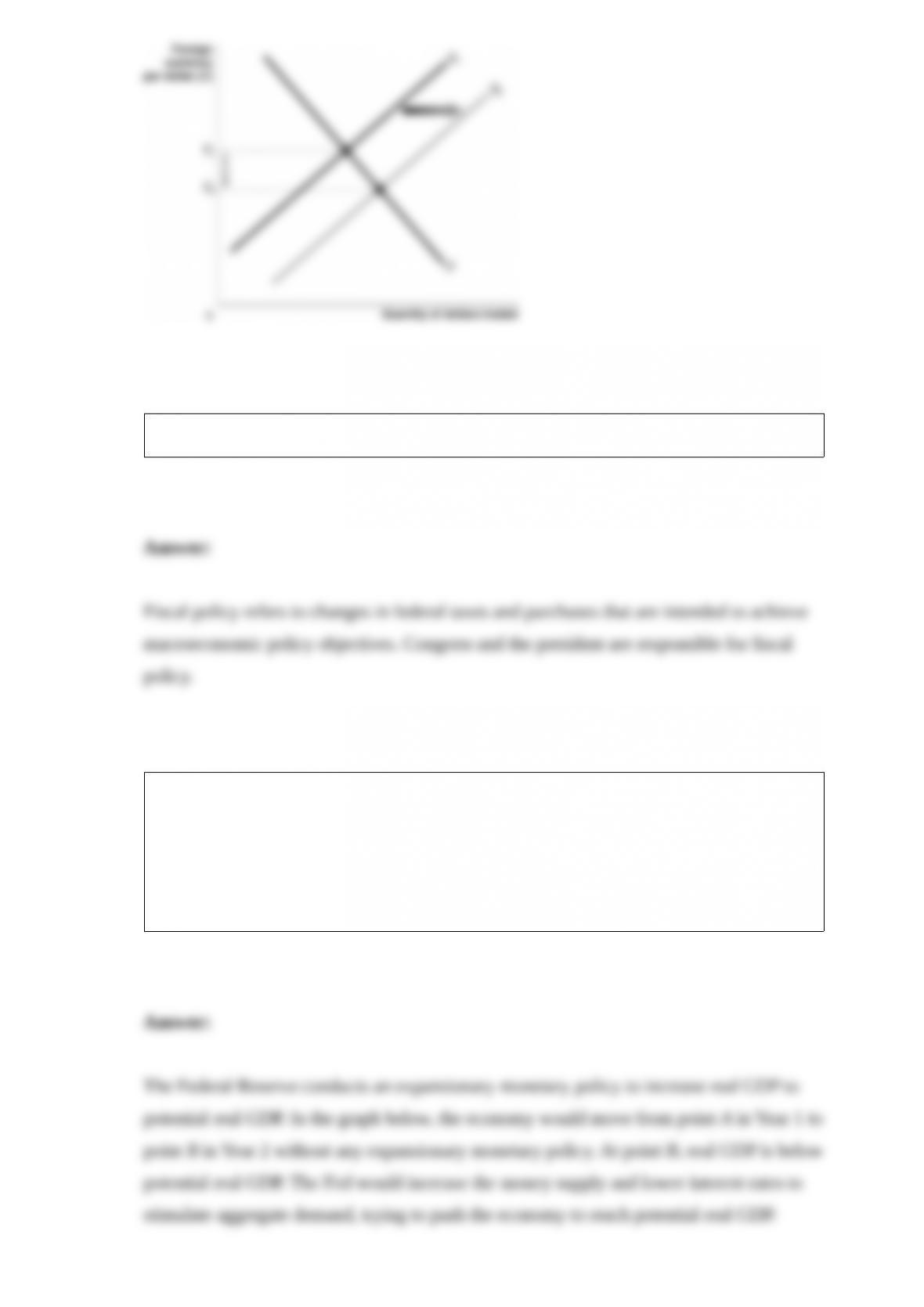
What is fiscal policy, and who is responsible for fiscal policy?
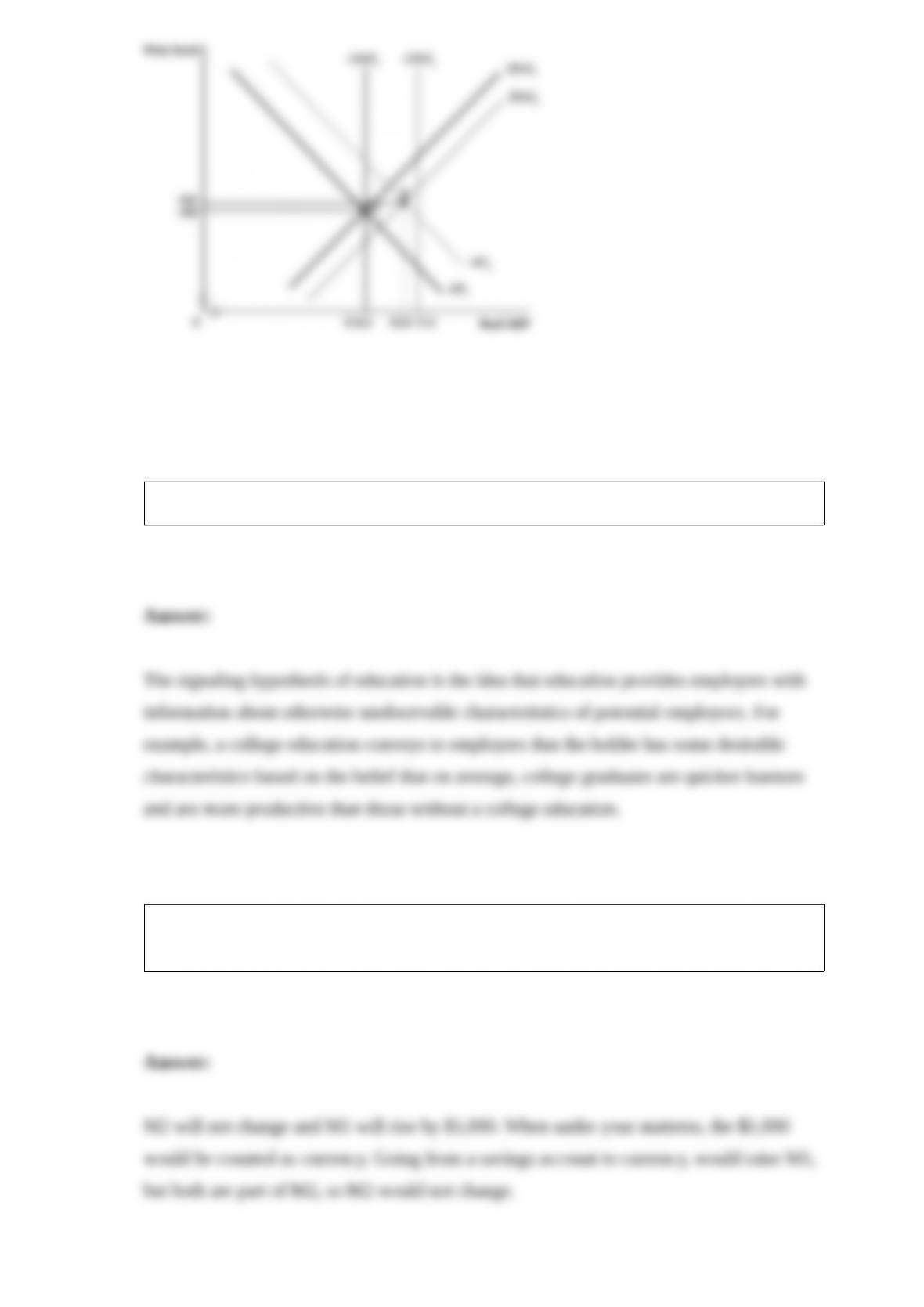
Use the dynamic aggregate demand and aggregate supply model and start with Year 1 in
long-run macroeconomic equilibrium. For Year 2, graph aggregate demand, long-run
aggregate supply, and short-run aggregate supply such that the condition of the
economy will induce the Federal Reserve to conduct an expansionary monetary policy.
Briefly explain the condition of the economy and what the Federal Reserve is
attempting to do.
What is the signaling hypothesis of education?
Suppose you withdraw $1,000 from your savings account and put it under your
mattress. Briefly explain how this will affect M1 and M2.
What is the signaling hypothesis of education?
Suppose that you decide that you no longer want to hold currency, and deposit all of
your currency holdings to your checking account. What is the immediate or initial
impact of this transaction on M1 and M2?