1) which of the following is most likely to be an inferior good?
a.fur coats
b.ocean cruises
c.used clothing
d.steak
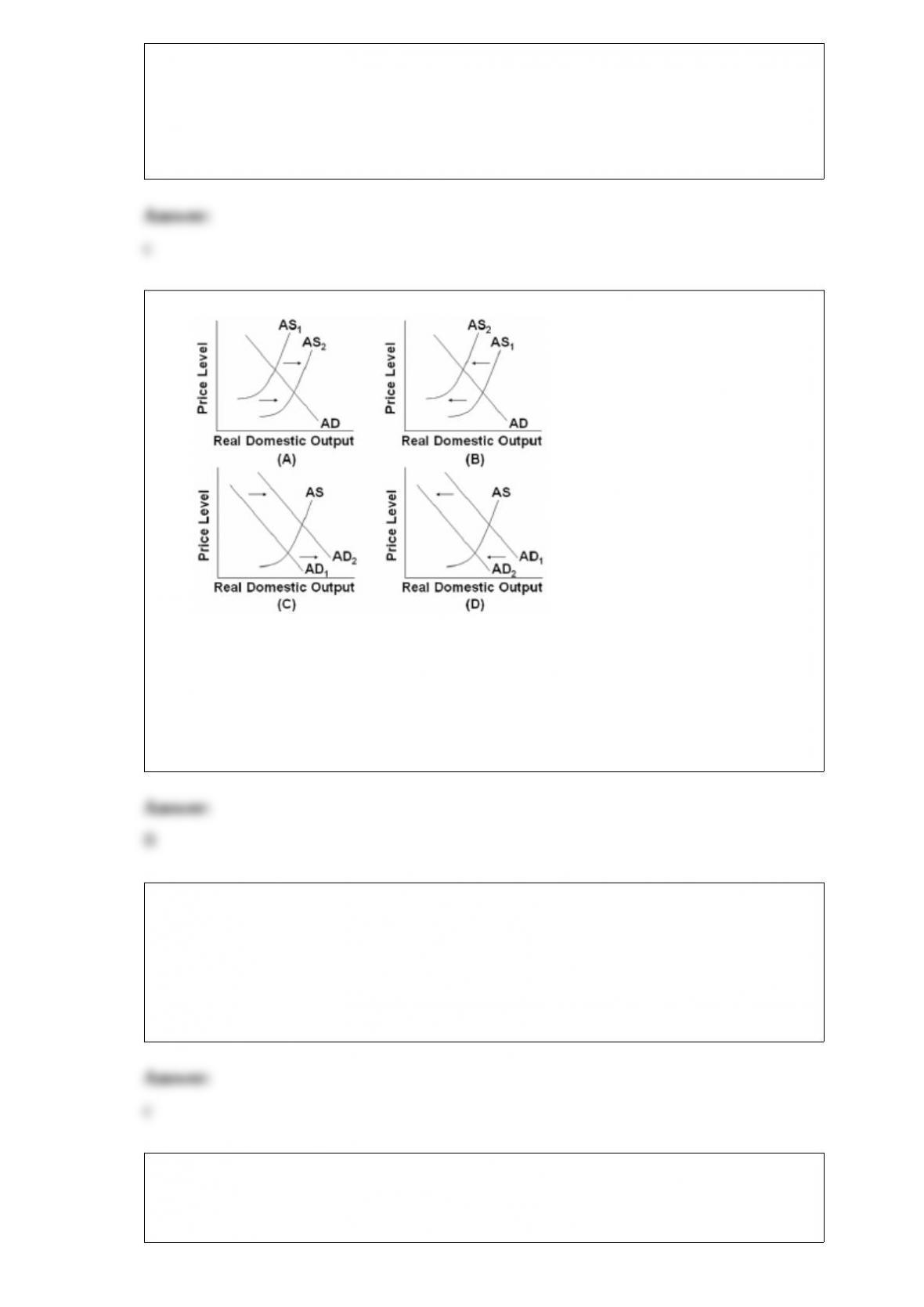
2)
Which of the above diagrams best portrays the effects of a decrease in the availability
of key natural resources?
A.A
B.B
C.C
D.D
3) if price (p) and quantity (q) are directly related, this means that:
a.a change in q will alter p, but a change in p will not alter q.
b.if p increases, q will decrease.
c.if p increases, q will also increase.
d.an increase in p will cause q to change, but the direction in which q changes cannot be
predicted.
4) economists define saving as:
a.that part of after-tax income which is not consumed.
b.total income less taxes.

c.bank accounts.
d.purchases of stocks and bonds.
5) which of the following is true concerning purely competitive industries?
a.there will be economic losses in the long run because of cut-throat competition.
b.economic profits will persist in the long run if consumer demand is strong and stable.
c.in the short run, firms may incur economic losses or earn economic profits, but in the
long run they earn normal profits.
d.there are economic profits in the long run, but not in the short run.
6) The tragedy of the commons is the idea that:
A.society has a tendency to overuse and thus abuse common resources.
B.total external costs in society far outweigh total external benefits.
C.matter can be transformed to other matter or into energy but can never vanish.
D.crime rates typically are higher in public places than where property is privately
owned.
7) (Consider This) Which of the following is not part of the M2 money supply?
A.currency in circulation.
B.credit card balances.
C.small time deposits of less than $100,000.
D.checkable deposits.
8) Answer the next four questions on the basis of the following table which shows the
rankings of the public goods by three voters: A, B, and C.

(a)What will be the choice between a new park and a new bridge?
(b)What will be the choice between a new school and a new park?
(c)What will be the choice between a new bridge and a new school?
(d)What do the rankings in the table indicate about choices made under majority rule?
9) (Last Word) Suppose you borrow $500 for a year and the lender discounts $75 of
interest at the time the loan is made (giving the borrower only $425). The interest rate
on this loan is about:
A.12.5 percent.
B.14 percent.
C.18 percent.
D.10 percent.
10) other things equal, the optimal quantity of immigrants will be greater, the:
a.higher the unemployment rate in the destination nation.
b.greater the degree of substitutability between immigrant and domestic-born workers.
c.greater the degree of complementarity between immigrant and domestic-born
workers.
d.lower the rate at which immigrants can be absorbed.
11) The purely competitive employer of resource A will maximize the profits from A by
equating the:
A.price of A with the MRP of A.
B.marginal productivity of A with the MRC of A.
C.marginal productivity of A with the price of A.
D.price of A with the MRC of A.
12)
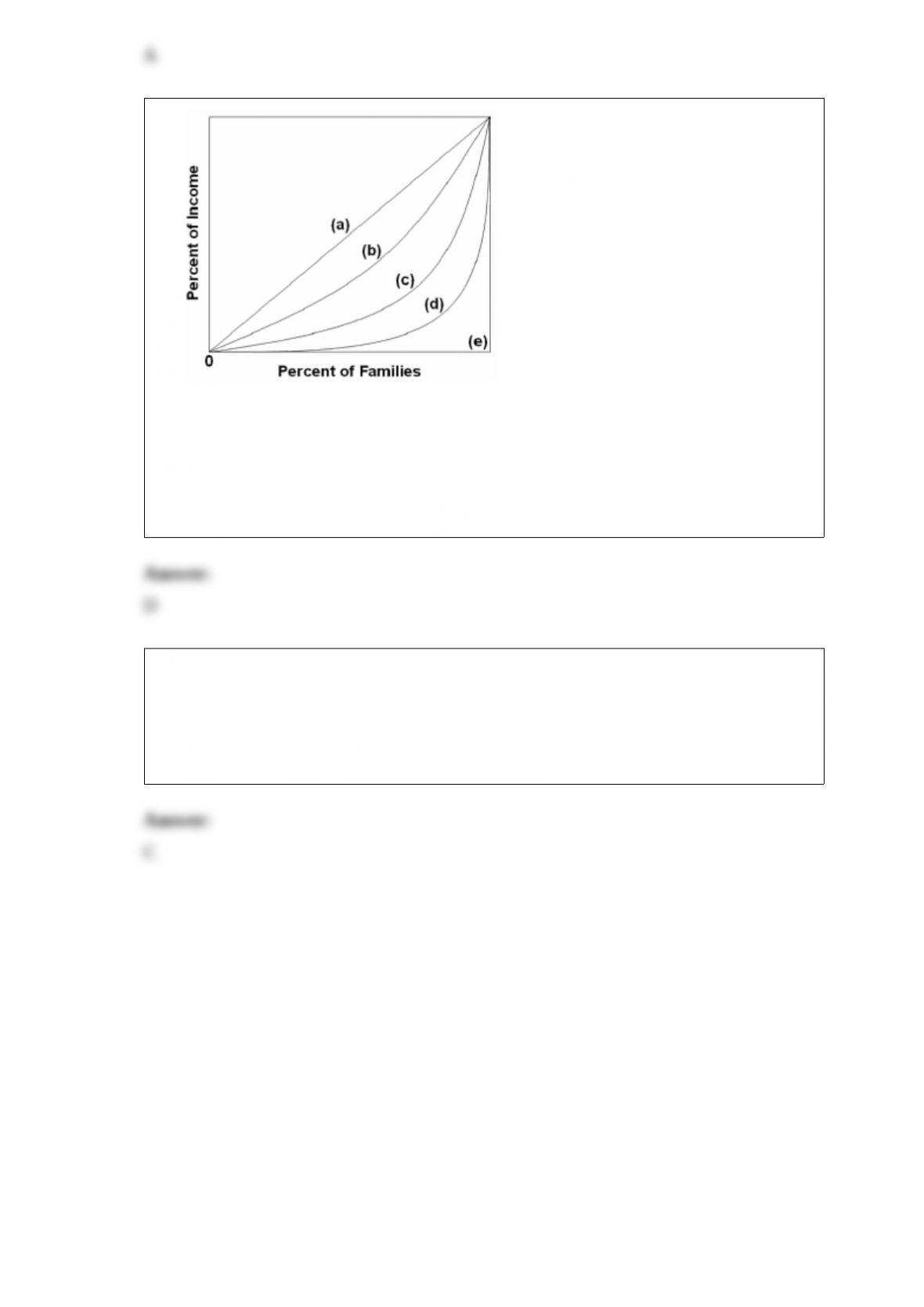
Refer to the above diagram where curves (a) through (e) are for five different countries.
Of the countries listed below, income is most unequally distributed in country:
A.a.
B.b.
C.c.
D.d.
13) A profit-maximizing firm employs resources to the point where:
A.MRC = MP.
B.Resource price equals product price.
C.MRP = MRC.
D.MP = product price.