
In the short run, changes in output can only be brought about by a change in the
quantity of variable inputs.
A prisoner’s dilemma leads to a noncooperative equilibrium.
Increases in capital per hour worked cannot sustain high rates of economic growth
unless accompanied by technological change.
Rent control is an example of a price ceiling.

The government makes all economic decisions in a centrally planned economy.
If the Fed wishes to decrease the supply of money and credit, it may sell government
securities, raise the discount rate, or lower required reserve ratios.
The demand and supply equations for the peach market are:
Demand: P = 24 – 0.5Q
Supply: P = -6 + 2.5Q
where P = price per bushel, and Q = quantity (in thousands). a. Calculate the
equilibrium price and quantity.
b. Suppose the government guaranteed producers a price of $24 per bushel. What would
be the effect on quantity supplied? Provide a numerical value.
c. By how much would the $24 price change the quantity of peaches demanded?
Provide
a numerical value.
d. Would there be a shortage or surplus of peaches?
e. What is the size of this shortage or surplus? Provide a numerical value.

The industrialized group of countries has growth rates that are consistent with the
findings of the economic growth model. That is, Taiwan, Korea, and Singapore had
________ incomes in 1960 than the United States and Switzerland, and Taiwan, Korea,
and Singapore grew ________ than the United States and Switzerland between 1960
and 2010.
A) lower; more rapidly
B) greater; less rapidly
C) lower; less rapidly
D) greater; more rapidly
What is a primary market?
A) a market where primary inputs like steel are sold
B) a market where you can sell any bonds you own as a private investor
C) a market where a newly issued claims are sold to initial buyers by the borrowing
firm
D) a market where you can sell any stocks you own as a private investor
In a market economy, who decides what goods and services will be produced?
A) only the producers
B) only consumers
C) consumers and producers
D) the government
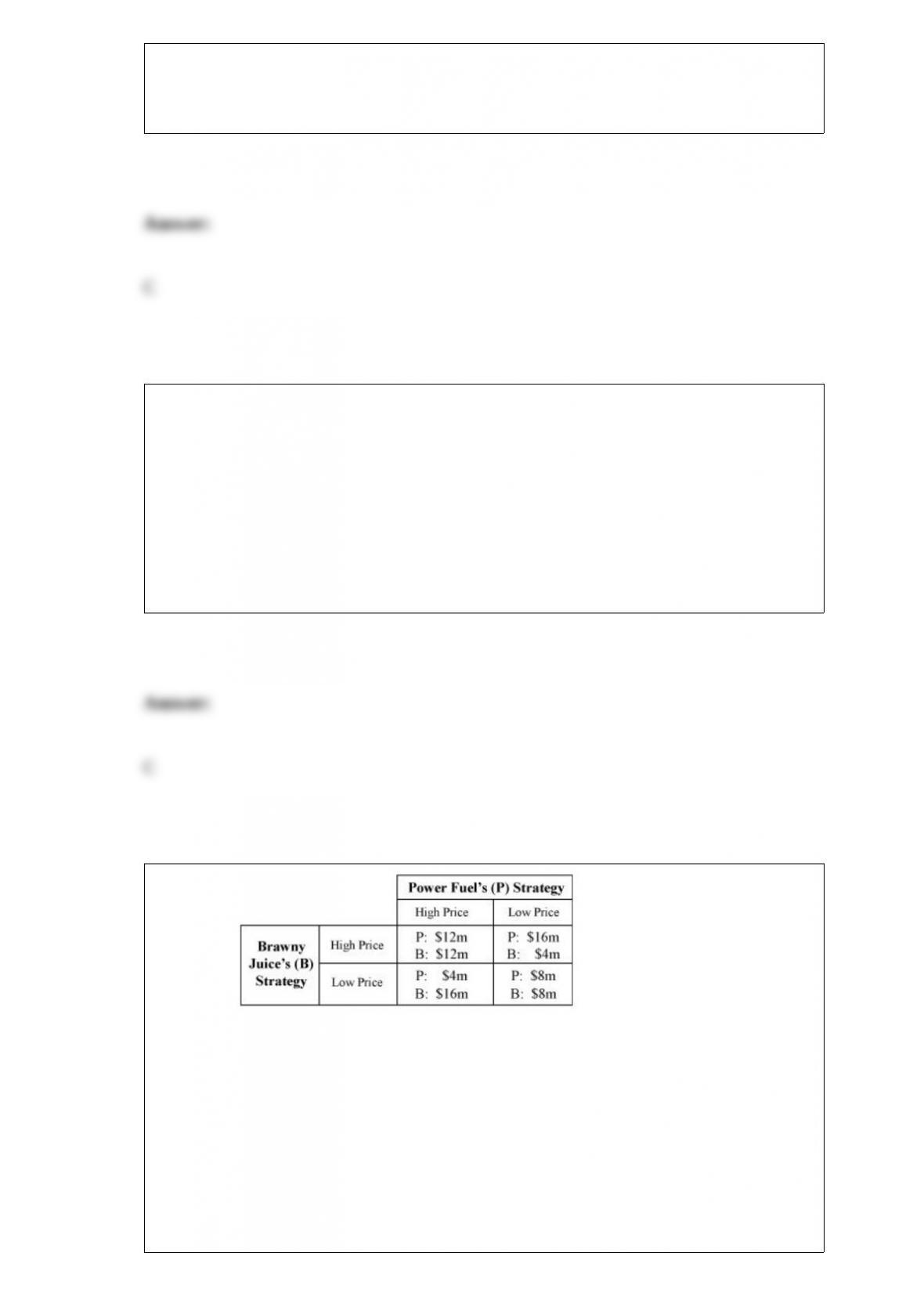
Table 14-8 Two rival oligopolists in the
athletic supplements industry, the Power Fuel Company and the Brawny Juice
Company, have to decide on their pricing strategy. Each can choose either a high price
or a low price. Table 14-8 shows the payoff matrix with the profits that each firm can
expect to earn depending on the pricing strategy it adopts.
If Brawny Juice selects a high price, what is Power Fuel’s best strategy and what will
Power Fuel earn as a result of this strategy?
A) Power Fuel will select a low price and earn $8 million.

B) Power Fuel will select a low price and earn $16 million.
C) Power Fuel will select a high price and earn $12 million.
D) Power Fuel will select a high price and earn $16 million.
Suppose an excise tax of $0.75 is imposed on every pack of cigarettes sold and sellers
are responsible for paying this tax. How would the imposition of the tax be illustrated in
a graph?
A) The supply curve for cigarettes would shift to the left by $0.75.
B) The supply curve for cigarettes would shift to the left by less than $0.75.
C) The supply curve for cigarettes would shift to the left by more than $0.75.
D) The supply curve for cigarettes would shift to the right by $0.75.
Because workers in the United States work fewer hours per week, on average, than they
did over 100 years ago,
A) workers in the United States are worse off than they were over 100 years ago.
B) workers in the United States earn less income than they did over 100 years ago.
C) GDP is lower than it would be if U.S. workers worked the same workweek they had
100 years ago.
D) GDP is higher than it would be if U.S. workers worked the same workweek they had
100 years ago.

If real GDP per capita doubles between 2005 and 2020, what is the average annual
growth rate of real GDP per capita?
A) 4.7%
B) 10.5%
C) 15%
D) 21%
Oligopolies are difficult to analyze because
A) the firms are so large.
B) demand and cost curves do not exist for these types of industries.
C) how firms respond to a price change by a rival is uncertain.
D) oligopolies are a recent development so economists have not had time to develop
models.
The difference between technology and technological change is that
A) technology refers to the processes used by a firm to transform inputs into output
while technological change is a change in a firm’s ability to produce a given level of
output with a given quantity of inputs.
B) technology is carried out by firms producing physical goods but technological
change is an intellectual exercise into seeking ways to improve production.
C) technology is product-centered, that is, developing new products with our limited
resources while technological change is process-centered in that it focuses on
developing new production techniques.
D) technology involves the use of capital equipment while technological change
requires the use of brain power.
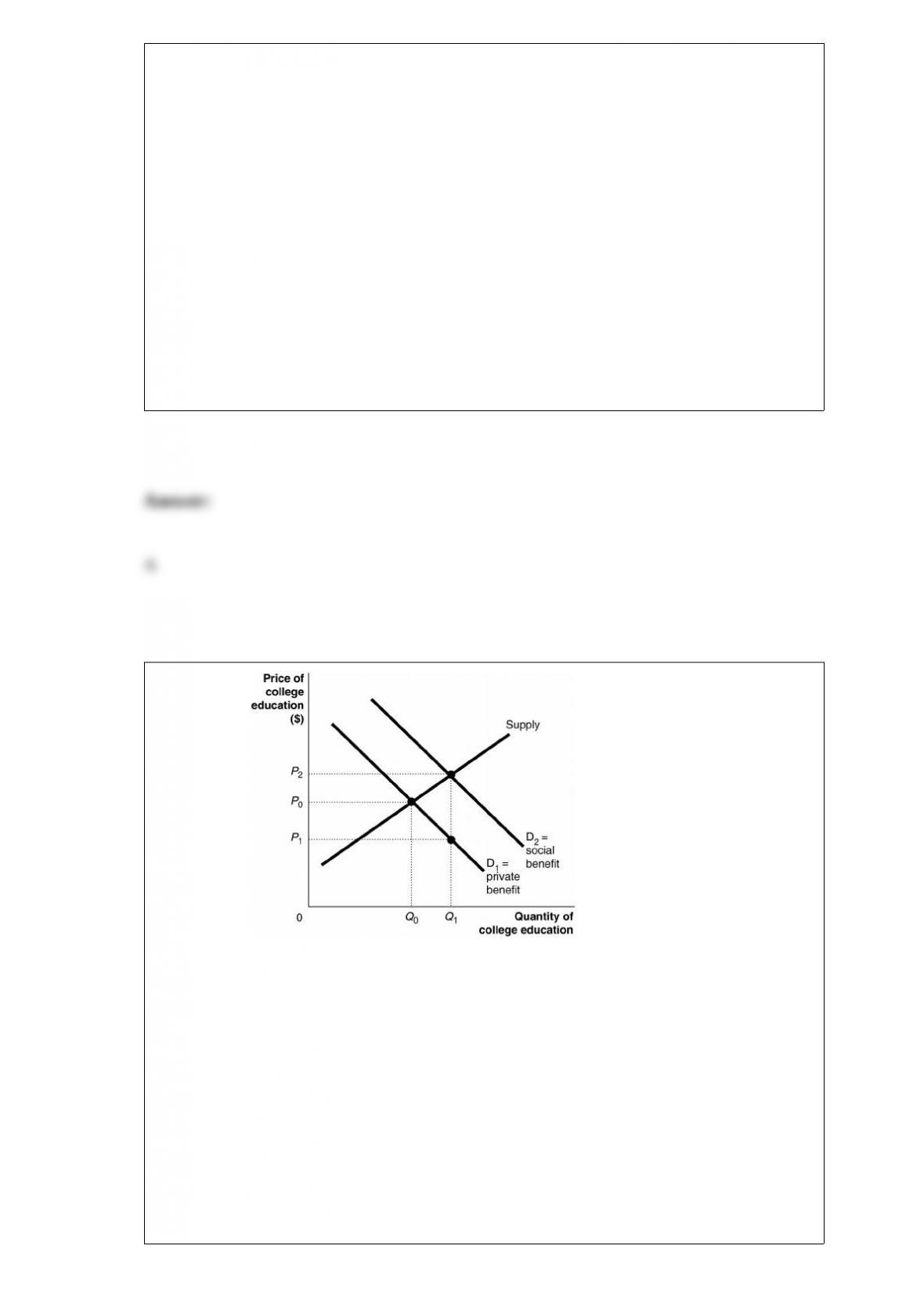
Figure 5-12 College education benefits
society by producing a more employable workforce, reducing crime and creating a
better informed citizenry. Thus, the social benefits of college education exceed the
private benefits for any level of college education. This is illustrated in Figure 5-12.
One way to obtain the economically efficient amount of college education is for
governments to subsidize college education. What is the size of the per-student
Pigovian subsidy that the government must provide to internalize the external benefits?
(Note that the subsidy can be granted to the education institutions or to the students
directly or indirectly; for example, through low-interest student loans.)
A) P2 – P0
B) P2 – P1

C) P0 – P1
D) P1
What is the principle monetary policy tool used by the Fed. Why?
Suppose the United States experiences a long period of inflation relative to other
countries. How will this affect U.S. net exports?

If you pay $14,000 in taxes on an income of $125,000, and $17,400 in taxes on an
income of $144,000, what is your marginal tax rate? Show your work.
What is moral hazard?
What is a marginal cost?