Which of the following exchange rates between the dollar and the peso would an
American buyer of Mexican goods most prefer?
a. $0.10 = 1 peso
b. $0.08 = 1 peso
c. $0.06 = 1 peso
d. $0.04 = 1 peso
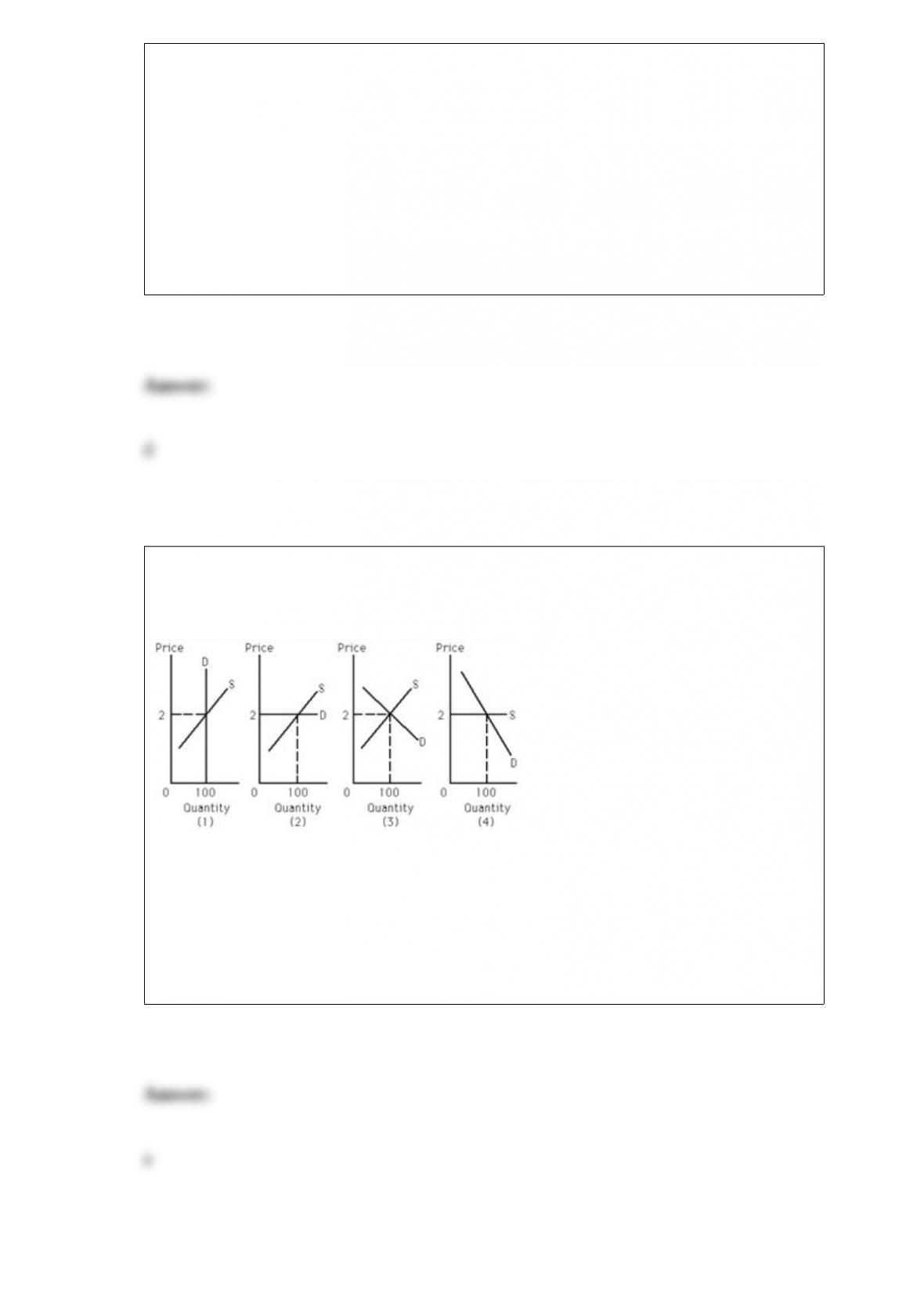
Refer to Exhibit 20-7. As a producer, if you had a choice, which of the depicted markets
would you operate in?
Exhibit 20-7
a. (1)
b. (2)
c. (3)
d. (4)

The lower the elasticity of demand for labor,
a. the larger the cutback in labor for a given wage increase.
b. the smaller the cutback in labor for a given wage increase.
c. the higher the wage rate that a labor union receives for its membership.
d. the lower the wage rate that a labor union receives for its membership.
e. the more members of a given union.
Candidates in a two-person race express very similar positions a few weeks before the
election. A voter complains that there is not much difference between the two
candidates. What this voter misunderstands or ignores is that
a. each candidate has an incentive to be like the other.
b. each candidate has an incentive to be different from the other.
c. each candidate has an incentive to be perceived as in the “middle of the road,” and if
both candidates correctly act on this incentive they will end up sounding alike.
d. this simply happens sometimes.
e. none of the above
The excess capacity theorem states that a monopolistic competitor

a. will produce an output level smaller than the one that would minimize its unit costs.
b. will produce an output level where MR > MC.
c. generally does not attain long run equilibrium, and thus charges a higher price than it
should.
d. typically produces too much of a good at too low a quality.
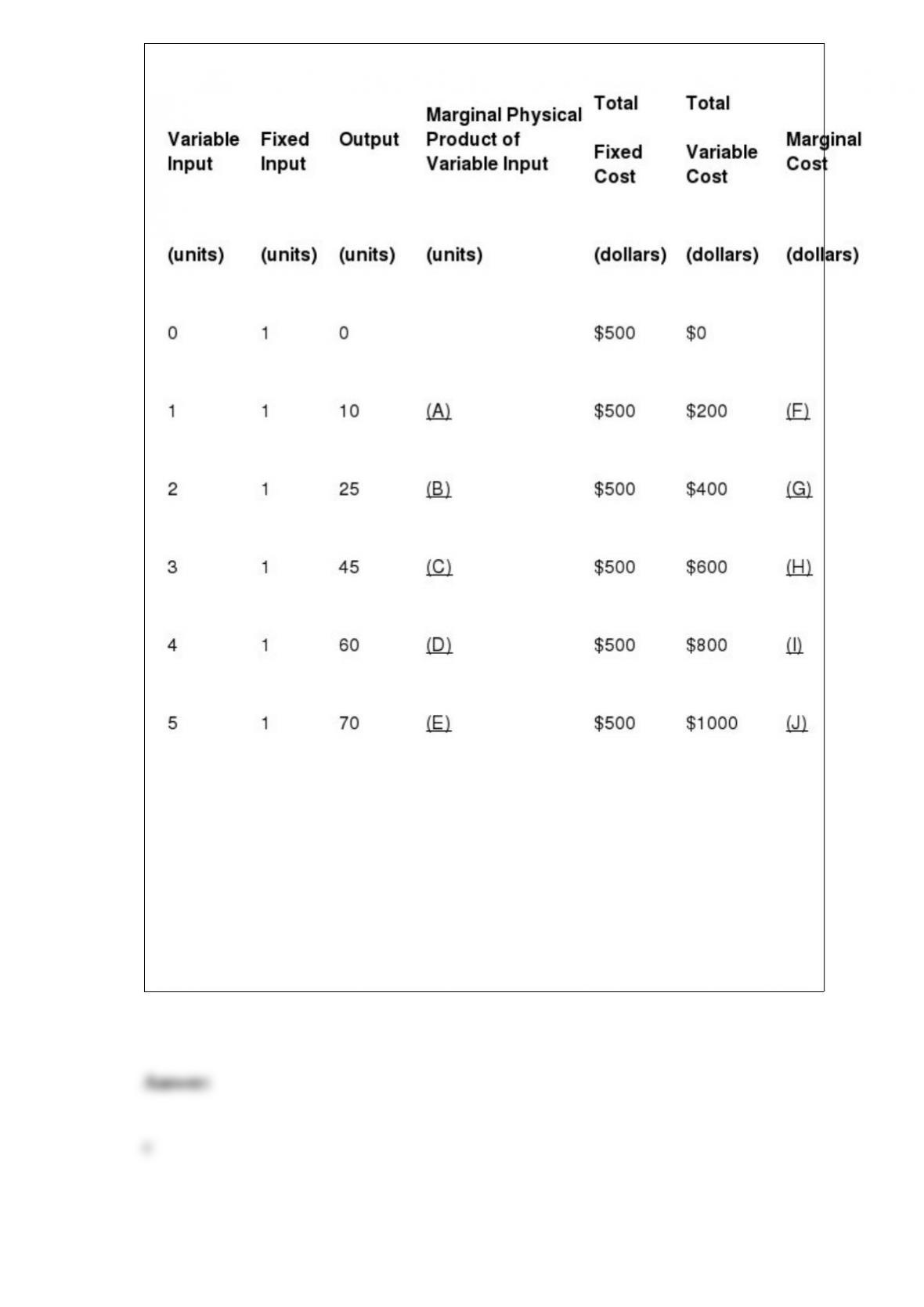
Refer to Exhibit 22-3. The marginal cost figures in blanks (F) and (G), respectively, are
Exhibit 22-3
a. $2.00 and $1.33.
b. $2.00 and $1.60.
c. $20.00 and $13.33.
d. $2.00 and $2.66.
e. none of the above
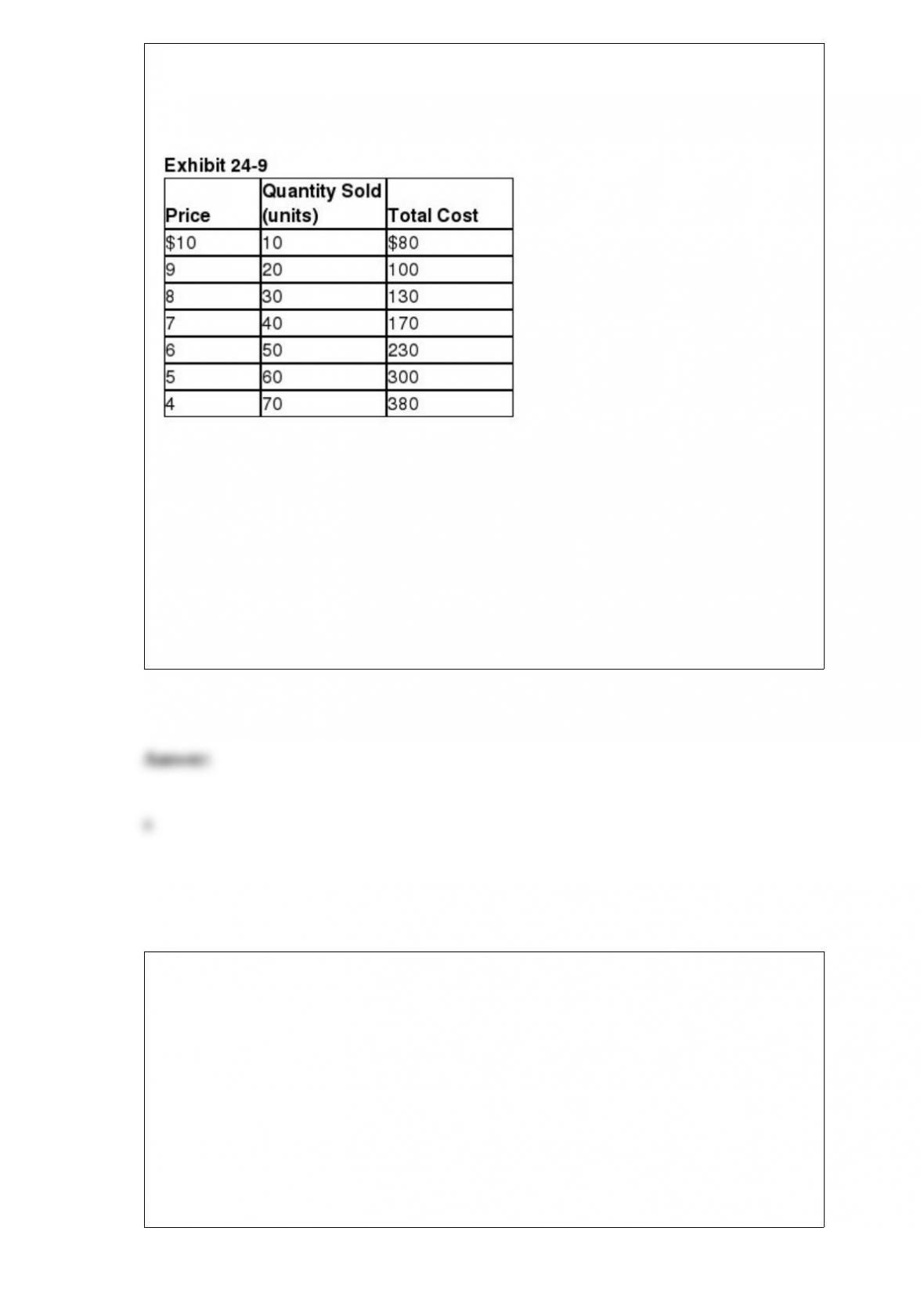
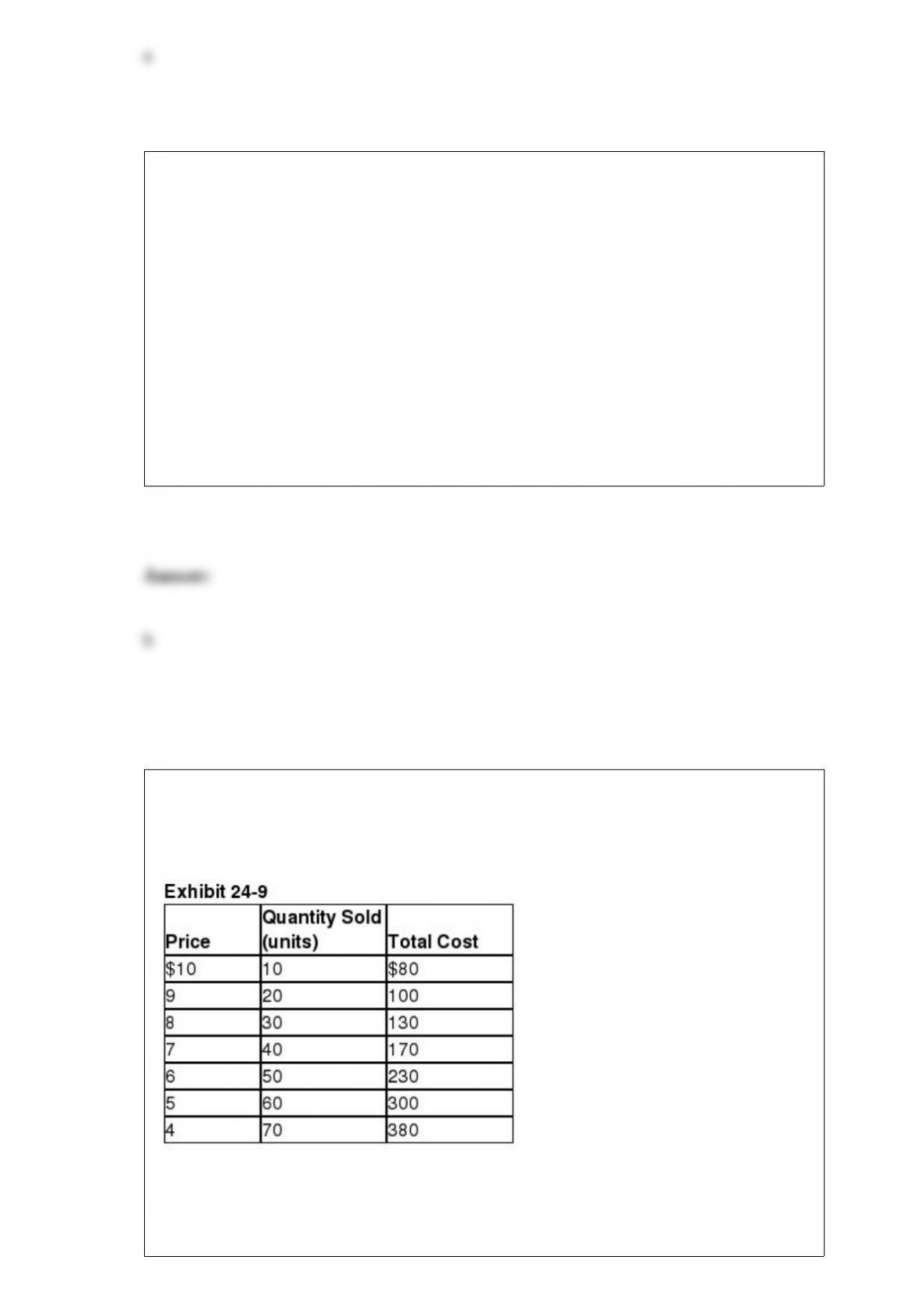
Refer to Exhibit 24-9. Assuming that the firm is maximizing profits, the marginal
revenue of the last unit produced equals
a. $4.
b. $40.
c. $5.
d. $50.
e. $6.
The price elasticity of demand indicates
a. buyers’responsiveness to price changes.
b. the slope of the demand curve.
c. how far demand stretches over time.
d. the extent to which a demand curve shifts as incomes change.
e. none of the above

Theories should be judged based upon how
a. well they explain things.
b. consistently and accurately they predict.
c. famous the economist is making the prediction.
d. the amount of attention given to them by the media.
e. a and b
What is the relationship between the average fixed cost (AFC) curve and the marginal
cost (MC) curve?
a. The MC curve intersects the AFC curve at its minimum point.
b. When the MC curve is above the AFC curve, AFC must be increasing.
c. Both a and b are true.
d. There is no relationship between the AFC curve and the MC curve..
Competition for votes between two political parties will cause those parties to
a. produce quite different policy proposals.
b. have very similar policy proposals.
c. find ways to clearly distinguish themselves in order to give voters a clear choice.
d. a and c
e. none of the above
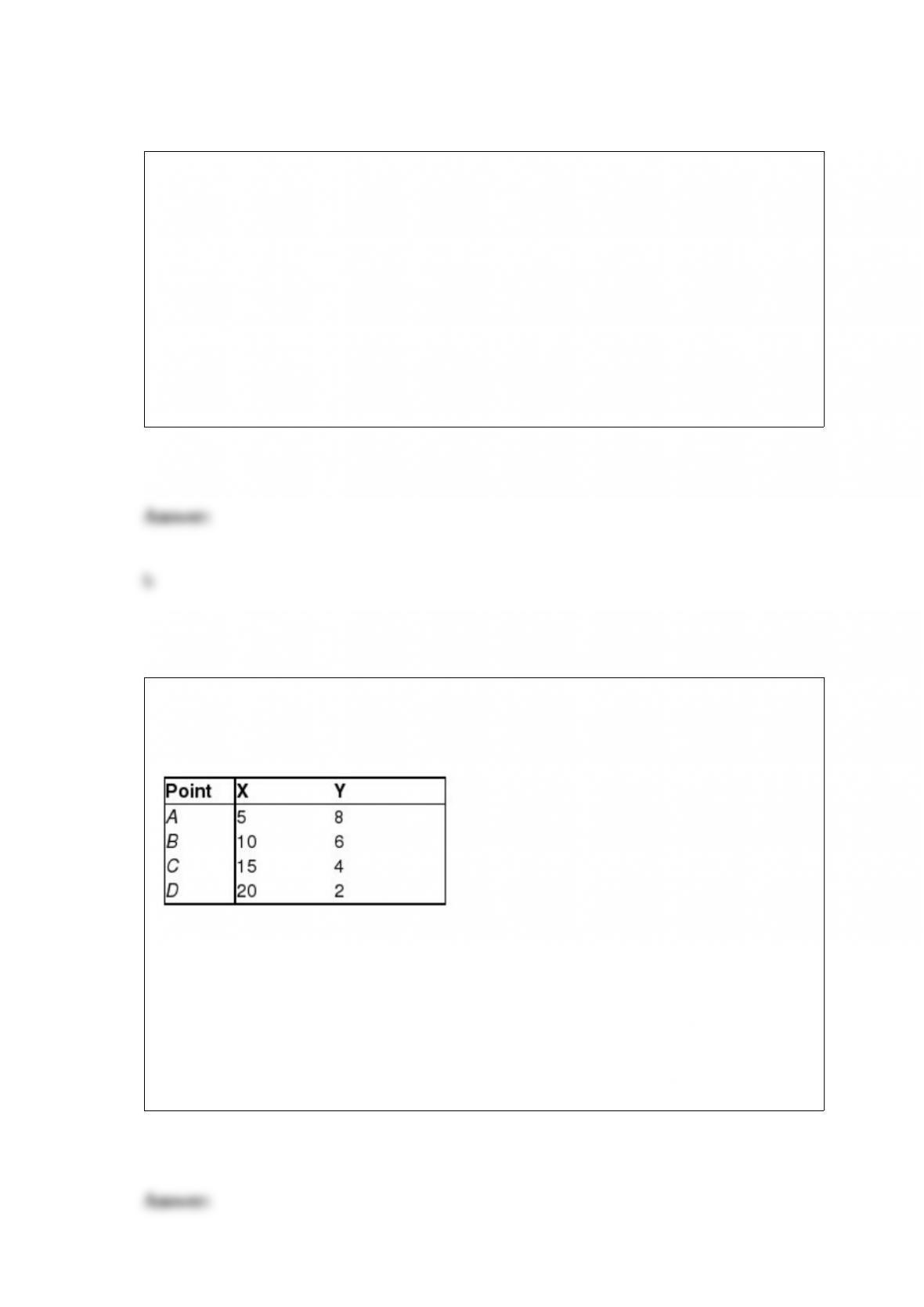
Refer to Exhibit 1-3.Based on the data provided in this table,what type of relationship
exists between variables X and Y?
Exhibit 1-3
a. inverse
b. direct
c. independent
d. There is no relationship between variables X and Y.
Suppose that a consumer purchases a combination of X and Y such that MUX/PX = 15
utils per dollar and MUY /PY = 10 utils per dollar. To maximize utility, the consumer
should buy
a. less of X and more of Y.
b. more of X and less of Y.
c. more of both X and Y.
d. less of both X and Y.
e. neither X nor Y.
Refer to Exhibit 24-9. The reason we know the firm represented in the exhibit is a price
searcher and not a price taker is because
a. its total costs rise as more output is produced and sold.
b. it has to lower price to sell additional units of its good.

c. marginal revenue is not constant for all given levels of output.
d. at some levels of output it earns negative profit.
e. b and c
The producer of good X is contemplating a price change and has asked for your advice.
After some empirical investigation, you conclude that the price elasticity of demand for
good X is 0.75. Your best advice to the producer would be to
a. increase the price of good X to raise total revenue.
b. decrease the price of good X to raise total revenue.
c. leave the price of good X unchanged since it will not influence total revenue.
d. increase the price of good X to reduce total revenue.
As the price of good A rises, the demand for good B rises. Therefore, goods A and B are
a. normal goods.
b. inferior goods.
c. substitutes.
d. complements.

e. none of the above
Which of the following statements is true?
a. At a high level of output, AFC is zero.
b. If the law of diminishing marginal returns did not exist, then the marginal cost curve
would not have an upward-sloping portion.
c. The marginal cost curve cuts the average fixed cost curve at its minimum.
d. There are no fixed costs in the short run.
e. none of the above
Which of the following assumptions do the market structures of monopolistic
competition and perfect competition share?
a. many buyers and sellers
b. homogeneous products
c. difficult entry into the market
d. difficult exit from the market
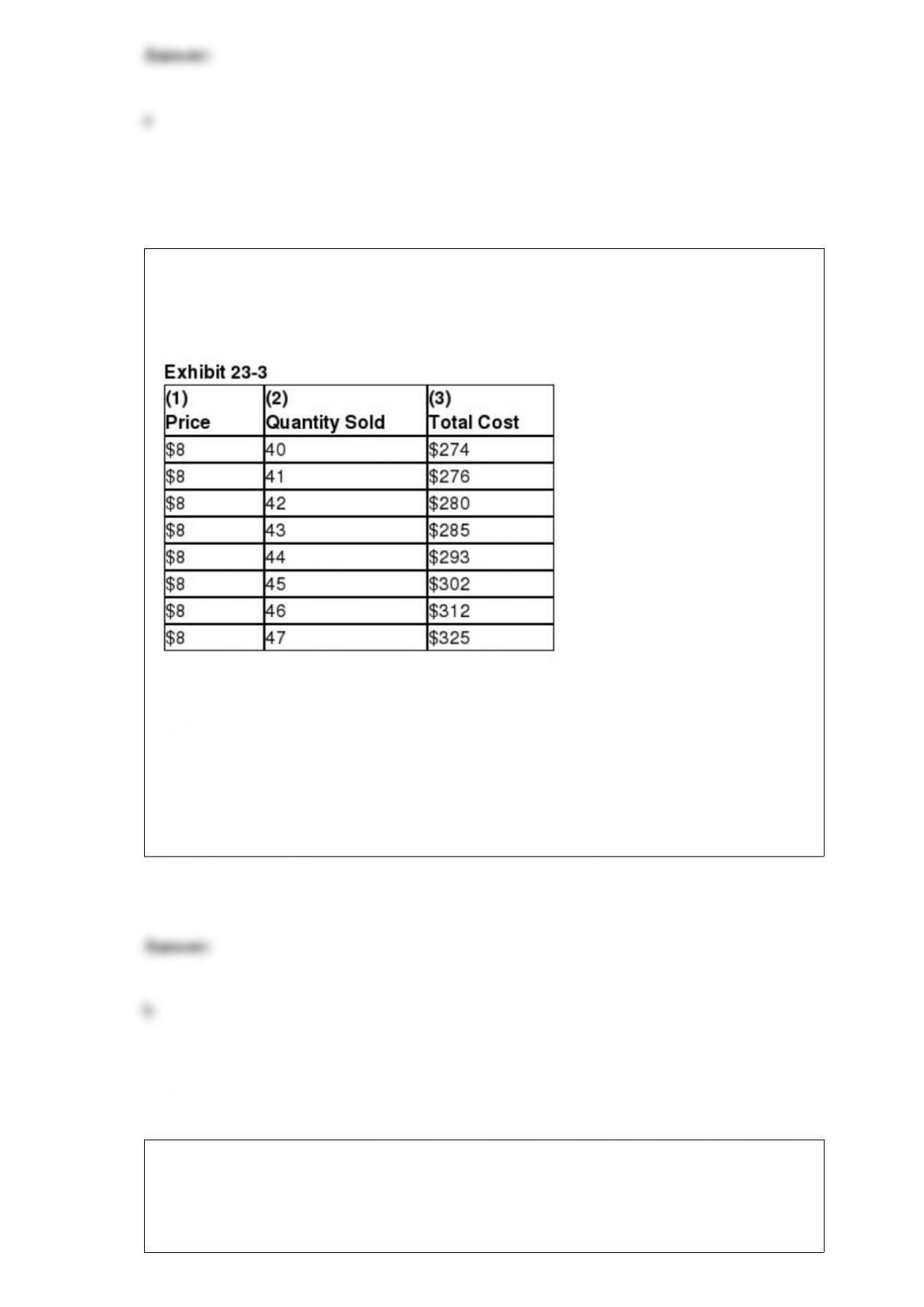
Refer to Exhibit 23-3. Is it possible for this firm to produce “too much” in the
short-run?
a. Any quantity above 42 units is too much.
b. Any quantity above 44 units is too much.
c. Any quantity above 40 units is too much.
d. none of the above
The Justice Department most closely examines proposed __________ mergers.
a. horizontal
b. vertical
c. conglomerate
d. international
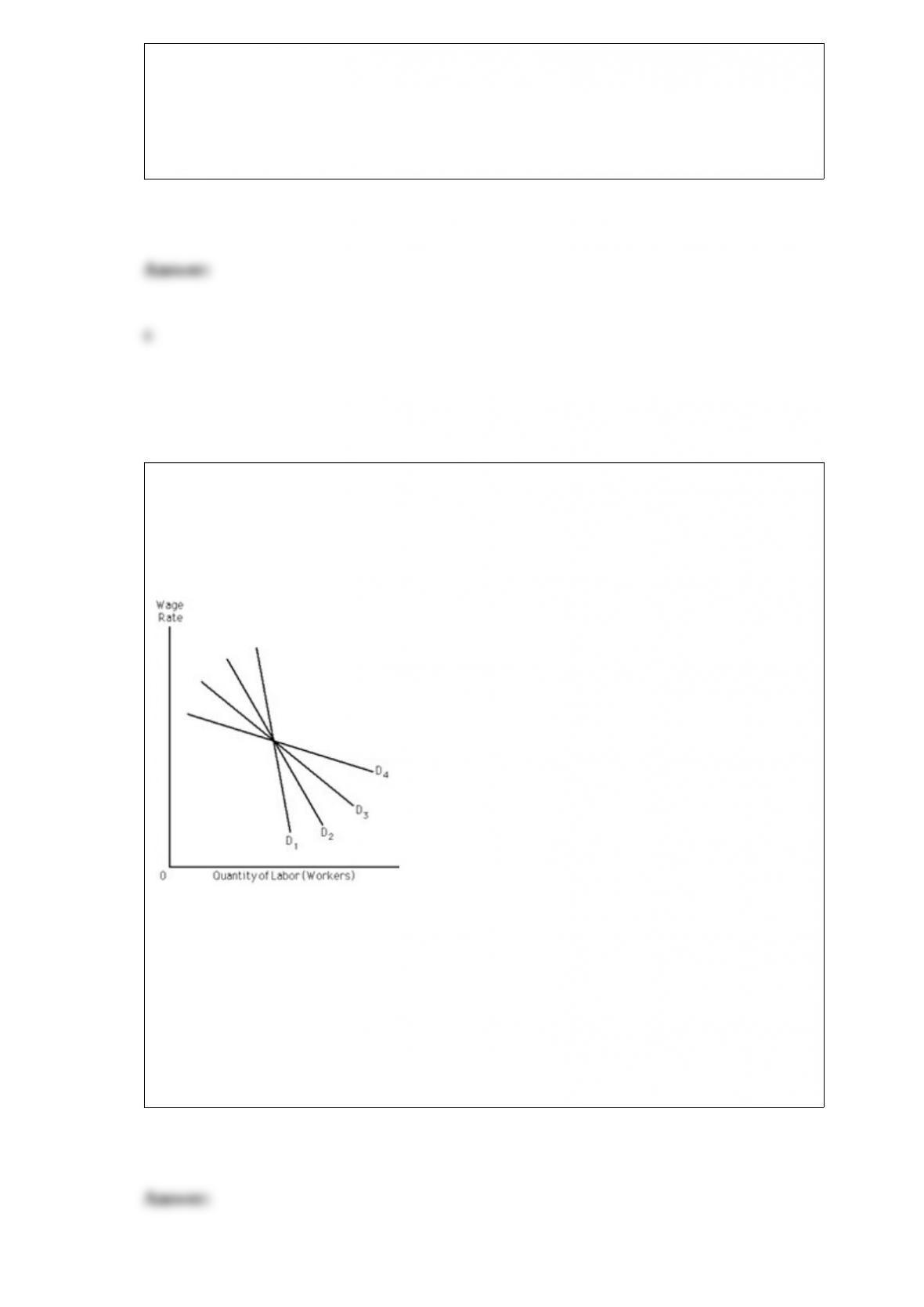
Refer to Exhibit 28-l. Four demand curves for labor are displayed: D1, D2, D3, and D4.
Which provides the most pronounced wage-employment tradeoff?
Exhibit 28-1
a. D1
b. D2
c. D3
d. D4

A factor price taker is a firm that
a. can sell as many units of its good as it wants without affecting price.
b. sells fewer units of its good at higher prices than lower prices.
c. can buy all of a factor it wants at the equilibrium price.
d. drives up factor price if it buys an additional factor unit.
e. none of the above