1) if a nation’s real gdp increases from 100 billion to 106 billion and its population
jumps from 200 million to 212 million, it real gdp per capita will:
a.remain constant.
b.fall by 6 percent.
c.rise by 6 percent.
d.fall by 12 percent.
2)
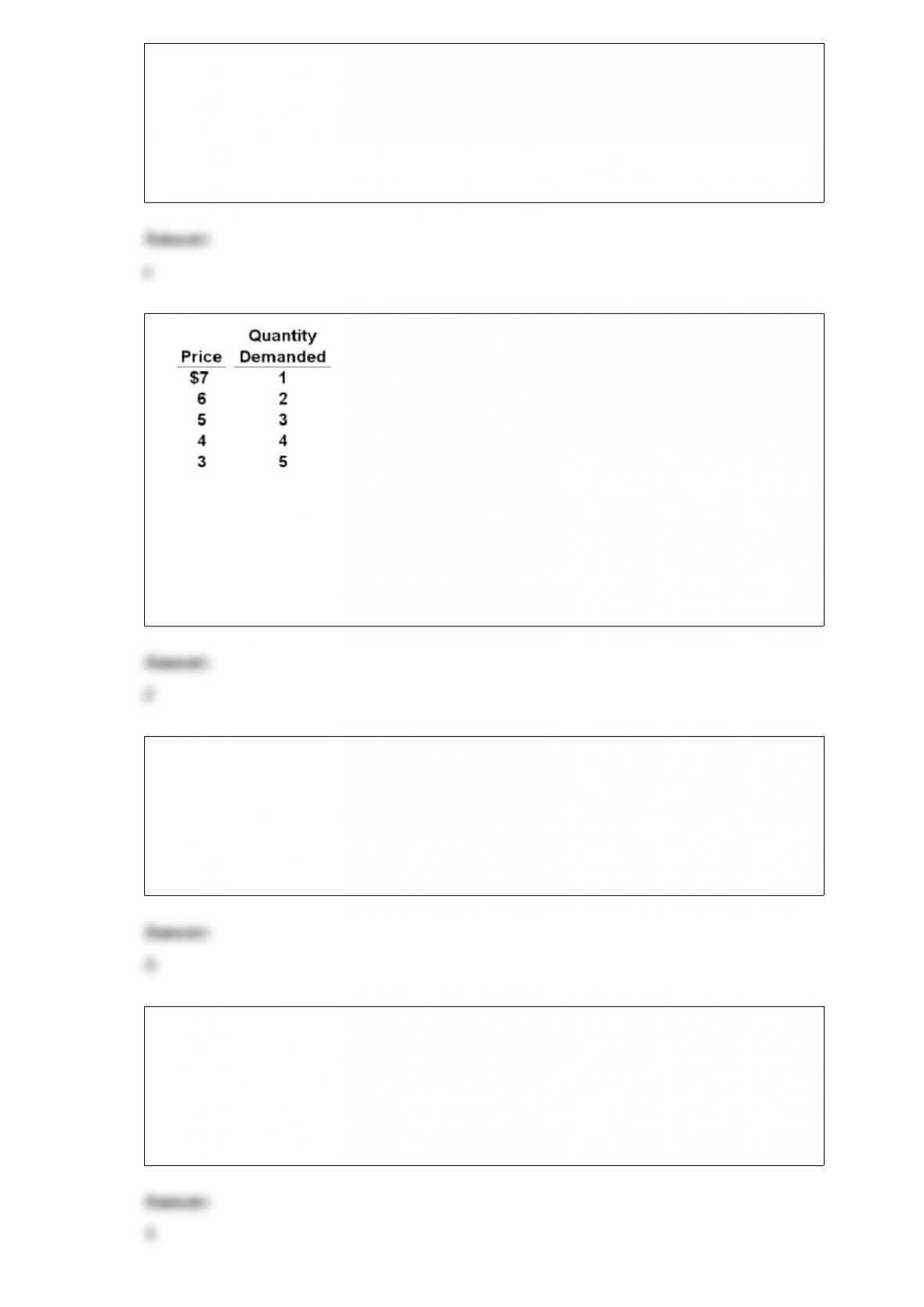
refer to the above data. at the point where 3 units are being sold, the coefficient of price
elasticity of demand:
a.cannot be estimated.
b.suggests that the market is purely competitive.
c.is less than unity (one).
d.is greater than unity (one).
3) The following are hypothetical exchange rates: 2 euros = 1 pound; $1 = 2 pounds.
We can conclude that:
A.$1 = 4 euros.
B.$1 = .5 euros.
C.1 euro = $.50.
D.1 euro = $2.
4) Other things equal, we would expect the labor demand curve of a monopolistic seller
to:
A.decline more rapidly than that of a purely competitive seller.
B.decline less rapidly than that of a purely competitive seller.
C.decline at the same rate as that of a purely competitive seller.
D.be more elastic than that of a purely competitive seller.
5) In a certain year the aggregate amount demanded at the existing price level consists
of $100 billion of consumption, $40 billion of investment, $10 billion of net exports,
and $20 billion of government purchases. Full-employment GDP is $200 billion. To
obtain full employment under these conditions the government should:
A.encourage personal saving by increasing the interest rate on government bonds.
B.decrease government expenditures.
C.reduce tax rates and/or increase government spending.
D.discourage private investment by increasing corporate income taxes.
6) health savings accounts (hsas) implemented by the 2003 medicare law:
a.are only available to those enrolled in medicare.
b.allow workers to accumulate untaxed dollars for payment of qualified medical
expenses.
c.are criticized because they require workers to “use it or lose it” each year; workers are
not allowed to accumulate balances over time.
d.can only be used to pay for prescription drugs.
7)
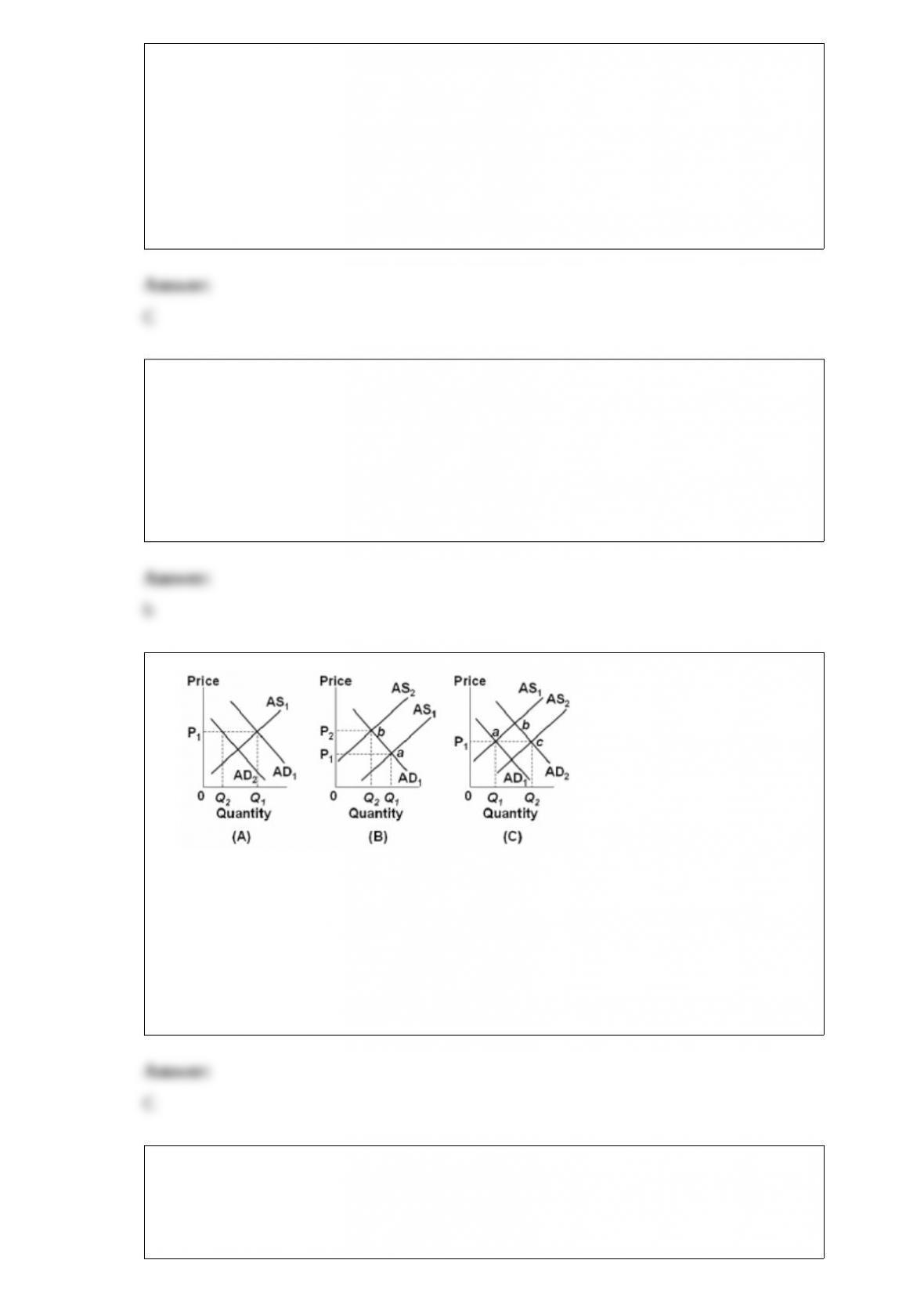
Refer to the above diagrams, in which AD1 and AS1 are the “before” curves and AD2
and AS2 are the “after” curves. Other things equal, a decrease in resource prices is
depicted by:
A.panel (A) only.
B.panel (B) only.
C.panel (C) only.
D.panels (B) and (C).
8) assume you are spending your full budget and purchasing such amounts of x and y
that the marginal utility from the last units consumed is 40 and 20 utils respectively.
assume (a) the prices of x and y are $8 and $4 respectively; (b) it takes 3 hours to
consume a unit of x and 1 hour to consume a unit of y; and (c) your time is worth $2 per

hour. you
a.should substitute x for y until the marginal utility per hour is the same for both
products.
b.are consuming x and y in the optimal amounts.
c.should consume less of y and more of x.
d.should consume less of x and more of y.
9) real gdp measures:
a.current output at current prices.
b.current output at base year prices.
c.base year output at current prices.
d.base year output at current exchange rates.
10) the achievement of full employment through time will:
a.diminish labor productivity.
b.reduce the level of investment as a percentage of gdp.
c.increase the realized rate of economic growth.
d.have no impact on the rate of economic growth.
11) Compare the real cost of commodity resources today (circa 2007) with their cost in
the 18451850 period. What explains the change?
12) Describe the short-run situation in U.S. agriculture. What are its causes?
13) Explain how monopolistically competitive producers try to improve on the
condition of just breaking even in the long run. Is this improvement a benefit for
consumers?
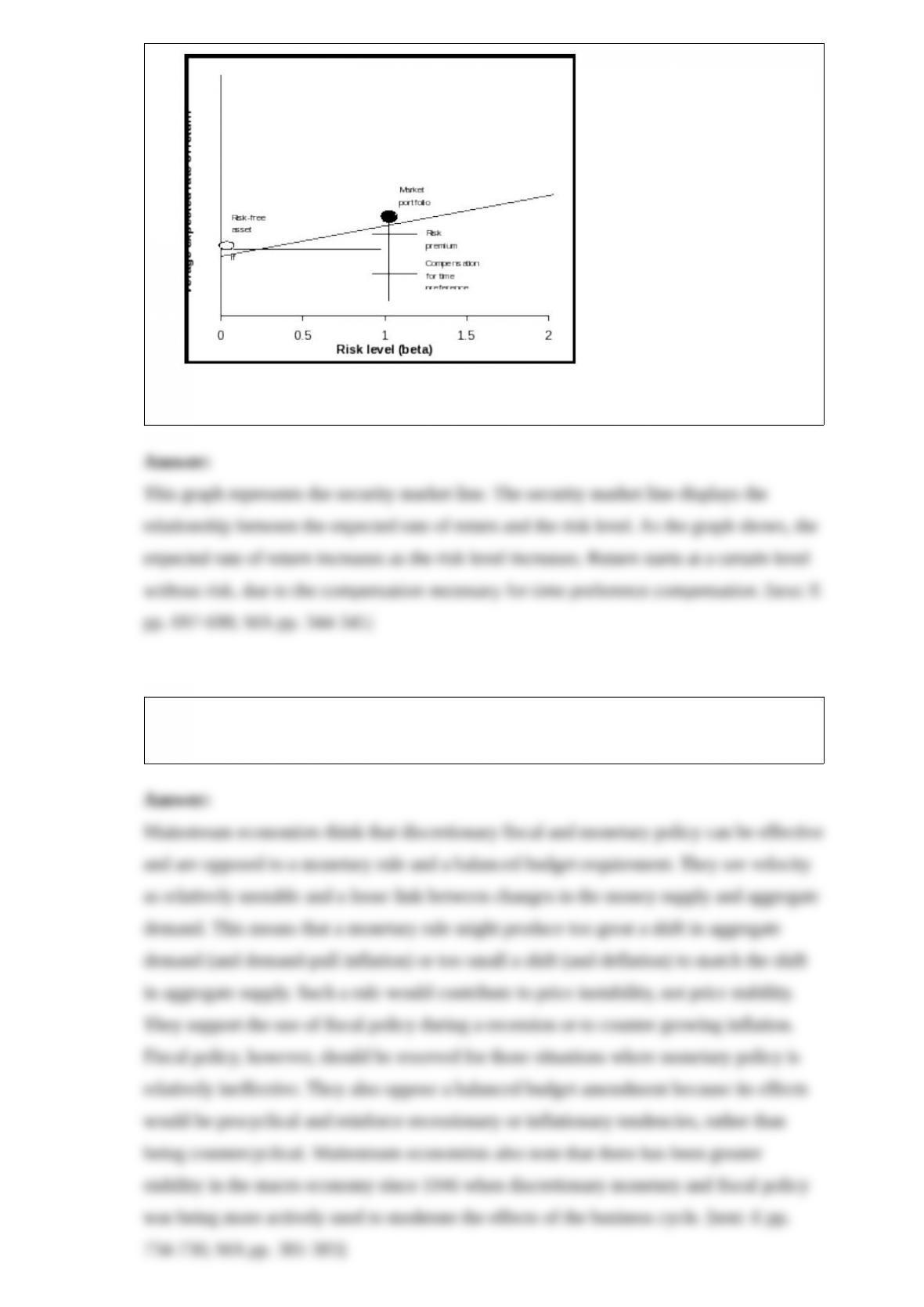
14) Explain the relationship
displayed on the graph. Mark the following points of interest: if, a risk-free asset, a
market portfolio, the compensation for time preference and the risk premium.
15) Explain the mainstream economists justification for the use of discretionary fiscal
and monetary policy and their criticisms of policy rules.
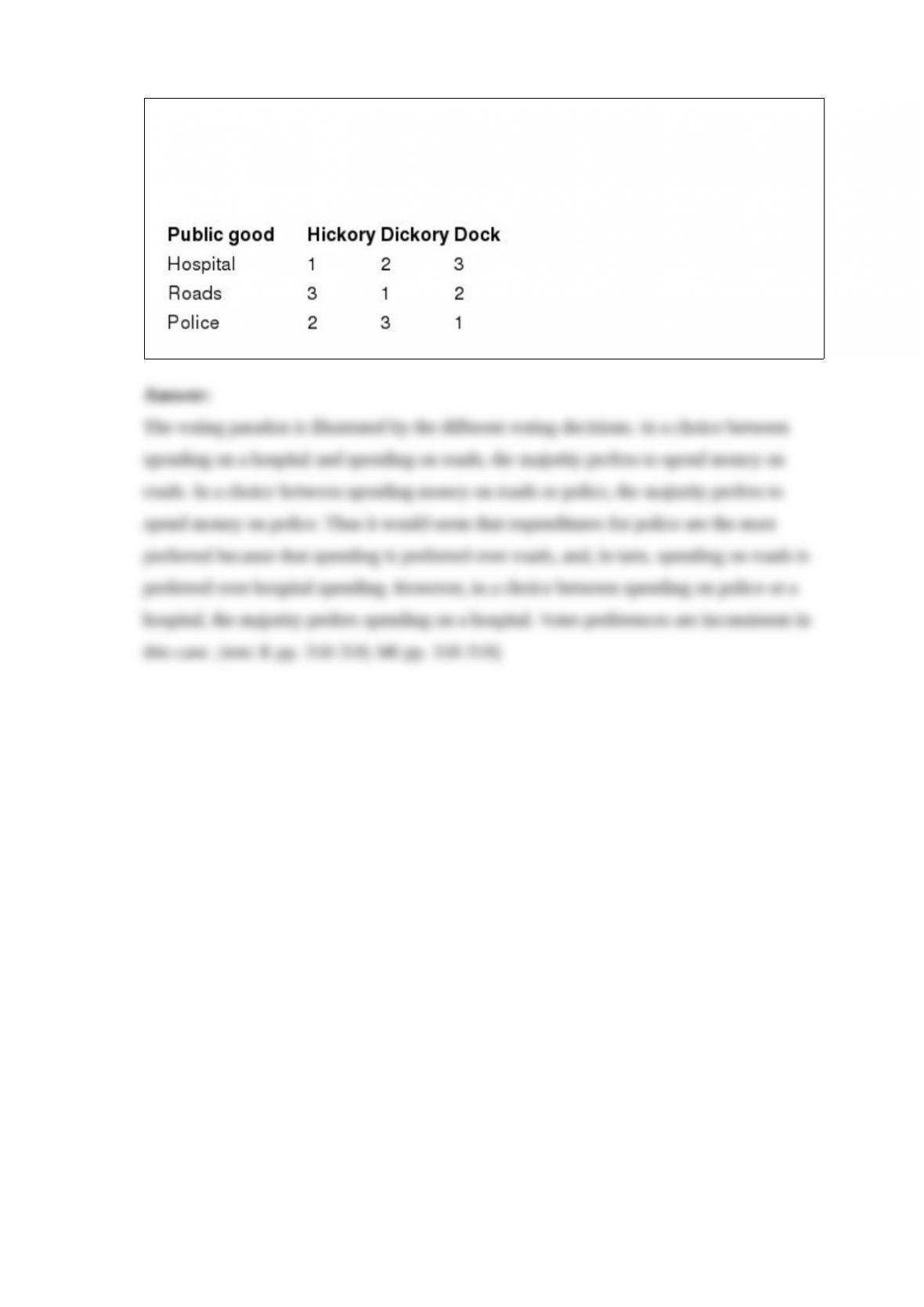
16) Explain the paradox of voting that is illustrated in the table below in choices
between the same expenditure on three different public goods. The numbers under each
name indicate the voting preferences (first, second, or third choice) of each of the three
citizens in the society.