1) Which of the following are included and which are excluded in calculating this years
GDP? Explain in each instance.
(a)A monthly scholarship check received by an economics student
(b)The purchase of a new truck by a trucking company
(c)Government purchase of missiles from a private business
(d)The purchase of a used tractor by a farmer
(e)The value of the purchase of shares of Microsoft by an individual
2) the regulatory mechanism of the market system is:
a.self-interest.
b.private property.
c.competition.
d.specialization.
3) The aggregate expenditures model is built upon which of the following assumptions?
A.Prices are sticky downward.
B.The economy is at full employment.
C.Prices are fully flexible.
D.Government spending policy has no ability to affect the level of output.
4) if in the short run a firm’s total product is increasing, then its:
a.marginal product must also be increasing.
b.marginal product must be decreasing.
c.marginal product could be either increasing or decreasing.
d.average product must also be increasing.
5) The equilibrium interest rate:
A.allocates the available supply of loanable funds to investment projects that have high
enough rates of return to justify the borrowing.
B.rises when the supply of loanable funds increases.
C.is the price paid for the use of any resource.
D.affects the size of total output but not the composition of that output.
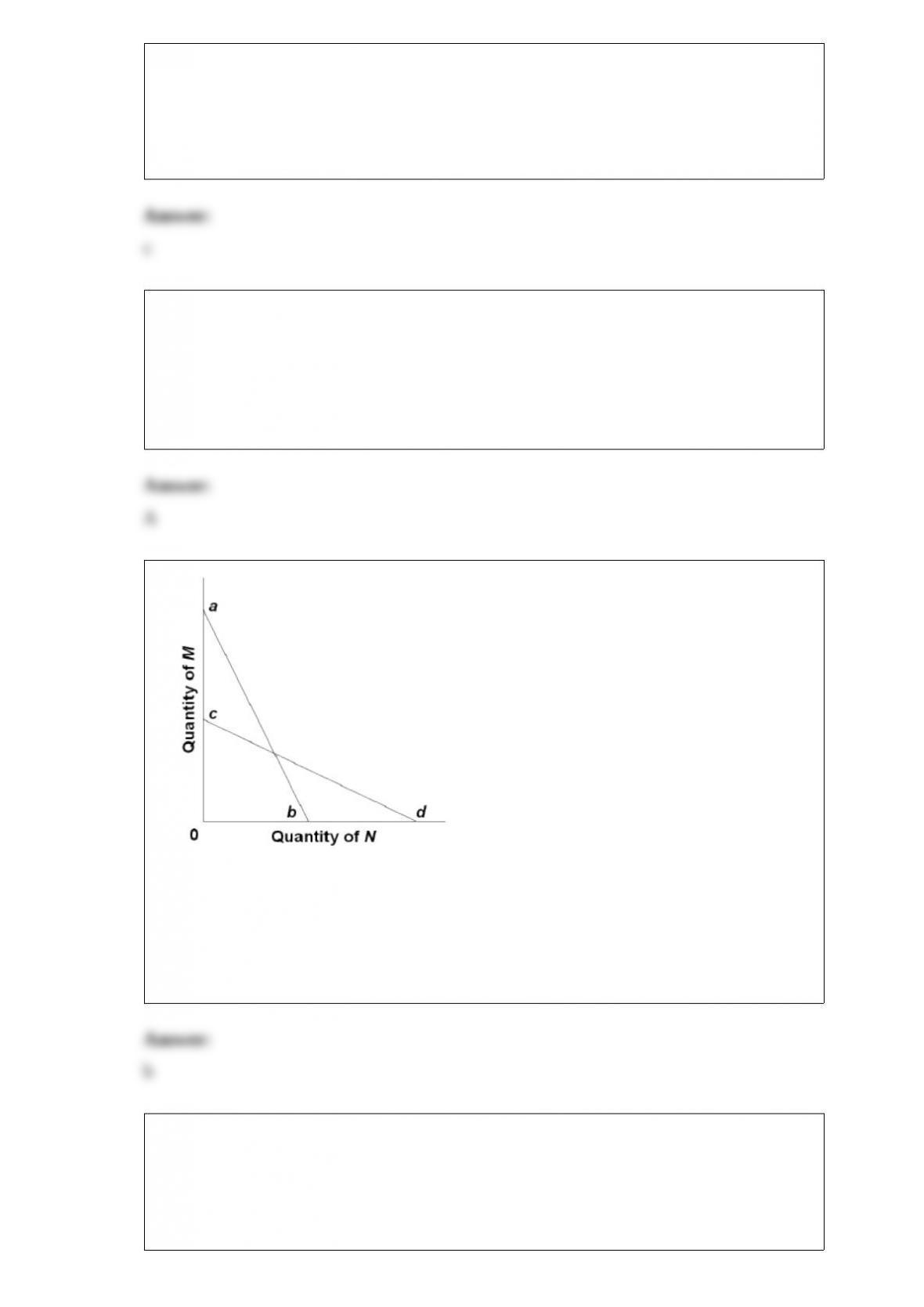
6)
the budget line shift from ab to cd in the above figure is consistent with:
a.decreases in the prices of both m and n.
b.an increase in the price of m and a decrease in the price of n.
c.a decrease in money income.
d.an increase in money income.
7) Suppose that a union successfully negotiated a 10 percent wage increase and the
quantity of labor demanded increased by 10 percent. We can conclude that:
A.the labor demand curve must have independently shifted to the right.
B.labor demand is highly elastic.
C.the coefficient of labor demand elasticity is less than 1.
D.labor demand is unit-elastic.
8) The rationale for ability-to-pay taxation and the contention that those with large
incomes should pay more taxes both absolutely and relatively is that:
A.high-income receivers are generally in a better position to shift taxes than are
low-income receivers.
B.the transfer system is regressive and it is therefore essential to have an offsetting
progressive tax structure.
C.rational consumers spend their first dollars of income on the most urgently desired
goods and successive dollars on less essential goods.
D.taxes should be paid for financing public goods in direct proportion to the satisfaction
an individual derives from those goods.
9) x-inefficiency refers to a situation in which a firm:
a.is not as technologically progressive as it might be.
b.encounters diseconomies of scale.
c.fails to realize all existing economies of scale.
d.fails to achieve the minimum average total costs attainable at each level of output.
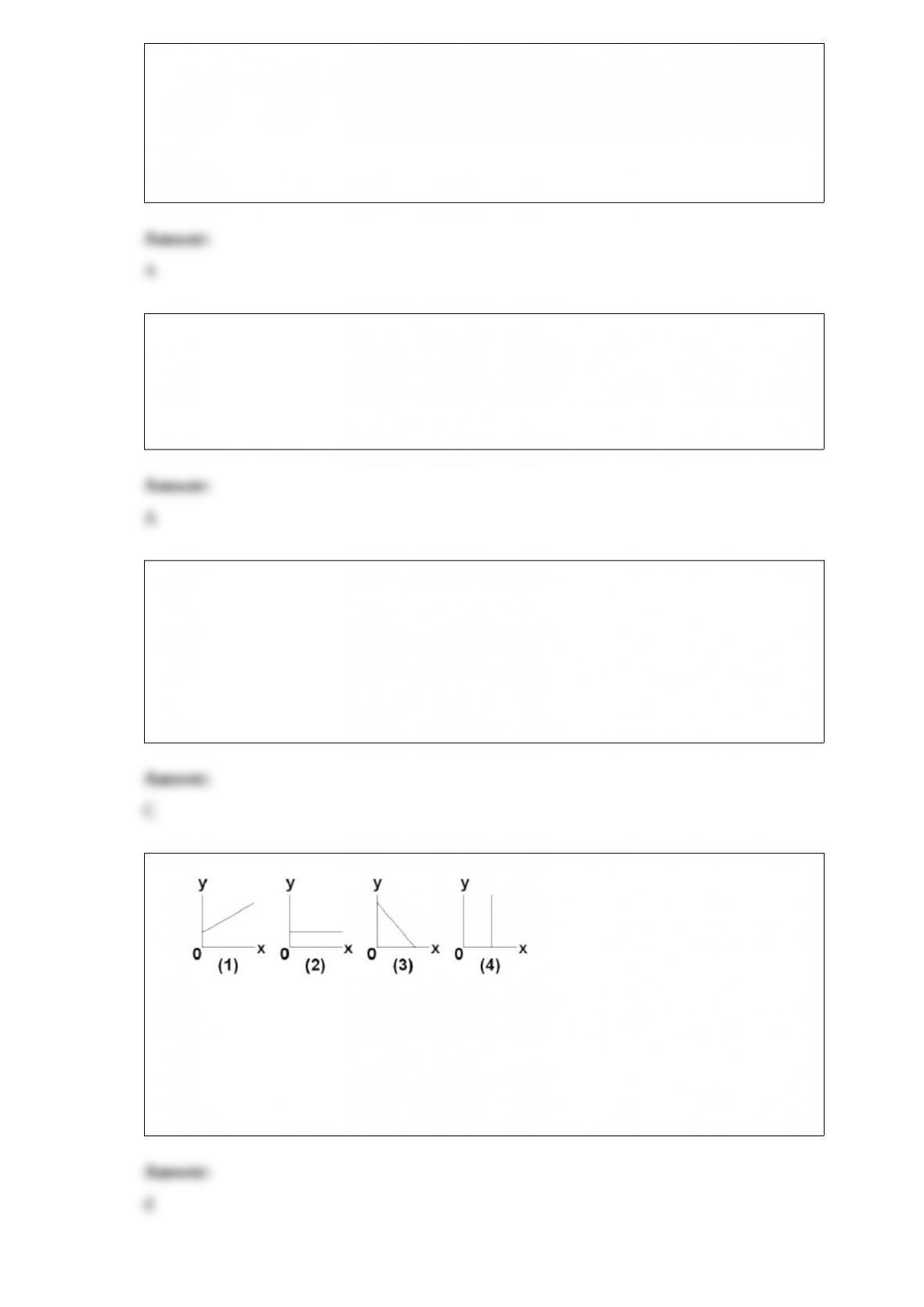
10) The following information for the Moolah Bank.
Assume that the listed amounts constitute this bank’s complete set of accounts.
Moolah’s:
A.assets are $1000.
B.liabilities are $1000.
C.net worth is zero.
D.profit is $1000.
11) In recent years the industrially advanced nations as a group have provided foreign
aid amounting to about what percentage of their aggregate outputs?
A..25 percent
B..7 percent
C.1 percent
D.2 percent
12) Which one of the following is concerned with social regulation?
A.Equal Employment Opportunity Commission
B.Federal Communications Commission
C.Sherman Commission
D.Federal Energy Regulatory Commission
13) Mainstream macroeconomics has embraced the:
A.rational expectations view that stabilization policy is totally ineffective.
B.monetarist view that the Fed should increase the money supply at a fixed annual rate.
C.rational expectations view that expectations can shift the aggregate demand and
aggregate supply curves.
D.monetarist view that an increase in government spending crowds out an equal amount
of investment spending.
14)
answer on the basis of the relationships shown in the above four figures. the amount of
y is directly related to the amount of x in:
a.both 1 and 3
b.both 1 and 2
c.2 only
d.l only
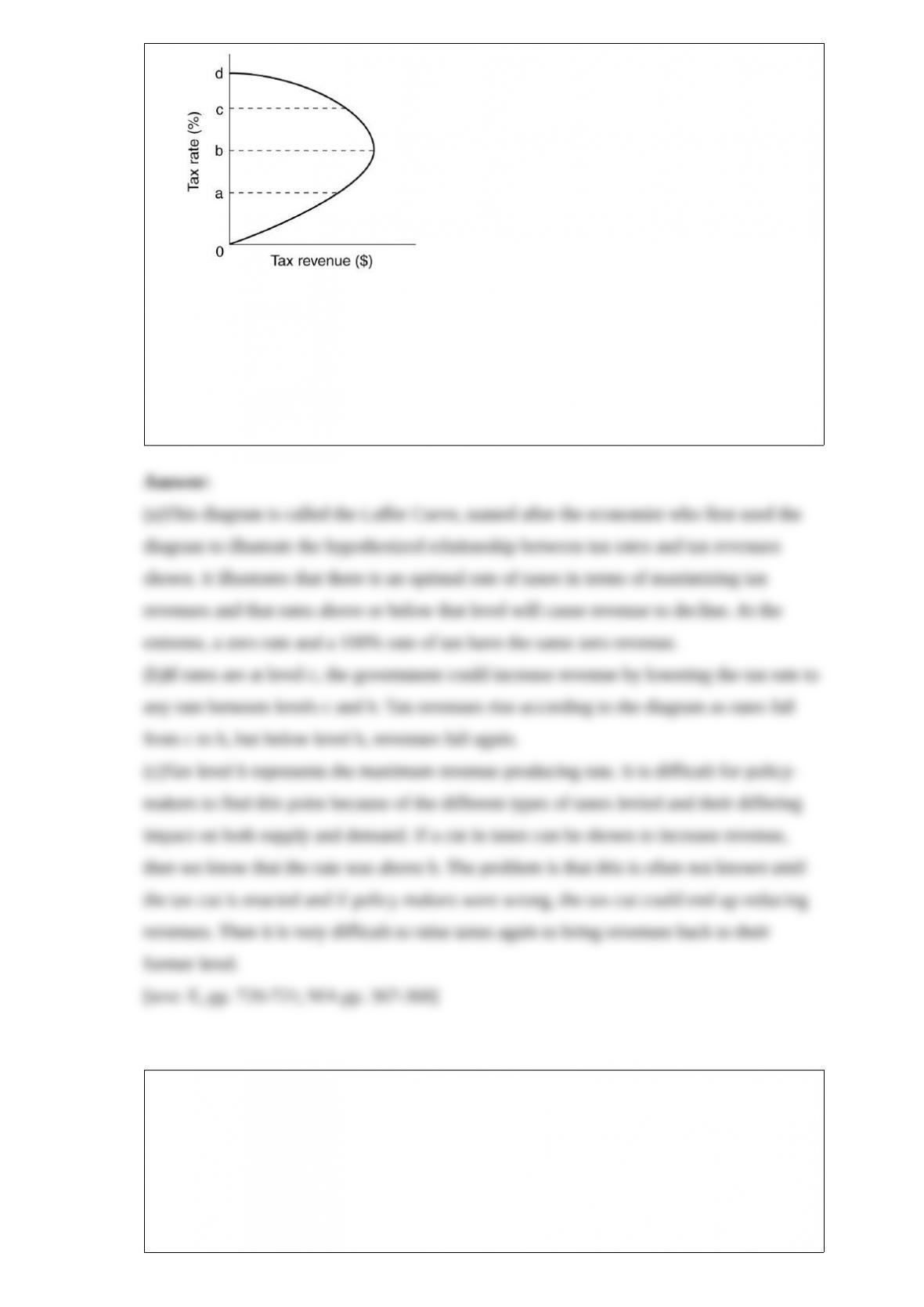
15)
Use the following diagram to answer the next three questions.
(a)What is this diagram called and what does it say about the relationship between tax
rates and tax revenues?
(b)If tax rates are at level c, should the government raise or lower tax rates to increase
revenues? Explain.
(c)What does tax level b represent? Could policy makers find the actual rate that b
represents? Discuss this point.
16) the law of increasing opportunity costs states that:
a.if society wants to produce more of a particular good, it must sacrifice larger and
larger amounts of other goods to do so.
b.the sum of the costs of producing a particular good cannot rise above the current
market price of that good.
c.if the sum of the costs of producing a particular good rises by a specified percent, the
price of that good must rise by a greater relative amount.

d.if the prices of all the resources used to produce goods increase, the cost of producing
any particular good will increase at the same rate.
17) government transfer payments:
a.have been virtually eliminated by federal revenue sharing.
b.have virtually no effect on the distribution of income.
c.make the distribution of income less equal.
d.make the distribution of income less unequal.
18) The main focus of the Big Mac index is relative:
A.inflation rates among countries.
B.purchasing power of the world’s currencies.
C.real wage rates among countries.
D.income changes among countries.
19) if you would have to pay $5000 in taxes on a $25,000 taxable income and $7000 on
a $30,000 taxable income, then the marginal tax rate on the additional $5000 of income
is:
a.40 percent and the average tax rate is about 23 percent at the $30,000 income level.
b.50 percent and the average tax rate is 40 percent at the $30,000 income level.
c.40 percent and the average tax rate is 25 percent at the $25,000 income level.
d.30 percent but average tax rates cannot be determined from the information given.
20) other things equal, if the fixed costs of a firm were to increase by $100,000 per
year, which of the following would happen?
a.marginal costs and average variable costs would both rise.
b.average fixed costs and average variable costs would rise.
c.average fixed costs and average total costs would rise.
d.average fixed costs would rise, but marginal costs would fall.