
Increases in the supply of scientists and engineers can increase the level of
a. investment.
b. consumption.
c. government spending.
d. technology.
If a farmer’s opportunity cost of producing 50,000 bushels of wheat is 20,000 fewer
bushels of soybeans, then her opportunity cost of producing 50,000 bushels of soybeans
must also be 20,000 fewer bushels of wheat.
a. True
b. False
Most economists seem to agree that cutting taxes
a. on saving has more impact than cutting taxes to increase investment.
b. to stimulate investment is more effective than cutting taxes to stimulate work.
c. to increase work is more effective than cutting taxes to stimulate investment.
d. to increase work incentives is more effective than cutting taxes on saving.

Enacting a law controlling rents near a major university will increase the affordable
housing for college students.
a. True
b. False
Nondiscriminatory firms hiring in the market place have a cost advantage.
a. True
b. False
In 1972, a very controversial study asserted that income differences among individuals
did not depend on genetic differences in reasoning ability, or differences between
schools, or family background. Moreover, the effects of level of schooling are much

less than previously understood. After controlling for all of these background variables,
much of the variation in earnings appeared to be random. From this analysis, one might
reach the very controversial conclusion that earnings depended to a very great extent on
a. human capital.
b. ability.
c. schooling.
d. luck.
Specialization and division of labor are made easier by the existence of money.
a. True
b. False
The Federal Reserve stepped in to help
a. Bear Stearns but not Lehman Brothers.
b. Lehman Brothers but not Bear Stearns.
c. both Bear Stearns and Lehman Brothers.
d. neither Bear Stearns nor Lehman Brothers.

Airline deregulation has led to: (i) lower prices; (ii) a deterioration of service to isolated
communities.
a. i and ii
b. i but not ii
c. ii but not i
d. neither i nor ii
Productivity growth is the main cause of rising living standards.
a. True
b. False
Someone who studies the pricing policies of the Microsoft Corporation would be a
microeconomist.
a. True
b. False
The aggregate supply curve shows how much the nation’s businesses are willing and
able to produce at each price level.
a. True
b. False
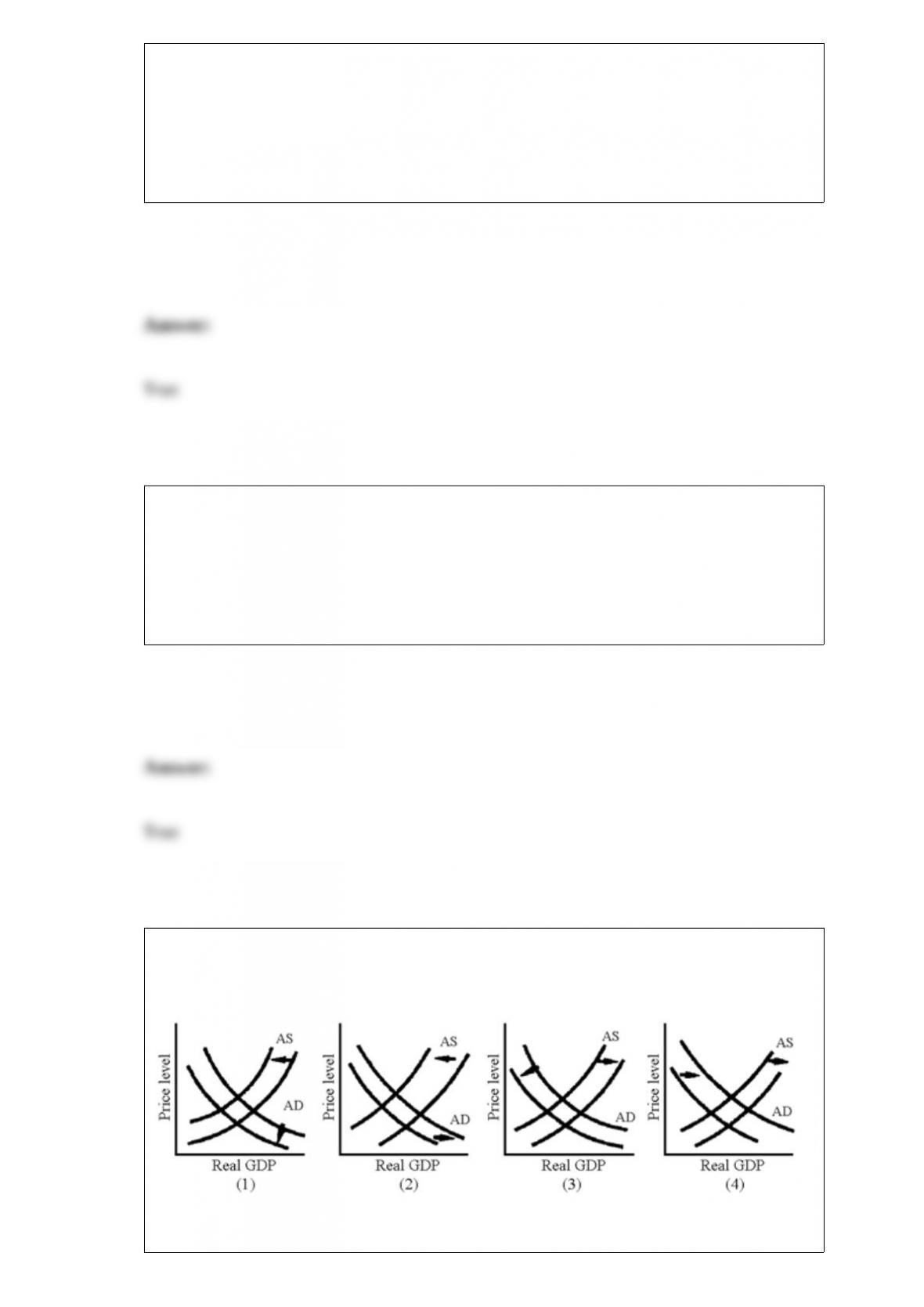
Figure 20-4
Which of the situations illustrated in Figure 20-4 shows a currency depreciation leading

to inflation?
a. 1
b. 2
c. 3
d. 4
A local flower grower grows products in a plot of land which is exceptionally colorful,
and is admired by many passersby. There is no way to charge for this in the price of the
flowers. We can safely conclude that
a. the florist produces too many flowers.
b. the florist produces too few flowers.
c. the florist produces the right amount of flowers.
d. society pays the socially optimal amount for the flowers.
Which of the following situations would cause a period of stagflation at a later point in
time?
a. a recessionary gap

b. a reduction in investment spending
c. an increase in technological development
d. an inflationary gap
Random walk theory says
a. throwing darts will pick winners.
b. random selection of stocks will do as well as other methods of stock choice.
c. speculation can’t lose if you wait long enough.
d. investment in stocks can’t be profitable.
Which of the following countries has not experienced hyperinflation in the twentieth
century?
a. Germany
b. Russia
c. Argentina
d. United States

The production possibilities frontier can be used to show a manufacturer’s possible
combinations of output of two goods.
a. True
b. False
The theory of rational expectations says that
a. workers make excellent choices of places to work.
b. workers make the best possible forecasts of inflation.
c. economists make rational expectations of inflation.
d. economists expect workers to be rational.

If U.S. securities pay 7 percent interest, and if Great Britain’s securities pay 5 percent
interest, then
a. pounds depreciate relative to dollars.
b. pounds appreciate relative to dollars.
c. Great Britain’s imports will rise.
d. Great Britain’s exports will fall.
If price goes up 20 percent and quantity demanded declines by 10 percent, total revenue
will rise.
a. True
b. False
Economics
a. is a narrowly focused discipline.
b. is a broad-ranging discipline.
c. concerns itself only with the U.S. economy.
d. says little about “everyday life.”
e. deals with minor problems.
Protectionism may fail to reduce a current account deficit because it
a. depreciates the dollar.
b. invites retaliation, which hurts exports.
c. encourages exports.
d. does not reduce imports.
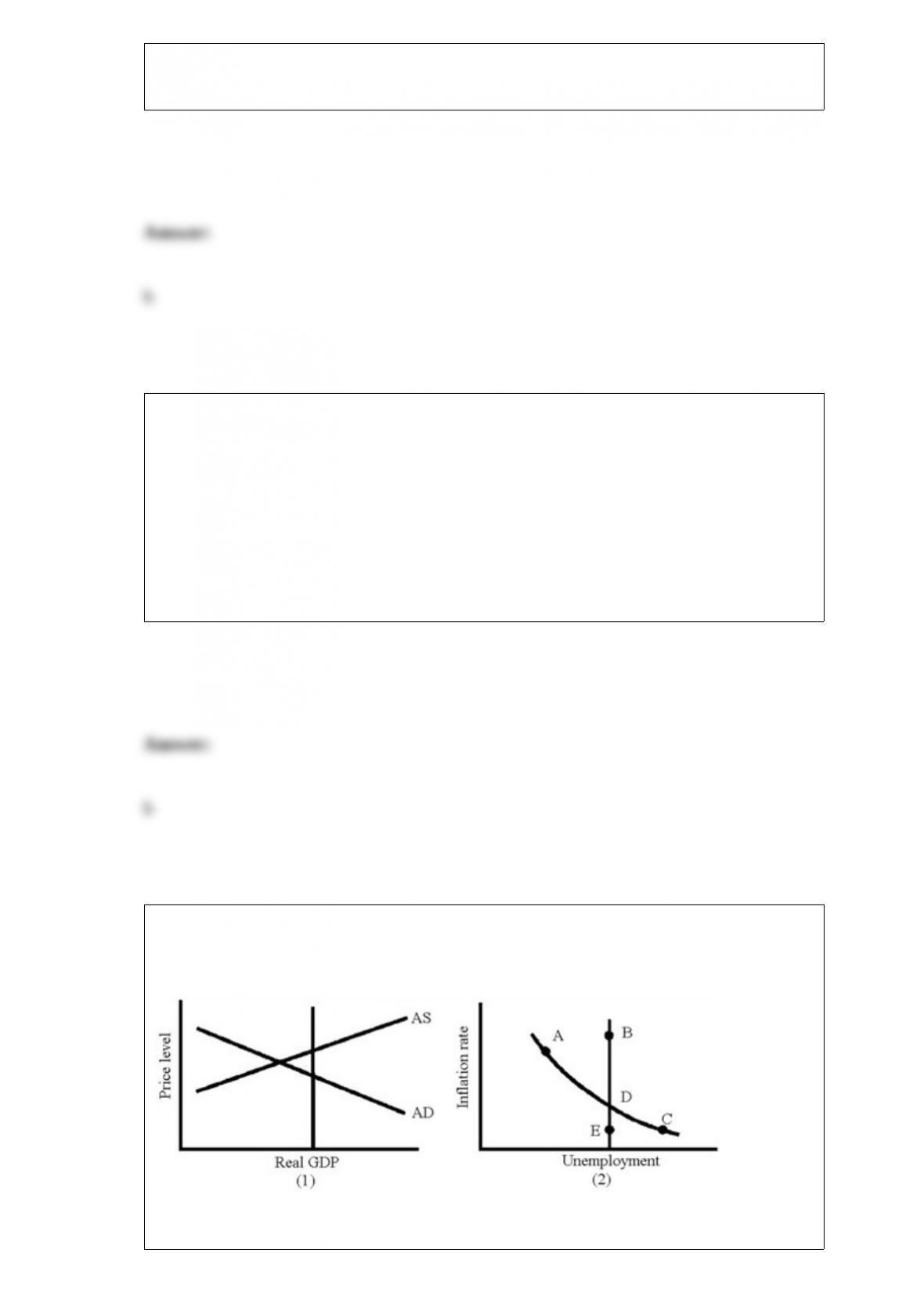
Figure 17-2
Given the situation in graph (1) in Figure 17-2, what action could be expected from the

economy’s self-correcting mechanism?
a. an increase in aggregate demand
b. a decrease in aggregate demand
c. an increase in aggregate supply
d. a decrease in aggregate supply
Define the following terms completely and concisely.
a. marginal revenue
b. average revenue
c. optimal decision
d. satisficing
e. marginal profit

Economic growth solves the problem of scarcity.
a. True
b. False
The quantity demanded in a market depends on many things, but the concept of
elasticity focuses on the effect of changes in the price of the good.
a. True
b. False

The difference between the earnings of construction workers who work on bridges and
skyscrapers and those who work on highways is probably due to
a. differences in education requirements.
b. ability (mental) differences.
c. a compensating differential.
d. luck.
For the monopolistic competitor, MR = P.
a. True
b. False
In the cigarette industry either R. J. Reynolds or Phillip Morris, for a time, raised prices
twice a year by about 50 cents per carton. The other firms in the industry raised their
prices by the same amount. Economists call this
a. predatory pricing.
b. a price war.
c. price leadership.

d. sales maximization.
Economic theory has traditionally focused on optimality in decision-making.
a. True
b. False
The Iranian Revolution in 1979 led to another interruption of oil supplies to the United
States. This caused the reoccurrence of
a. deflation.
b. full-employment.
c. trade surpluses.
d. stagflation.

We should expect the consumption function to shift downward if
a. real interest rates rise.
b. price levels fall.
c. consumers become more optimistic about future incomes.
d. consumers become more pessimistic about future incomes.
To increase the money supply, the Fed purchases government securities from banks,
paying for them with new reserves.
a. True
b. False