
1) Which of the following frontier fields of economics identifies that people do not
always act rationally?
a.asymmetric information
b.political economy
c.behavioral economics
d.existential economics
2) Suppose when a monopolist produces 75 units its average revenue is $10 per unit, its
marginal revenue is $5 per unit, its marginal cost is $6 per unit, and its average total
cost is $5 per unit. What can we conclude about this monopolist?
a.The monopolist is currently maximizing profits, and its total profits are $375.
b.The monopolist is currently maximizing profits, and its total profits are $300.
c.The monopolist is not currently maximizing profits; it should produce more units and
charge a lower price to maximize profits.
d.The monopolist is not currently maximizing profits; it should produce fewer units and
charge a higher price to maximize profits.
3) Which of the following prohibits executives of competing firms from even talking
about fixing prices?
a.Sherman Act
b.Clayton Act
c.Federal Trade Commission
d.U.S. Justice Department
4) Suppose you value a special watch at $100. You purchase it for $75. On your way
home from class one day, you lose the watch. The store is still selling the same watch,
but the price has risen to $85. Assume that losing the watch has not altered how you
value it. What should you do?
a.Pay the $85 to buy the watch.
b.Wait to see if the watch goes on sale. If the price drops to $75 or less, buy the watch.
c.Wait to see if the watch goes on sale. If the price drops to $25 or less, buy the watch.
d.Do not buy the watch.
5) In a duopoly if the firms have agreed to jointly maximize profits, then each firm can
increase its current profits by producing more.
a.True
b.False
6) Scenario 13-13
Christine is an artist who creates custom cookie jars. Her annual revenue from selling
the cookie jars is $90,000. The annual explicit costs of the materials used to make the
cookie jars are $54,000.
Christine used $5,000 from her personal savings account to buy pottery tools for her
business. The savings account paid 1% annual interest. What is Christine’s annual
opportunity cost of the financial capital that she invested in her business?
a.$5
b.$50
c. $100
d. $200
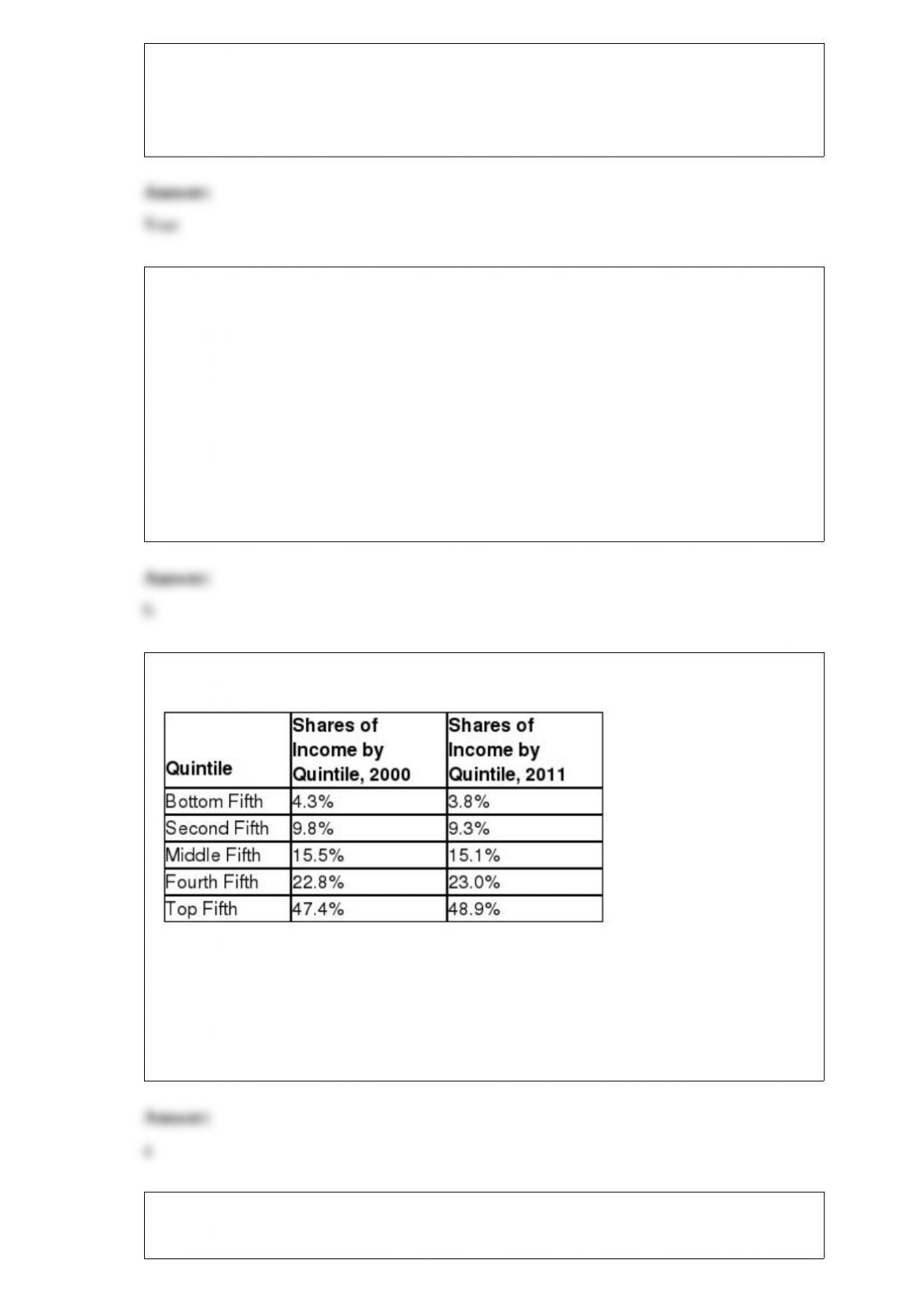
7) Table 20-8
Source: U.S. Bureau of Census
Refer to Table 20-8. In 2011, the bottom 40% of families has
a.about 13% of total income in the U.S.
b.about 28% of total income in the U.S.
c.about 51% of total income in the U.S.
d.about 72% of total income in the U.S.
8) Economists have found evidence of a Giffen good when studying the consumption of
rice in the Chinese province of Hunan.
a.True
b.False
9) The traditional view of monopolistic competition holds that this type of industrial
structure is inefficient because
a.there are too few firms to reach an efficient level of production.
b.firms do not operate at the output that minimizes average costs.
c.more advertising is needed to inform customers about product differences.
d.consumers do not have enough choice among the product varieties available.
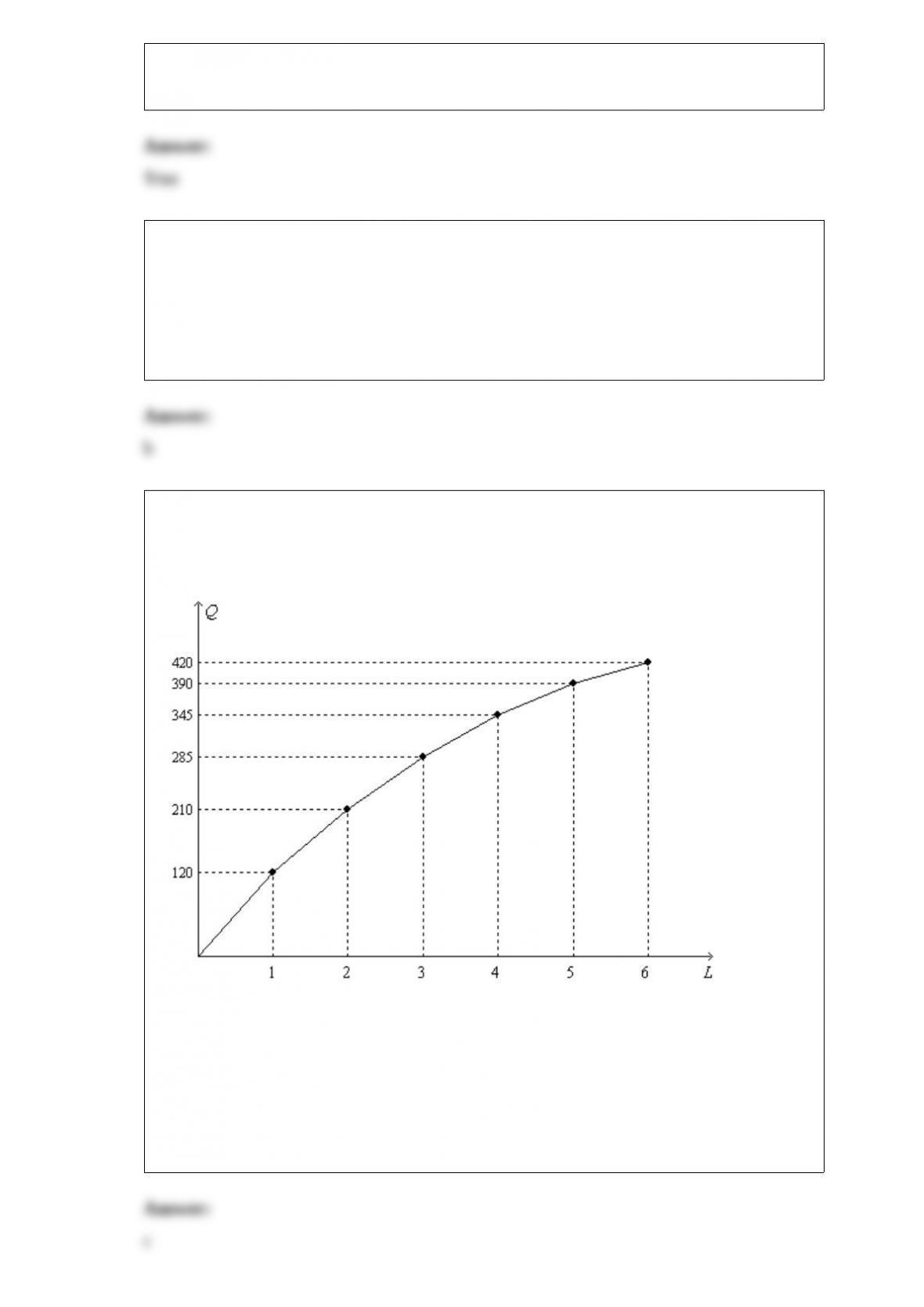
10) Figure 18-1
On the graph, L represents the quantity of labor and Q represents the quantity of output
per week.
Refer to Figure 18-1. Suppose the firm sells its output for $12 per unit, and it pays
each of its workers $700 per week. How many workers will the firm hire to maximize
its profit?
a.2
b.3
c.4
d.5
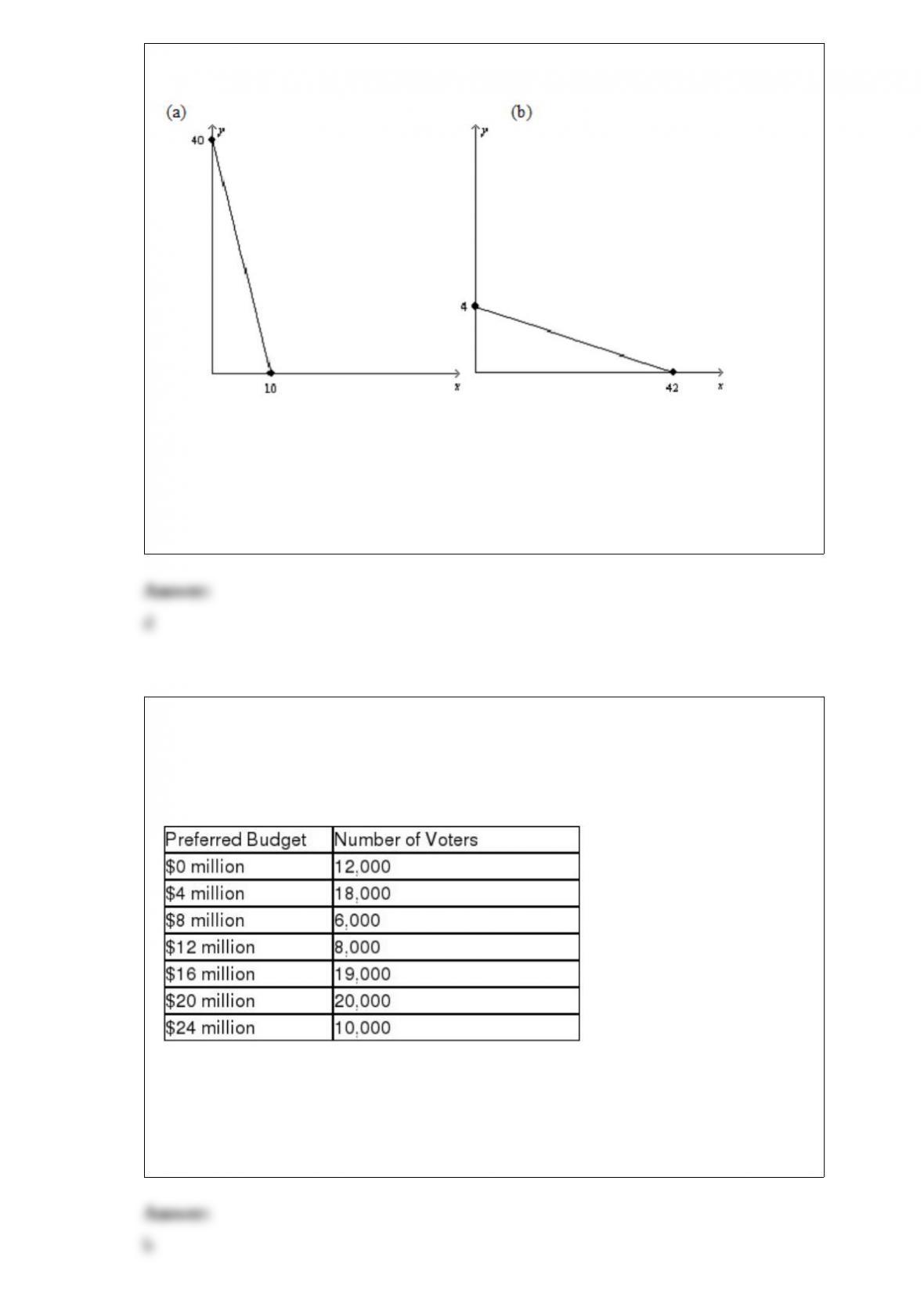
11) Figure 21-5
Refer to Figure 21-5. In graph (a), what is the price of good X relative to the price of
good Y (i.e., PX/PY)?
a. 1/4
b.1/3
c.3
d.4
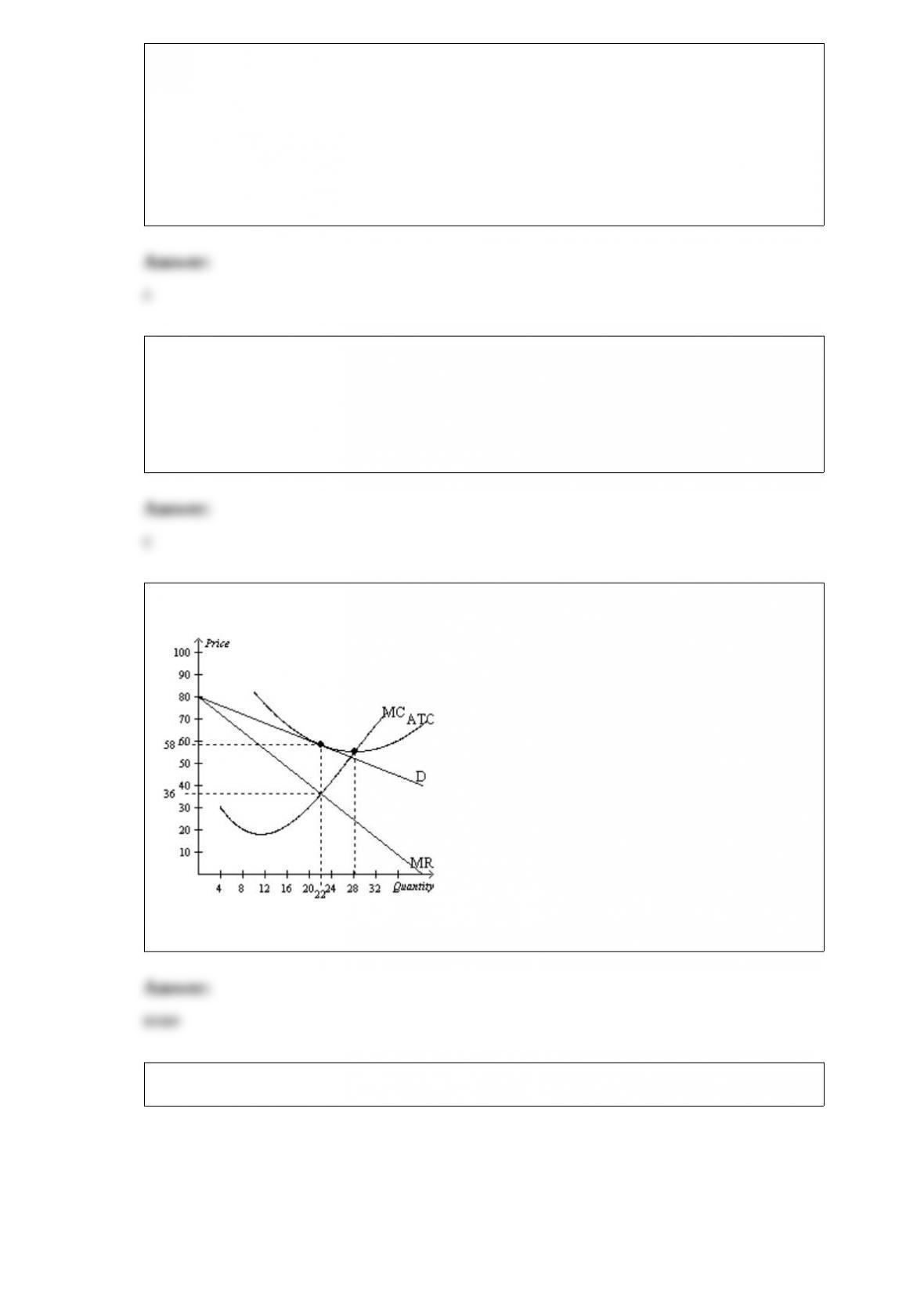
12) Table 22-22
The town of Fairview is considering a renovation to the high school. The voters in
Fairview have different preferences on the budget for the renovation as displayed
below.
Refer to Table 22-22. The median voter is one who prefers to spend
a.$12 million.
b.$16 million
c.$20 million.
d.None of the above are correct.
13) The world price of a ton of steel is $650. Before Russia allowed trade in steel, the
price of a ton of steel there was
$1,000. Once Russia allowed trade in steel with other countries, Russia began
a.exporting steel and the price per ton in Russia decreased to $650.
b.exporting steel and the price per ton in Russia remained at $1,000.
c.importing steel and the price per ton in Russia decreased to $650.
d.importing steel and the price per ton in Russia remained at $1,000.
14) Which of the following is not held constant in a demand schedule?
a.income
b.tastes
c.price
d.expectations
15) Figure 16-12
What, if any, long run adjustment will take place in this industry?
16) Consider the following demand schedule.
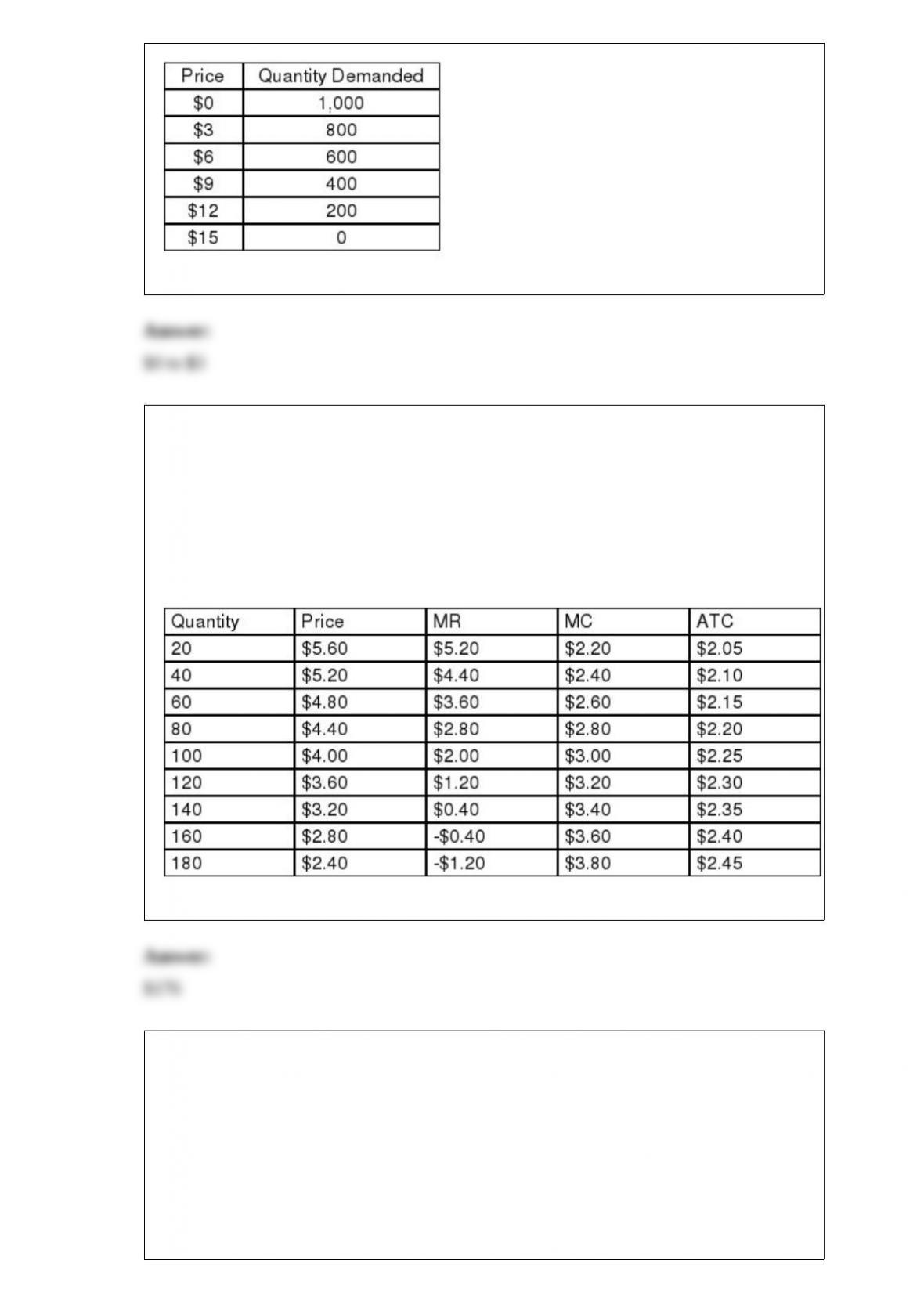
Using the midpoint method, between which two prices is most inelastic?
17) Scenario 16-3
Peter operates an ice cream shop in the center of Fairfield. He sells several unusual
flavors of organic, homemade ice cream so he has a monopoly over his own ice cream,
though he competes with many other firms selling ice cream in Fairfield for the same
customers. Peter’s demand and cost values for sales per day are given in the table below.
(Everyone who purchases Peter’s ice cream buys a double scoop cone because it’s so
delicious.)
What is the maximum amount of profit that Peter can earn per day?
18) Scenario 1-2
Suppose that you have a choice between going to the movies with a friend for two
hours or working at your job. If you go to the movies, you will spend $7 on a ticket and
$5 on popcorn. If you choose to work, you will earn $10 an hour.
You have the afternoon free. You have a choice between going to the movies with a
friend or studying economics for three hours. If you go to the movies, you will spend
$8.00 on a ticket and $4.50 on popcorn. If you choose to study economics for three
hours, you will raise your exam grade by 10 points.
What is your opportunity cost of working?

19)
20) Refer to Scenario 5-7. Good X and Good Y are related as
21) Scenario 19-6
Suppose that in the competitive market for auto repair, firms prefer to hire men rather
than women. Assume that the women applying for positions have the same skills,
experience, and work ethic as the men. As a result of this discrimination, the demand
for women is lower than it otherwise would be.
Refer to Scenario 19-6. Suppose that consumers prefer to have men work on their auto
repairs and are willing to pay higher prices to accommodate these preferences. What
will happen to the wage differential between men and women?
22) Economists use the term to refer to an increase in the overall level of prices in the
economy.
23) Considering perfect competition, monopolistic competition, and monopoly, which
of the market structures can have positive profits in the short run?