
1)
Refer to the above table. In a choice between the highway and the lighthouse:
A.a majority of voters favor the lighthouse.
B.a majority of voters favor the highway.
C.the voters are indifferent as between the two.
D.no voter decision is possible.
2) a natural monopoly occurs when:
a.long-run average costs decline continuously through the range of demand.
b.a firm owns or controls some resource essential to production.
c.long-run average costs rise continuously as output is increased.
d.economies of scale are obtained at relatively low levels of output.
3) if labor productivity in the health care industry rises very slowly relative to wages
and salaries in the industry, this would tend to:
a.increase the demand for health care.
b.decrease the demand for health care.
c.increase the supply of health care.
d.decrease the supply of health care.
4) proponents of the wto argue that free international trade and investment will:
a.reduce economic growth rates in the industrial economies.
b.reduce employment in developing nations.
c.eliminate world poverty.
d.increase living standards of all trading nations.
5) Economists believe that use of the term auction facility:
A.has intensified business cycle fluctuations.

B.has replaced open-market operations as the most important tool of monetary policy.
C.will be limited to times of economic crisis when a quick injection of reserves will be
helpful.
D.will give the Fed the ability to prevent recessions.
6) which of the following would most likely move the economy into a recession in the
short term?
a.invention of a new product that most consumers will want to buy.
b.innovations in management that enhance worker productivity.
c.the central bank printing less money than was anticipated.
d. congress passing a reduction in personal income tax rates.
7) Which of the following will not cause a shift in the demand for resource X?
A.a decline in the price of resource X
B.an increase in the price of the product resource X is producing
C.a decrease in the price of substitute resource Y
D.an increase in the productivity of resource X
8) suppose that steve heads to the local hamburger shop with $3, expecting to spend $2
for his favorite burger and $1 for french fries. when he gets there he discovers that his
favorite burger is on sale for $1, so he buys two burgers and one order of french fries.
steve’s consumption behavior is best explained by:
a.the income effect.
b.the substitution effect.
c.diminishing marginal utility.
d.increasing marginal utility.
9) When the actual rate of inflation exceeds the expected rate:
A.the unemployment rate will temporarily rise.
B.firms will experience rising profits and thus increase their employment.
C.the actual rate of inflation will fall.
D.nominal wages will decline.
10) The union wage advantage:
A.has consistently been in the 25-30 percent range since the Second World War (1945).
B.is estimated to be about 15 percent.
C.has steadily increased along with the relative decline in unionism occurring since
1955.
D.reached a record-high level in 2003.
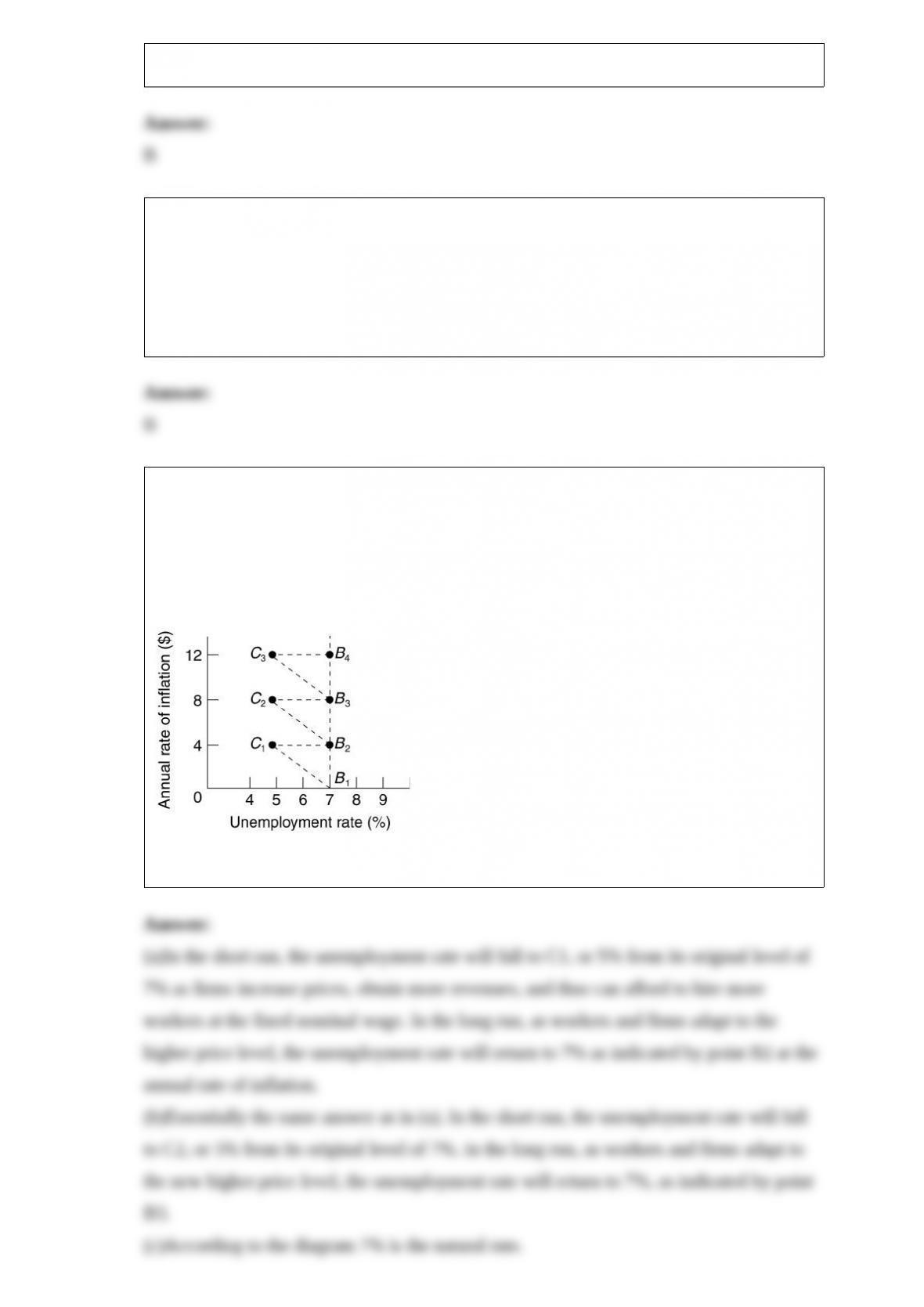
11) Answer the questions based on the following diagram.
(a)Assume the economy is initially at point B1 and there is an increase in aggregate
demand which results in a 4% increase in prices. Describe the short-run and long-run
outcomes that would result in this economy.
(b)Assume the economy is initially at point B2, and there is an increase in aggregate
demand. What will happen in the economy? Explain, using the graph.
(c)Based on this diagram, what would the prediction be for the natural
(full-employment) rate of unemployment?
12)
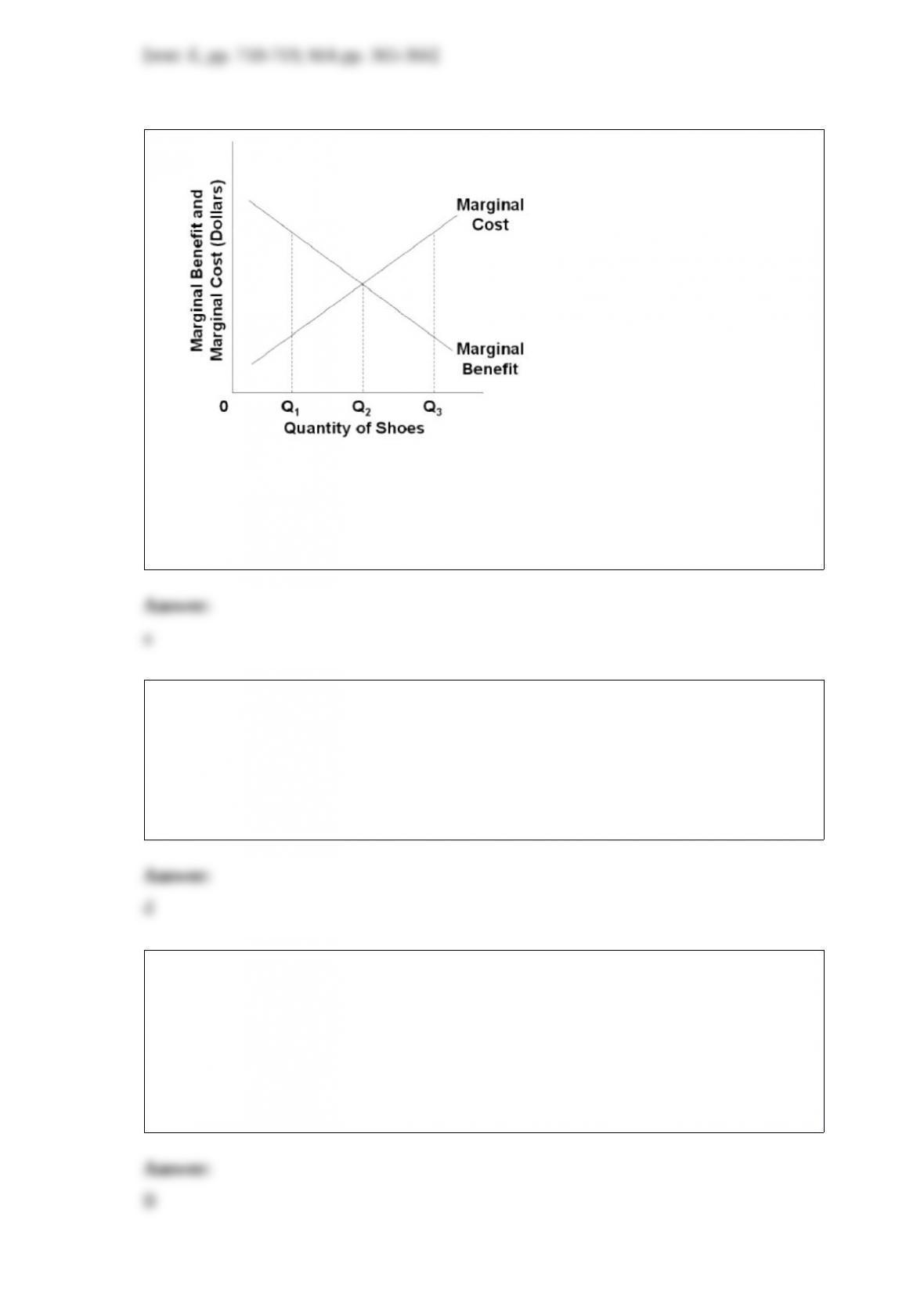
refer to the above diagram for athletic shoes. if the current output of shoes is q3, then:
a.society should produce fewer shoes to achieve the optimal allocation of resources.
b.society should produce more shoes to achieve the optimal allocation of resources.
c.resources are being allocated efficiently to the production of shoes.
d.shoes are more valuable to society than alternative products
13) the social security program (excluding medicare) in the united states is expected to
exhaust the monies in the social security trust fund in:
a.2008
b.2010
c.2017
d.2041
14) A person arguing that income inequality is actually less than that described by the
standard Census data might say that the:
A.Census data fail to include cash transfers as income.
B.Census data fail to include the value of noncash transfers as income.
C.lifetime distribution of income is less equal than the annual distribution.
D.household distribution of wealth is much more equally distributed than the household
distribution of income.

15) Which of the following statements best illustrates the concept of derived demand?
A.As income goes up the demand for farm products will increase by a smaller relative
amount.
B.A decline in the price of margarine will reduce the demand for butter.
C.A decline in the demand for shoes will cause the demand for leather to decline.
D.When the price of gasoline goes up, the demand for motor oil will decline.