
According to economists, competition exists because of
a. scarcity.
b. capitalism.
c. money.
d. unintended effects.
Ceteris paribus means
a. one variable too many.
b. the correct relationship specified.
c. assuming economic motives.
d. all other things held constant or nothing else changes.
Labor unions tend to favor strictly enforced immigration laws with the intention of
lowering the elasticity of demand for union labor.
a. True
b. False
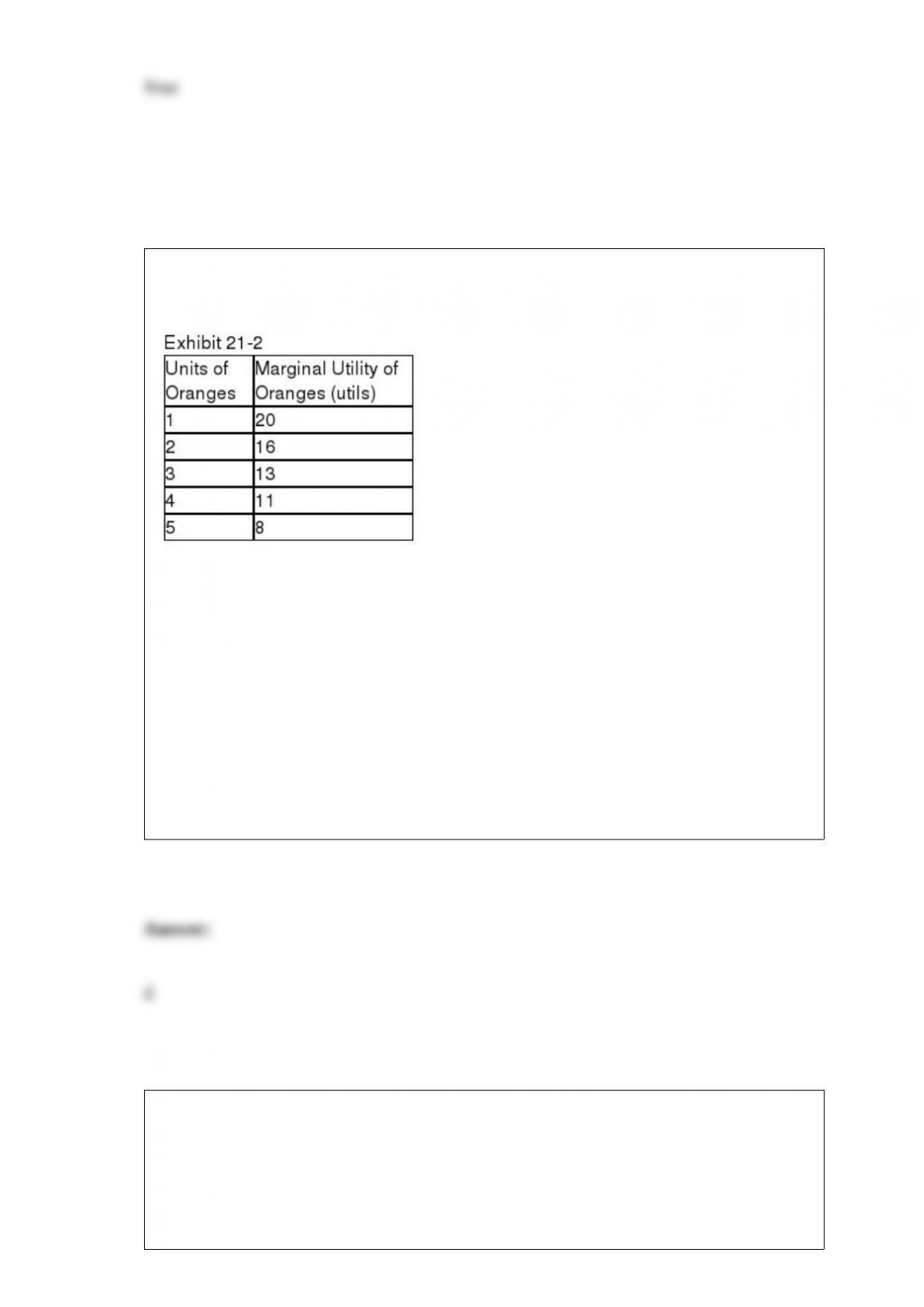
Total utility for the first two oranges is
a. 36 utils.
b. 20 utils.
c. 40 utils.
d. 36 utils.
e. cannot be determined
Which of the following statements is true?
a. Employers are not concerned with determining a potential employee’s productivity
because they know that with experience the employee’s output will increase.
b. Employers are not concerned with determining a potential employee’s productivity

because they realize that they cannot accurately determine it beforehand.
c. Employers are not concerned with determining a potential employee’s productivity
because they know that they can train the employee after he’s hired.
d. Employers are concerned with determining a potential employee’s productivity due to
the high costs of training new employees.
e. a, b, and c
Which of the following is not an assumption of the theory of monopolistic competition?
a. There are many sellers and buyers.
b. Each firm produces and sells a slightly differentiated product.
c. There is easy entry.
d. There is easy exit.
e. All firms face the same cost conditions.
Exhibit 2-7
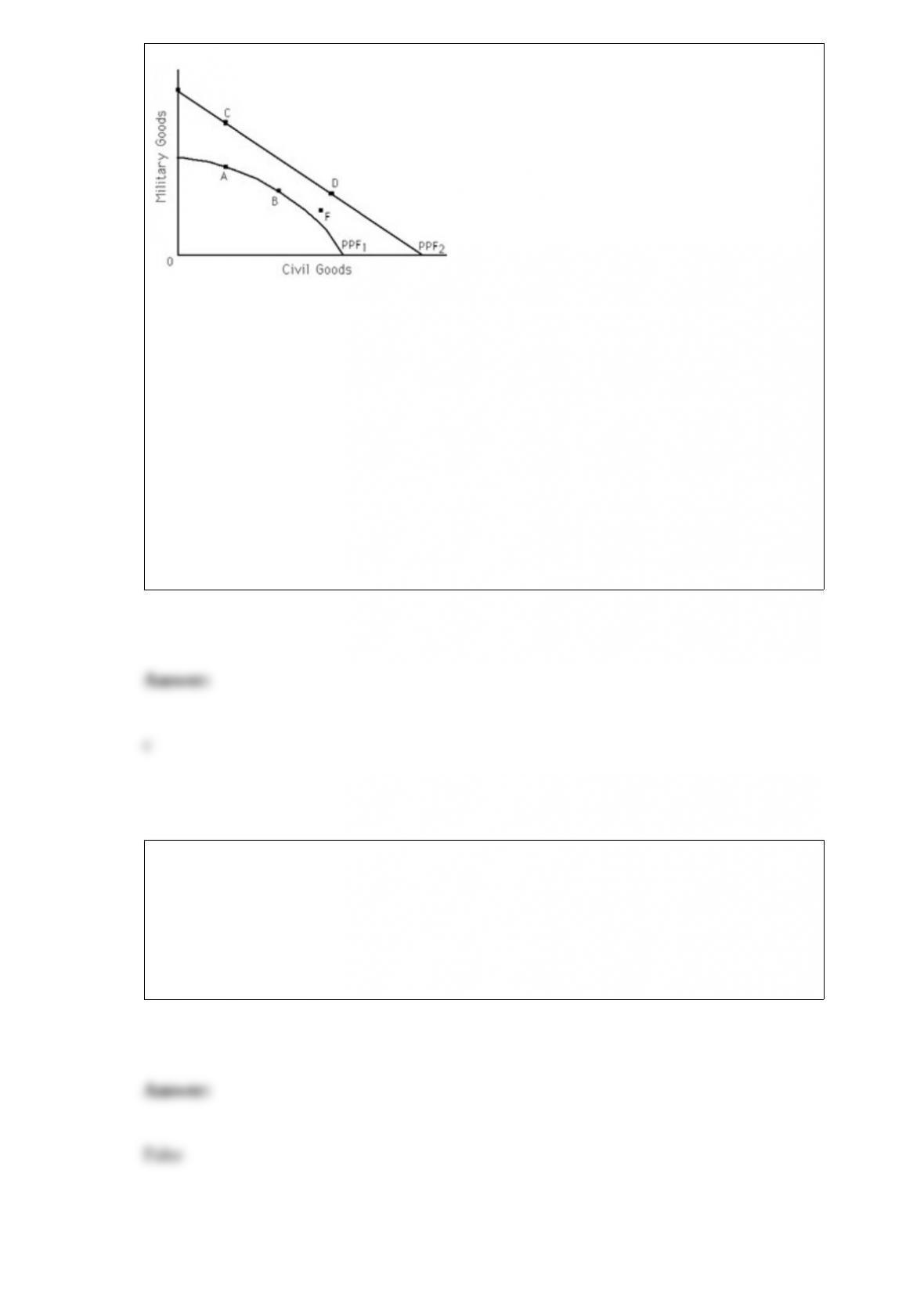
For which of the following is the statement “In order to get more civilian goods, we
have to forfeit some military goods” true?
a. a movement from A to C
b. a movement from B to D
c. a movement from C to D
d. a movement from F to D
e. none of the above
If a theory gives a scientist results that she does not want, then she should not believe in
that theory.
a. True
b. False

Which of the following illustrates the law of demand?
a. Jorge buys fewer pencils at $2 per pencil than at $1 per pencil, ceteris paribus.
b. Chen buys more ice cream at $4 per half-gallon than at $3 per half gallon, ceteris
paribus.
c. Karissa buys fewer sweaters at $50 each than at $35 each, ceteris paribus.
d. a, b, and c
e. a and c
If there is always a 4-for-1 tradeoff between producing good X and good Y, it follows
that the opportunity cost of X (in terms of Y) ____________________ and the PPF for
these two goods is ______________________.
a. decreases at low levels of X; a straight line
b. rises at high levels of Y; bowed-outward
c. decreases at high levels of X; bowed-outward
d. is always the same; a straight line