
1) Economists refer to a budget deficit that exists when the economy is achieving full
employment as a:
A.cyclical deficit.
B.full-employment deficit.
C.natural deficit.
D.nonrecurring deficit.
2) A profit-maximizing firm will:
A.expand employment if marginal revenue product exceeds marginal resource cost.
B.reduce employment if marginal revenue product exceeds marginal resource cost.
C.expand employment if marginal revenue product equals marginal resource cost.
D.reduce employment if marginal revenue product equals marginal resource cost.
3) if there is a shortage of product x:
a.fewer resources will be allocated to the production of this good.
b.the price of the product will rise.
c.the price of the product will decline.
d.the supply curve will shift to the left and the demand curve to the right, eliminating
the shortage.
4) Assume you pay a tax of $4,000 on a taxable income of $24,000. If your taxable
income were $30,000, your tax payment would be $5,000. This suggests that the tax is:
A.progressive.
B.proportional.
C.regressive.
D.discriminatory.
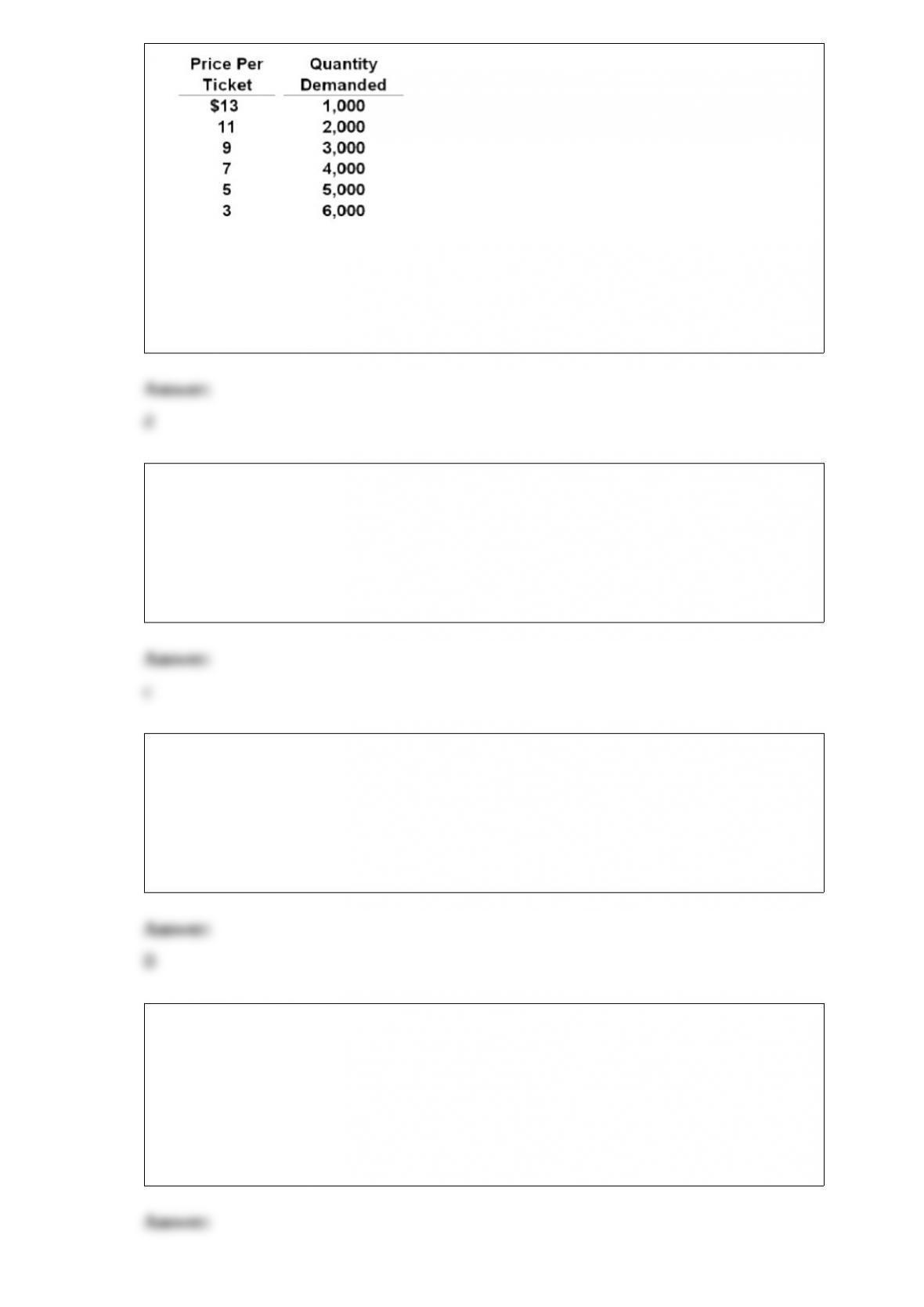
5)
refer to the above information. over the $7-$5 price range, demand is:
a.perfectly elastic.
b.perfectly inelastic.
c.elastic.
d.inelastic.
6) when the price of a product increases, a consumer is able to buy less of it with a
given money income. this describes:
a.the cost effect.
b.the inflationary effect.
c.the income effect.
d.the substitution effect.
7) According to mainstream economists, the Fed’s adherence to a traditional monetary
rule rather than to discretionary monetary policy is likely to:
A.reduce the severity of business cycles.
B.increase the amount of instability in the economy.
C.increase the rate of inflation.
D.crowd out much needed investment spending during times of rapid inflation.
8) Depreciation of the dollar will:
A.decrease the prices of both U.S. imports and exports.
B.increase the prices of both U.S. imports and exports.
C.decrease the prices of U.S. imports, but increase the prices to foreigners of U.S.
exports.
D.increase the prices of U.S. imports, but decrease the prices to foreigners of U.S.
exports.

9) Currency held within banks is part of:
A.both the M1 and M2 definitions of the money supply.
B.the M2 definition of the money supply only.
C.the M1 definition of the money supply only.
D.none of these definitions of the money supply.
10) A restrictive monetary policy is designed to shift the:
A.aggregate demand curve rightward.
B.aggregate demand curve leftward.
C.aggregate supply curve rightward.
D. aggregate supply curve leftward.
11) comparing a pure monopoly and a purely competitive firm with identical costs, we
would find in long-run equilibrium that the pure monopolist’s:
a.price, output, and average total cost would all be higher.
b.price and average total cost would be higher, but output would be lower.
c.price, output, and average total cost would all be lower.
d.price and output would be lower, but average total cost would be higher.
12) Which of the following is an example of a land-intensive commodity?
A.chemicals
B.autos
C.watches
D.wool
13) The idea that a person’s productive efforts and his or her economic rewards are
unrelated:
A.is the neocolonialism view of economic development.
B.describes the vicious circle of poverty.

C.is the surplus labor theory of economic development.
D.is the capricious universe view.
14) (Consider This) Governments’ main economic concern about low birthrates is that:
A.in a few decades there will not be enough working age adults to support pension
responsibilities to retirees.
B.the smaller population makes the economy more vulnerable to foreign takeover.
C.a declining population will reduce worker productivity.
D.smaller populations are more susceptible to epidemics.