1) (Last Word) Which one of the following is one of the leading economic indicators?
A.index of consumer expectations
B.the unemployment rate
C.the consumer price index
D.Federal income tax collections
2) The change in a firm’s total revenue that results from hiring an additional worker is
measured by:
A.marginal product.
B.marginal revenue.
C.marginal revenue product.
D.average revenue product.
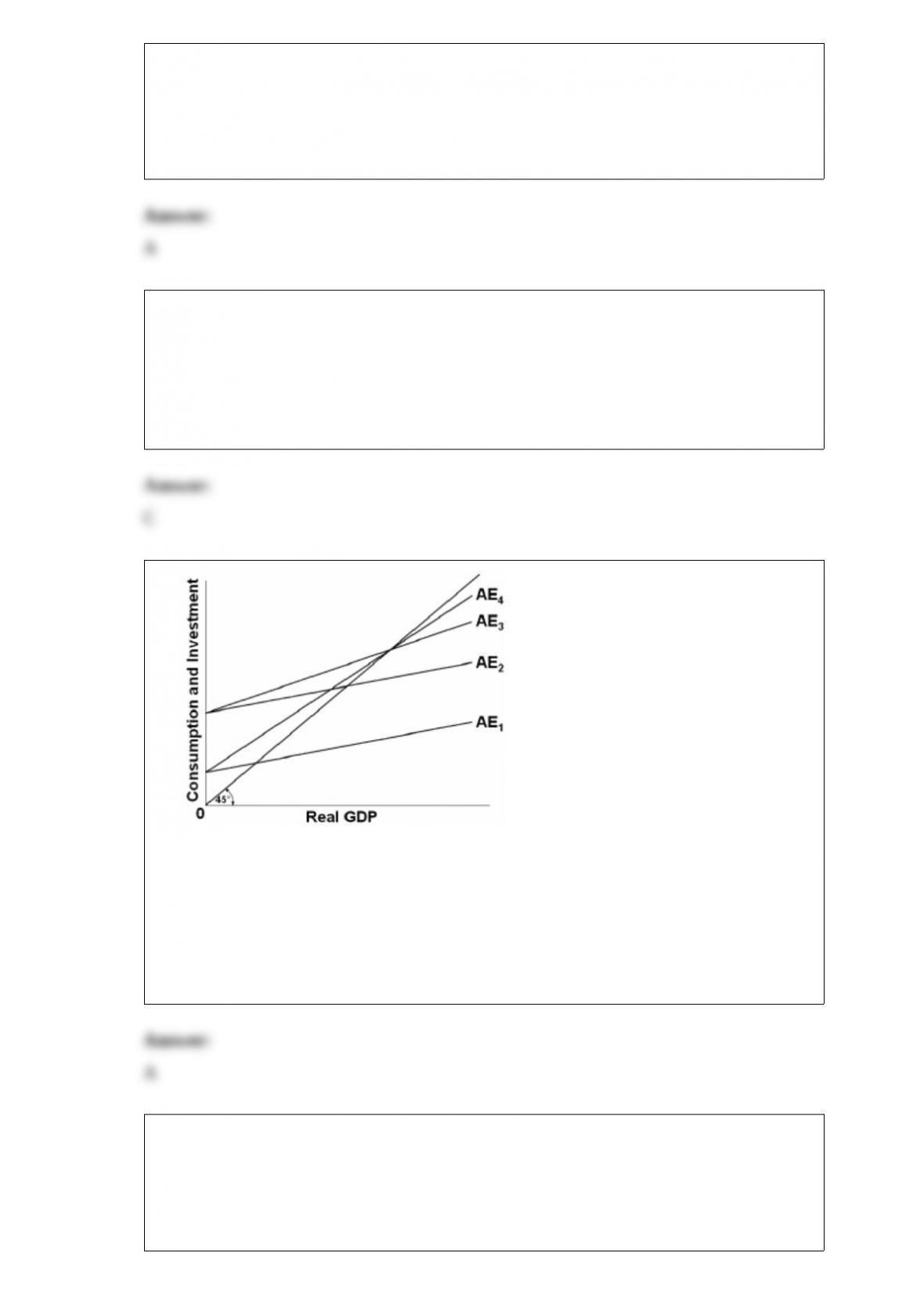
3)
Which aggregate expenditure schedule AE in the above diagram for a private closed
economy implies the largest MPC, assuming investment is the same at each level of
income?
A.AE4
B.AE3
C.AE2
D.AE1
4) The general rule for hiring any input (say, labor) in the profit-maximizing amount is
MRC = MRP. This rule takes the special form W = MRP (where W is the wage rate)
when the:
A.labor supply curve is upsloping.
B.supply of labor is inelastic.

C.firm is hiring labor under purely competitive conditions.
D.firm is hiring labor under imperfectly competitive conditions.
5) Tying agreements:
A.establish common boards of directors for previously competing firms.
B.obligate a purchaser of product X to also buy product Y from the same seller.
C.allow manufacturers to specify the retail prices of their products.
D.prohibit firms from selling their products outside of specified geographic areas.
6) according to behavioral economists, older workers tend to save more for retirement
than younger workers because:
a.older workers have less faith that the social security will be able to pay out promised
benefits.
b.older workers experience greater diminishing marginal utility from saving additional
dollars.
c.younger workers like to consume a greater variety of goods than older workers.
d.even though younger workers know it is important to save for retirement, they feel
less of a sense of urgency.
7) if potential gdp is $330 billion and there is a positive gdp gap of $30 billion, real gdp
is:
a.$300 billion.
b.$30 billion.
c.$360 billion.
d.$630 billion.
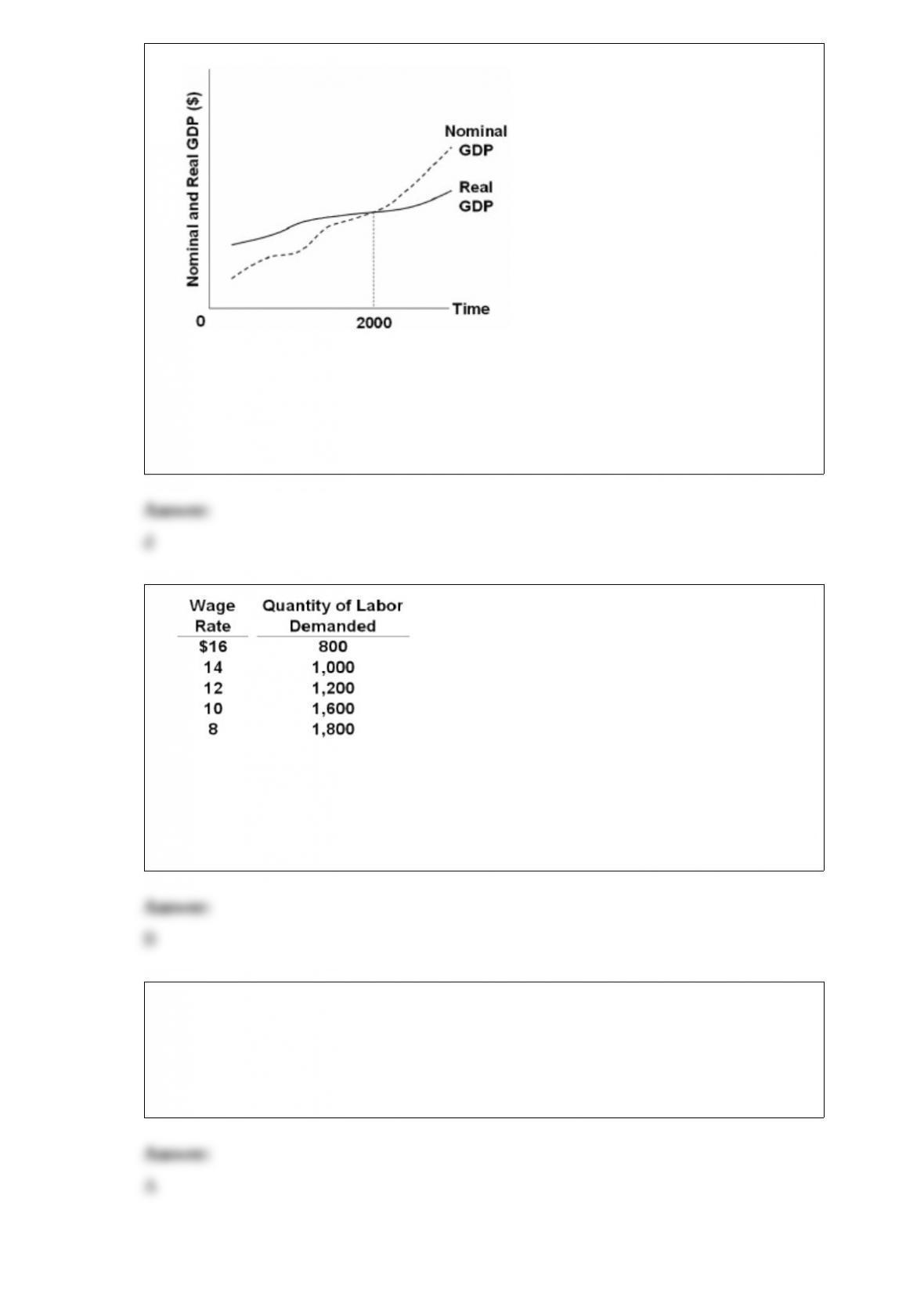
8)
refer to the above diagram. which of the following statements is correct?
a.the price index is greater than 100 for every year shown on the graph.
b.nominal gdp must be deflated in each year prior to 2000 to determine real gdp.
c.real gdp has grown in this economy, but nominal gdp has not.
d.nominal gdp must be deflated in each year since 2000 to determine real gdp.
9)
Refer to the above data. For the $16 to $14 range of wage rates, labor demand is:
A.perfectly elastic.
B.elastic.
C.perfectly inelastic.
D.inelastic.
10) A decline in the price of resource A will:
A.increase the demand for complementary resource B.
B.shift the demand curve for A to the left.
C.shift the demand curve for A to the right.
D.reduce the demand for complementary resource B.

11) Fast-second strategies are more likely to be used by:
A.dominant firms than by startup firms.
B.pure competitors rather than oligopolists.
C.startup firms rather than existing firms.
D.entrepreneurs than by corporations.
12) The members of the Federal Reserve Board:
A.serve seven-year terms.
B.are appointed by the American Economic Association.
C.are elected by votes of the 12 presidents of the Federal Reserve Banks.
D.serve 14-year terms.
13) A commercial bank can expand its excess reserves by:
A.demanding and receiving payment on an overdue loan.
B.buying bonds from a Federal Reserve Bank.
C.buying bonds from the public.
D.paying back money borrowed from a Federal Reserve Bank.
14) The pure interest rate is:
A.the nominal rate plus the rate of inflation.
B.not used in making investment decisions.
C.is the nominal rate of interest less the rate of return on an investment.
D.the rate paid on long term, relatively risk-free bonds.
15) a supply curve that is parallel to the horizontal axis suggests that:
a.the industry is organized monopolistically.
b.the relationship between price and quantity supplied is inverse.
c.a change in demand will change price in the same direction.
d.a change in demand will change the equilibrium quantity but not price.