
1) the medicare prescription drug, improvement, and modernization act of 2003
established a system of national health insurance.
2) because the equilibrium position of a purely competitive seller entails an equality of
price and marginal costs, competition produces an efficient allocation of economic
resources.
3) Critics of the minimum wage contend that higher minimums cause employers to
move up their labor demand curves, reducing employment of low-wage workers.
4) the primary purpose of the “play or pay” reform proposal is to reduce aggregate
health care costs.
5) If the price of British pounds, measured in terms of U.S. dollars, is rising, then the
price of U.S. dollars, measured in terms of British pounds, is also rising.
6) in economics, a firm earns a normal profit when its total revenue equals its total
economic costs.
7) barriers to free trade impair efficiency in the international allocation of resources.

8) in moving northeasterly from the origin we encounter indifference curves that reflect
higher and higher levels of total utility.
9) The following information. Assume that by devoting all its resources to the
production of X, nation Alpha can produce 40 units of X. By devoting all its resources
to Y, Alpha can produce 60Y. Comparable figures for nation Beta are 60X and 40Y.
Refer to the above information. Alpha should specialize in Y and Beta in X.
10) The job of the Fed in limiting the supply of money may be made more complex if
commercial banks initially have substantial excess reserves.
11) The United States is in imminent danger of running out of energy.
12) The Celler-Kefauver Act made vertical mergers legal, provided each firm does not
have more than 30 percent of its relevant market.
13) An advantage of direct foreign investment (compared to foreign loans) is that
management skill and technological knowledge often accompany such capital flows.
14) The twelve Federal Reserve Banks are governmentally owned but privately
controlled.

15)
refer to the above diagram. the budget line shift that moves the consumer’s equilibrium
from point a to point b suggests:
a.an increase in the demand for product x.
b.a decrease in the demand for product x.
c.no change in the demand for product x.
d.that x is an inferior good.
16) (Last Word) Major countries in which citizens hold and use large quantities of U.S.
dollars are:
A.Germany, England, and France.
B.Russia, Argentina, and Turkey.
C.Canada, Australia, and New Zealand.
D. Egypt, Spain, and Italy.
17) Human capital is best defined as:
A.the productive skills and knowledge that workers acquire from education and
training.
B.the substitution of labor for machinery in the production process.
C.any piece of machinery that must be combined with labor to be productive.
D.the exchange of money for real assets.
18) the demand curve faced by a pure monopolist:
a.may be either more or less elastic than that faced by a single purely competitive firm.
b.is less elastic than that faced by a single purely competitive firm.
c.has the same elasticity as that faced by a single purely competitive firm.
d.is more elastic than that faced by a single purely competitive firm.

19) The basic issue in the DuPont cellophane case was:
A.whether trade crossed state lines.
B.defining the relevant market.
C.structure versus behavior.
D.the rule of reason.
20) Process innovation refers to:
A.development of new products.
B.implementation of better methods of producing products.
C.first discovery of new scientific principles.
D.wide-spread imitation of innovations.
21) if there is a shortage of product x:
a.fewer resources will be allocated to the production of this good.
b.the price of the product will rise.
c.the price of the product will decline.
d.the supply curve will shift to the left and the demand curve to the right, eliminating
the shortage.
22) Given a 25 percent reserve ratio, assume the commercial banking system is loaned
up. Now assume the reserve ratio is reduced to 20 percent. As a result of this reduction:
A.we can expect bank lending and bank profits to decline.
B.each dollar of bank reserves will now support a maximum of $5 of checkable
deposits.
C.the banking system must now reduce outstanding loans by 5 percent.
D.the banking system can now increase lending by 5 percent.
23) answer the next question(s) on the basis of the following data. all figures are in
billions of dollars.
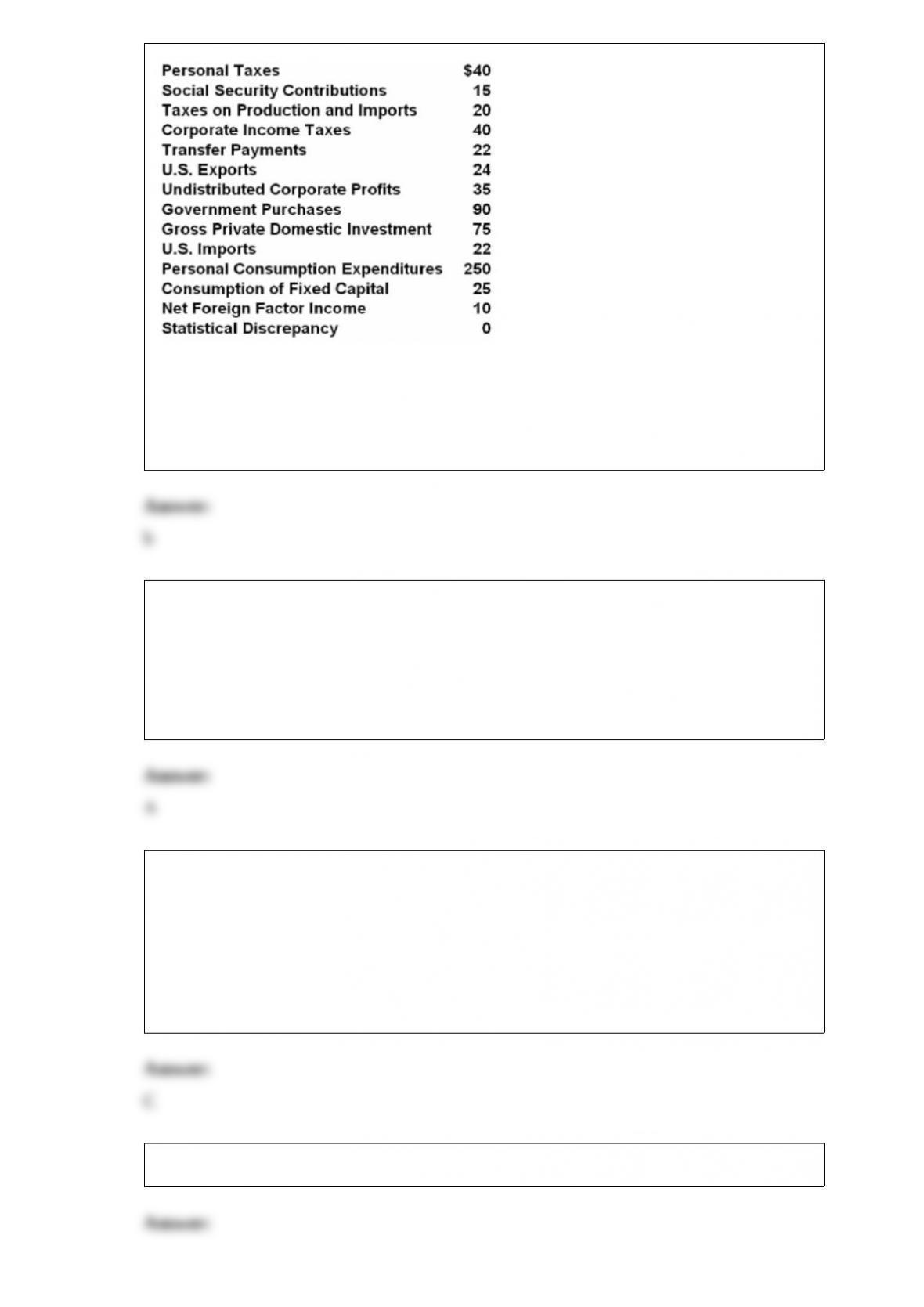
refer to the above data. gdp is:
a.$390.
b.$417.
c.$422.
d.$492.
24) Census data indicate that currently the top fifth of all households receive about
________ times as much income as the bottom fifth.
A.fifteen
B.twelve
C.eight
D.three
25) If one worker can pick $30 worth of grapes and two workers together can pick $50
worth of grapes, the:
A.marginal revenue product of each worker is $25.
B.marginal revenue product of the first worker is $20.
C.marginal revenue product of the second worker is $20.
D.data given do not permit the determination of the marginal revenue product of either
worker.
26) What is Okuns law? Give an example of how it works.
27) What are network effects? How do they contribute to economies of scale?
28) (Consider This) How has the influx of women into the paid labor force over the past
half century influenced economic growth? State at least three of the six reasons given
for the increase in the number of women in the paid workforce over the past half
century.
29) Suppose an increase in aggregate demand raises the price level. What would be the
effect on the total money demand curve?
30) Explain the difference between real and nominal income. How can you get an
approximation of the percentage change in real income from one time period to
another?
31) What is the efficiency factor?
32) What are the seven functions of the Federal Reserve System? Which one is most
important?