
One problem with deflation is that it can raise the real value of debt.
The GDP deflator is a measure of the price level which is calculated as nominal GDP
divided by real GDP and multiplied by 100.
An increase in perceived risk of foreign assets increased both the financial account
surplus and current account deficit in the United States during the late 1990s.
Prior to the 1930s, the majority of dollars spent by government was spent at the state
and local levels.

Both countries involved in a pegging of currency must agree to the terms of the
pegging.
The price elasticity of demand for Kellogg’s Raisin Bran is larger in absolute value than
the price elasticity for all breakfast cereals.
An easy way to determine if a currency is undervalued at a point in time is to use the
model of purchasing power parity.
The Japanese system of universal health insurance requires no co-payments from
residents for health services.

If the opportunity cost of producing more of one good remains the same as more of that
good is produced, then the production method is inefficient.
The market price of a factor of production that is in fixed is determined only by
demand.
In market economies, income distribution is always going to be completely equitable.
One factor which brought on the recession of 2007-2009 was the end of the housing
bubble.
Which of the following is not an example of price discrimination?
A) Adobe Systems offers software at discounted prices to students and faculty at K-12
and university levels.
B) Unlike foreign tourists, citizens of Cambodia are exempted from paying an
admission fee to the temples of Angkor.
C) Senior citizens may purchase special fare tickets for public transportation that are
not available to others.
D) Buyers at an automotive parts store receive a discount for bulk buying because the
store is able to pass on to its customers some of the lower average cost for producing
large quantities.
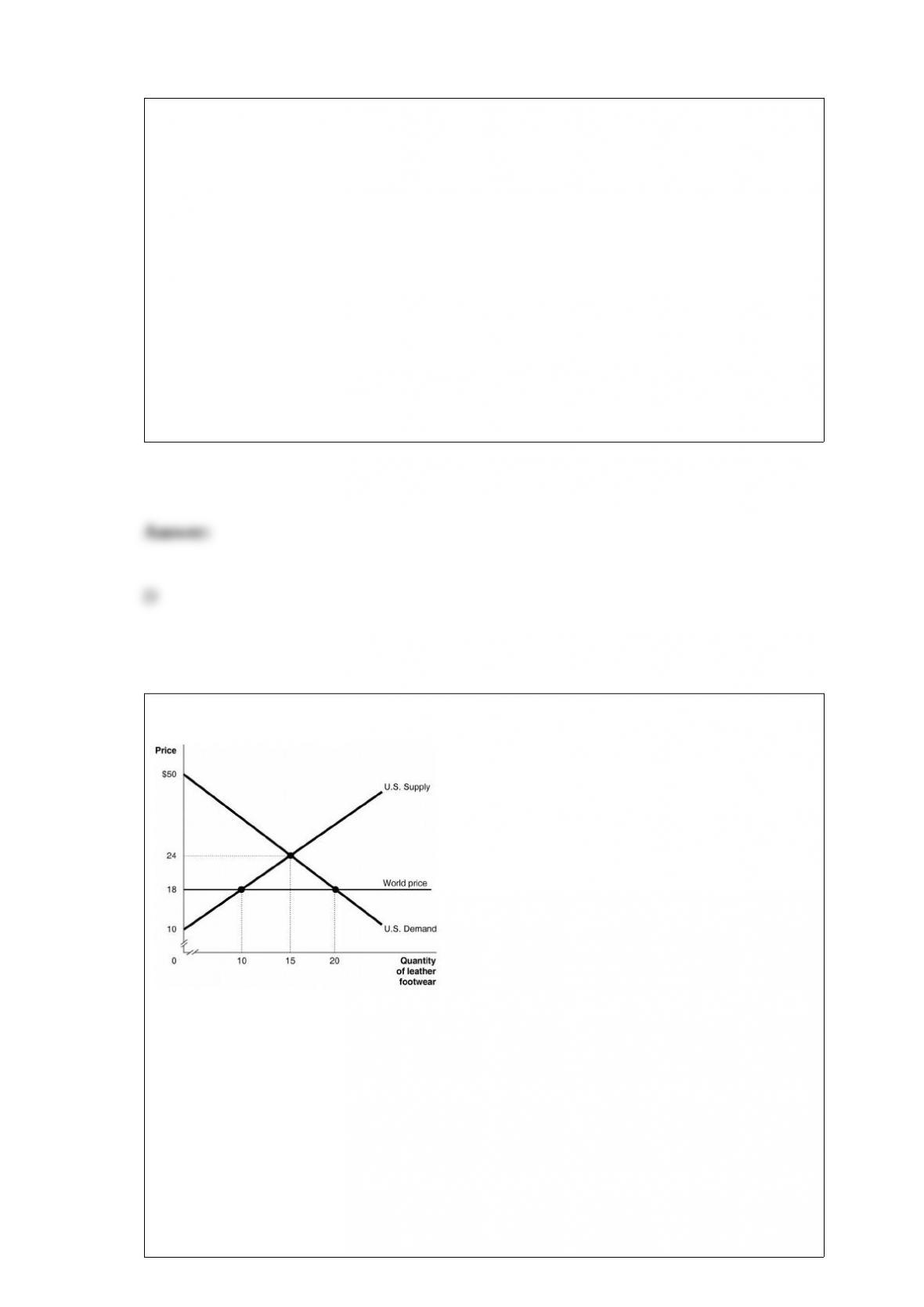
Figure 9-1
Figure 9-1 shows the U.S. demand and supply for
leather footwear. Suppose the government allows imports of leather footwear into the
United States. The market price falls to $18. What is the value of domestic producer
surplus?
A) $0.
B) $40.
C) $320.
D) $360.

Scenario 1-2 Suppose a hat manufacturer currently sells 2,000 hats per week and makes
a profit of $5,000 per week. The plant owner observes, “Although the last 300 hats we
produced and sold increased our revenue by $1,000 and our costs by $1,100, we are still
making an overall profit of $5,000 per week so I think we’re on the right track. We are
producing the optimal number of hats.”
Had the firm not produced and sold the last 300 hats, would its profit be higher or
lower, and if so by how much?
A) Its profit will be $1,100 higher.
B) Its profit will be $100 higher.
C) Its profit will be $100 lower.
D) Its profit will be $1,000 lower.
Suppose that the economy is producing below potential GDP and the Fed implements
the correct change in monetary policy, but not until after the economy has passed the
trough of the recession. Then
A) the Fed’s contractionary policy will result in too large of a decrease in GDP.
B) the Fed’s contractionary policy will result in too small of a decrease in GDP.
C) the Fed’s expansionary policy will result in too small of a decrease in GDP.
D) the Fed’s expansionary policy will result in too large of an increase in GDP.
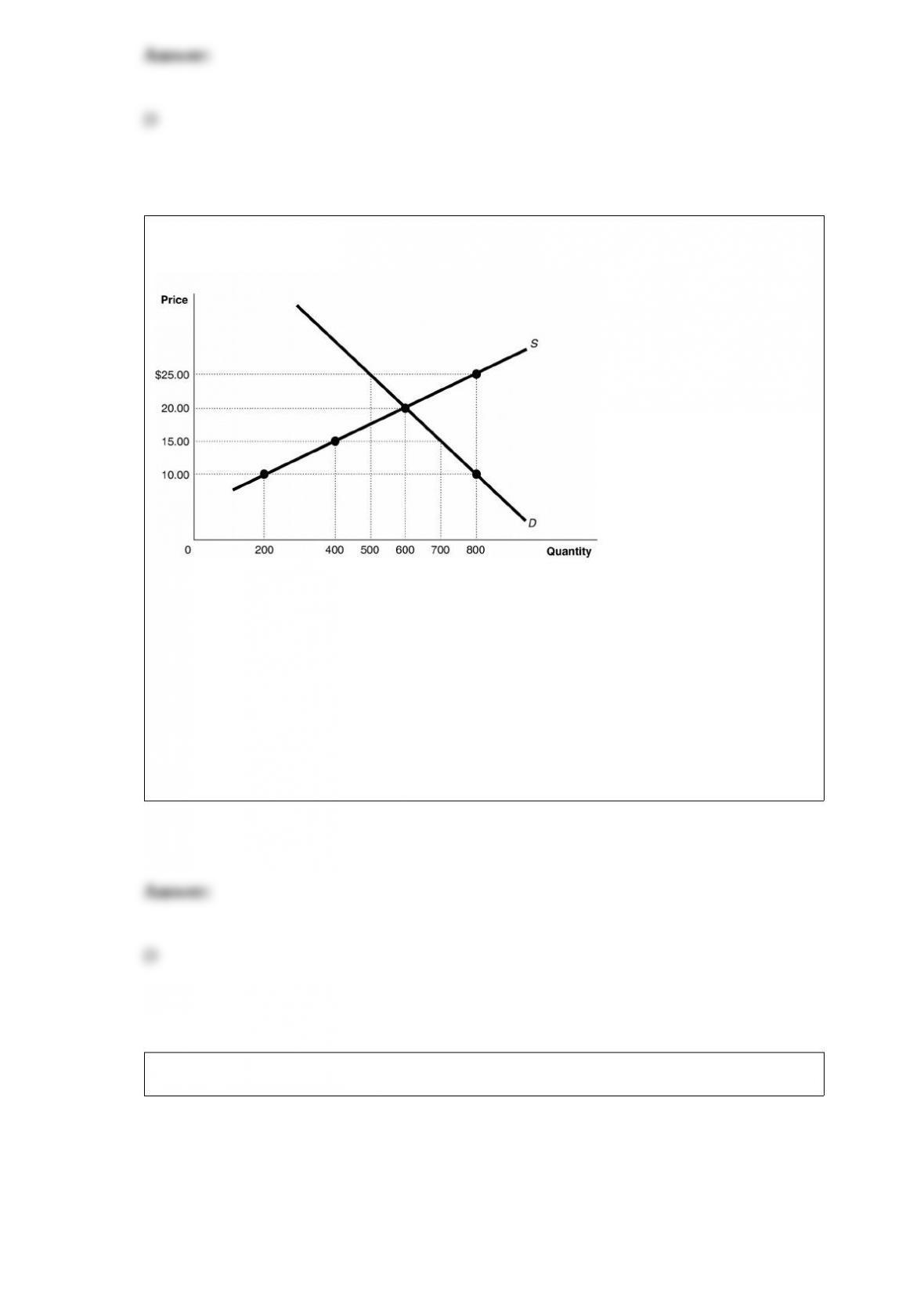
Figure 3-4
At a price of $25, how many units will be supplied?
A) 400
B) 500
C) 600
D) 800
Figure 2-7

Mercedes Benz produces a full line of luxury automobiles, including coupes, sedans,
and SUVs, at a variety of manufacturing plants across the globe. Assume Mercedes
Benz produces both coupes and SUVs at its Tuscaloosa, Alabama factory. Figure 2-7
shows changes to its production possibilities frontier in response to new developments
and different strategic production decisions at this factory.
Suppose Mercedes-Benz has to shut down a portion of its facility as it works on
remodeling the facility to merge two of its separate assembly lines in preparation for the
production of a new, hybrid models. The production decision to shut down temporarily
will result in a
A) movement from E to F in Graph A.
B) movement from G to H in Graph B.
C) movement from K to L in Graph C.
D) movement from J to H in Graph B.
The change in a firm’s revenue as a result of hiring one more worker
A) is the definition of the marginal product of labor.
B) is equal to the firm’s marginal cost.
C) is the definition of the marginal revenue product of labor.
D) will be negative if the demand for the firm’s output is inelastic.
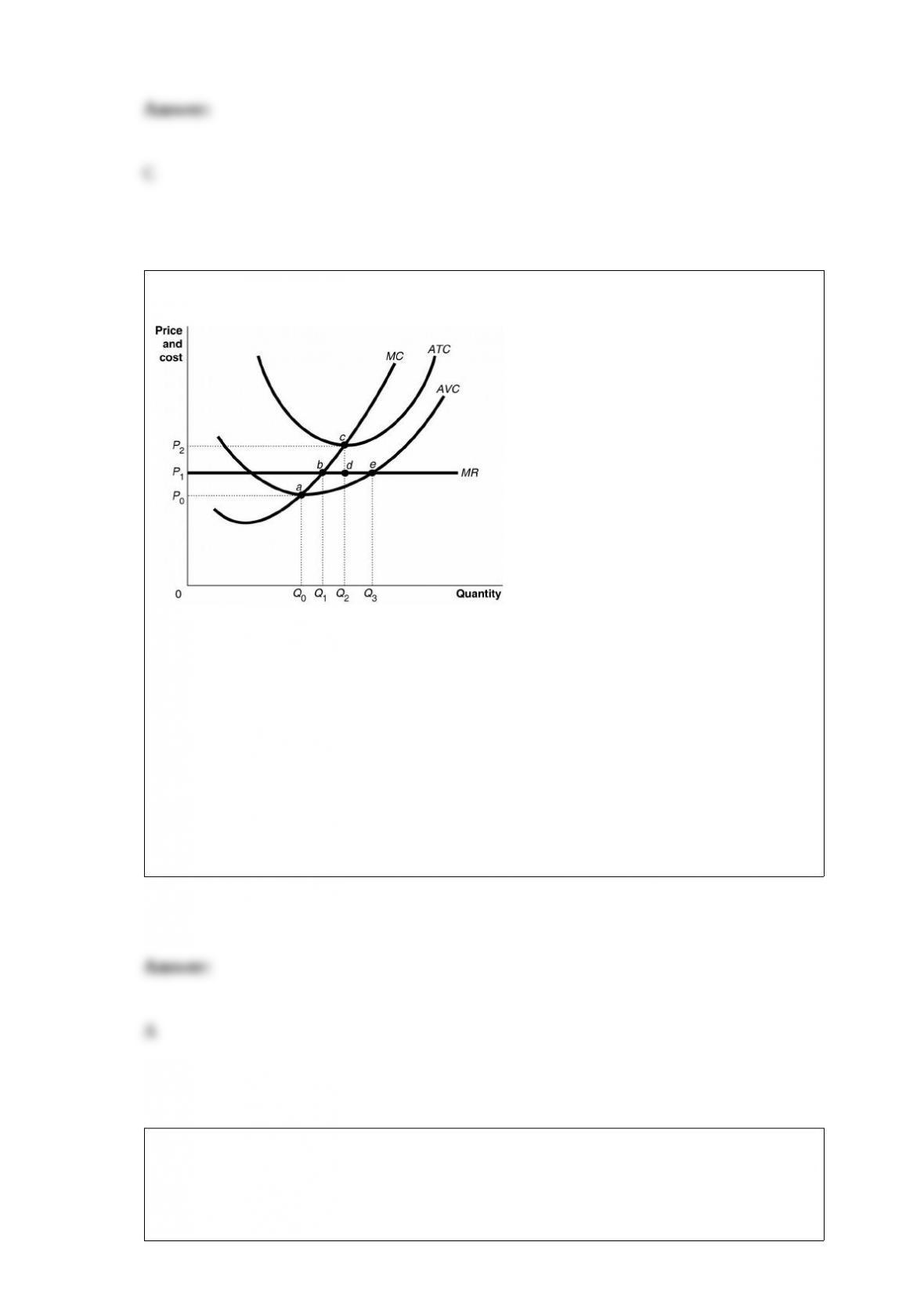
Figure 12-13
Suppose the prevailing price is P1 and the firm is currently producing its
loss-minimizing quantity. In the long-run equilibrium
A) there will be fewer firms in the industry and total industry output decreases.
B) there will be more firms in the industry and total industry output increases.
C) there will be fewer firms in the industry but total industry output increases.
D) there will be more firms in the industry and total industry output remains constant.
The price elasticity of demand is equal to
A) the value of the slope of the demand curve.

B) the change in quantity demanded divided by the change in price.
C) the percentage change in price divided by the percentage change in quantity
demanded.
D) the percentage change in quantity demanded divided by the percentage change in
price.
Liquidity is defined as
A) the ease with which a given asset can be converted to a store of value.
B) the ease with which a given asset can be converted to a unit of account.
C) the ease with which a given asset can be converted to a medium of exchange.
D) the ease with which a given asset can be converted to a standard of deferred
payment.
Which of the following is an implicit cost of production?
A) interest paid on a loan to a bank
B) wages paid to labor plus the cost of carrying benefits for workers
C) the utility bill paid to water, electricity, and natural gas companies
D) rent that could have been earned on a building owned and used by the firm
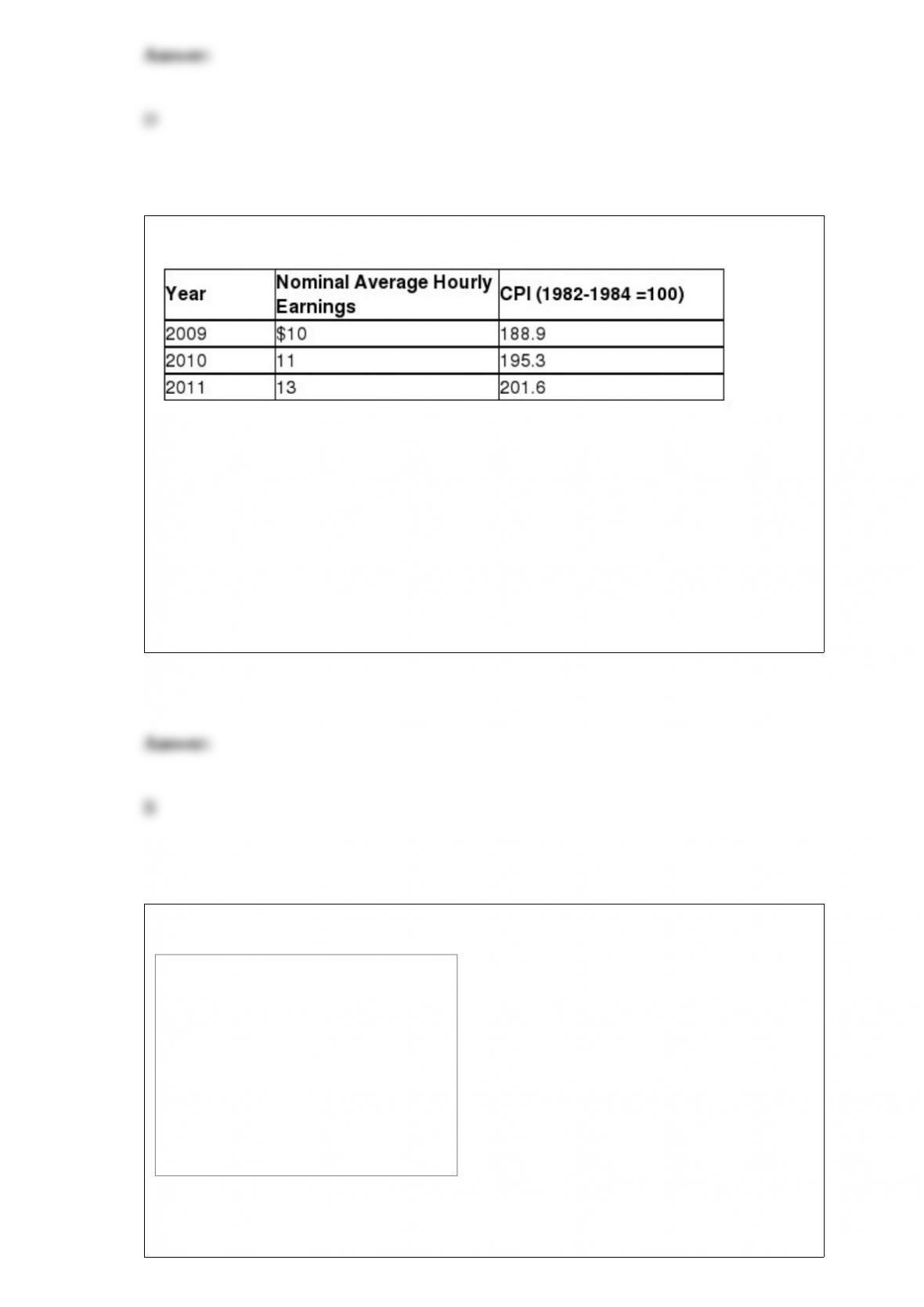
Table 20-17
Looking at the table above, real average hourly earnings in 2010 were
A) $3.67.
B) $5.63.
C) $10.24.
D) $11.37.
Figure 5-4
Suppose there are several paper mills producing paper for a market. These mills,
located upstream from a fishing village, discharge a large amount of wastewater into the

river. The waste material affects the number of fish in the river, and the use of the river
for recreation and as a public water supply source. Figure 5-4 shows the paper market.
Use this Figure to answer the following question(s).
Why is there a deadweight loss?
A) because the marginal social cost of producing each additional unit in excess of Q2
exceeds the marginal benefit
B) because the marginal private cost of producing each additional unit in excess of Q2
exceeds the marginal benefit
C) because the marginal social benefit of producing each additional unit in excess of Q2
exceeds the private cost
D) because the marginal private benefit of producing each additional unit in excess of
Q2 exceeds the social cost
In the principal-agent relationship, the principal is
A) the owner of a resource that has hired a third party to act in the best interest of that
third party.
B) the person who is placed in control over resources that are not his own, with a
contractual obligation to use these resources in the interests of some other party.
C) the person who is placed in control over resources that are not his own and agrees to
compensate the resource owner in the event of outcomes that do not satisfy the resource
owner.
D) the person who places his resources in professional hands in exchange for the
professional’s promise to act on the resource owner’s behalf.

Figure 27-12
An increase in government purchases of $200 billion causes aggregate demand to shift
ultimately from AD1 to AD2. Assuming a constant price level, the difference in real
GDP between point A and point B will be ________ $200 billion.
A) equal to
B) less than
C) greater than
D) There is insufficient information given here to draw a conclusion.
If the consumption function is defined as C = 7,250 + 0.8Y, what is the multiplier?
A) 0.2
B) 0.8
C) 1.25
D) 5

Allocative efficiency is achieved when
A) goods and services are fairly distributed among consumers in an economy.
B) firms produce the goods and services that consumers value most.
C) firms produce goods and services at the lowest cost.
D) there are no shortages or surpluses in the market.
Adam spent $10,000 on new equipment for his small business, “Adam’s Fitness
Studio.” Membership at his fitness center is very low and at this rate, Adam needs an
additional $12,000 per year to keep his studio open. Which of the following is true?
A) The fixed cost of running the studio is $22,000.
B) The variable cost of running the studio is $22,000.
C) The $10,000 Adam spent on equipment is a fixed cost of business and the $12,000
he’ll need to continue operations is a variable cost.
D) The $10,000 Adam spent on equipment is the total cost of starting the business and
the $12,000 he’ll need to continue operations is a marginal cost.
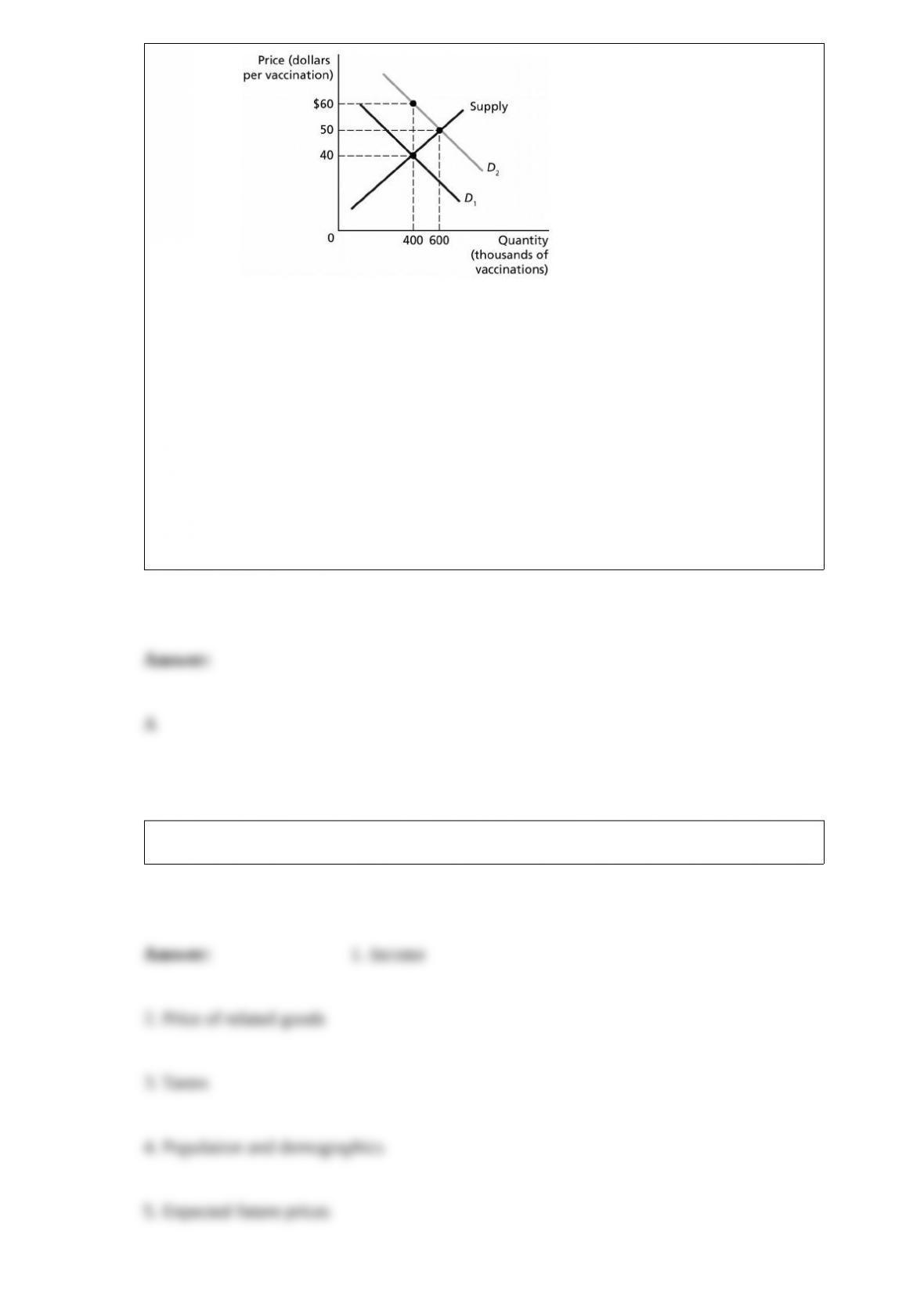
Figure 7-2 Figure 7-2 represents the market
for vaccinations. Vaccinations are considered a benefit to society, and the figure shows
both the marginal private benefit and the marginal social benefit from vaccinations.
At the efficient equilibrium,
A) economic surplus is maximized.
B) economic surplus is minimized.
C) economic surplus is zero.
D) economic surplus is negative.
What are the five variables that will shift the demand curve?
What is the underground economy and how could it hurt an economy? How does it hurt
developing economies?
Use the equations for public and private saving to demonstrate how total saving in the
economy equals investment.
Suppose a presidential candidate makes a statement in a debate whereby he promises
that he would encourage the Fed to permanently lower the unemployment rate to 3%.
His opponent claims that this type of policy idea is mired in the 1960s and would only
cause inflation. Explain what the opponent means.
Table 19-31
The table above represents hypothetical data from the National Income Accounts for
2013. Use the data to calculate personal income and disposable income.
Explain the relationships between a corporation’s shareholders, its board of directors,
and its top managers.
Suppose you see a 2008 Ford Mustang GT advertised in the local newspaper for
$15,000. If you knew the car was reliable, you would be willing to pay $17,000 for it. If
you knew the car was unreliable, you would only be willing to pay $12,000 for it.
Under what circumstances should you buy the car?
What is a firm’s balance sheet?