1) Assume the demand for automobile tires is highly inelastic and that the supply is
highly elastic. The burden of a $2 excise tax on each tire will be:
A.borne by resource suppliers who provide the inputs for manufacturing tires.
B.shared about equally by buyers and sellers of tires.
C.borne primarily by buyers of tires.
D.borne primarily by sellers of tires.
2) The initial values for expected returns, R&D and interest-rate cost for an energy
companys investment in developing alternative fuels are listed in the table below. Using
this information, answer the following questions.
(a)What is the equilibrium level of return and R&D?
(b)Suppose that the energy companys credit rating plummets after it is exposed for
using unethical accounting practices. How will this affect the expected-rate-of-return
curve and interest-rate cost of funds?
(c)Suppose the interest-rate cost of funds curve shifts upward by 10%. What will be the
new equilibrium rate of return and level of R & D investment?
(d)Suppose that the increased cost of oil has increased the demand for alternative fuels.
How will this affect the interest-rate cost of funds and expected return curves?
(e)Suppose the expected-rate-of-return curve shifts outward by 10%. What will be the
new equilibrium level of R&D and expected rate of return? (Assume the interest-rate
cost of funds is 15%.)
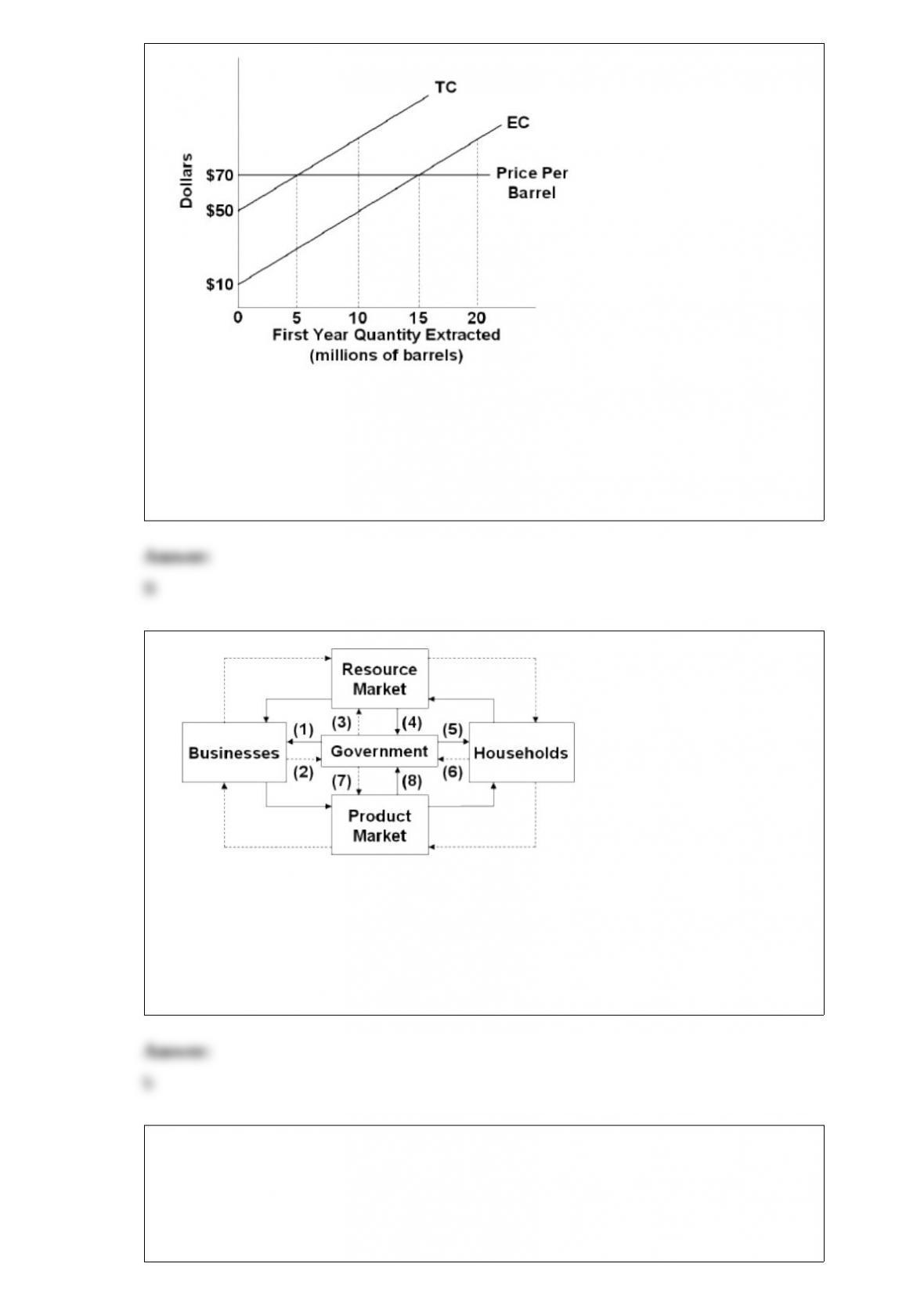
3)
Refer to the diagram above, representing Slippery Slope Oil Company. A $5 decrease in
the user cost would:
A.decrease the optimal quantity extracted in the present.
B.increase the optimal quantity extracted in the present.
C.not affect the optimal quantity extracted in the present.
D.reduce extraction costs in the present.
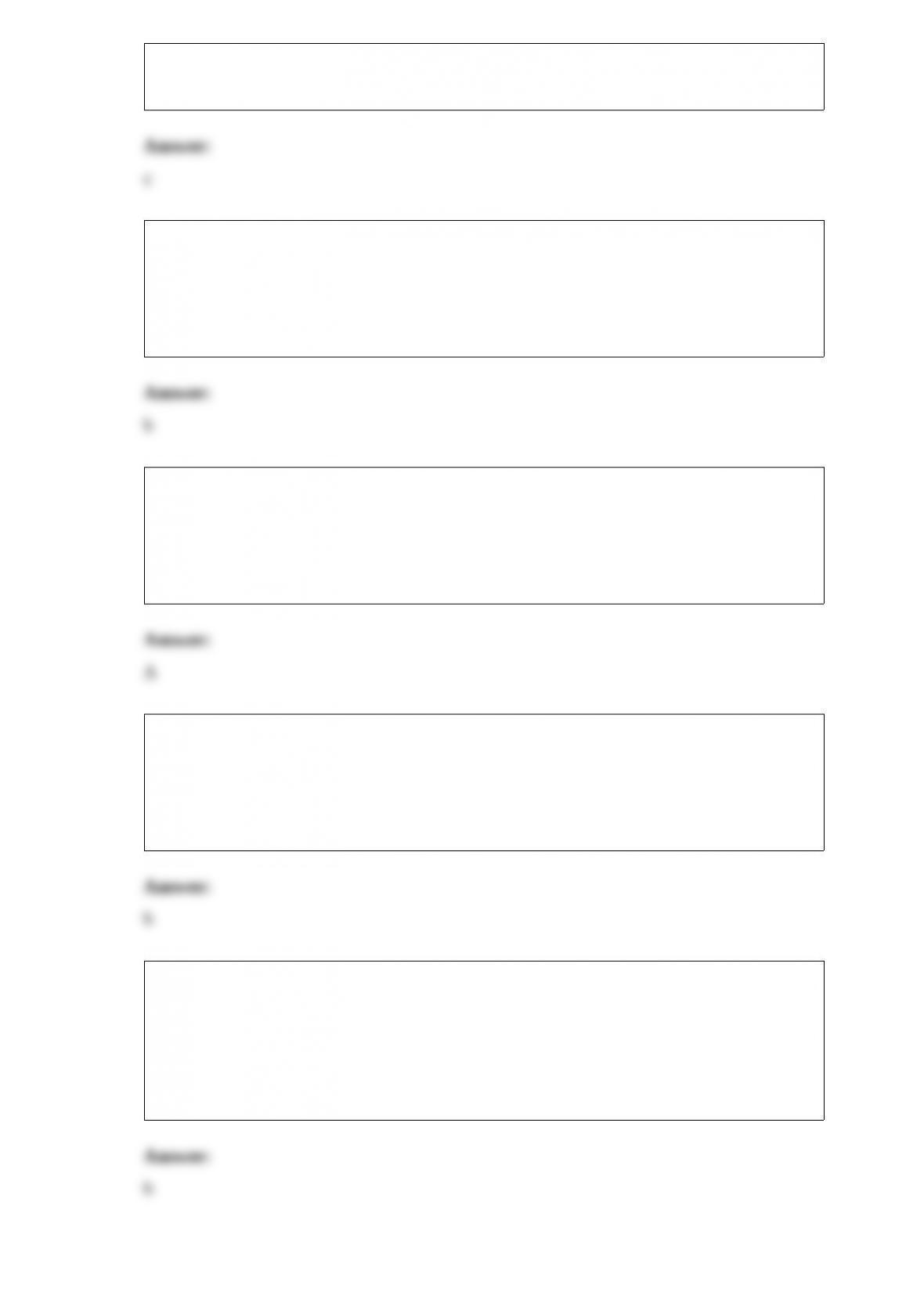
4)
refer to the above diagram, in which solid arrows reflect real flows; broken arrows are
monetary flows. flow (8) might represent:
a.personal income taxes.
b.automobile purchases by the state of maine.
c.the services of firefighters.
d.subsidies to farmers.
5) if a purely competitive firm is producing where price exceeds marginal cost, then:
a.the firm will fail to maximize profit, but resources will be efficiently allocated.
b.the firm will fail to maximize profit and resources will be overallocated to the
product.
c.the firm will fail to maximize profit and resources will be underallocated to the
product.
d.resources will be underallocated to the product, but the firm will maximize profit.
6) allocative efficiency refers to:
a.the use of the least-cost method of production.
b.the production of the product-mix most wanted by society.
c.the full employment of all available resources.
d.production at some point inside of the production possibilities curve.
7) In the United States, the money supply (M1) is comprised of:
A.coins, paper currency, and checkable deposits.
B.currency, checkable deposits, and Series E bonds.
C.coins, paper currency, checkable deposits, and credit balances with brokers.
D.paper currency, coins, gold certificates, and time deposits.
8) in constructing a stable demand curve for product x:
a.consumer preferences are allowed to vary.
b.the prices of other goods are assumed constant.
c.money incomes are allowed to vary.
d.the supply curve of product x is assumed to be fixed.
9) an efficiency loss (or deadweight loss) declines in size when a unit of output is
produced for which:
a.marginal cost exceeds marginal benefit.
b.maximum willingness to pay exceeds minimum acceptable price.
c.consumer surplus exceeds producer surplus.
d.producer surplus exceeds consumer surplus.
10) Which of the following is a true statement?
A.There is a long-run tradeoff between inflation and unemployment.
B.The short-run Phillips Curve is vertical.
C.The long-run Phillips Curve is horizontal.
D.Adverse aggregate supply shocks can simultaneously worsen unemployment and
inflation.
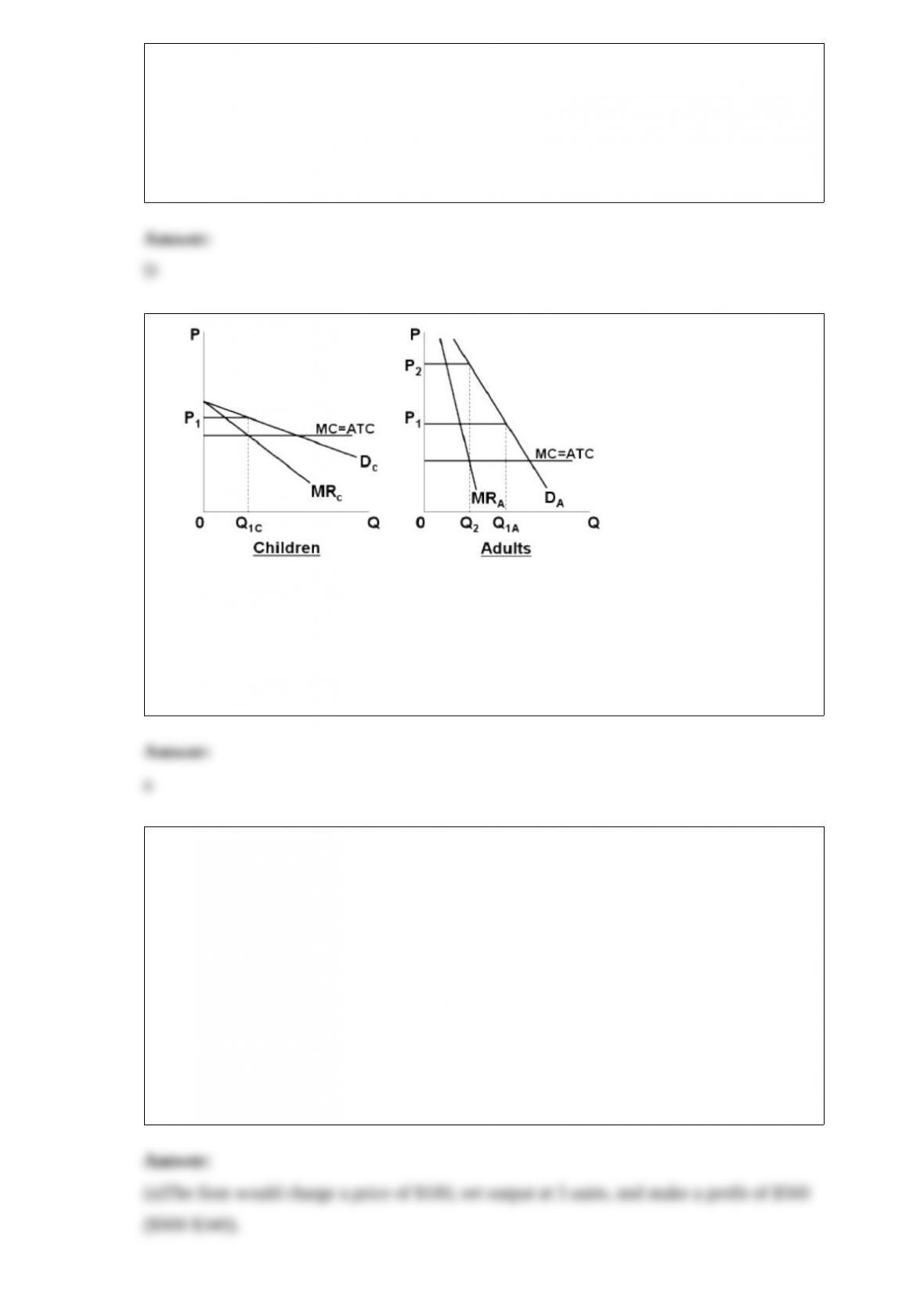
11)
assume the above figure applies to a pure monopolist. if this firm is able to price
discriminate between children and adults, it should charge prices of:
a.p1 to children, and p2 to adults.
b.p1 to adults, and p2 to children.
c.p1 to both children and adults.
d.p2 to both children and adults.
12) An oligopoly producing a homogeneous product is composed of three firms that act
like a cartel. Assume that these three firms have identical cost schedules. Assume also
that if any one of these firms sets a price for the product, the other two firms charge the
same price. As long as they all charge the same price they will share the market equally;
and the quantity demanded of each will be the same.
Below are the total-cost schedule of one of these firms and the demand schedule that
confronts it when the other firms charge the same price as this firm. Complete the
marginal-cost and marginal-revenue schedules facing the firm.
(a)What price would be charged, what output would be produced, and what profit
would be made by this firm?
(b)If the firms collude to maximize joint profits, what would be the industry price,
output, and profit?
13) The equality-efficiency tradeoff best describes the:
A.tradeoff between a lower benefit-reduction rate and a higher break-even level of
income maintenance plans.
B.failure to include noncash benefits in calculating the poverty rate.
C.inequities in Temporary Assistance for Needy Households benefits among the various
states.
D.the choice between “more equality and less output” and “less equality and more
output.”
14) health maintenance organizations (hmos):
a.are based on the traditional fee-for-service system of paying physicians.
b.charge a fixed amount per member, hire many of their own physicians, and provide
health services only to members.
c.are also known as preferred provider organizations.
d.are illegal in several states.
15) Which of the following might be expected to increase union membership?
A.increased labor force participation by women and young people
B.decreased imports of manufactured goods
C.increased substitution of capital for labor in the production process
D.continued growth of servic-related industries
16)
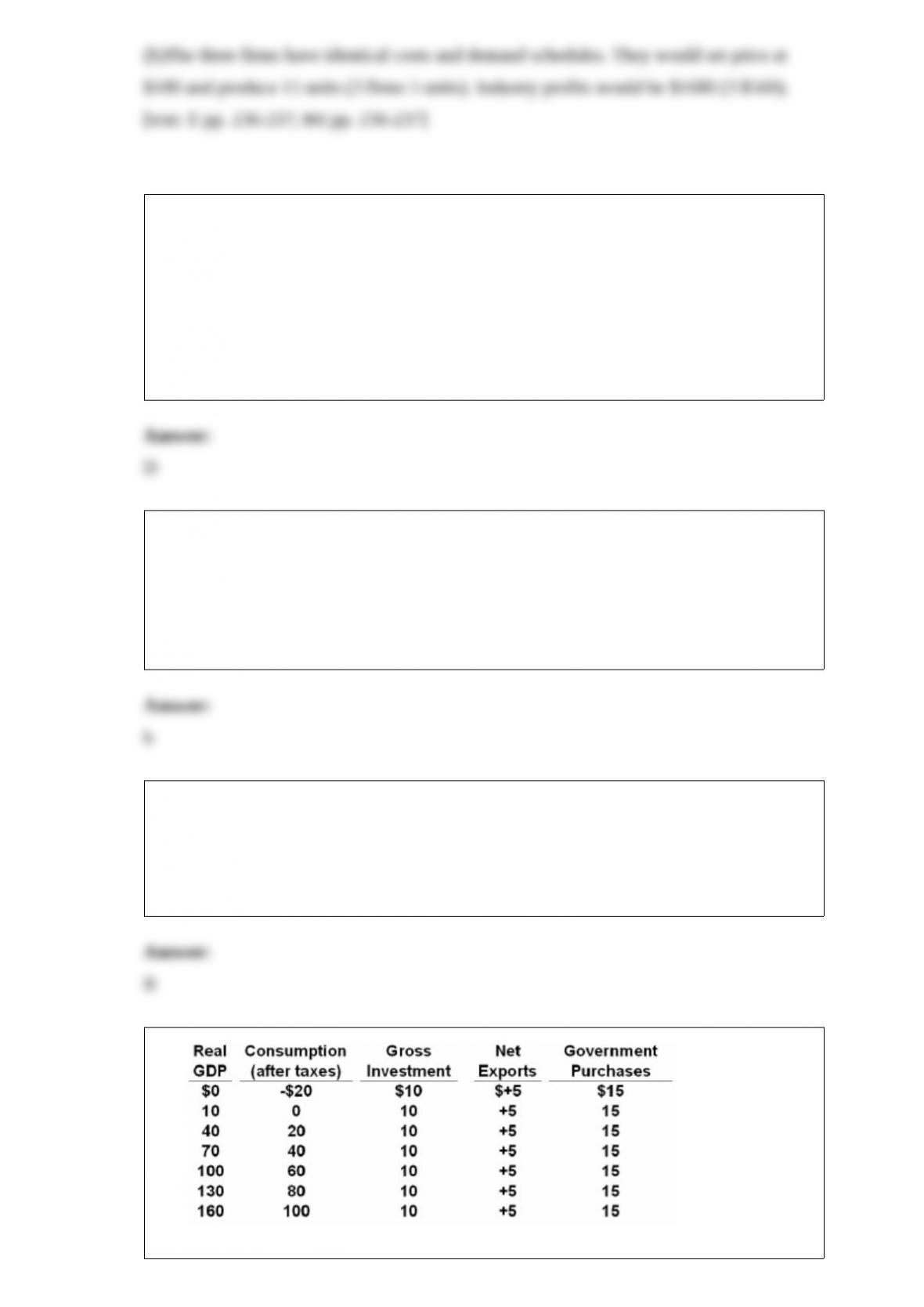
Refer to the above table. If the full-employment real GDP is $70 the:
A.inflationary expenditure gap is $30.
B.recessionary and inflationary expenditure gaps are both $0.
C.inflationary expenditure gap is $10.
D.recessionary expenditure gap is $10.
17)
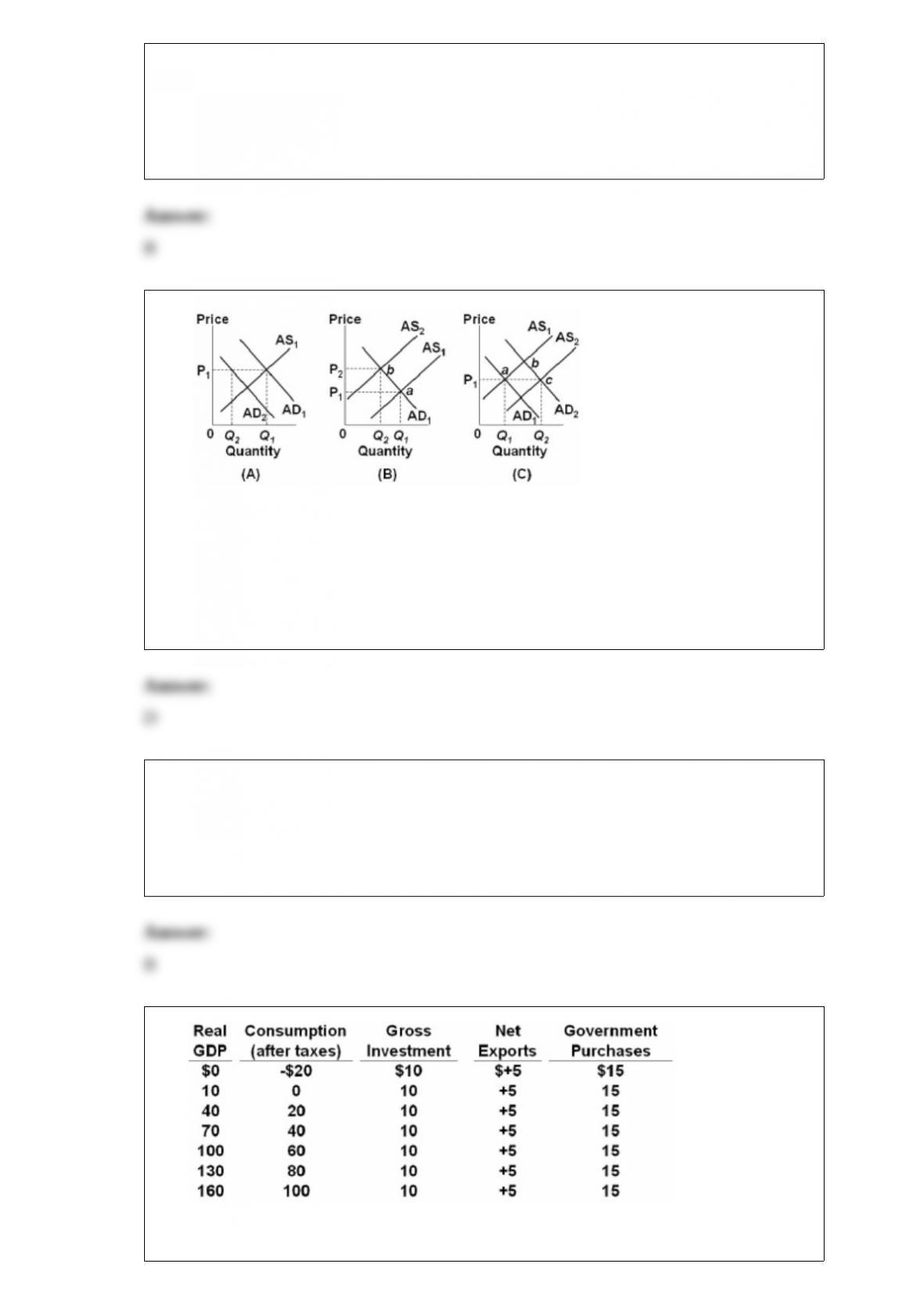
Refer to the above diagrams, in which AD1 and AS1 are the “before” curves and AD2
and AS2 are the “after” curves. Other things equal, inflation is absent in:
A.panel (A) only.
B.panel (B) only.
C.panel (C) only.
D.panels (A) and (C).
18) Real wages in the United States are:
A.the highest in the world.
B.relatively high, but not as high as in some other industrially advanced nations.
C.much higher than output per worker.
D.higher than nominal wages.
19)
Refer to the above table. The multiplier is:

A.5.
B.4.
C.3.
D.2.