1) In the market for loanable funds:
A.an increase in bank lending will increase the interest rate.
B.a decrease in saving will reduce the interest rate.
C.an increase in borrowing for investment will increase the interest rate.
D.a decrease in government borrowing will increase the interest rate.
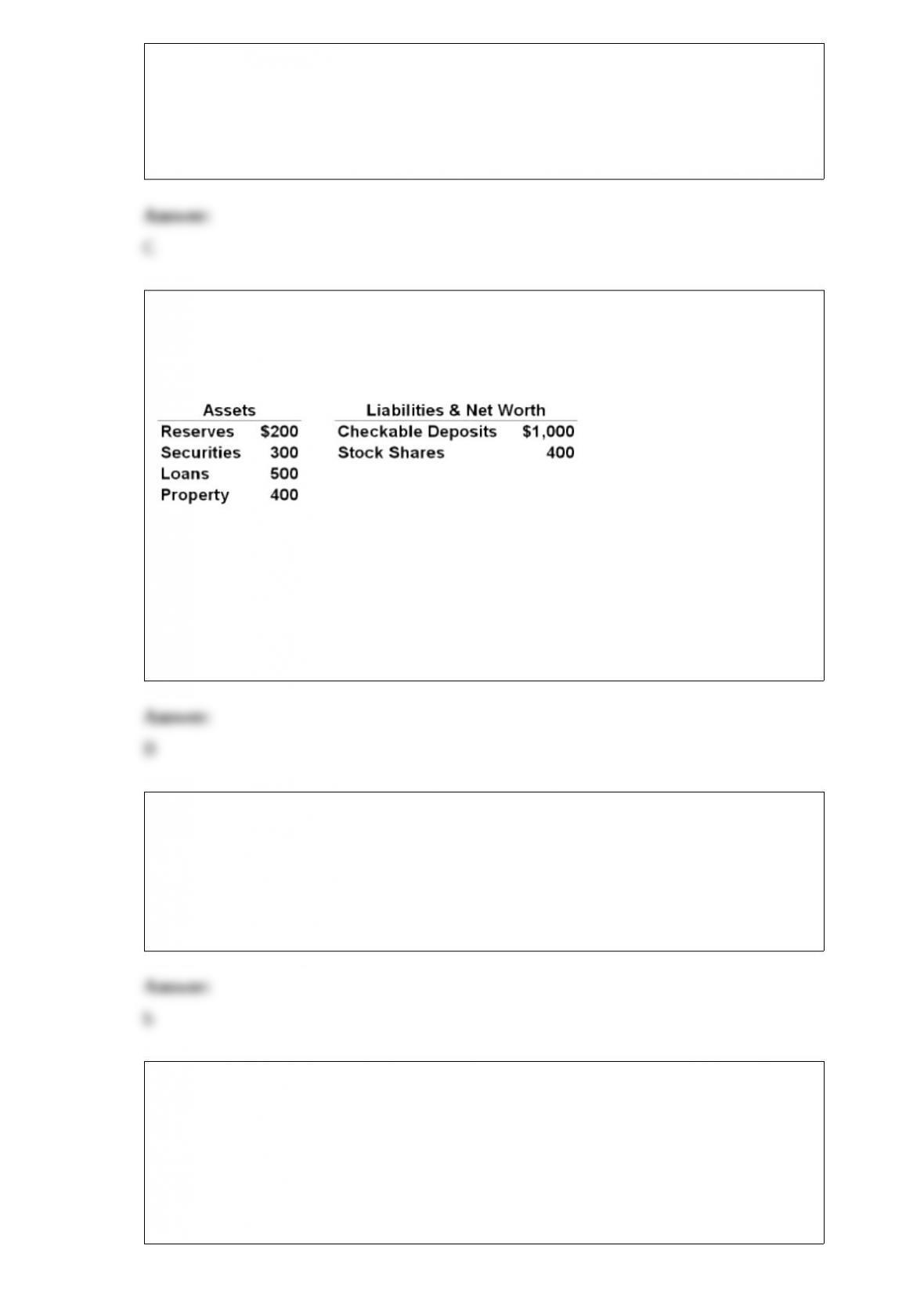
2) The following consolidated balance sheet of the commercial banking system.
Assume that the reserve requirement is 20 percent. All figures are in billions and each
question should be answered independently of changes specified in all preceding ones.
Refer to the above data. Suppose the Fed wants to reduce the money supply by $200
billion to drive up interest rates and dampen inflation. To accomplish this it could
increase the reserve requirement from 20 percent to:
A.22 percent.
B.25 percent.
C.30 percent.
D.33 percent.
3) for every 1 percentage point that the actual unemployment rate exceeds the natural
rate, a 2 percentage point negative gdp gap occurs. this is a statement of:
a.taylor’s rule.
b.okun’s law.
c.say’s law.
d.the coase theorem.
4) Which of the following statements is correct?
A.The standardized budget and the actual budget differ because the latter does not take
government transfer payments into account.
B.The standardized budget is less likely to show a deficit than is the actual budget.
C.The standardized budget and the actual budget will show the same size deficit or
surplus in any given fiscal year.
D.The standardized budget is more likely to show a deficit than is the actual budget.
5) In comparing a tariff and an import quota we find that:
A.the tariff and quota both generate the same amount of revenue for the United States
Treasury.
B.the tariff generates revenue for the United States Treasury but the quota does not.
C.the quota generates revenue for the United States Treasury but the tariff does not.
D.neither the tariff nor the quota generates revenue for the United States Treasury.
6) which of the following is a distinguishing feature of a market system?
a.public ownership of all capital.
b.central planning.
c.wide-spread private ownership of capital.
d.a circular flow of goods, resources, and money.
7) which of the following pairs of countries were admitted to the european union in
2007?
a.croatia and kosovo
b.romania and bulgaria
c.switzerland and hungary
d.tunisia and liechtenstein
8) for many years the price of medical care in the united states has:
a.risen at the same rate as the overall price level.
b.risen at a faster rate than the overall price level.
c.risen, but at a slower rate than the overall price level.
d.fallen.
9) sam decides to join the gigantic state university’s rugby team when he learns that his
health insurance will pay for any subsequent injury. this illustrates:
a.the diagnosis-related-group system.
b.a “pay or play” system.
c.the moral hazard problem.
d.the coase theorem.
10)
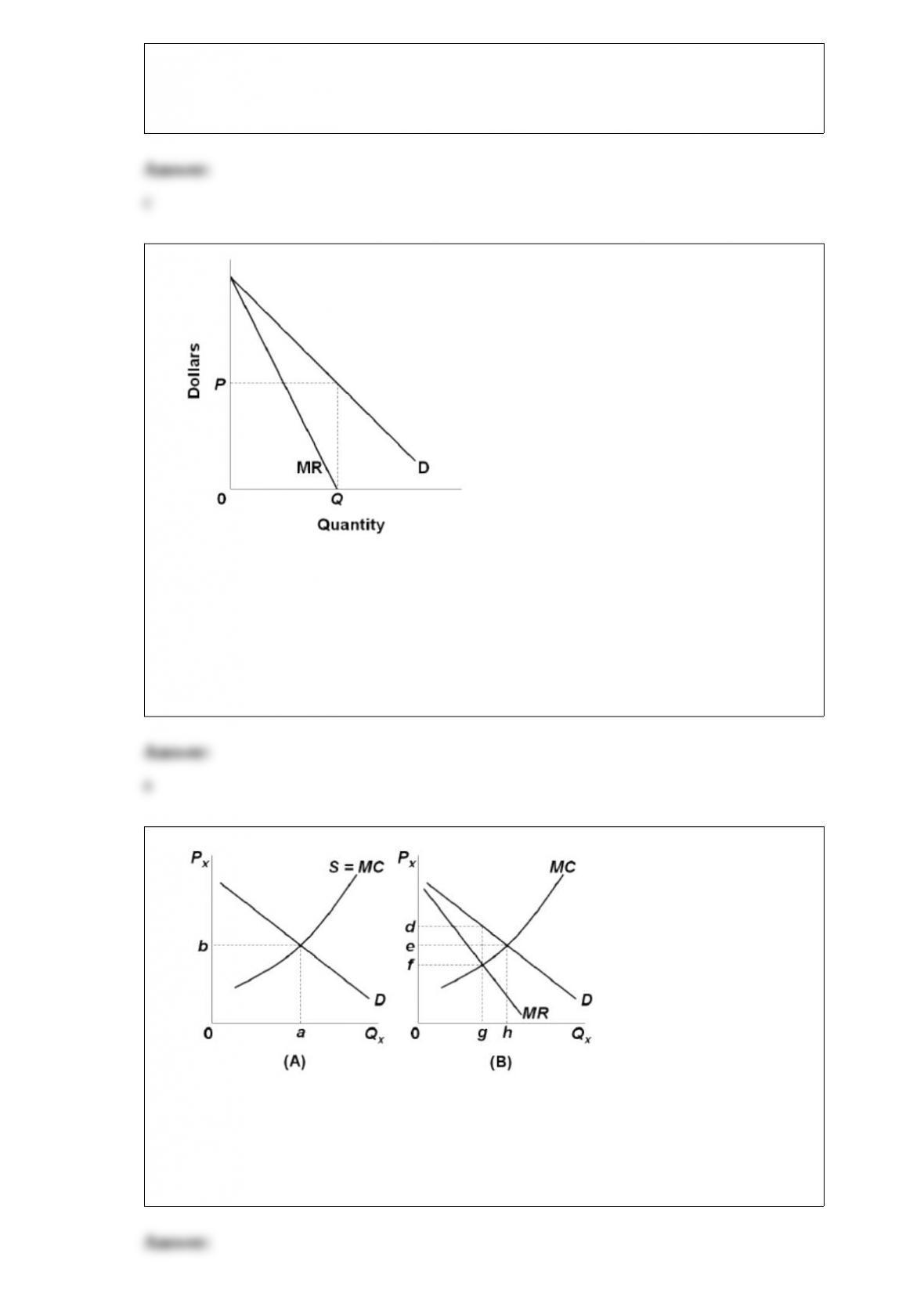
assume a pure monopolist is charging price p and selling output q as shown on the
above diagram. on the basis of this information we can say that:
a.if marginal costs were somehow zero, the firm would be maximizing its profits.
b.if marginal costs were positive the firm would increase profits by reducing price and
selling more output.
c.the firm is producing where the price elasticity coefficient is less than one.
d.the firm is a “price taker.”
11)
refer to the above diagrams. in diagram (b) the profit-maximizing quantity is:
a.g and the profit-maximizing price is e
b.h and the profit-maximizing price is e
c.g and the profit-maximizing price is f
d.g and the profit-maximizing price is d
12) Which of the following is an example of a public good?
A.a weather warning system
B.a television set
C.a sofa
D.a bottle of soda
13) if a corporation goes bankrupt, its stockholders will lose:
a.only the value of their stock.
b.the value of their stock plus any other business assets they may own.
c.the value of their stock plus any other personal assets they may own.
d.the value of their stock plus any other business and personal assets they may own.
14) A particular woman is denied on-the-job training because women on average are
more likely to drop out of the workforce than men. This illustrates:
A.occupational segregation.
B.the crowding model.
C.the taste-for-discrimination model.
D.statistical discrimination.
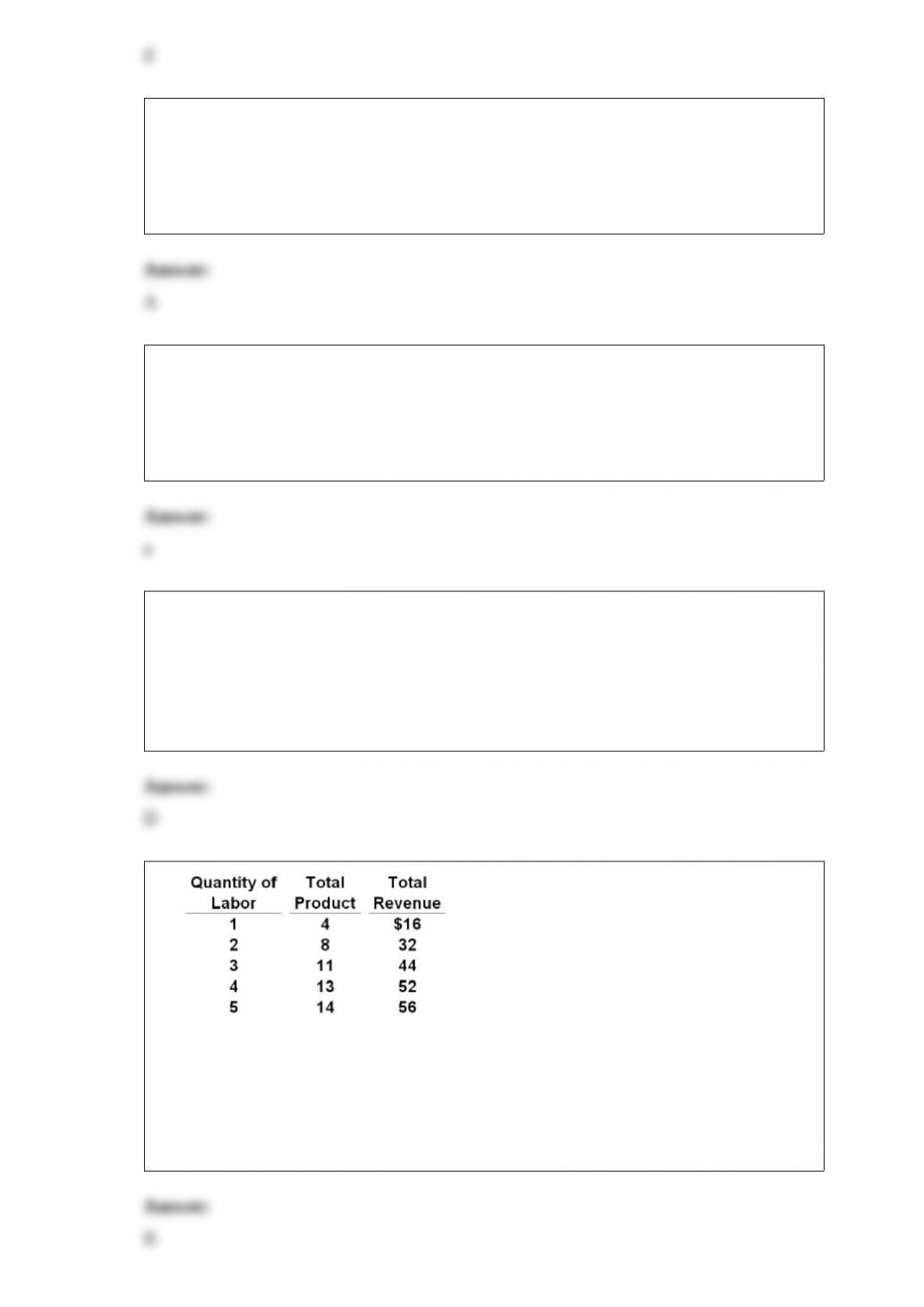
15)
Refer to the above data. If this firm can hire as few or many workers as it wants at $8, it
is:
A.hiring labor in a monopsony labor market.
B.hiring labor in a purely competitive labor market.
C.selling its product in a monopolized product market.
D.selling its product in a purely competitive product market.
16) nontariff barriers are:
a.maximum limits on the quantity or total value of specific products imported to a
nation.
b.excise taxes or duties placed on imported products.
c.licensing requirements, unreasonable quality standards, and the like designed to
impede imports.
d.government payments to domestic producers to reduce the world prices of exported
goods.
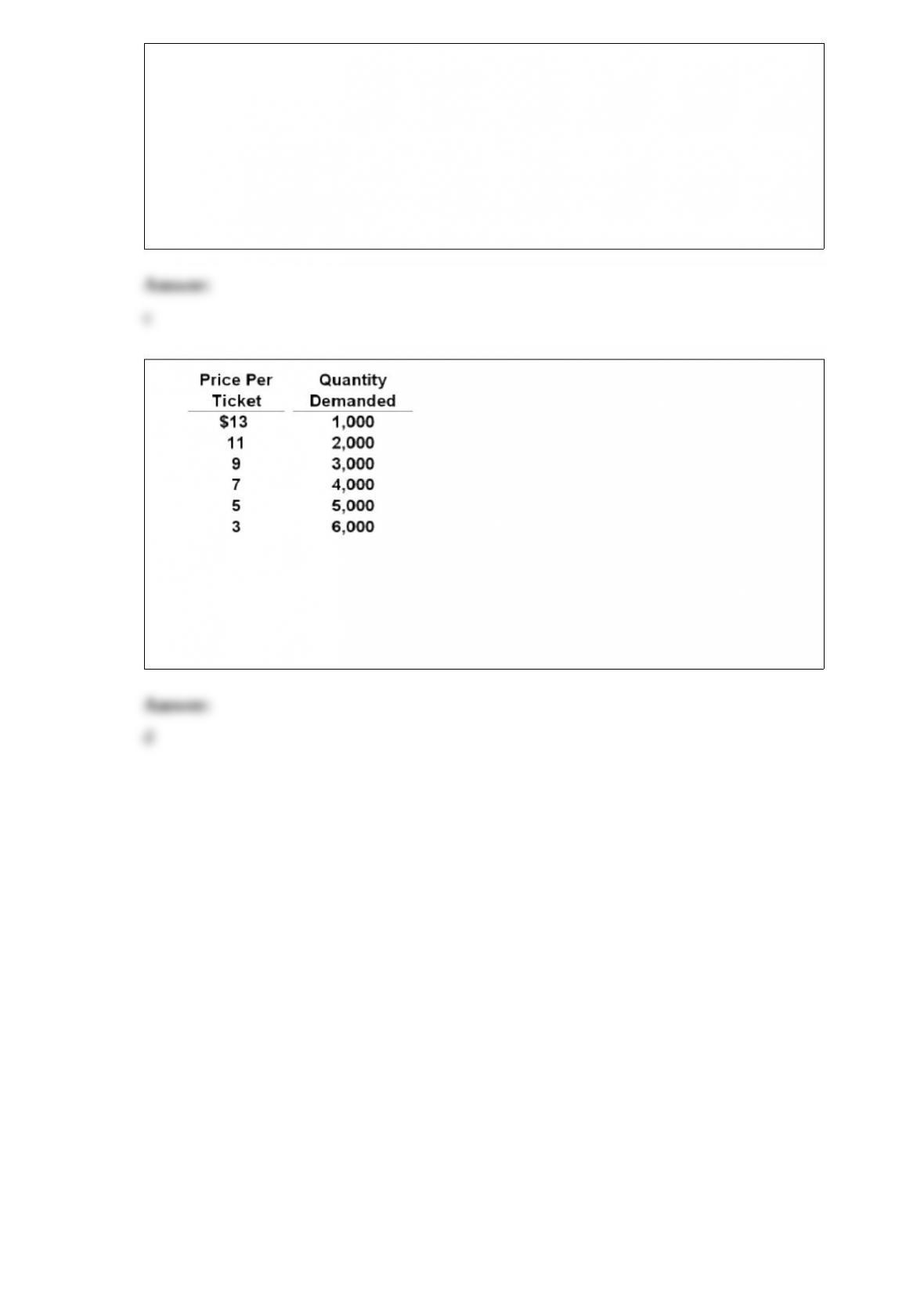
17)
refer to the above information. over the $7-$5 price range, demand is:
a.perfectly elastic.
b.perfectly inelastic.
c.elastic.
d.inelastic.