Suppose the equilibrium price of milk is $3 per gallon but the federal government sets
the market price at $4 per gallon. The market mechanism will force the milk price back
down to $3 per gallon unless the government:
A) rations the excess demand for milk among consumers.
B) buys the excess supply of milk and removes it from the market.
C) Both A and B are plausible actions.
D) The government cannot maintain the price above the equilibrium level.
Figure 4.2
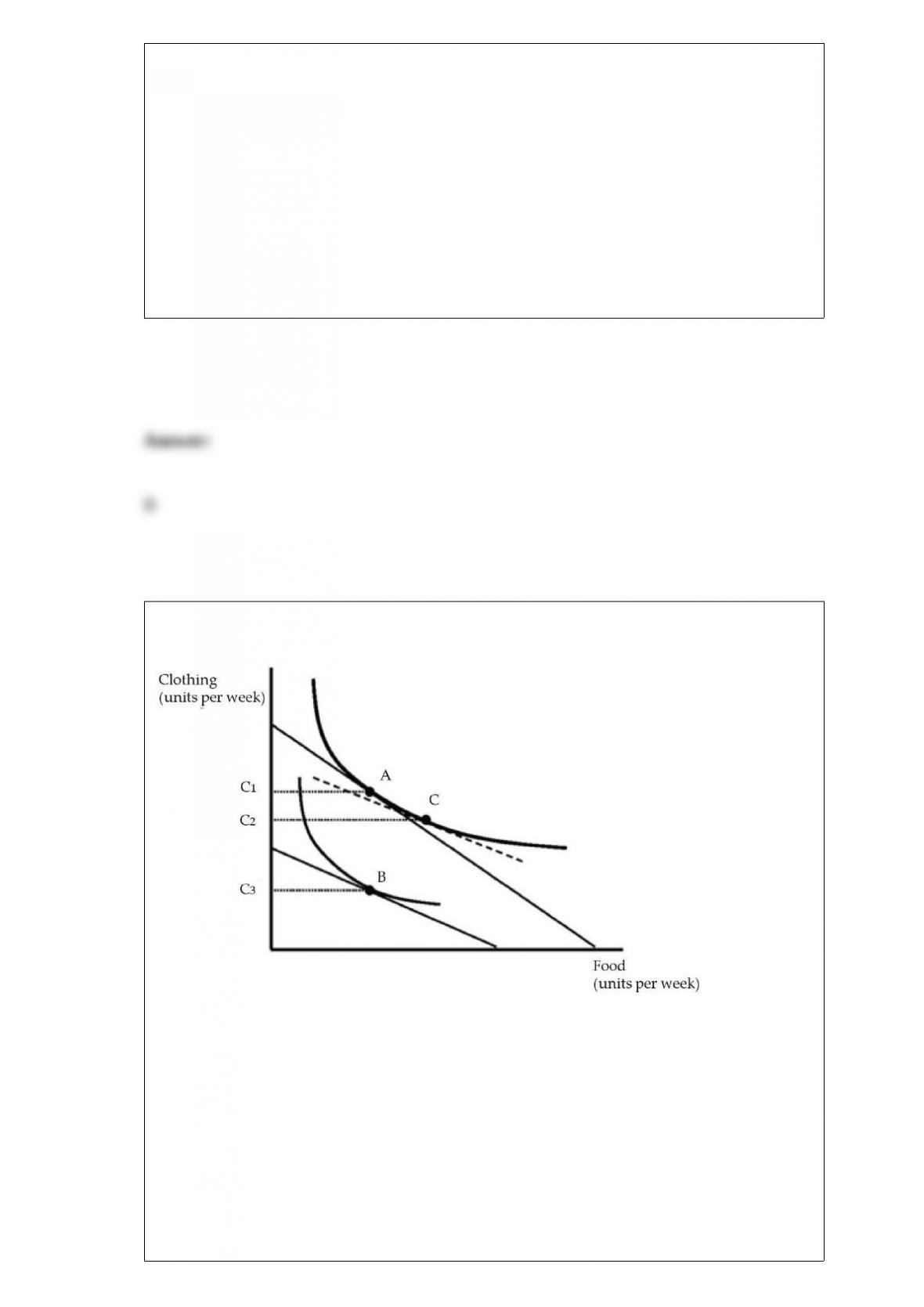
A consumer’s original utility maximizing market basket of goods is shown in Figure 4.2
as point A. Following a price change, the consumer’s utility maximizing market basket
is at point B.
Based Figure 4.2, clothing is:
A) a normal good.
B) an inferior good, but not a Giffen good.

C) a Giffen good.
D) none of the above
Suppose that, at the market clearing price of natural gas, the price elasticity of demand
is -1.2 and the price elasticity of supply is 6. What will result from a price ceiling that is
10 percent below the market clearing price?
A) A shortage equal to 1.8 percent of the market clearing quantity
B) A shortage equal to 0.6 percent of the market clearing quantity
C) A shortage equal to 18 percent of the market clearing quantity
D) A shortage equal to 6 percent of the market clearing quantity
E) More information is needed.
Use the following statements to answer this question:
I. The first theorem of welfare economics refers to efficient allocation of goods across
groups of consumers, and it does not consider the problem of efficient production of
these goods.
II. The only way to achieve an efficient allocation of goods is to use competitive
markets.

A) I and II are true.
B) I is true and II is false.
C) II is true and I is false.
D) I and II are true.
Scenario 12.3:
Suppose a stream is discovered whose water has remarkable healing powers. You
decide to bottle the liquid and sell it. The market demand curve is linear and is given as
follows:
P = 30 – Q
The marginal cost to produce this new drink is $3.
Refer to Scenario 12.3. What is the monopoly price of this new drink?
A) 0
B) $3
C) $13.50
D) $16.50
E) $27

Suppose two firms with differentiated products are competing on price. The reaction
curve for Firm 1 is P1 = 4 + 0.5 P2, and the reaction curve for Firm 2 is P2 = 4 + 0.5P1.
What is the equilibrium price outcome in this market?
A) P1 = P2 = 4
B) P1 = P2 = 6
C) P1 = P2 = 8
D) P1 = 6 and P2 = 8
To find the social marginal benefit of public goods, one needs to
A) sum the consumers’ demand curves vertically.
B) sum the consumers’ demand curves horizontally.
C) sum the marginal private benefit and the marginal external benefit for each unit.
D) sum the marginal private cost and the marginal external cost for each unit.
E) subtract the individual portion of the tax burden necessary for the government to
provide the good from the demand curve of each consumer who desires the good.

Scenario 13.1:
You are negotiating with your florist over the price of flowers for your wedding. You
value the floral arrangements at $500. The florist’s cost for the arrangement is $200.
You finally settled on a price of $250.
Refer to Scenario 13.1. At your negotiated price the producer surplus is:
A) $0.
B) $50.
C) $200.
D) $250.
E) $300.
Recently, Skooterville has experienced a large growth in population. As a result, the
demand curve for telephone service in Skooterville:
A) has shifted to the right.
B) has shifted to the left.
C) has shifted down.
D) Both B and C are correct.
E) none of the above

All of the payment to a factor of production will be economic rent when the factor of
production has:
A) an infinitely inelastic supply curve.
B) an infinitely elastic supply curve.
C) a constant, unit elastic supply curve.
D) an infinitely inelastic demand curve.
The price of video cassette recorders (VCRs) remains constant, but the market demand
curve for VCRs shifts leftward as consumers shift to DVDs and other video
technologies. What happens to the consumer surplus in this market as the demand curve
shifts?
A) Increases
B) Decreases
C) Remains the same
D) We do not have enough information to answer this question.
You have just won a cash award of $500 for academic excellence.

A) The substitution effect of this award will be larger than its income effect.
B) The income effect of this award will be larger than its substitution effect.
C) The substitution and income effects will be of identical size.
D) It is impossible to know whether the substitution effect is larger than the income
effect or vice versa.
If X transferable emissions permits are issued and there are n potential polluters,
A) the government must initially assign each of the potential polluters X/n permits.
B) the government must assign X/n permits to each potential polluter and check
periodically that those permits have not moved.
C) emissions will be the same whether or not the permits are split equally, so long as
none of the permits are issued outside the group.
D) emissions will be the same no matter who receives them first, so long as the
recipient is willing and able to participate in the permit market.
E) emissions will be less if the permits are given initially to firms with lower abatement
costs.
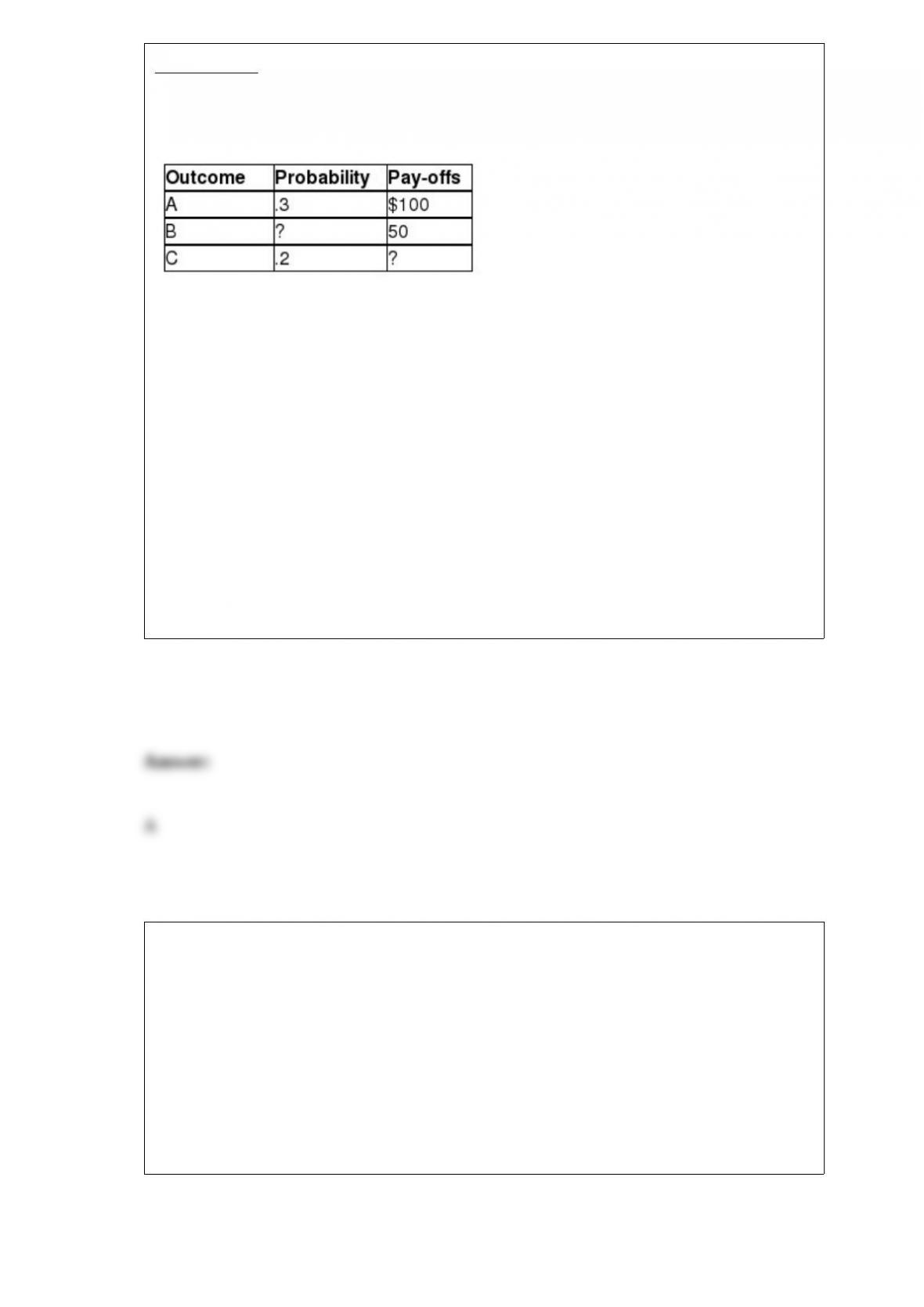
Scenario 5.4:
Suppose an individual is considering an investment in which there are exactly three
possible outcomes, whose probabilities and pay-offs are given below:
The expected value of the investment is $25. Although all the information is correct,
information is missing.
Refer to Scenario 5.4. What is the pay-off of outcome C?
A) -150
B) 0
C) 25
D) 100
E) 150
Suppose the labor market and all output markets are perfectly competitive. When the
labor market is in equilibrium, the wage rate will:
A) be less than the marginal revenue product of labor.
B) equal the marginal revenue product of labor.
C) be greater than the marginal revenue product of labor.
D) None of the above is necessarily correct.

Assume that a firm’s marginal cost is $10 and the elasticity of demand is -2. We can
conclude that the firm’s profit maximizing price is approximately
A) $20.
B) $5.
C) $10.
D) The answer cannot be determined without additional information.
A farmer uses L units of labor and K units of capital to produce Q units of corn using a
production function F(K,L). A production plan that uses K’ = L’ = 10 to produce Q’ units
of corn where
Q’ < F(10, 10) is said to be
A) technically feasible and efficient.
B) technically unfeasible and efficient.
C) technically feasible and inefficient.
D) technically unfeasible and inefficient.
E) none of the above
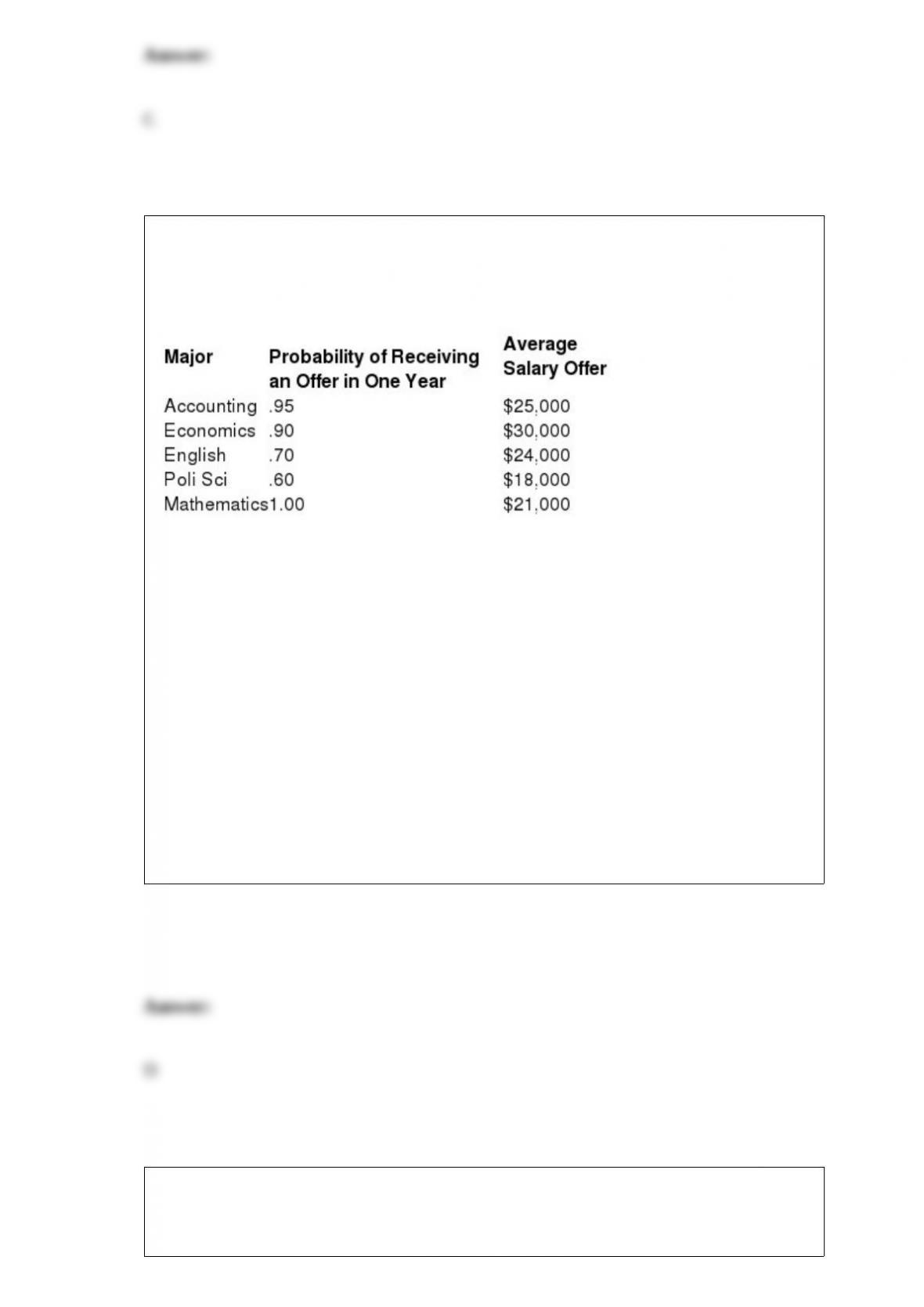
Consider the following information about job opportunities for new college graduates in
Megalopolis:
Table 1
Refer to Table 5.1. A risk-averse student making a decision solely on the basis of the
above information
A) would definitely become a math major.
B) would definitely not become an English major.
C) would definitely become a political science major.
D) might be either a mathematics major or English major, depending upon the utility of
the average offer.
E) would definitely be indifferent between the accounting major and the English major
if the probability of finding a job in accounting were any value higher than 0.95.
Which of the following is NOT true about price floors?
A) Consumer surplus is always lower than it would be in the competitive equilibrium.

B) Producer surplus could be lower, higher, or the same as it would be in competitive
equilibrium.
C) Producer surplus could be negative as the result of a price floor.
D) Producers will often respond to a price floor by cutting production to the point at
which price equals marginal cost.
E) The total producer surplus depends on how producers respond to the price floor in
determining their output level.
Suppose the upward sloping labor supply curve shifts leftward in a labor market with a
single employer (monopsony). What happens to the marginal expenditure curve?
A) Shifts left
B) Shifts right
C) Remains the same
D) We do not have enough information to answer this question.
Use the following statements to answer this question:
I. The price for a given product may differ across sellers if the market is not perfectly
competitive.
II. A single “market price” does not exist in imperfectly competitive markets.
A) I and II are true.
B) I is true and II is false.
C) II is true and I is false.
D) I and II are false.
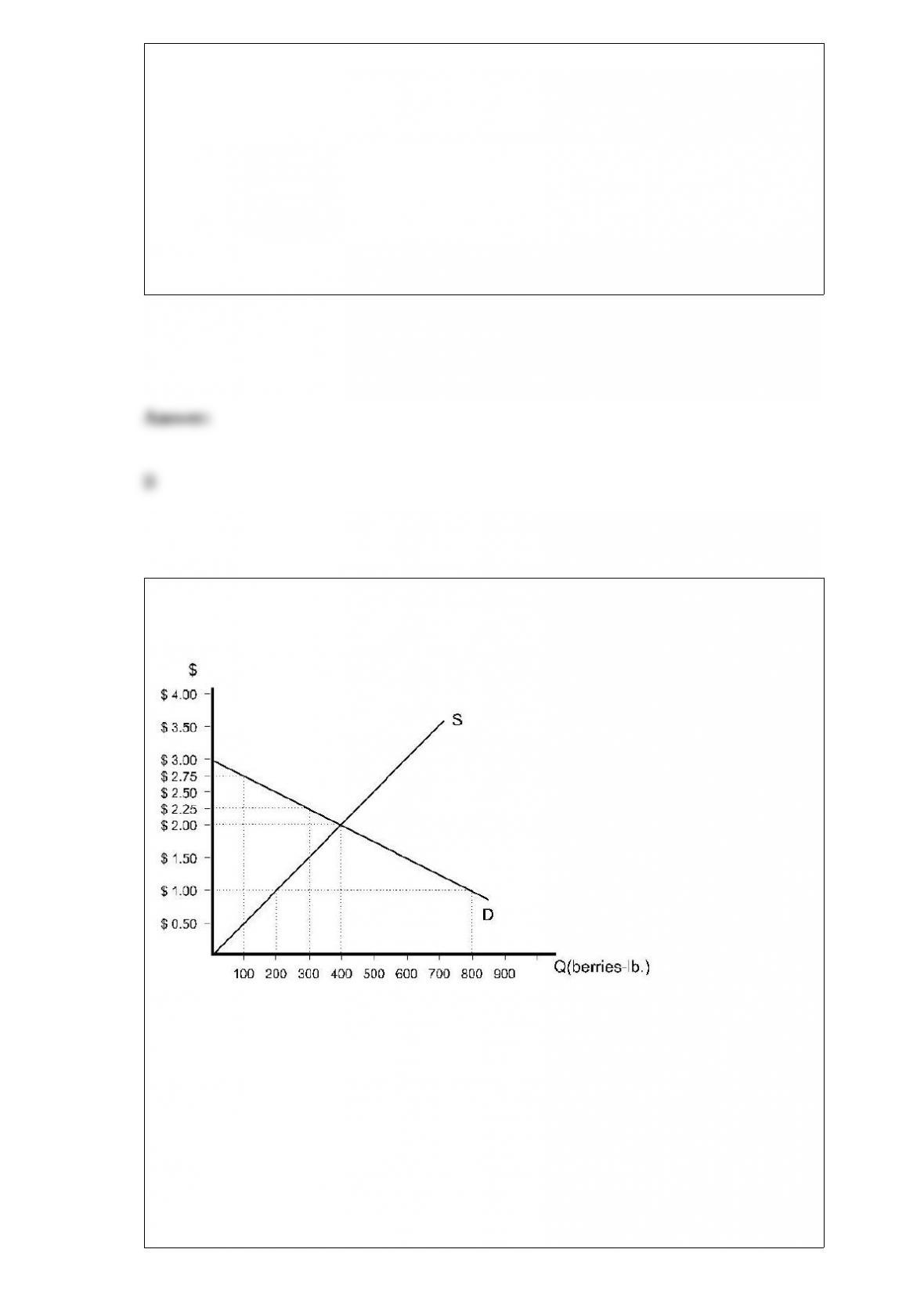
Figure 9.5
Refer to Figure 9.5. If the government establishes a price floor of $2.50, how many
pounds of berries will be sold?
A) 200
B) 300
C) 400

D) 600
E) 800
A move from one point on a contract curve to another point on the contract curve will
make
A) both individuals better off.
B) both individuals worse off.
C) one individual better off and the other individual worse off.
D) the goods more expensive.
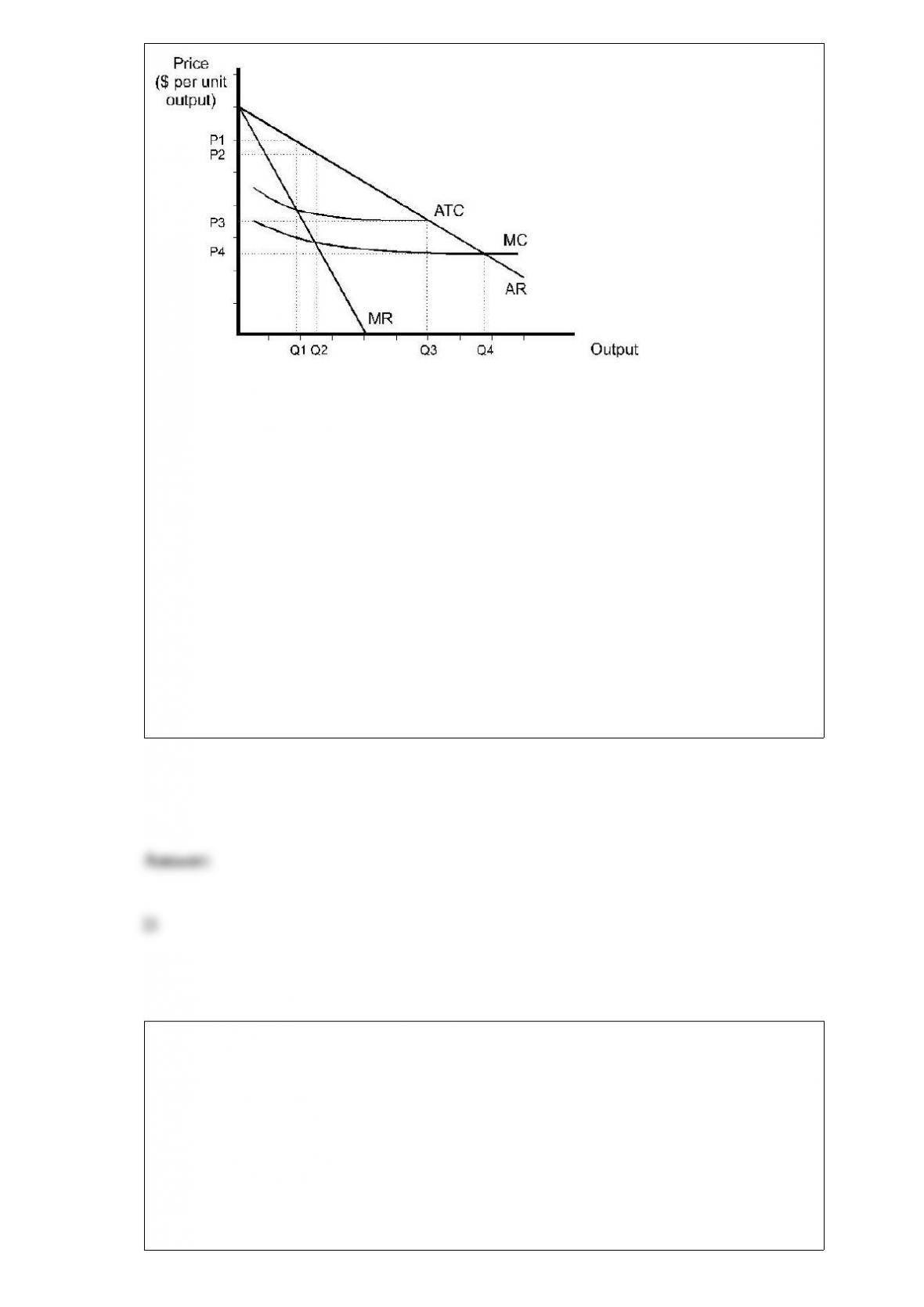
Figure 1
The revenue and cost curves in the diagram above are those of a natural monopoly
Refer to Figure 10.1. Suppose that the government decides to limit monopoly power
with price regulation. If the government sets the price at the competitive level, it will set
the price at ________.
A) P1
B) P2
C) P3
D) P4
E) none of the above
When a firm charges each customer the maximum price that the customer is willing to
pay, the firm
A) engages in a discrete pricing strategy.
B) charges the average reservation price.
C) engages in second-degree price discrimination.

D) engages in first-degree price discrimination.
The relationship between a pure-strategy Nash equilibrium and a dominant-strategy
equilibrium is that
A) a dominant-strategy equilibrium is a special case of a pure-strategy Nash
equilibrium.
B) a pure-strategy Nash equilibrium is a special case of a dominant-strategy
equilibrium.
C) they are the same.
D) there may not be a dominant-strategy equilibrium, but there always is a
pure-strategy Nash equilibrium.
E) they are mutually exclusive and exhaustive, in that a dominant-strategy equilibrium
is the same thing as a mixed-strategy Nash equilibrium.
Consider the following information:
The probability of a fire in a factory without a fire prevention program is 0.01. The
probability of a fire in a factory with a fire protection program is 0.001. If a fire
occurred, the value of the loss would be $300,000. A fire prevention program would
cost $80 to run.
. Moral hazard arises in this situation because once the firm

A) pays the premium that is based on the 0.001 probability, it has no incentive to spend
the additional $80 for the fire protection program, so the true probability of loss is no
longer 0.001.
B) pays the premium that is based on the 0.01 probability, it has no incentive to spend
the additional $80 for the fire protection program, so the true probability of loss is no
longer 0.01.
C) puts the fire protection program in place, it has less incentive to spend $300 for a
premium, leaving the firm underinsured.
D) puts the fire protection program in place, it has less incentive to spend $6,000 for a
premium, leaving the firm underinsured.
E) puts the fire protection program in place, it will consider that a substitute for
insurance and not be able to deal with the loss from a fire should it occur.
Hulk goes to the gym 20 times a month. His income is $1,000 per month and his visits
to the gym cost $4 per visit.
a. Draw Hulk’s budget line for visits to the gym and all other goods, show the
consumption bundle that maximizes his satisfaction, and draw the indifference curve
through that point.
b. Recently, a new health club opened which offers identical facilities but which charges
a flat fee of $60 per month plus $1 per visit. Draw Hulk’s budget line if he were to join
this new club.
c. Would Hulk continue to work out at the gym or would he join the new health club.
Why?
Scenario 13.1:
You are negotiating with your florist over the price of flowers for your wedding. You
value the floral arrangements at $500. The florist’s cost for the arrangement is $200.
You finally settled on a price of $250.
Refer to Scenario 13.1. Your negotiations are an example of:
A) a noncooperative game.
B) a cooperative game.
C) a constant sum game.
D) a competitive game.
E) both B and C
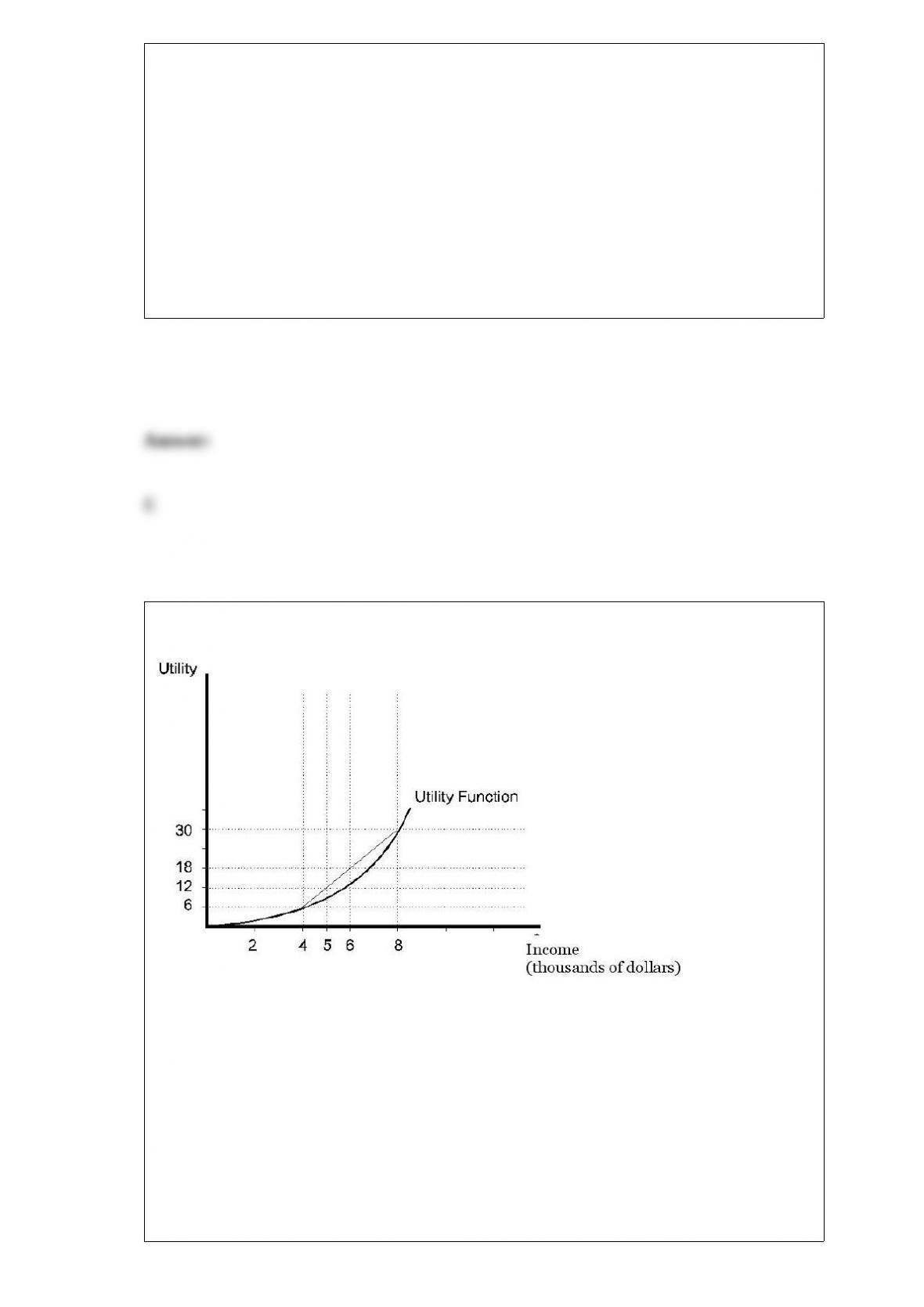
Figure 5.3
The individual pictured in Figure 5.3
A) would pay a risk premium of 2 utils to avoid facing the two outcomes.
B) would want to be paid a risk premium of 2 utils to give up the opportunity of facing
the two outcomes.
C) would pay a risk premium of $1000 to avoid facing the two outcomes.

D) would want to be paid a risk premium of $1000 to give up the opportunity of facing
the two outcomes.
E) has a risk premium of 2 utils.
General equilibrium analysis is different from partial equilibrium analysis in that
general equilibrium analysis
A) explicitly takes feedback effects into account and partial equilibrium analysis does
not.
B) does not take into consideration specific problems, but partial equilibrium analysis
does.
C) takes into consideration specific problems, but partial equilibrium analysis does not.
D) allows one to arrive at a specific conclusion, but partial equilibrium analysis does
not.
Alvin’s preferences for good X and good Y are shown in the diagram below.

Figure 3.1
Refer to Figure 3.1. Which of the following is true concerning Alvin’s marginal rate of
substitution?
A) It is diminishing.
B) It is positive but varies along the indifference curve.
C) It is constant.
D) It is zero.
For most residential telephone service, people pay a monthly fee to have a hookup to
the telephone company’s line plus a fee for each call actually made. Under this pricing
scheme, the telephone company is using
A) limit pricing.
B) a two-part tariff.
C) second-degree price discrimination.
D) two stage price discrimination.

Scenario 5.9:
Torrid Texts, a risk-neutral new firm that specializes in making college textbooks more
interesting by inserting contemporary material wherever possible, is planning for next
year’s production and must decide how many paper producers to contract with. It knows
fairly well what the general demand for textbooks is, but is uncertain how faculty will
react to this new material. If faculty react very negatively, the firm expects course
orders to be down. The executives at Torrid believe that the likelihood of a positive
faculty response is 75%. The table below contains profit information under the different
possible outcomes.
Producers Faculty Reaction Expected
Contracted Negative Positive Profit
1 $3 million $30 million $23.25 million
2 $1 million $60 million $45.25 million Refer to Scenario 5.9. The value to Torrid Texts
of complete information is
A) $0.25 million.
B) $0.5 million.
C) $1 million.
D) $14.75 million.
E) $30 million.