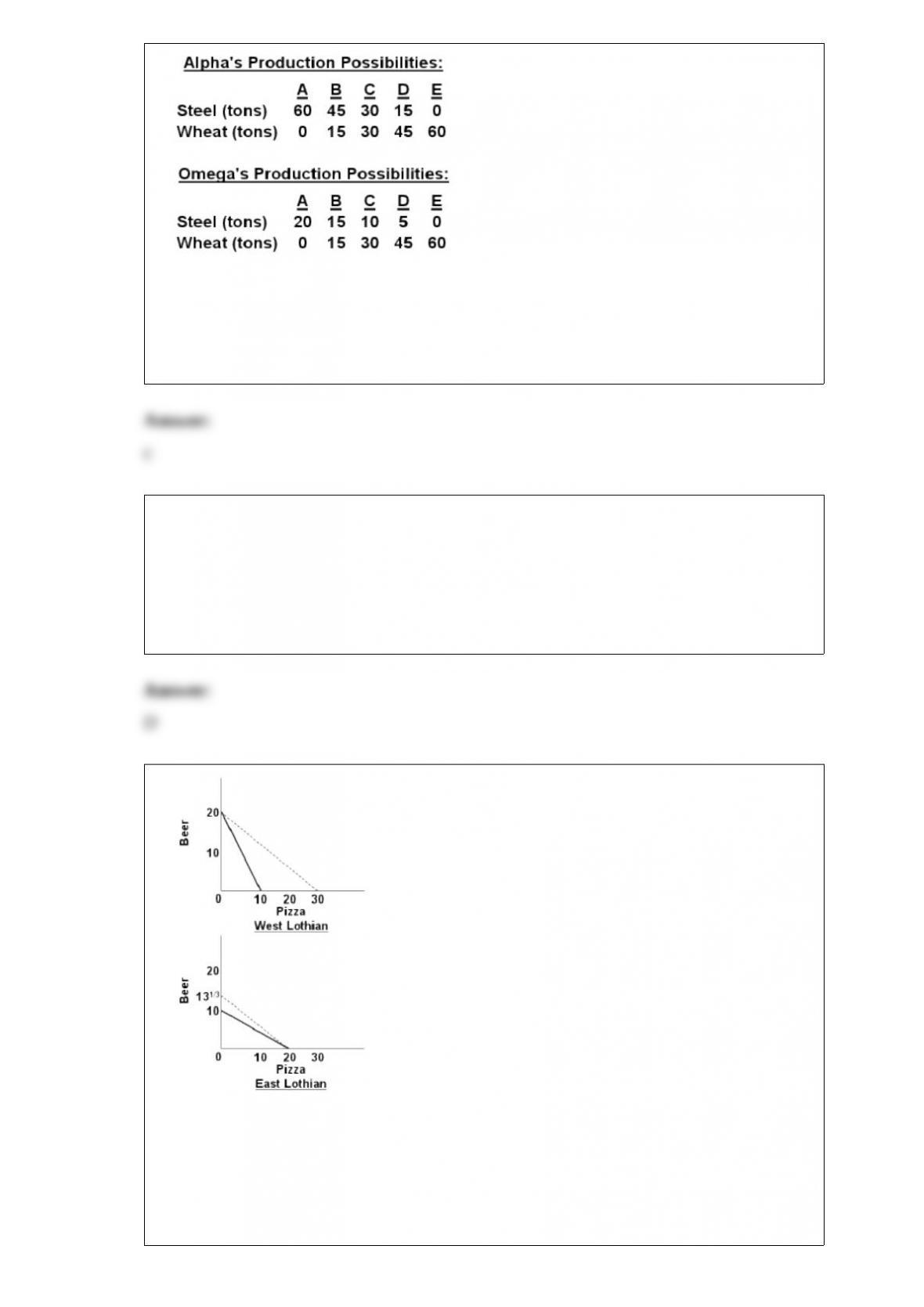
1)
refer to the above data. alpha has a comparative advantage in producing:
a.neither steel nor wheat.
b.both steel and wheat.
c.steel.
d.wheat.
2) Which of the following is not a feature of the Food, Conservation, and Energy Act of
2008?
A.direct payments (direct subsidies) based on crops previously grown
B.countercyclical payments
C.marketing loans
D.acreage allotments (restrictions on the number of acres that can be planted)
3)
Refer to the above diagrams. The solid lines are production possibilities curves; the
dashed lines are trading possibilities curves. The trading possibilities curves imply that:
A.both countries have a trade surplus that will result in economic growth.
B.the domestic production possibilities curves entail unemployment and/or the
domestic misallocation of resources.
C.world resources will be allocated more efficiently if the two nations specialize and

trade based on comparative advantage.
D.both nations will be worse off as a result of international specialization and trade.
4) okun’s law:
a.measures the tradeoff between the rate of inflation and the rate of unemployment.
b.indicates the number of years it will take for a constant rate of inflation to double the
price level.
c.quantifies the relationship between nominal and real incomes.
d.shows the relationship between the unemployment rate and the size of the negative
gdp gap.
5) (Advanced analysis) Answer the next question(s) on the basis of the following
consumption and investment data for a private closed economy. Figures are in billions
of dollars.
C = 60 + .6Y
I = I0 = 30
Refer to the above data. In equilibrium the level of saving will be:
A.30.
B.26.
C.25.
D.60.
6) The Fed introduced the term auction facility in response to:
A.the mortgage debt crisis.
B.the 2001 recession.
C.concerns about rising inflation.
D.the diminished effectiveness of open-market operations.
7) Supporters of farm subsidies have:
A.argued that farmers are comparatively poor and therefore should receive public help.
B.contended that the family farm is an American “way of life” and should be protected.
C.argued that farmers are at a disadvantage because they buy inputs in monopolized
markets and sell their output in competitive markets.
D.made all of these arguments.
8) Total Allowable Catch (TAC):
A.explicitly limits the number of days in a season that particular fish may be caught.
B.explicitly limits the number of boats allowed to fish in a particular area.
C.explicitly limits the number or tonnage of fish that can be harvested from a particular
fishery.
D.issues tradable permits limiting the number of fish a particular fisher can catch.
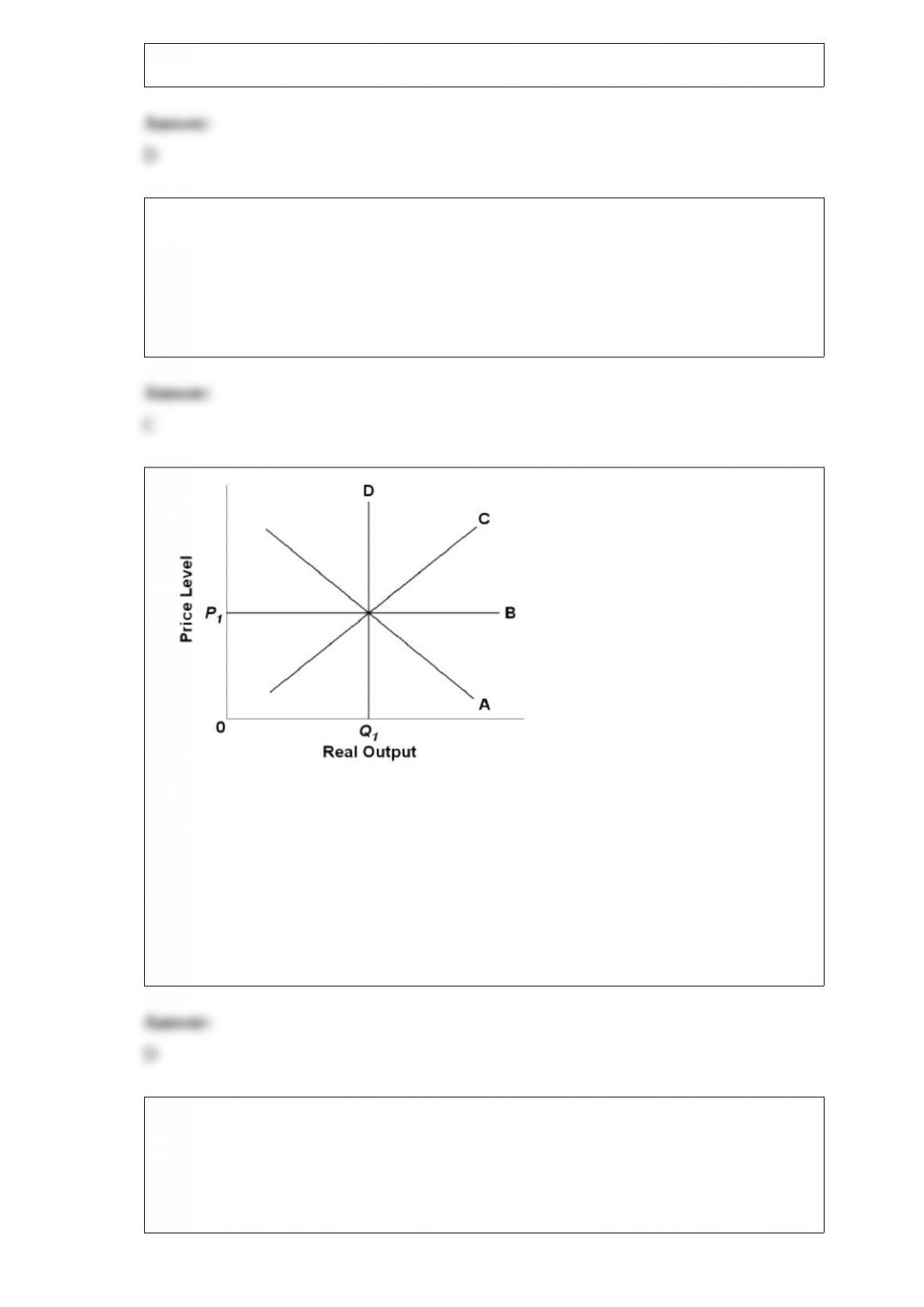
9)
Refer to the above diagram. Assume both upward and downward price and wage
flexibility in the economy. In the extended AD-AS model:
A.demand-pull inflation would involve a rightward shift of curve A, followed by a
rightward shift of curve C
B.cost-push inflation would involve a leftward shift of curve C, followed by an upward
shift of curve B.
C.recession would involve a leftward shift of curve A
D.a rightward shift of curve D would be equivalent to an outward shift of the nation’s
production possibilities curve.
10) (consider this) the main point of the consider this box on clipping coins is that:
a.decreases in the money supply cause deflation.
b.decreases in tax rates often increase tax revenues.
c.inflation imposes a “hidden tax” on those who hold money.
d.demand creates its own supply.
11) Which of the following is a true statement?
A.The bank and thrift share of total financial assets has increased dramatically since
1980.
B.The vast bulk of investment in the major nations is financed, not from internal saving,
but from funds from abroad.
C.The world’s financial markets have become increasingly integrated.
D. International stock and bond funds cannot be sold in the United States.
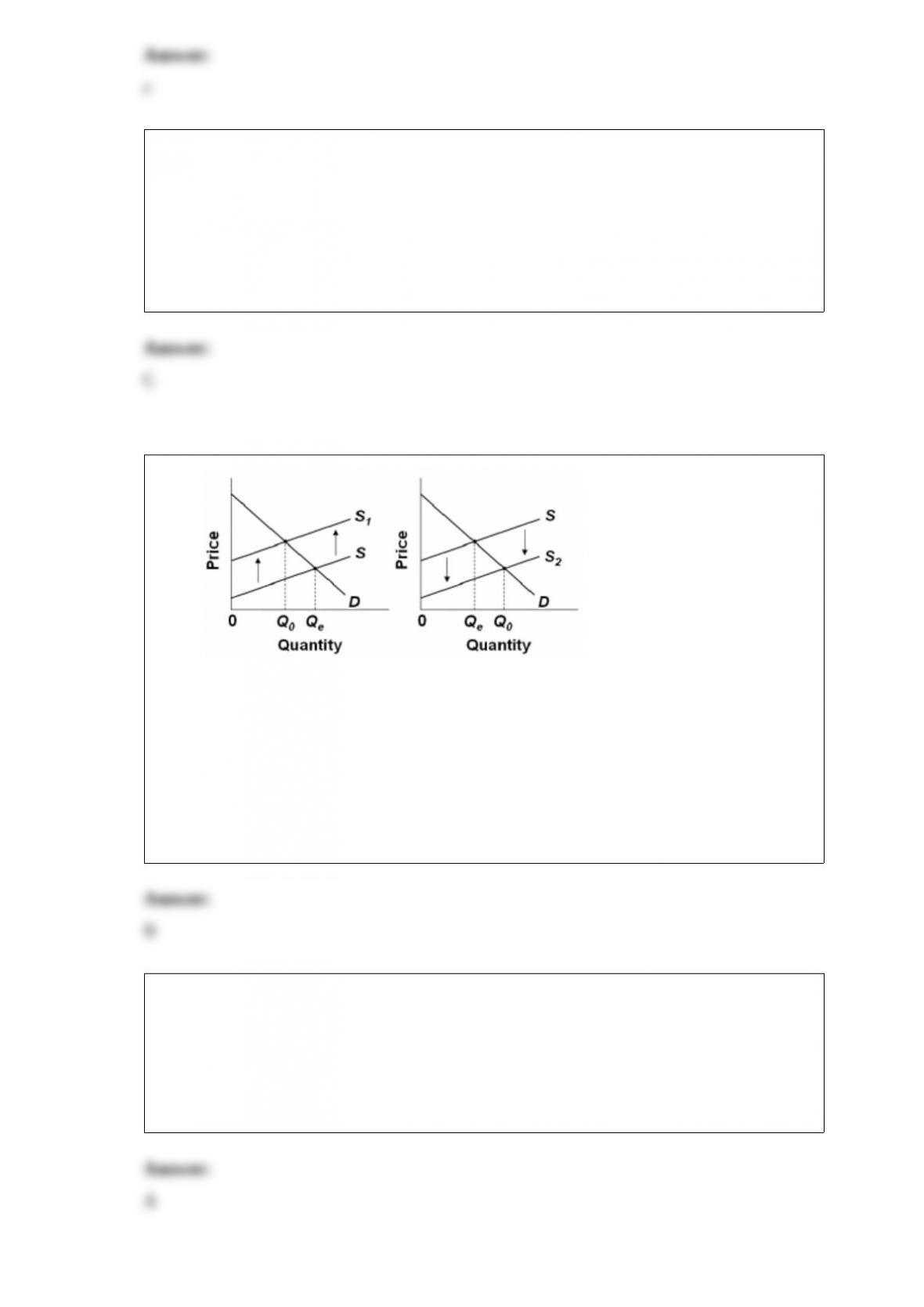
12)
Refer to the above diagrams for two separate product markets. Assume that society’s
optimal level of output in each market is Q0 and that government purposely shifts the
market supply curve from S to S1 in diagram (a) and from S to S2 in diagram (b). The
shift of the supply curve from S to S1 in diagram (a) might be caused by a per unit:
A.subsidy paid to the producers of this product.
B.tax on the producers of this product.
C.subsidy paid to the buyers of this product.
D.tax on the buyers of this product.
13) Suppose the balance on the current account is +$50 billion and the balance on the
capital account is +$1 billion. The balance on the financial account is:
A.-$51 billion.
B.-$50 billion.
C.-$49 billion.
D.+ $51 billion.
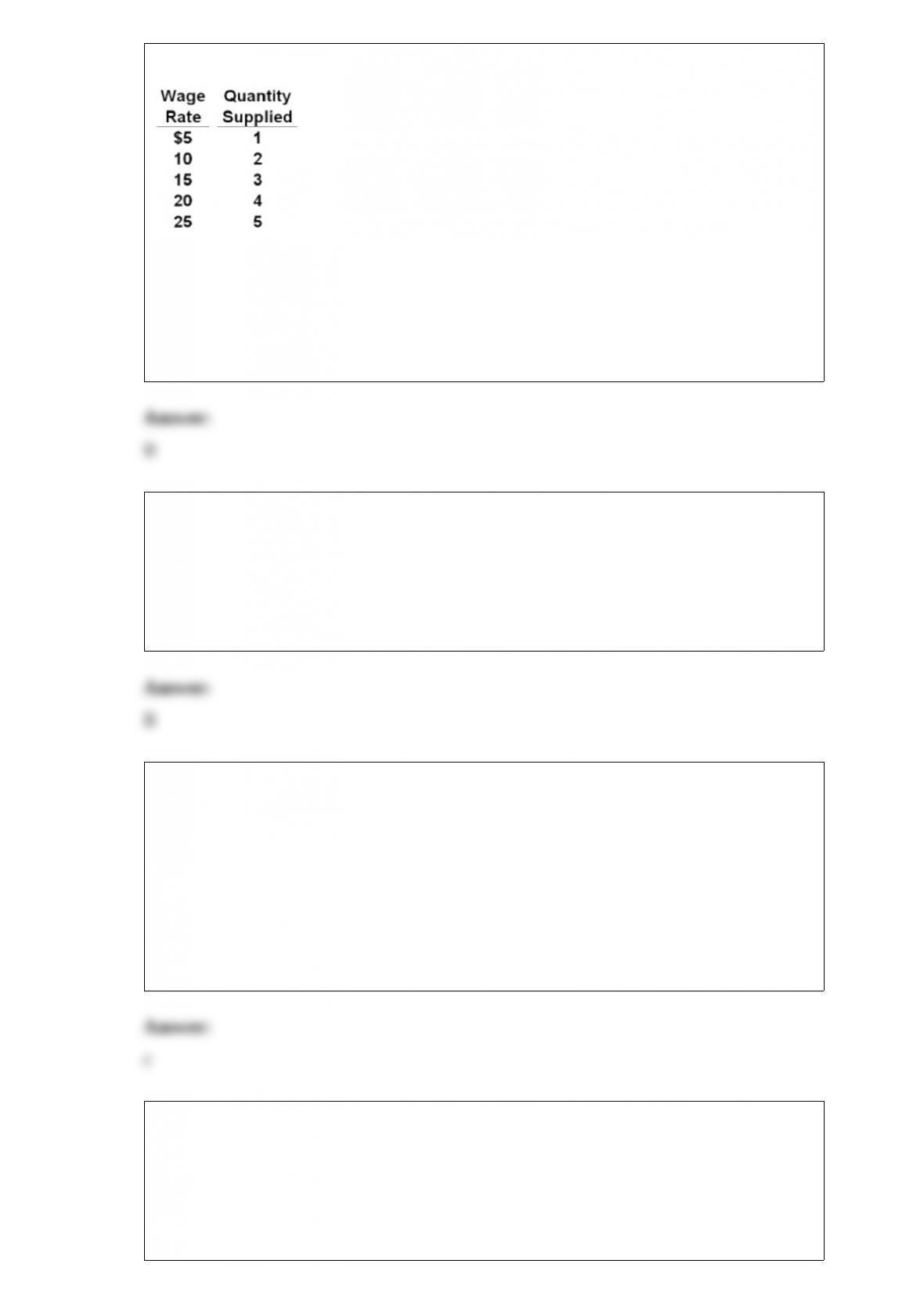
14)
Refer to the above information. The marginal resource (labor) cost of the third worker
is:
A.$15.
B.$25.
C.$35.
D.$45.
15) If a nation has a comparative advantage in the production of X, this means the
nation:
A.cannot benefit by producing and trading this product.
B.must give up less of other goods than other nations in producing a unit of X.
C.has a production possibilities curve identical to those of other nations.
D.is not subject to increasing opportunity costs.
16) which of the following is correct?
a.budget lines are linear and upsloping; indifference curves are downsloping and
concave to the origin.
b.budget lines are linear and downsloping; indifference curves are downsloping and
concave to the origin.
c.budget lines are linear and downsloping; indifference curves are downsloping and
convex to the origin.
d.budget lines are downsloping and convex to the origin; indifference curves are linear
and downsloping.
17) Suppose an investor is considering investing in three different assets. One asset is
equally likely to earn 10, 14 or 20 percent per year. Another is likely to earn 15 percent
per year 75% of the time and 25 percent per year 25% of the time. The final asset is
equally likely to earn 15 or 20 percent per year.
(a)What are the expected rates of return for each of the assets?
(b)Based on your results in (a), which asset is the investor likely to choose?
(c)Suppose the beta values for each asset were 1.0, 2.0 and 0.75 and the investor is risk
averse. Now which asset is he likely to choose?
18) long-run competitive equilibrium:
a.is realized only in constant-cost industries.
b.will never change once it is realized.
c.is not economically efficient.
d.results in zero economic profits.