
Assume a decreasing-cost industry that is initially in long-run competitive equilibrium.
A decrease in demand will cause a(n) __________ in prices and profits, and as a result,
firms will __________ the industry, causing the market supply curve to shift
__________,which, in turn, will eventually cause the equilibrium price to be
__________ before.
a. a decrease; exit; rightward; lower than
b. an increase; enter; rightward; higher than
c. a decrease; exit; leftward; higher than
d. an increase; enter; rightward; the same as
e. an increase; exit; leftward; lower than
When a firm is experiencing constant returns to scale, it follows that
a. unit costs are rising.
b. average total cost is rising.
c. unit costs are constant.
d. average total cost is constant.
e. c and d
Which of the following statements is false?

a. Average-cost pricing usually refers to setting a price for a natural monopoly firm that
is equal to its ATC, thus guaranteeing the firm a normal profit.
b. An economist thinks that there are both benefits and costs to most (if not all) types of
regulation.
c. The public choice theory of regulation holds that regulators are seeking to do, and
will do through regulation, what is in the best interest of the society at large.
d. One of the unintended effects of profit regulation (in the form of guaranteeing the
natural monopoly firm that it will always earn normal profit-nothing more and nothing
less) is that the natural monopoly has no incentive to keep its costs down.
To lower the elasticity of demand for labor, a labor union might attempt to
a. decrease the availability of substitutes for the products union workers produce.
b. increase the availability of substitutes for the products union workers produce.
c. increase the availability of substitute factors for union labor.
d. a and c
e. b and c
Exhibit 31-2
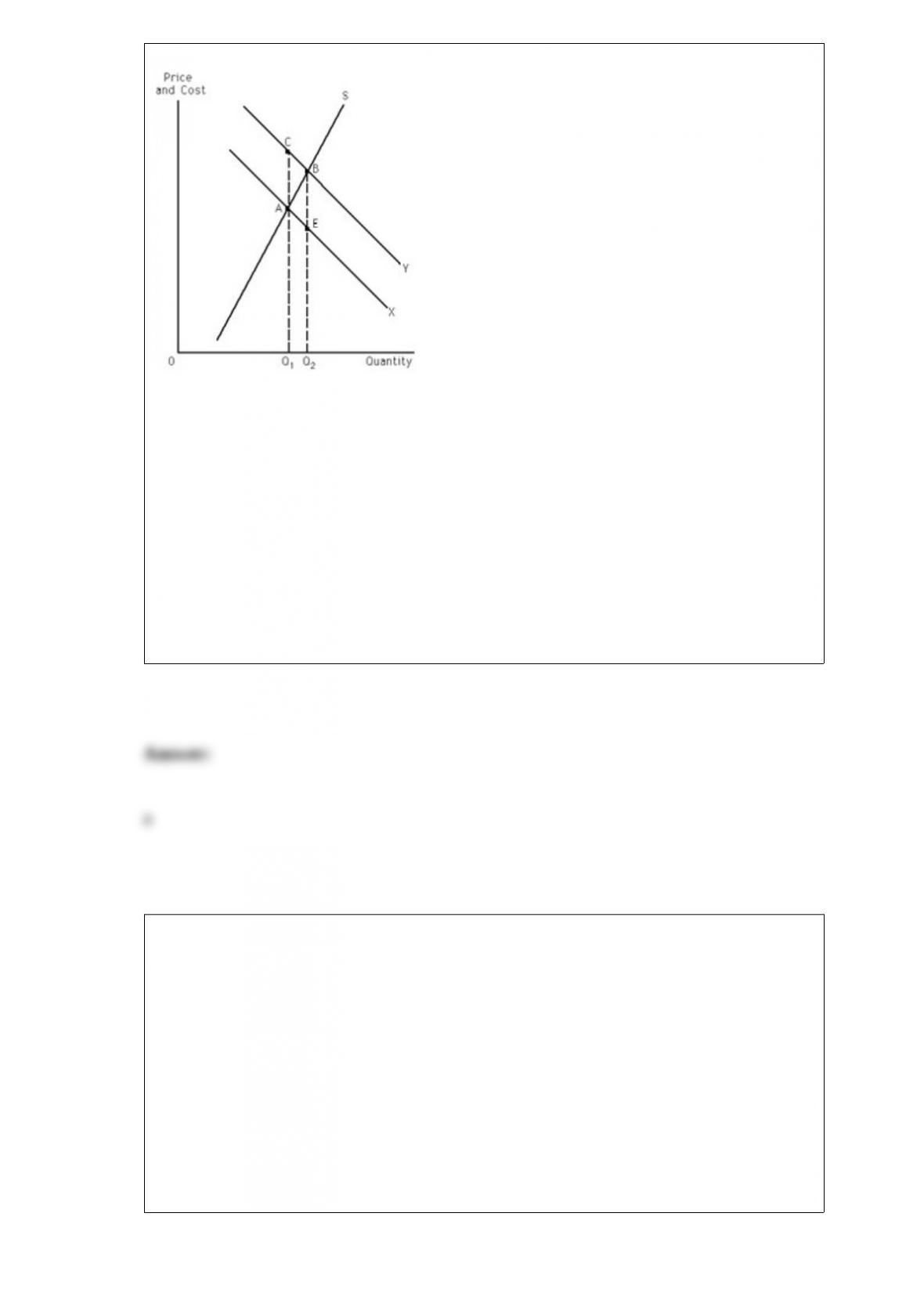
If the exhibit represents a positive externality situation, the private cost of expanding
output from Q1 to Q2 is the area of
a. Q1ABQ2.
b. Q1AEQ2.
c. Q1CBQ2.
d. ABE.
Which of the following statements is true?
a. The marginal cost curve has an upward-sloping portion to it because of the law of
diminishing marginal returns.
b. The marginal cost curve cuts the ATC curve at its highest point.
c. When marginal cost is rising, so must average total cost be rising.
d. A decline in marginal cost causes the MPP (of the variable input) to decline.
e. none of the above
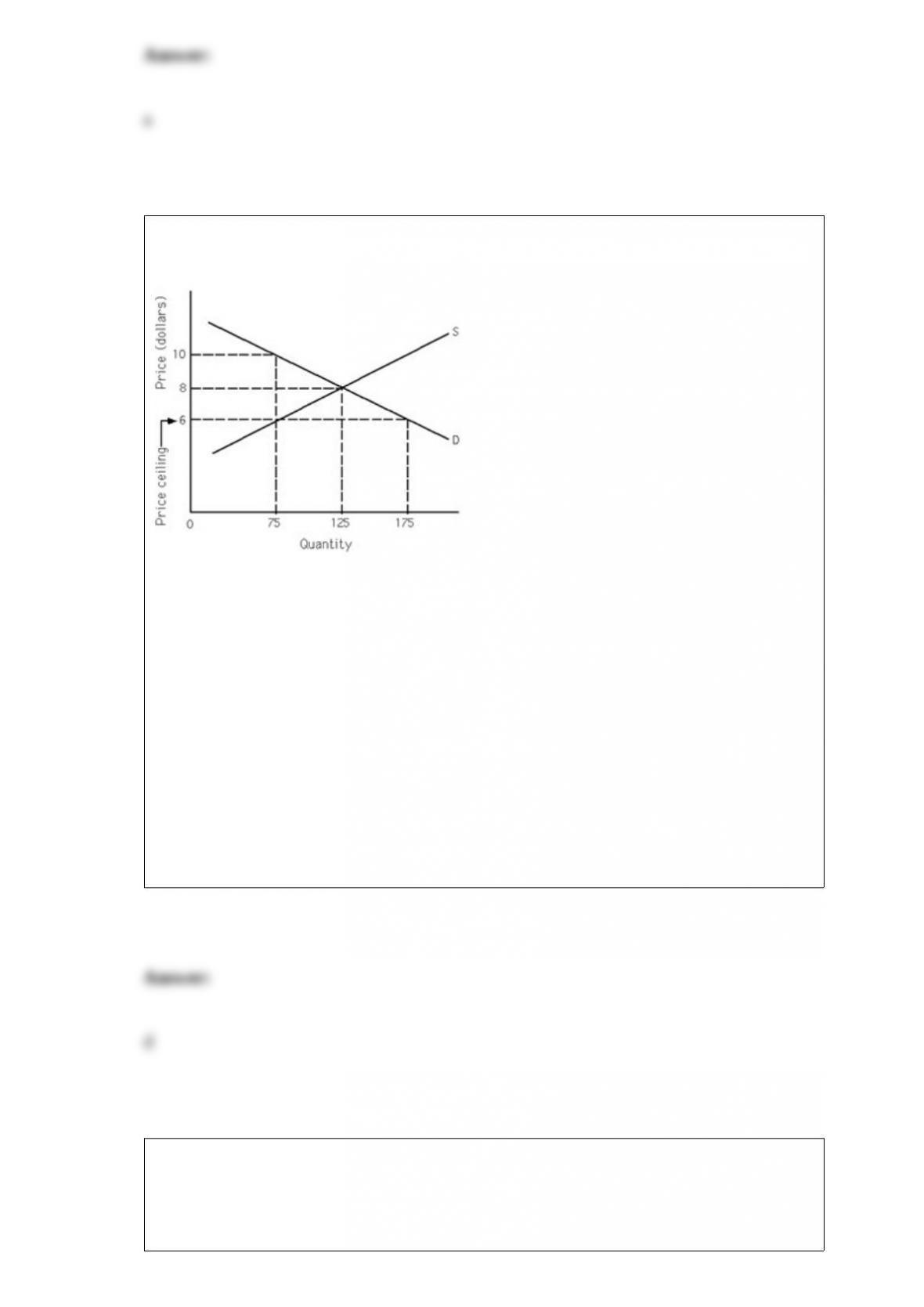
Exhibit 4-1
Suppose the good shown is being sold at the $6 price ceiling. At a quantity of 75 units,
what is the maximum per-unit price buyers would be willing to pay for a good “tied” to
the good shown in the exhibit?
a. $10
b. $8
c. $6
d. $4
e. none of the above
Persons who choose not to become informed on political and governmental matters
because they feel that the costs of becoming informed exceed the benefits of becoming
informed are
a. rationally ignorant.
b. not acting in their own best interests.
c. members of special interest groups.
d. shortsighted.
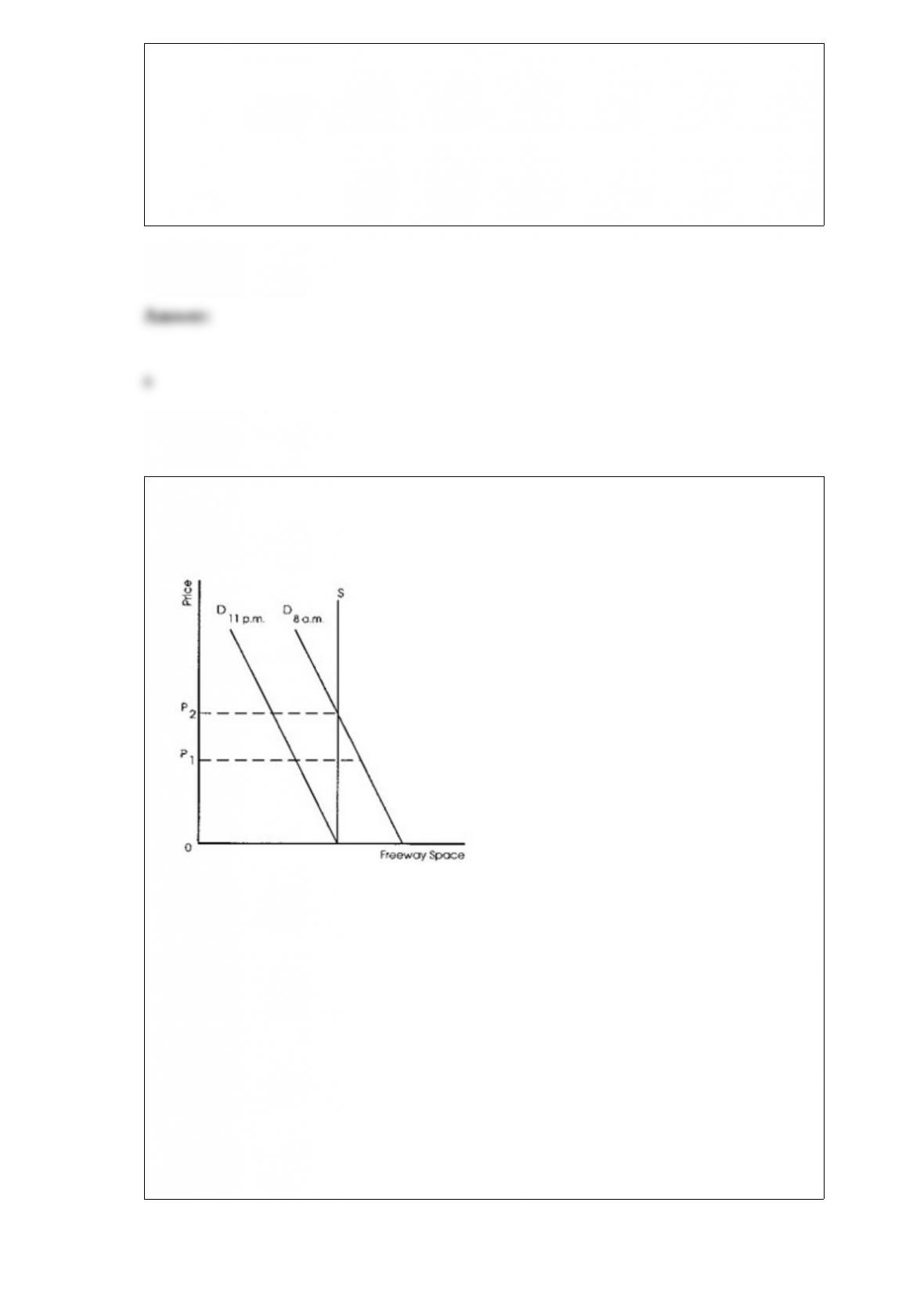
Exhibit 5-1
which shows supply and demand for freeway space at both 8 a.m. and 11 p.m. Suppose
that the government decides to set the money price of driving on the freeway at zero,
but builds more freeways to eliminate the shortage of freeway space at 8
a.m.Graphically, the result of the increase in freeway space would be shown by
a. shifting the supply of freeway space curve rightward.
b. shifting the demand for freeway space curve leftward from D8a.m. to D11p.m.
c. a movement up along D8a.m. to the point where D8a.m. intersects the supply curve.
d. shifting the supply of freeway space curve leftward.

Suppose that the exchange rate between the U.S. dollar and the Mexican peso is 1 peso
= $0.11.If the U.S. dollar price per Mexican peso changes to 1 peso =$0.10, the peso is
said to have __________ and the dollar to have __________.
a. depreciated; appreciated
b. appreciated; appreciated
c. appreciated; depreciated
d. depreciated; depreciated
In the United States, there are _______________ people in the average household in the
top quintile (of total money income) than in the bottom quintile.This situationtends to
skew the Census€s measure of the income distribution so that the income distribution
appears to be __________________ than it would be if a correction were made so that
each quintile actually contained 20% of the population.
a. more; less equal
b. less; less equal
c. more; more equal
d. less; more equal