
Why must profits be zero in long-run competitive equilibrium?
a. If profits are not zero, firms will enter or exit the industry.
b. If profits are not zero, firms will produce higher-quality goods.
c. If profits are not zero, marginal revenue will rise.
d. If profits are not zero, marginal cost will rise.
According to economists, money is a resource.
a. True
b. False
Exhibit 34-7
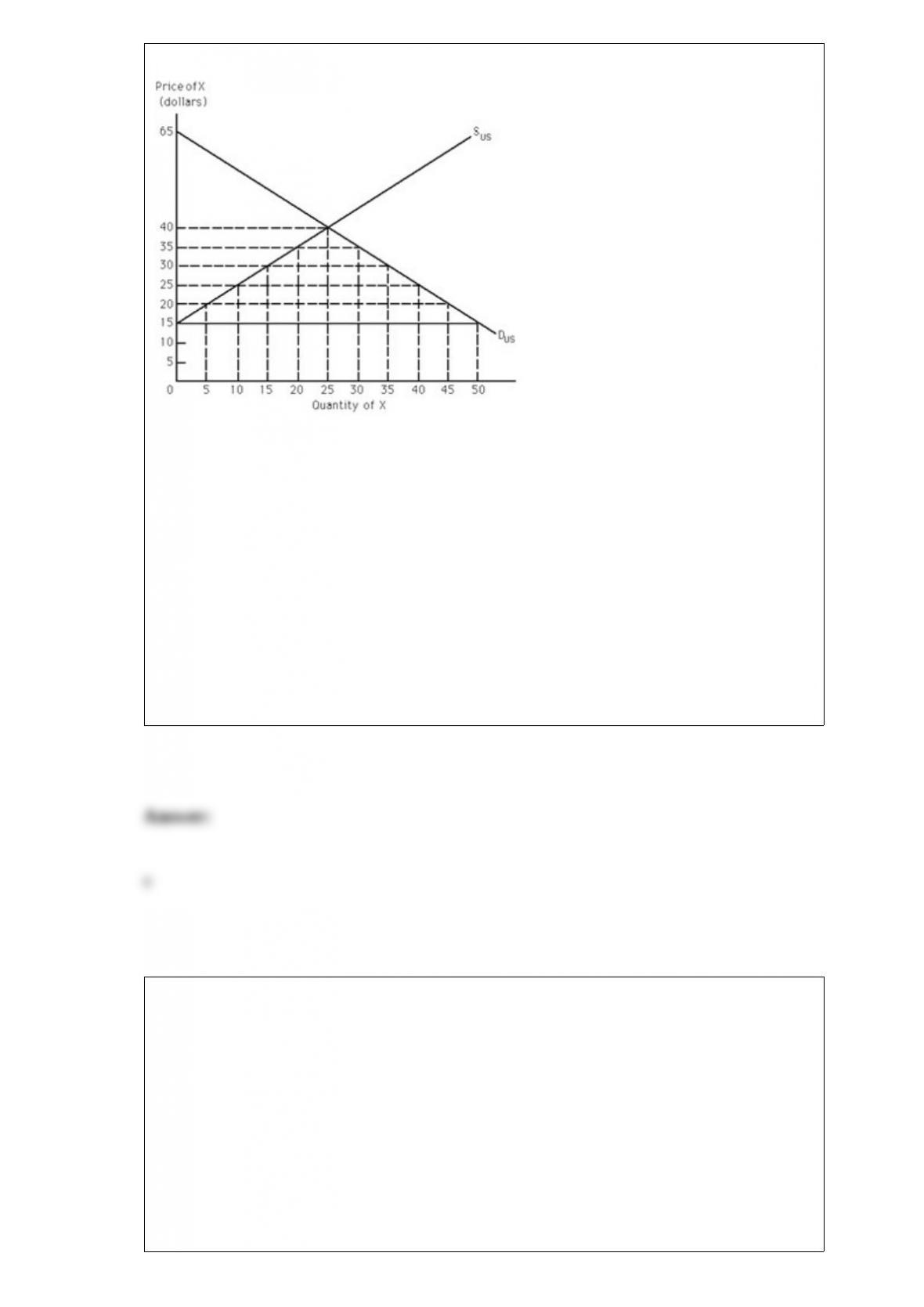
The world price of good X is $15. Under a policy of free trade, the U.S. production of
good X would be
a. 10 units.
b. 20 units.
c. 25 units.
d. 50 units.
e. none of the above
At a price above the equilibrium price, there is
a. a shortage.
b. a surplus.
c. excess demand.
d. super-equilibrium.
e. none of the above

Marginal revenue product is
a. the additional cost of employing a factor.
b. the additional revenue generated by employing an additional factor unit.
c. marginal revenue multiplied by price of the factor unit.
d. price of the good that is sold multiplied by unit cost.
e. none of the above
What is the approximatevalue of a future income stream of three $1,000 payments to be
received one, two, and three years from today if the interest rate is 5 percent?
a. $864
b. $1,633
c. $2,723
d. $5,062

Individuals want nonexcludable public good X, but the market does not provide it
because of the free rider problem.Government overcomes the free rider problem by
______________ individuals and then either producing good X itself or paying
someone to produce it.
a. forcing individuals to work longer hours
b. taxing
c. surveying
d. subsidizing
e. none of the above
Which of the following statements is false?
a. Private equity firms often need to borrow the money needed to buy a public
corporation.
b. Once a private equity firm owns a formerly publicly held corporation, they tend to
cut costs and enhance efficiency.
c. Critics of private equity firms say that companies that have too much cash and too
little debt become targets for private equity firms to buy.
d. A private equity firm is a group of investors that takes a privately held corporation
and uses an investment banker to turn it into a publicly held corporation.

A decrease in the expected price of corn would likely do the following to the current
supply and demand for corn:
a. increase both the demand and the supply.
b. decrease both the demand and the supply.
c. increase the demand, but decrease the supply.
d. increase the supply, but decrease the demand.
In year 1 the average price of X is $10, and in year 2 the average price of X is $23. If
consumers buy more units of X in year 2 than in year 1, it follows that
a. the law of supply does not hold for good X.
b. demand for good X could be higher in year 2 than in year 1.
c. supply of good X could be less in year 2 than in year 1.
d. good X buyers have received an increase in income between year 1 and year 2, and
good X is a normal good.
e. b and d
Exhibit 34-1
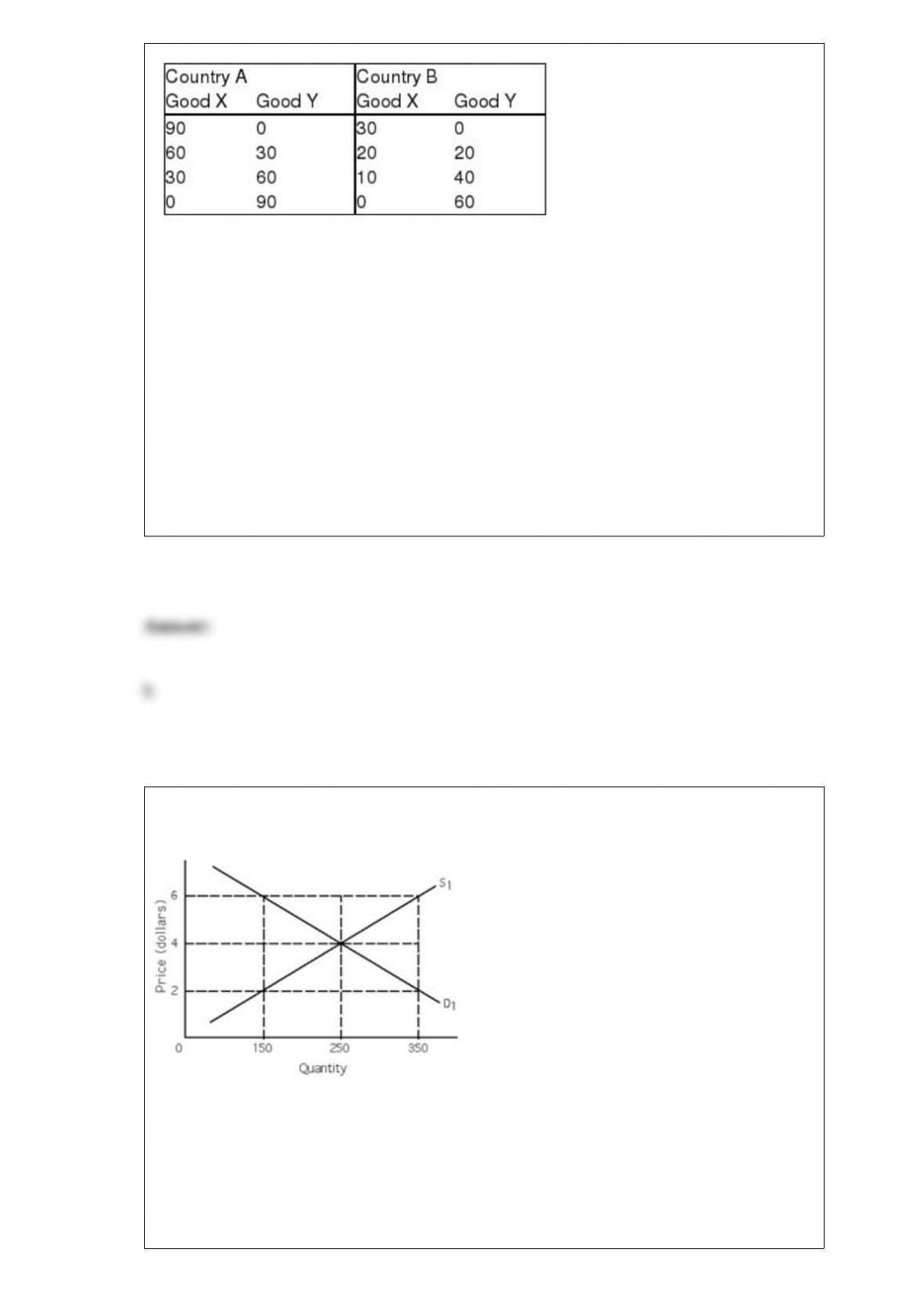
Considering the data, which of the following terms of trade would both countries agree
to?
a. 1 unit of Y for 1 unit of X
b. 1 unit of Y for 0.75 units of X
c. 1 unit of Y for 0.25 units of X
d. 1 unit of Y for 1.50 units of X
e. all of the above
Exhibit 3-1
At a price of $2 there is a
a. shortage of 100 units.
b. shortage of 200 units.

c. shortage of 150 units.
d. surplus of 200 units..
e. surplus of 150 units.