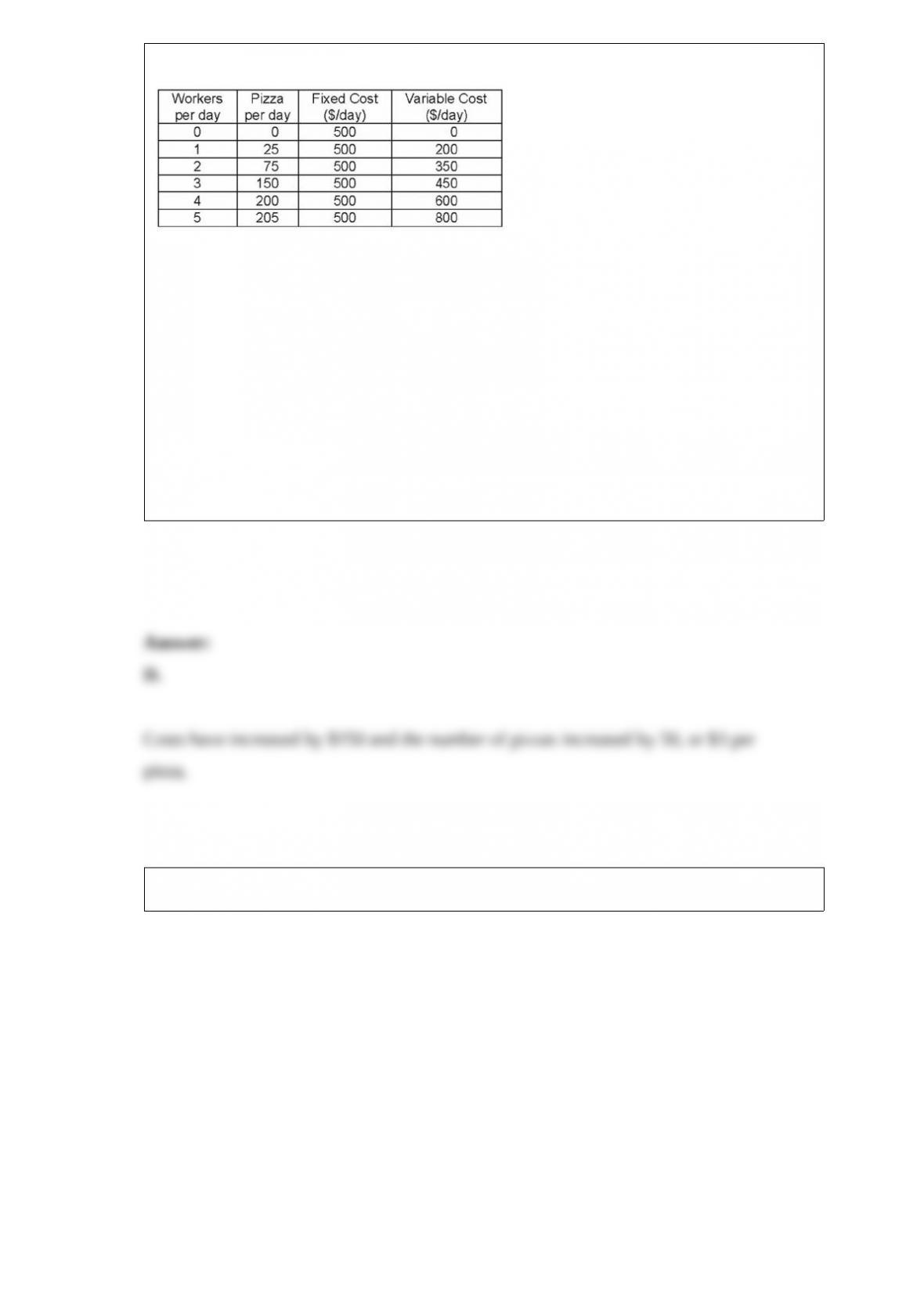
Pizzas sell for $10 each.
Refer to the figure above. When the pizza shop employs 2 workers per day, it will
experience a marginal cost of ______ per pizza.
A. $15
B. $25
C. $6
D. $3
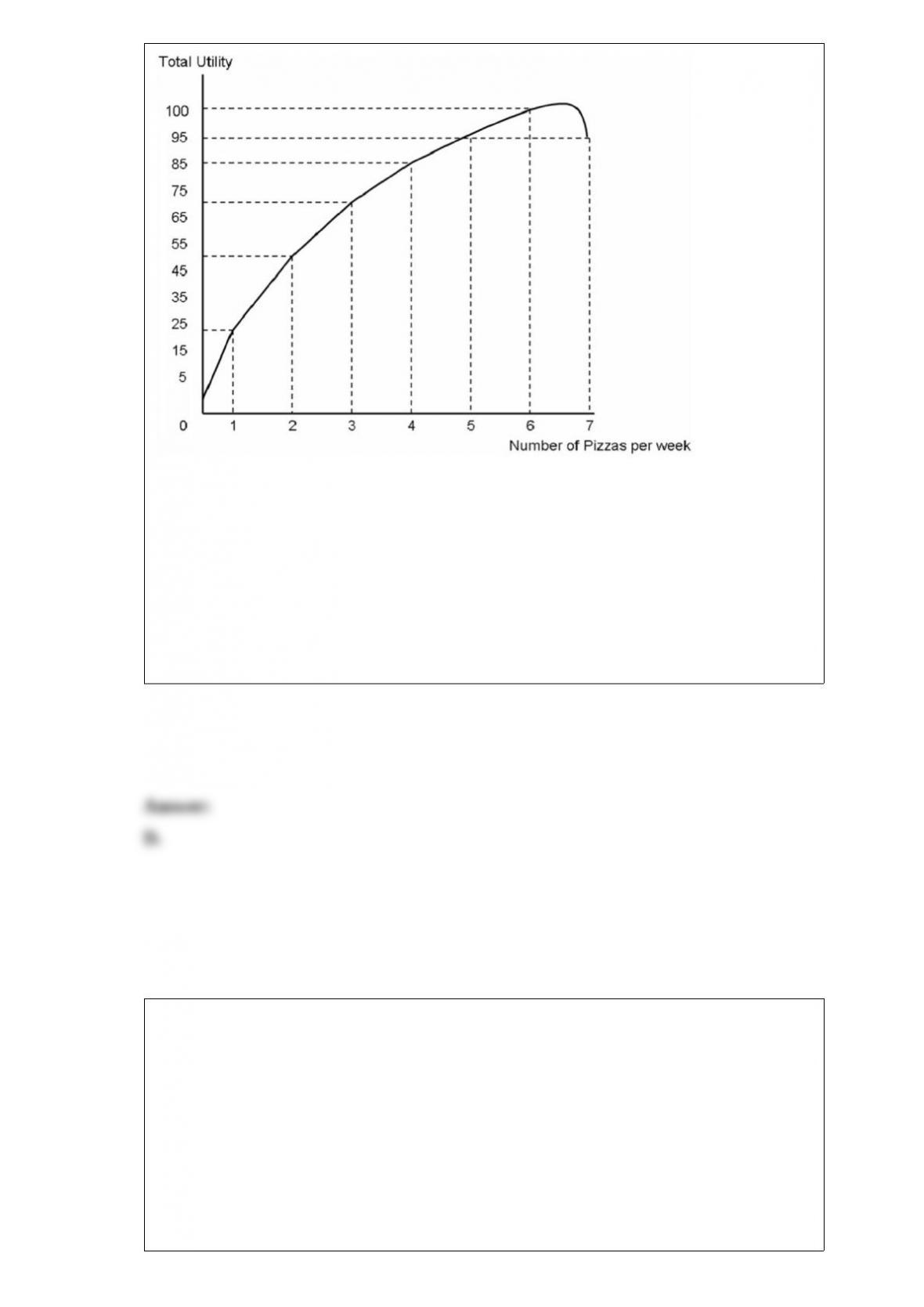
Refer to the figure above. The marginal utility of the 7th pizza is
A. 10
B. 5
C. -10
D. -5
Assume that Dusty has $30 in income, the price of a loaf of bread is $1.50, and the
price of a jar of peanut butter is $3.
If Dusty’s income rises to $45, Dusty can now buy a maximum of _____ loaves of
bread or a maximum of _____ jars of peanut butter.
A. 5; 25
B. 10; 40
C. 15; 30

D. 30; 15
Holding other factors constant, if new technology becomes available that allows
machines to produce manufactured goods more quickly and with fewer defects, then the
real interest rate will ______ and the equilibrium quantity of national saving and
investment will ____.
A. increase; increase
B. increase; decrease
C. increase; not change
D. decrease; increase
The extra benefit that comes from an extra unit of activity is called the _________ of
the activity.
A. marginal benefit.
B. marginal cost.
C. average benefit.
D. reservation benefit.
Suppose that a vaccine is developed for a highly contagious strain of flu. The likelihood
that anyone will get this flu decreases as more people receive the vaccine. One of the
demand curves in the diagram reflects private benefits and the other reflects social
benefits.
Refer to the figure above. Private benefits are measured by ______, and social benefits
are measured by _____.
A. D-1; MC
B. D-2; MC
C. D-1; D-2
D. D-2; D-1
The vertical intercept of the consumption function equals ______ and the slope equals
_____.
A. the mpc; autonomous consumption

B. autonomous consumption; the mpc
C. the unplanned component of consumption; the planned component of consumption
D. the planned component of consumption; the unplanned component of consumption
Steve uses $300 from his paycheck to pay off his credit card balance. Based on this
information:
A. Steve’s saving has increased by $300.
B. Steve’s saving has decreased by $300.
C. Steve’s wealth is unchanged.
D. Steve has a capital loss of $300.
Imagine that you are an entrepreneur, making designer t-shirts in your garage. Your
accountant has estimated that your firm’s total costs can be expressed by the function
TC = 300 + 10 × Q, where Q represents the number of t-shirts you make.
Refer to the information given above. As you increase production of t-shirts your
average fixed costs _____ and your marginal costs ________.
A. decrease; increase
B. increase; decrease
C. decrease; stay the same
D. stay the same; increased
The money demand curve will shift to the left if:
A. the nominal interest rate increases.
B. the nominal interest rate decreases.
C. ATM machines are introduced.
D. the price level increases.
Which of the following is an example of cyclical unemployment?
A. Dora lost her job when the textile factory closed. She does not have skills to work in
another industry and has been unemployed for over a year.
B. Marsha was laid off from her job with the airline because the recession has reduced
the demand for airline travel. She expects to get her job back when the economy picks
up.
C. George is an unskilled worker who mows lawns in the summer, but is unemployed
the rest of the year.

D. Jim had a job as an engineer, but quit when his wife was transferred to another state.
He looked for a month before finding a new job that he liked.
Suppose that a government agency is trying to decide between two pollution reduction
policy options. Under the permit option, 100 pollution permits would be sold, each
allowing emission of one unit of pollution. Firms would be forced to shut down if they
produced any units of pollution for which they did not hold a permit. Under the
pollution tax option, firms would be taxed $250 for each unit of pollution produced.
The regulated firms all currently pollute and face varying costs of pollution reduction,
though all face increasing marginal costs of pollution reduction.
The two policies being considered will result in the same amount of pollution reduction
A. never.
B. always.
C. only if the equilibrium price in the pollution permit market is $250.
D. only if the regulating agency opens the bidding for permits at $250.
One source of friction in the governmental provision of a pure public good is that voters
receive __________ of the public good and have __________ for the public good.
A. different amounts; different reservation prices
B. different amounts; the same reservation price
C. the same amount; different reservation prices
D. the same amount; the same reservation price
According to the equilibrium principle:
A. unregulated markets tend to reach equilibrium prices and quantities without
government regulation.
B. once a market has reached equilibrium, price will not change.
C. collective action cannot improve on individual action.
D. market equilibrium exploits all opportunities for individual gain, but may not exploit
gains possible through collective action.
Curly and Moe are considering living alone or being roommates and splitting the rent
for the next twelve months. If they live alone, they each rent a one bedroom, one bath
apartment for $500 per month, while if they are roommates, they can split a two
bedroom, one bath apartment for $800 per month. The one difficulty they have is that
Moe snores very loudly. Curly estimates the cost of poor sleep due to Moe’s snoring at
$150 per month. Moe could obtain a snore-eliminating device for $50 per month.
Refer to the information given above. The least costly solution to the externality present
in this situation is for:
A. Curly to endure Moe’s snoring.
B. both to live alone.
C. Moe to eliminate his snoring.
D. Moe to pay Curly for his discomfort.
Based on the information in the table, we can conclude that, in 1932, each of the
following events occurred EXCEPT:
A. The public increased the amount of currency it held.
B. Banks were keeping more of their deposits in reserves, and making fewer loans.
C. The Federal Reserve conducted open-market sales of U.S. government bonds.
D. The Federal Reserve injected reserves into the banking system.

A group of physicians that provide healthcare services to members for a fixed annual
fee is termed a
A. health management organization.
B. fee-for-service plan.
C. partnership.
D. health maintenance organization.
A real quantity is a quantity measured:
A. in physical terms.
B. in terms of current dollar value.
C. by the average quantity.
D. using real prices.

The Consumer Price Index measures the cost of:
A. a fixed basket of goods and services.
B. a changing basket of goods and services.
C. all goods and services purchased by consumers.
D. goods and services required to live above the poverty level.
Changes in consumption and planned investment spending resulting from changes in
the real interest rate alter:
A. the money supply.
B. money demand.
C. autonomous expenditures.
D. induced expenditures.
Consumers know that some fraction X of all new cars produced and sold in the market
are defective. The defective ones cannot be identified except by those who own them.
Assume for this problem that cars do not depreciate with use.
Suppose the consumers are risk-neutral with a reservation price of a used car $6,000.

Good used cars are worth $8,000 and lemon used cars are worth $2,000 to their owners.
What is the fraction X?
A. 0.25
B. 0.33
C. 0.5
D. 0.67
Suppose that the owner of a local ice cream store, knowing that demand for ice cream is
higher when the weather is warmer, always charges a price in cents for a scoop of ice
cream that is equal to two times the current outdoor temperature, measured in
Fahrenheit (so that if it is 90 degrees outside, the ice cream is $1.80 per scoop). This
type of behavior is ______.
A. exactly the type of behavior that Keynes believed most firms exhibit.
B. known as meeting demand.
C. inconsistent with the key assumption upon which the basic Keynesian model is built.
D. free from menu costs.
If the marginal utility per dollar is not the same for each good, the consumer could

_____ her utility by spending ______ on goods for which the marginal utility per dollar
is lower.
A. decrease, less
B. increase, more
C. maximize, more
D. increase, less
Two examples of governments that printed large quantities of paper currency to finance
massive budget deficits, causing hyperinflation, are ______ and ______.
A. the Confederacy during the American Civil War; Japan after World War II
B. the Confederacy during the American Civil War; Germany after World War I
C. the United States during the Great Depression; Japan after World War II
D. the United States during the Great Depression; Germany after World War I
If average labor productivity in two countries is the same, average living standards will
be higher in the country with:
A. the smaller population.
B. the larger population.
C. the higher share of population employed.

D. the lower share of population employed.
A head tax means the amount of tax paid is
A. the same for all taxpayers.
B. the same for all families.
C. a linearly increasing function of the taxpayer’s income.
D. the same for all taxpayers who use the public good.
The reason a warranty on a used car communicates credible information is because
A. everyone offers one.
B. it comes from the manufacturer.
C. it would cost a seller too much to honor a warranty on a car if it is a lemon.
D. it indicates the car is of average quality.
A consumer goes to purchase a TV advertised for $300. As he is checking out, the clerk
informs him of a $20 rebate offer for the TV, which he fills out and receives in 3
months. One can infer that the consumer had:
A. a reservation price of at least $300, but jumped the hurdle anyway.
B. a reservation price of at most $280.
C. a reservation price of exactly $300.
D. a reservation price of at least $280 but less than $300.
If the natural rate of unemployment is 6 percent, what is the actual rate of
unemployment if output is 2 percent below potential?
A. 2 percent
B. 7 percent
C. 8 percent
D. 10 percent

Which of the following equations is equivalent to the equation S – NX = I?
A. S + KI = I
B. S – I = KI
C. S – KI = NX
D. S + I = NX – KI