1) in which of the following industries or sectors of the economy will business cycle
fluctuations likely have the greatest effect on output?
a.military goods
b.capital goods
c.textile products
d.agricultural commodities
2) All else equal, when the Federal Reserve Banks engage in an expansionary monetary
policy, the interest rates received on government bonds usually:
A.fall.
B.rise.
C.remain constant.
D.move in the same direction as the bonds’ price.
3) The interest rate that banks charge one another on overnight loans is called the:
A.discount rate.
B.prime lending rate.
C.overnight lending rate.
D.Federal funds rate.
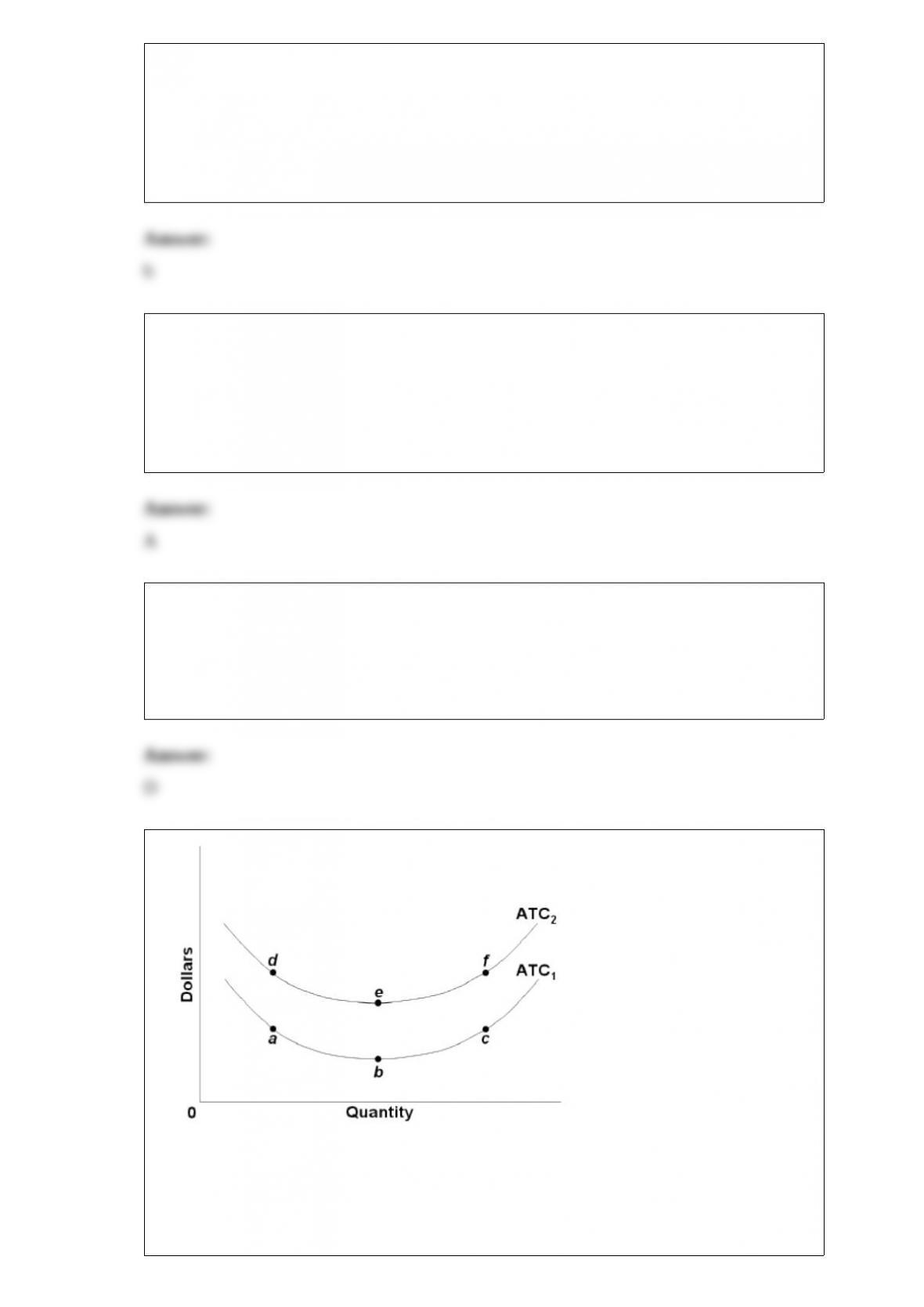
4)
refer to the above graph. which one of the following would cause a move from point b
on short-run average total cost curve atc1 to point e on short-run average cost curve
atc2?
a.diminishing marginal returns
b.an increase in the wage rate

c.a decrease in the wage rate
d.increasing marginal returns
5) all else equal, depreciation of the mexican peso relative to the u.s. dollar would make
a trip by:
a.an american to mexico more expensive.
b.a mexican to the united states less expensive.
c.an american to mexico less expensive.
d.an australian to the united states more expensive.
6) gigantic state university raises tuition for the purpose of increasing its revenue so that
more faculty can be hired. gsu is assuming that the demand for education at gsu is:
a.decreasing.
b.relatively elastic.
c.perfectly elastic.
d.relatively inelastic.
7) a decrease in the demand for recreational fishing boats might be caused by an
increase in the:
a.income of sports fishers.
b.price of outboard motors.
c.size and number of fish available.
d.price of sailing boats.

8)
Refer to the above diagram for the Federal funds market. If the Federal funds rate rose
from 3.5 percent to 4.0 percent, which of the following is the most likely explanation?
A.The Fed sold bonds to banks.
B.The Fed bought bonds from banks.
C.The demand for Federal funds fell.
D.The Fed raised the prime interest rate.
9) In the long run:
A.attempts to “fine tune” the economy cause the rate of unemployment to accelerate.
B.there is no inflation-unemployment tradeoff.
C.there is an inflation-unemployment tradeoff and the terms of that tradeoff have
worsened in recent years.
D.there is an inflation-unemployment tradeoff, but the terms of that tradeoff have
improved in recent years.
10) economics involves marginal analysis because:
a.most decisions involve changes from the present situation.
b.marginal benefits always exceed marginal costs.
c.marginal costs always exceed marginal benefits.
d.much economic behavior is irrational.
11) if negative externalities are not internalized, the:
a.equilibrium output will exceed the most efficient output.
b.most efficient output will exceed the equilibrium output.
c.product must be a public good.
d.distribution of income will necessarily become more equal.
12) Which of the following is least likely to violate the Sherman Act or the Clayton
Act?
A.Competitive firms A, B, and C meet and agree to charge a common price.
B.Competitive firms D and E, each with 35 percent market shares, merge into a single
firm.
C.Competitive firms F and G independently charge lower prices to frequent customers
than to occasional customers.
D.Large dominant firm H forces buyers to purchase its product X in order to buy its
popular product Y.
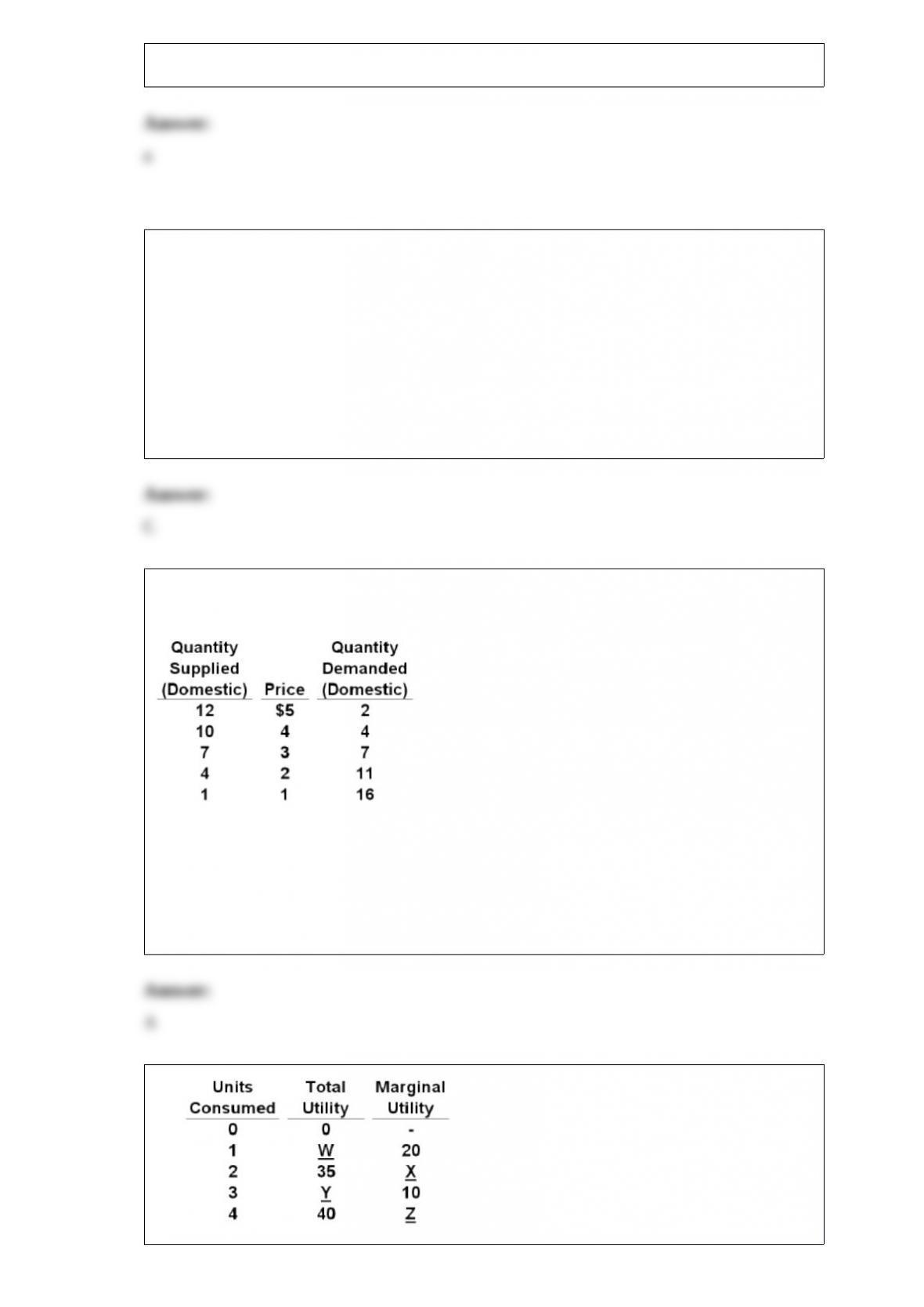
13) The following domestic supply and demand schedules for a product. Suppose that
the world price of the product is $1.
Refer to the above data. With free trade, that is, assuming no tariff, the outputs
produced by domestic and foreign producers respectively would be:
A.1 unit and 15 units.
B.4 units and 7 units.
C.7 units and 0 units.
D.4 units and 6 units.
14)

refer to the above data. the value for w is:
a.15
b.20
c.25
d.30
15) A firm charged with monopolizing a market is less likely to be convicted if:
A.the court accepts a broad definition of the market.
B.the court accepts a narrow definition of the market.
C.it has gained its monopoly through abusive means.
D.it sells its product to other firms, rather than directly to consumers.