1) Transfer payments that increase as GDP falls are a type of automatic stabilizer in the
economy.
2) When QE2 and Operation Twist were implemented, the Fed suspended its policy of
forward commitment.
3) Recent studies indicate that as the price of a barrel of oil rises to $80, the use of
biodiesel as an alternative fuel becomes economically viable.
4) Both neoclassical and behavioral economics believe that people are mostly rational
in both their decision making and their actions.
5) Voters’ preference for having government programs serve them is inherently in
conflict with their preference to pay no taxes.
6) The real-balance effect explains a shift in aggregate demand, while the wealth effect
explains a movement along the AD curve.
7) Behavioral economists avoid dealing with fairness concerns because the concept is
too subjective.
8) The idea of “nudging” people into certain choices is one major contribution of
behavioral economics to policy-making.
9) In response to the general public’s complaints about “price gouging” by sellers, the
government could impose a price floor.
10) There tends to be a positive correlation between real wages of workers and the
productivity of labor in the economy.
11) The U.S. has a sizable trade surplus in services.
12) The less the elasticity of product demand, the greater the elasticity of resource
demand.
13) U.S. gross domestic product (GDP) measures the market value of all goods and
services produced by Americans in one year.
14) Compared to a purely competitive firm, a monopsonist will pay:
A.A higher wage rate to its workers
B.Lower wages but hire more workers than the purely competitive firm
C.Lower wage rates and hire fewer workers than the purely competitive firm
D.Lower wages while hiring the same quantity of workers as the purely competitive
firm

15)
Refer to the given graph. A movement from a to b along C1 might be caused by a(n):
A.recession.
B.wealth effect of an increase in stock market prices.
C.increase in income tax rates.
D.increase in real GDP.
16) The United States has a trade deficit when U.S.:
A.Imports are greater than U.S. exports
B.Exports are greater than U.S. imports
C.Exports and U.S. imports are greater than 10 percent of GDP
D.Exports and U.S. imports are less than 10 percent of GDP
17)
The figure depicts a situation where:
A.prices are sticky, but output is flexible.
B.prices are flexible, but output is constant.
C.prices and output are both flexible.
D.prices are sticky and output is constant.
18) Which of the following statements about state lotteries is false?
A.State lotteries are monopolies, with competing private lotteries banned
B.State lotteries are highly controversial, with critics and defenders still debating their
merits
C.Less than half of the states in the U.S. have state lotteries because of their
controversial nature
D.The payout rates of state lotteries are substantially lower than in private betting
operations like casinos
19) One of the provisions of the Temporary Assistance for Needy Families (TANF)
program was to:
A.Guarantee cash assistance for poor families
B.Set a 5-year lifelong limit on welfare benefits
C.Get the Federal government to pay more of the cost of welfare
D.Make welfare benefits more equitable among those receiving them
20) Critics contend that imposing a minimum wage higher than the equilibrium wage in
a competitive industry would:
A.Decrease the number of workers employed in that industry
B.Decrease the quantity of labor supplied to that industry
C.Increase the demand for labor in the industry
D.Increase employment in that industry
21) To maintain returns from research and development, firms:
A.Sponsor start-ups
B.Keep trade secrets
C.Use a fast-second strategy
D.Advocate creative destruction
22)
Refer to the above graph for a profit-maximizing monopolist. At equilibrium, the firm
will be earning:
A.Positive profits
B.Negative profits
C.Zero profits
D.Profits that cannot be determined from the given graph
23) Money spent on the purchase of a new house is included in the GDP as a part of:
A.Household expenditures on durable goods
B.Personal consumption expenditures
C.Personal saving
D.Gross domestic private investment
24) The following table shows the percentage of income received by quintile. In the
graph below, draw a Lorenz curve using the before taxes and transfer data and a Lorenz
curve for the after taxes and transfer data. Label the Lorenz curves and each axis of the
graph.
25) Entrepreneurs are those people who are:
A.Their own bosses
B.Executive officers of corporations
C.Salaried managers
D.Working for research institutes
26) Give examples of two substitute goods and two complementary goods. In each case
explain why the goods are substitutes or complements.
27) What is the capital accumulation problem in DVCs?
28) Explain how Steve Jobs was able to make an economic profit with his company,
Apple Computers.
29) Why don’t economists use the same cost data as accountants use?
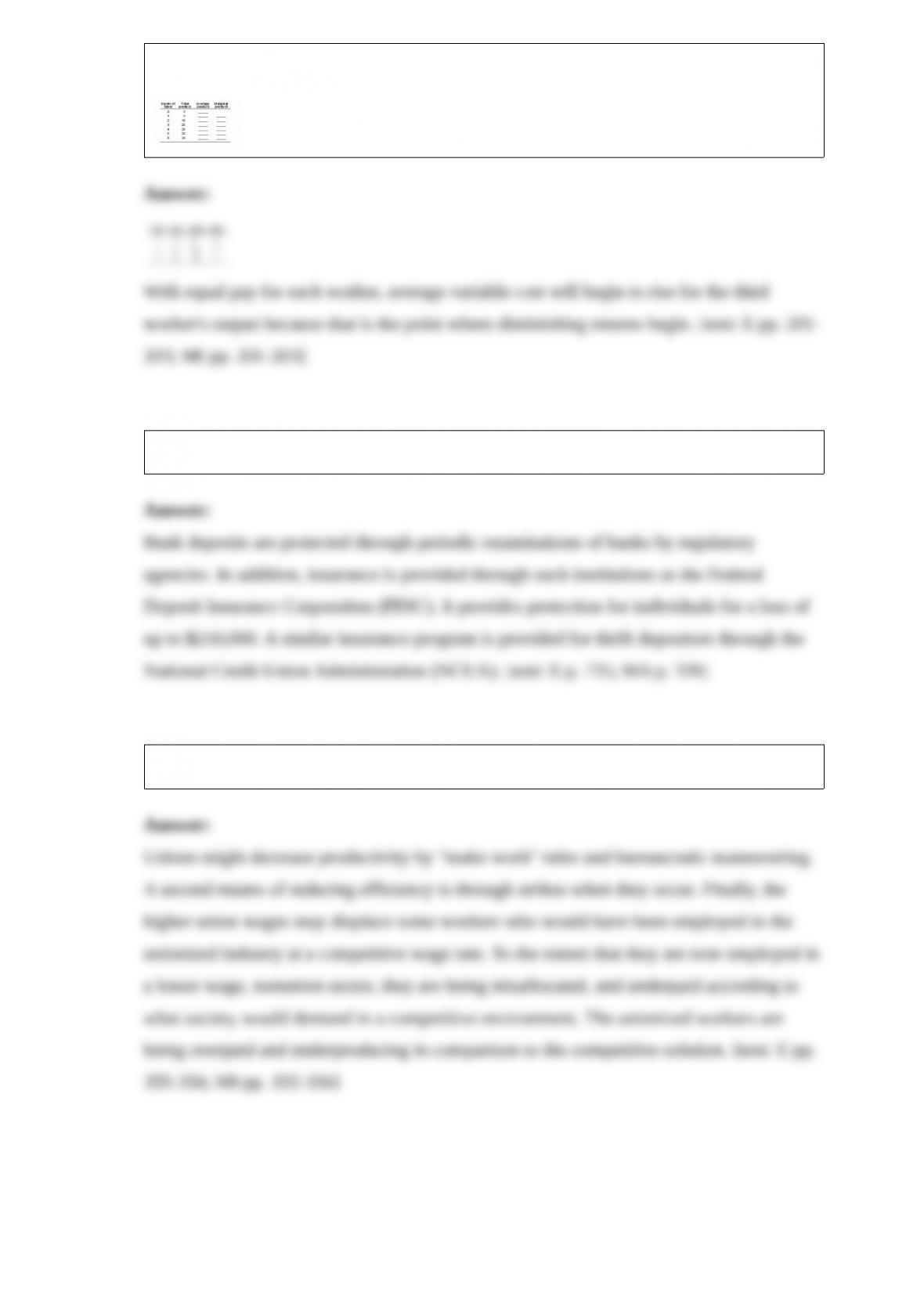
30) Complete the following table by finding the average and marginal product. At what
input-output level will average variable cost begin to rise? Explain.
31) How are bank customers protected against bank failures? Explain.
32) How can unions decrease productivity?