
If purchasing power parity tells us that if the exchange rate is a pound for a dollar, then
price of a haircut in London should cost the same as a haircut in New York.
Answer:
A decrease in disposable income will shift the aggregate demand curve to the left.
Answer:
Holding all other factors constant, income earned from capital is more unequally
distributed than income earned from labor.
Answer:
A tax is efficient if it imposes a small excess burden relative to the tax revenue it raises.
Answer:

Colleges offer merit awards to students who ordinarily would not qualify for financial
help. Some have criticized this on grounds that merit awards disproportionately benefit
students from wealthier communities with better school systems, siphoning resources
away from lower-income students with greater financial need. A college’s decision to
grant merit awards is motivated by economic efficiency.
Answer:
The sum of consumer surplus and producer surplus is equal to
A) the deadweight loss.
B) the economic surplus.
C) zero.
D) total profit.
Answer:
Gross domestic product understates the total production of final goods and services
because of the omission of
A) the underground economy.
B) intermediate goods.
C) inflation.
D) exports.
Answer:

A stock market crash which causes stock prices to fall should cause
A) a decrease in consumption spending.
B) an increase in consumption spending.
C) an increase in wealth.
D) no change in consumption spending.
Answer:
Which of the following is the best example of an oligopolistic industry?
A) the beef market
B) the pharmaceutical industry
C) public education
D) the beauty products industry
Answer:
An economic principle that explains why countries produce different goods and
services is
A) absolute advantage.

B) trade as a percentage of GDP.
C) comparative advantage.
D) NAFTA.
Answer:
What is a factor market?
A) It is a market where financial instruments are traded.
B) It is a market where stocks and bonds are traded.
C) It is a market producers buy consumption and capital goods.
D) It is a market where resources used to produce final goods are traded.
Answer:
If a corporation goes bankrupt, which of the following has first claim on the firm’s
assets?
A) stockholders
B) the state where chartered
C) employees
D) bondholders

Answer:
If the current unemployment rate is 5%, under which of the following circumstances
would you expect the Fed to use contractionary monetary policy?
A) if the natural rate of unemployment is below 5%
B) if the natural rate of unemployment is above 5%
C) if the inflation rate is above 5%
D) if the inflation rate is below 5%
Answer:
Imagine that you borrow $5,000 for one year and at the end of the year you repay the
$5,000 plus $600 of interest. If the inflation rate was 4%, what was the real interest rate
you paid?
A) 16 percent
B) 12 percent
C) 8 percent
D) 6 percent
Answer:

Holding everything else constant, an increase in the price of MP3 players will result in
A) a decrease in the quantity of MP3 players supplied.
B) a decrease in the demand for MP3 players.
C) an increase in the supply of MP3 players.
D) a decrease in the quantity of MP3 players demanded.
Answer:
When the marginal benefit equals the marginal cost of the last unit sold in a competitive
market
A) the net benefit of consumers is equal to the net benefit of producers.
B) an economically efficient level of output is produced.
C) producer surplus is equal to consumer surplus.
D) total benefit is equal to total cost.
Answer:
If the long-run aggregate supply curve is vertical,
A) the economy stays at the natural rate of inflation in the long run.
B) the short-run Phillips curve must be vertical.
C) unemployment and inflation are positively related in the long run.
D) the trade-off between unemployment and inflation cannot be permanent.
Answer:
The cost incurred from the production of an additional unit of a product
A) is a marginal cost to the firm.
B) is called a loss.
C) is called opportunity cost.
D) must be zero for a firm to be efficient.
Answer:
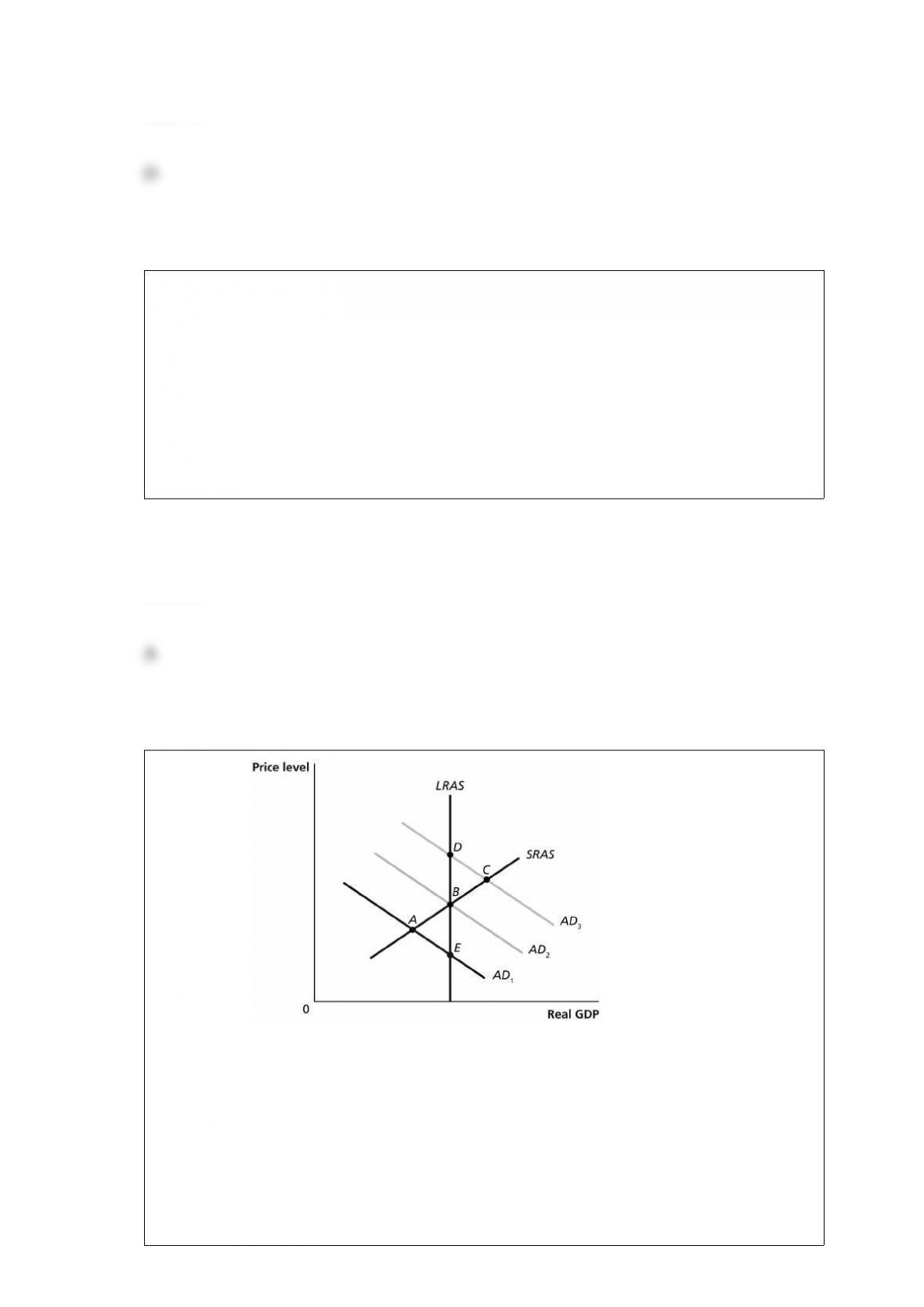
Figure 26-7
Suppose the economy is in a recession and the Fed pursues an expansionary monetary
policy. Using the static AD–AS model in the figure above, this would be depicted as a
movement from
A) A to B.
B) B to C.

C) C to B.
D) A to E.
E) C to D.
Answer:
Evidence shows that many people who delay searching for a job for a year or longer
after they are laid off
A) find it more difficult to find new employment than if they had searched for a new
job soon after they were laid off.
B) find it easier to find new employment than if they had searched for a new job soon
after they were laid off.
C) find that they have little to no chance to find new employment after being
unemployed for so long.
D) find that the extra unemployment benefits they receive during their extended period
of unemployment more than make up for the difficulty in finding a job once they decide
to re-enter the workforce.
Answer:
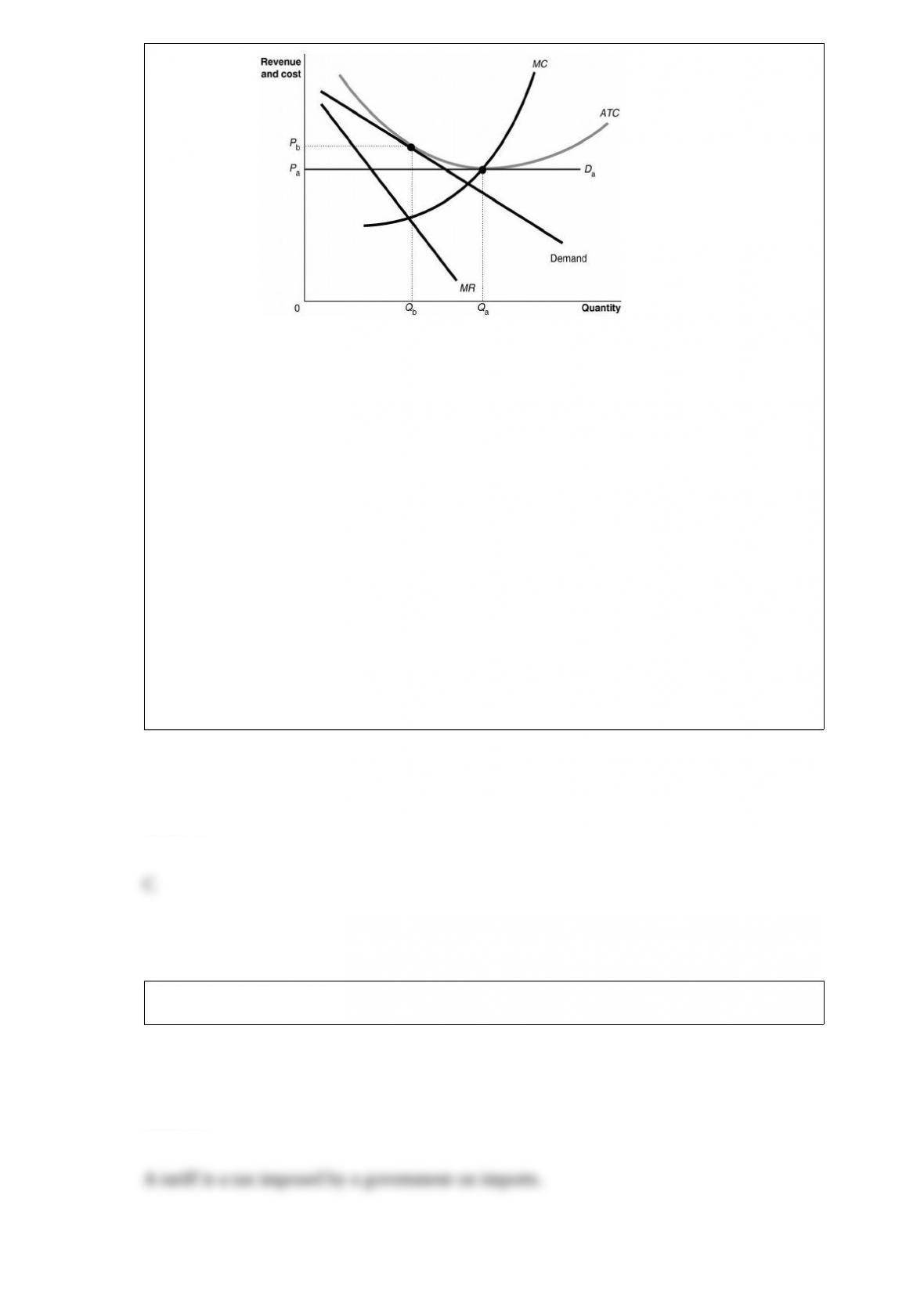
Figure 13-18
Which of the following statements is true?
A) Da represents the long-run demand curve facing a monopolistic competitor in a
constant-cost industry while Ddepicts the demand curve in the short run.
B) Darepresents the long-run demand curve facing a monopolistic competitor in a
constant-cost industry while Ddepicts the long-run demand curve in an increasing-cost
industry.
C) Darepresents the long-run demand curve facing a perfect competitor while Ddepicts
the long-run demand curve facing a monopolistic competitor.
D) Darepresents the long-run supply curve in a perfectly competitive, constant-cost
industry while Ddepicts the long-run demand curve facing a monopolistic competitor in
a decreasing-cost industry.
Answer:
What is a tariff?
Answer:
Use a long-run average cost curve graph to illustrate how diseconomies of scale would
not make it beneficial for two companies to go through with a merger.
Answer:
Use the money demand and money supply model to show graphically and briefly
explain the effect on the interest rate if real GDP increases.
Answer:

Explain the difference between substitutes and complements.
Answer:
Explain what economists mean by full employment and why this rate of unemployment
is not zero.
Answer:
What is meant by “excess capacity”? How does it relate to consumer utility?
Answer:
How do adverse selection and moral hazard affect the market for insurance?
Answer:
How does a positive externality in consumption reduce economic efficiency?
Answer:
What is a mixed economy?
Answer: