
1) A monopsonist faces an upsloping supply curve of labor, but it could face a
horizontal demand curve for its product in the output market.
2) U.S. exports to Japan create a supply of dollars and a demand for yen in the
foreign-exchange market.
3) A player is said to have a dominant strategy when one of the options available is
superior, regardless of what strategy the other player chooses.
4) Whenever a foreign producer is selling a product like steel at a lower price than
domestic producers, then dumping is being practiced and must be corrected.
5) In the U.S., the progressive income-tax system substantial redistributes income.
6) Neoclassical theory suggests that to the extent impulse buying occurs, it is infrequent
and does not affect the ability of economic models to predict behavior.
7) Monetarists and rational expectation theorists believe that cost-push inflation as
impossible in the long run in the absence of excessive money supply growth.
8) The level of potential output and location of the long-run aggregate supply curve are
determined by:
A.Federal Reserve policy.
B.the price level.
C.the intersection of aggregate demand and short-run aggregate supply.
D.the natural rate of unemployment.
9) Which of the following is true under conditions of pure competition?
A.There are differentiated products
B.The market demand curve is perfectly elastic
C.No single firm can influence the market price by changing its output
D.Each individual firm has the ability to set its own price
10) The four-firm sales concentration ratio for an industry measures the:
A.geographic concentration of firms.
B.extent to which the four largest firms dominate the production of a good.
C.percentage of the industry’s capital facilities owned by the four largest firms.
D.degree of X-inefficiency in the industry.
11) Which constitutes an obstacle to collusion among oligopolists?
A.A standardized product
B.A large number of firms
C.Prosperous economic conditions
D.Trademarks and copyrights
12)
The figure depicts a situation where:
A.prices are sticky, but output is flexible.
B.prices are flexible, but output is constant.
C.prices and output are both flexible.

D.prices are sticky and output is constant.
13) In essence, which of the following groups “creates” money?
A.Banks’ loan officers when they grant loans
B.Consumers when they go shopping
C.Depositors when they deposit or withdraw money from their banks
D.Firms when they pay workers their wages and salaries
14) The amount of new output produced per year for both consumption and additions to
capital stock is measured by:
A.GDP
B.Net investment
C.NDP
D.Net exports
15) The kinked-demand curve model of oligopoly:
A.assumes a firm’s rivals will ignore a price cut but match a price increase.
B.embodies the possibility that changes in unit costs will have no effect on equilibrium
price and output.
C.assumes a firm’s rivals will match any price change it may initiate.
D.assumes a firm’s rivals will ignore any price change it may initiate.
16)
Refer to the figure above. In Venezuela, there is a very small number of extremely
wealthy households and an extremely large number of very poor households. If the
United States is represented by Lorenz curve c above, which curve would represent
Venezuela?
A.a
B.b
C.c

D.d
17)
Refer to the above graph for a purely competitive firm in the short run. What minimum
output level should the firm produce just for it to break even?
A.A
B.B
C.C
D.Greater than C
18) Which of the following would not help to relieve the Social Security and Medicare
shortfalls?
A.Extending the Social Security tax to a higher level of earnings.
B.Restricting immigration of skilled working-age adults.
C.Increasing the retirement age for collecting Social Security and Medicare benefits.
D.Reducing Social Security and Medicare benefits for wealthier individuals.
19) Which of the following is an explicit cost of migration?
A.Wages a worker gives up when they leave their home country
B.Adapting to a new culture
C.Paying application fees
D.The stress of looking for a job in a new country
20) Answer the question based on the following payoff matrix for a duopoly in which
the numbers indicate the profit from either opening a coffee shop in a small town or not
opening the coffee shop.

Refer to the above table. If the firms are playing a sequential game, then
A.there is first mover advantage.
B.the firm with the first move will choose not to open a coffee shop.
C.the firm with the first move will choose to open a coffee shop.
D.both firms will choose not to open a coffee shop, regardless of which firm chooses
first.
21) Import quotas on products will reduce the quantity of the imported products and:
A.Decrease the price to the consumers
B.Increase the price to the consumers
C.Will not affect the price to the consumers
D.Increase the total quantity of the product consumed
22) Collusion among oligopolistic firms:
A.Is common in world markets, but does not happen in the U.S.
B.Becomes more difficult if there were fewer firms in the group
C.Becomes easier during a recession when sales are falling
D.Becomes more difficult if the firms all have different cost and demand curves
23) In one year the United States had a current account deficit of $461 billion. The
balance on the capital account was -$8 billion. What was the balance on the financial
account?
A.-$461 billion
B.+$469 billion
C.-$469 billion
D.+$453 billion
24) What impact will a negative supply shock have on the main measures of economic
performance?
A.Real GDP will increase, inflation will increase, and unemployment will decrease
B.Real GDP will decrease, inflation will decrease, and unemployment will increase
C.Real GDP will decrease, inflation will increase, and unemployment will increase
D.Real GDP will increase, inflation will decrease, and unemployment will decrease
25) Which of the following statements about interest rates is false?
A.Interest rates typically reflect the risk involved in extending a loan
B.Interest rates are affected by households’ spending decisions
C.The equilibrium interest rate is determined by the intersection of the supply and
demand schedules for loanable funds
D.The supply of loanable funds is independent of the rate of interest
26) Suppose that inventories are rising. We could expect that, in the future:
A.Real GDP will likely increase
B.Real GDP will likely decrease
C.We can’t predict what will happen to real GDP
D.Firms will raise prices of their goods and services
27) What are two ‘safe” or reasonable conclusions that can be drawn on about the
acceleration in productivity growth?
28) How does corruption contribute to government failure?
29) Explain the special-interest effect.
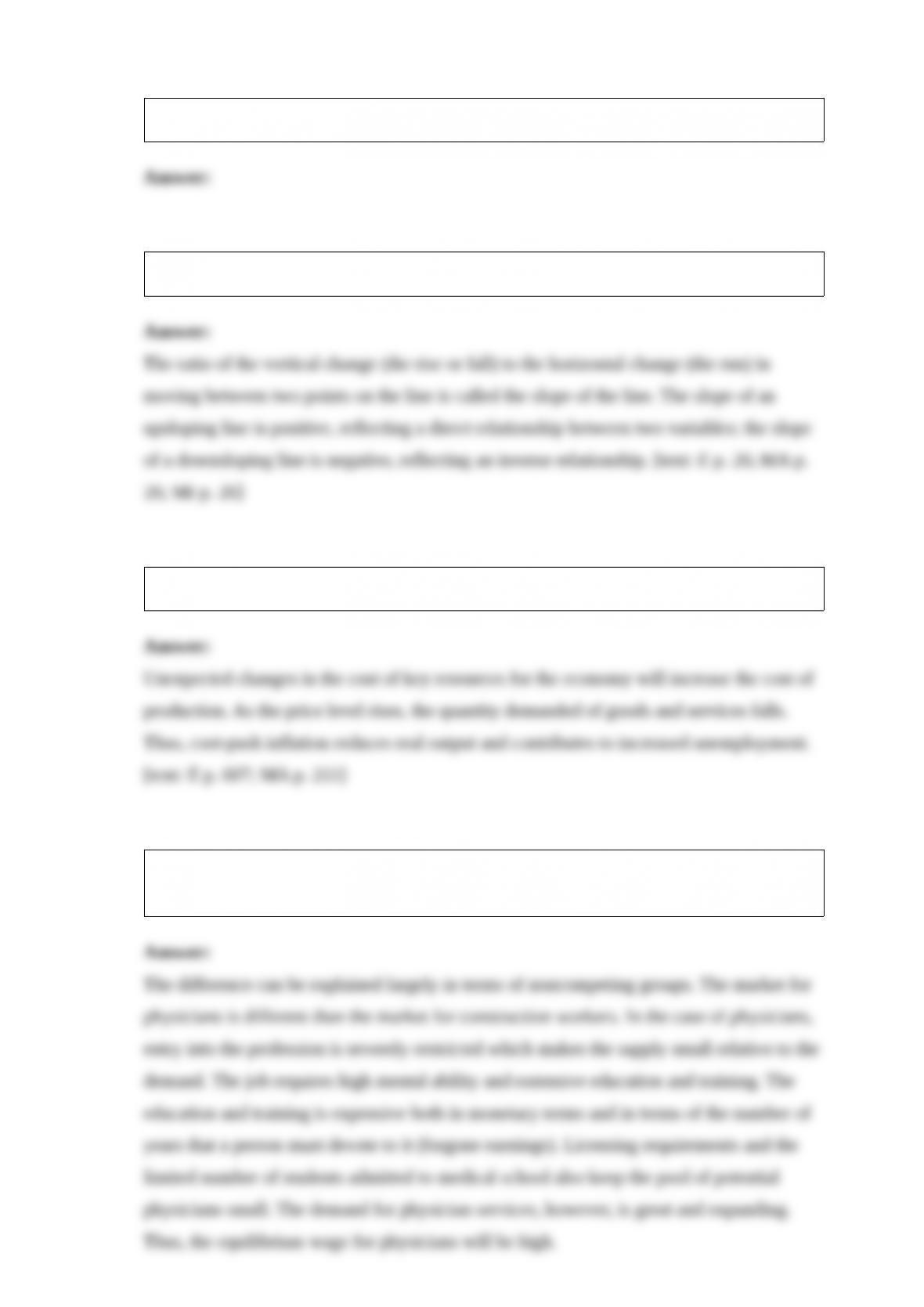
30) Discuss and show graphically how an increase in consumption at each level of GDP
effects saving.
31) Explain how changes in incomes, population, and lifestyles contribute to increasing
health care costs.
32) B.
33) State the definition for the slope of a straight line graph.
34) What are the effects of cost-push inflation on real output?
35) Why is there a significant difference in the pay of physicians and construction
workers?