All economic questions arise from the fact that resources are unlimited.
If consumption is defined as C = 1,350 + 0.6Y, then the marginal propensity to consume
is 0.6.
When the majority of voters have preferences very different from those of the median
voter, then the median voter theorem will lead to accurate predictions of the outcomes
of elections.
One example of human capital is the amount of skills that you have.

A bed of oysters is not an example of a factor of production but the shucked oysters
used to make oyster stew is a factor of production.
Net worth and stockholders’ equity are both equal to the difference between assets and
liabilities.
The overall mortality rate in the United States has remained fairly constant for the past
30 years.
In the long-run equilibrium, both the perfectly competitive firm and the
monopolistically competitive firm produce the output at which MR = MC and charge a
price equal to the average total cost of production.

If the market price is at equilibrium, the deadweight loss is zero.
A tariff is a tax imposed by a government on its own exports.
One reason a country does not specialize completely in production is that not all goods
and services are traded internationally.
Figure 16-6
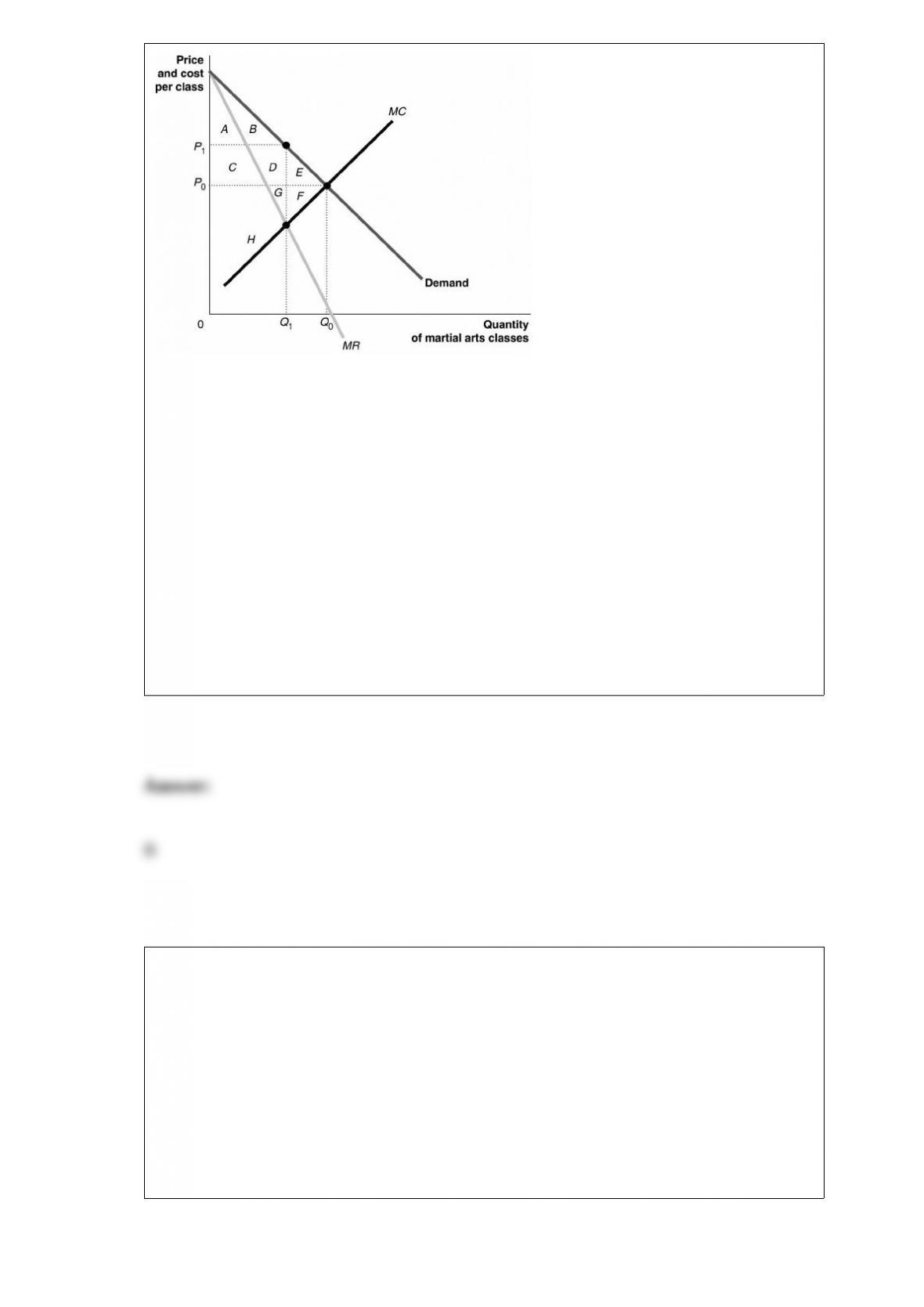
Watanabe Sensei operates the only
martial arts school in Hartfield. For simplicity, assume that consumers have identical
demand curves and that Sensei knows what this demand curve is. Figure 16-6 shows
this demand curve. Suppose instead of charging the monopoly price for his classes,
Sensei charges the competitive price. What is the competitive price and what is the
quantity demanded at this price?
A) P0, Q1
B) P0, Q0
C) P1,Q0
D) P1, Q1
If actual inflation is less than expected inflation, actual real wages will be ________
expected real wages and unemployment will ________.
A) greater than; rise
B) greater than; fall
C) less than; rise
D) less than; fall

A wheat farmer and a firm in a perfectly competitive market are similar in that
A) both face vertical demand curves.
B) both have to lower their prices if a rival firm lowers its price.
C) both face horizontal demand curves.
D) both will earn an economic profit if their total revenue equals their total cost.
________ have a horizontal and a vertical axis and are used in economics to illustrate
relationships between two economic variables.
A) Two-dimensional graphs
B) One-dimensional graphs
C) Pie Charts
D) Bar graphs
The proponents of rational expectations and monetarism think that the Federal Reserve

should adopt
A) an inflation target.
B) a monetary aggregate target.
C) a constant monetary growth rule.
D) an interest rate target.
In a competitive market the demand curve shows the ________ received by consumers
and the supply curve shows the ________.
A) utility; average cost.
B) marginal benefit; marginal cost
C) economic surplus; opportunity cost
D) net benefit; net cost
If a stock’s dividend is expected to grow at a constant rate of 6 percent in the future and
it has just paid a dividend of $3.00 per share, and you have an alternative investment of
equal risk that will earn a 9 percent rate of return, what would you be willing to pay per
share for this stock?
A) $9

B) $20
C) $45
D) $106
The year in which euro coins and paper currency were introduced and participating
“euro zone” countries withdrew old domestic currencies from circulation was
A) 2007.
B) 2002.
C) 1999.
D) 1995.
Suppose at the current price, the demand for copper is estimated at -3.14. What happens
to sales revenue if the government imposes a price ceiling below the free market
equilibrium price in the copper market?
A) Sales revenue falls.
B) Sales revenue rises.
C) Sales revenue remains unchanged because copper is a necessity for most industries.
D) It cannot be determined without information on prices.
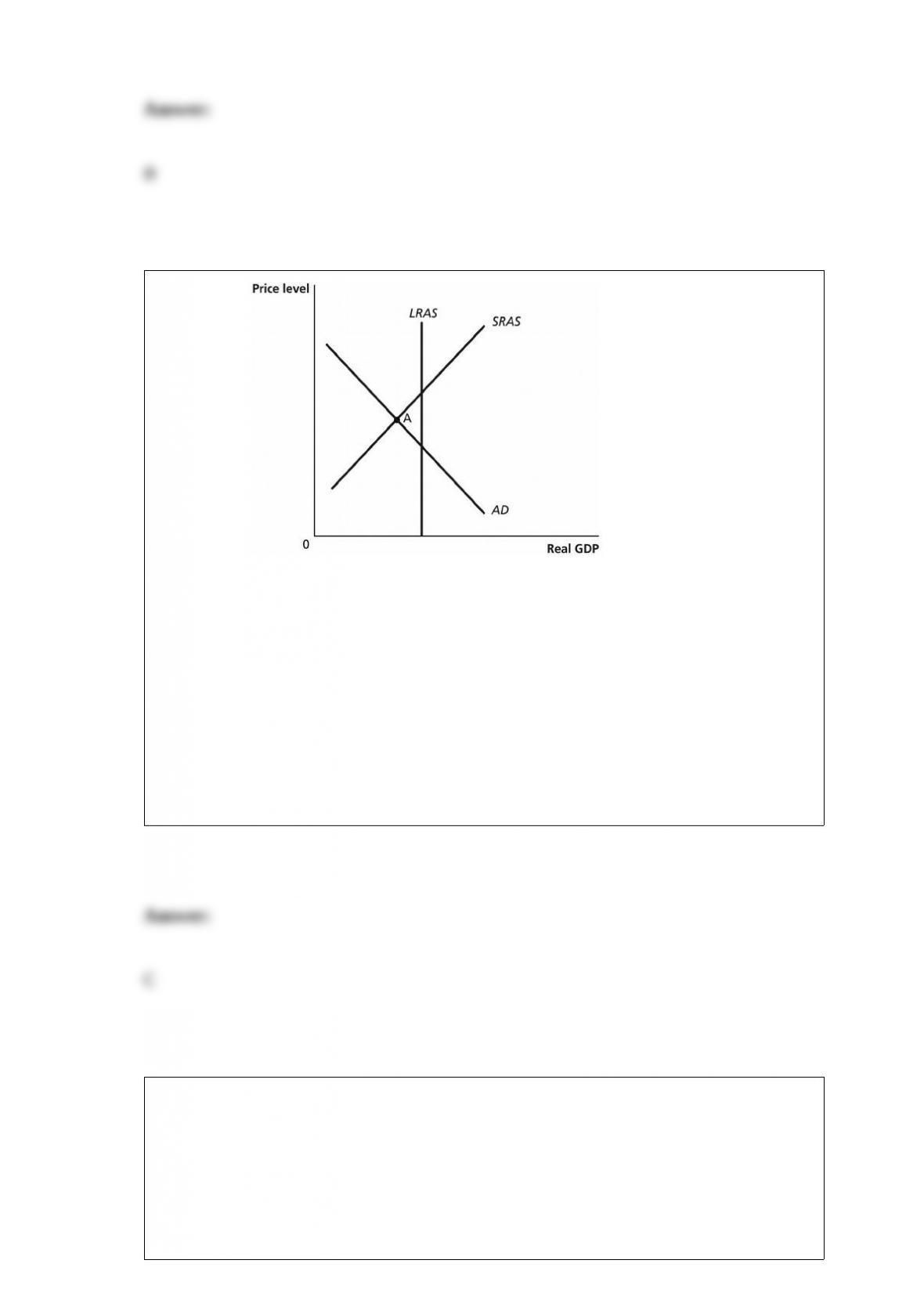
Figure 27-2
In the graph above, if the economy is at point A, an appropriate fiscal policy by the
Congress and the president would be to
A) decrease the required reserve ratio.
B) sell government securities.
C) increase government expenditures.
D) decrease transfer payments.
If interest rates in the United States rise,
A) the value of the dollar will fall as foreign investors sell their U.S. investments.
B) the value of the dollar will rise as the foreign investors increase their holdings of
U.S. investments.
C) the value of the dollar will fall as foreign investors increase their holdings of U.S.
investments.
D) the value of the dollar will rise as foreign investors sell their U.S. investments.
An “omitted variable” is
A) a variable which is purposely omitted from an economic analysis.
B) a variable which is inadvertently omitted from an economic analysis.
C) a variable that has no impact on other variables in an economic analysis.
D) a variable that affects other variables and its omission from economic analysis can
lead to false conclusions about cause and effect.
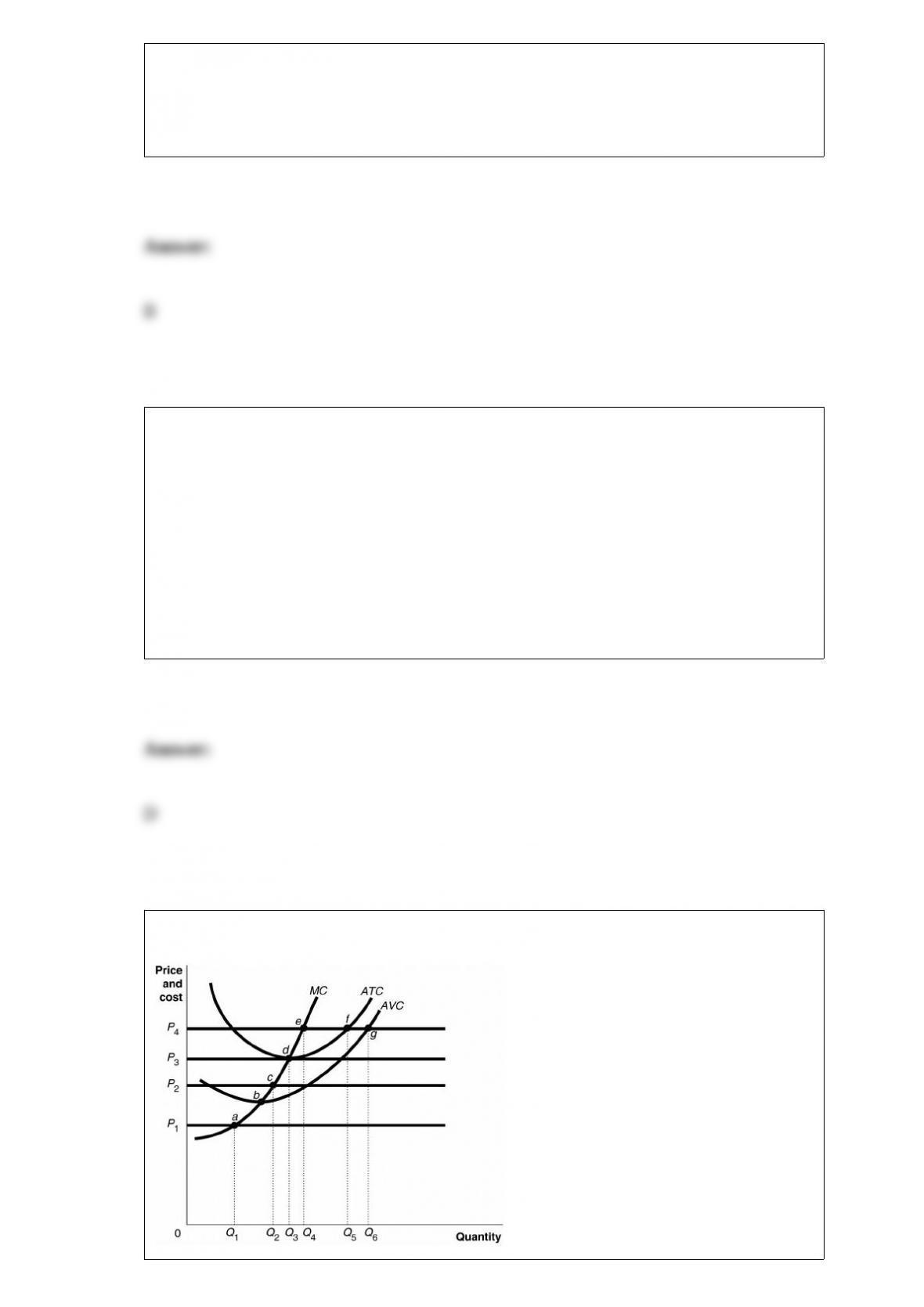
Figure 12-9
Figure 12-9 shows cost and demand
curves facing a profit-maximizing, perfectly competitive firm.
At price P2, the firm would
A) lose an amount equal to its fixed cost.
B) lose an amount more than fixed cost.
C) lose an amount less than fixed cost.
D) break even.
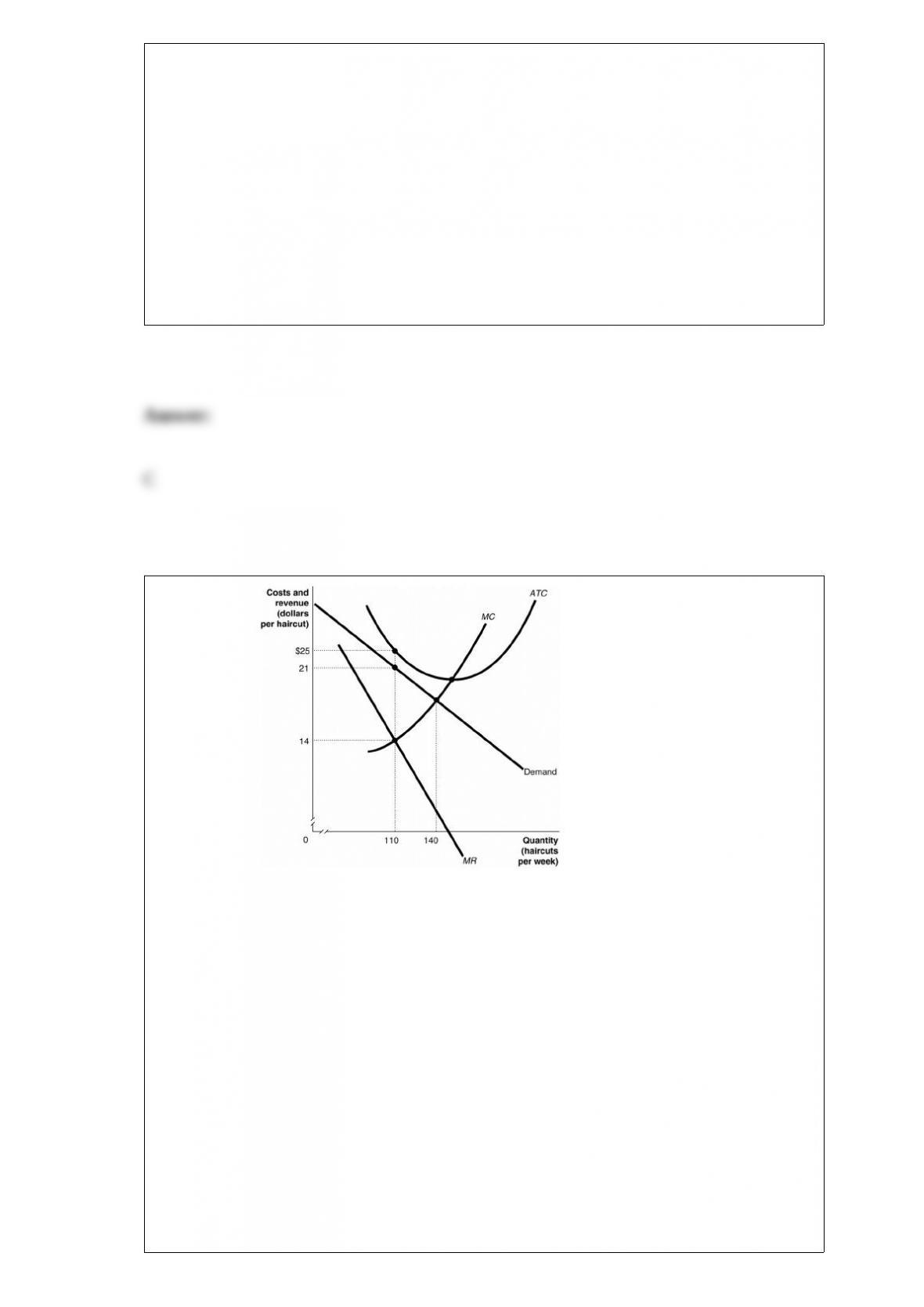
Figure 13-16
Figure 13-16 depicts a monopolistically competitive barber shop. Use the diagram to
answer the following questions.
a. Suppose the average variable cost of production is $15 when output equals 110
haircuts and $15.25 when output equals 140 haircuts. If the firm wants to maximize its
profit or minimize its losses, how many haircuts will it produce and what price should it
charge? Explain your answer.
b. Calculate the firm’s profit or loss.
c. What is likely to happen in this industry over time as it moves to its new long-run
equilibrium?
d. Suppose the barber shop depicted in the diagram remains in the industry. Is this
barber shop likely to produce this same quantity of haircuts as in part (a) in the long
run?
Briefly explain how the miserliness of Ebenezer Scrooge might actually be beneficial
for economic growth.
Adam Smith, the father of modern economics, wrote in his book, An Inquiry into the
Nature and Causes of the Wealth of Nations, “It is not from the benevolence of the
butcher, the brewer, or the baker, that we expect our dinner but from their regard to their
own interest.” Explain what he meant by that statement and how such behavior
promotes the wealth of a nation.
Define microeconomics.
What is the substitution effect of a wage increase? What is the income effect of a wage
increase? Under what conditions will a worker’s labor supply curve become downward
sloping?
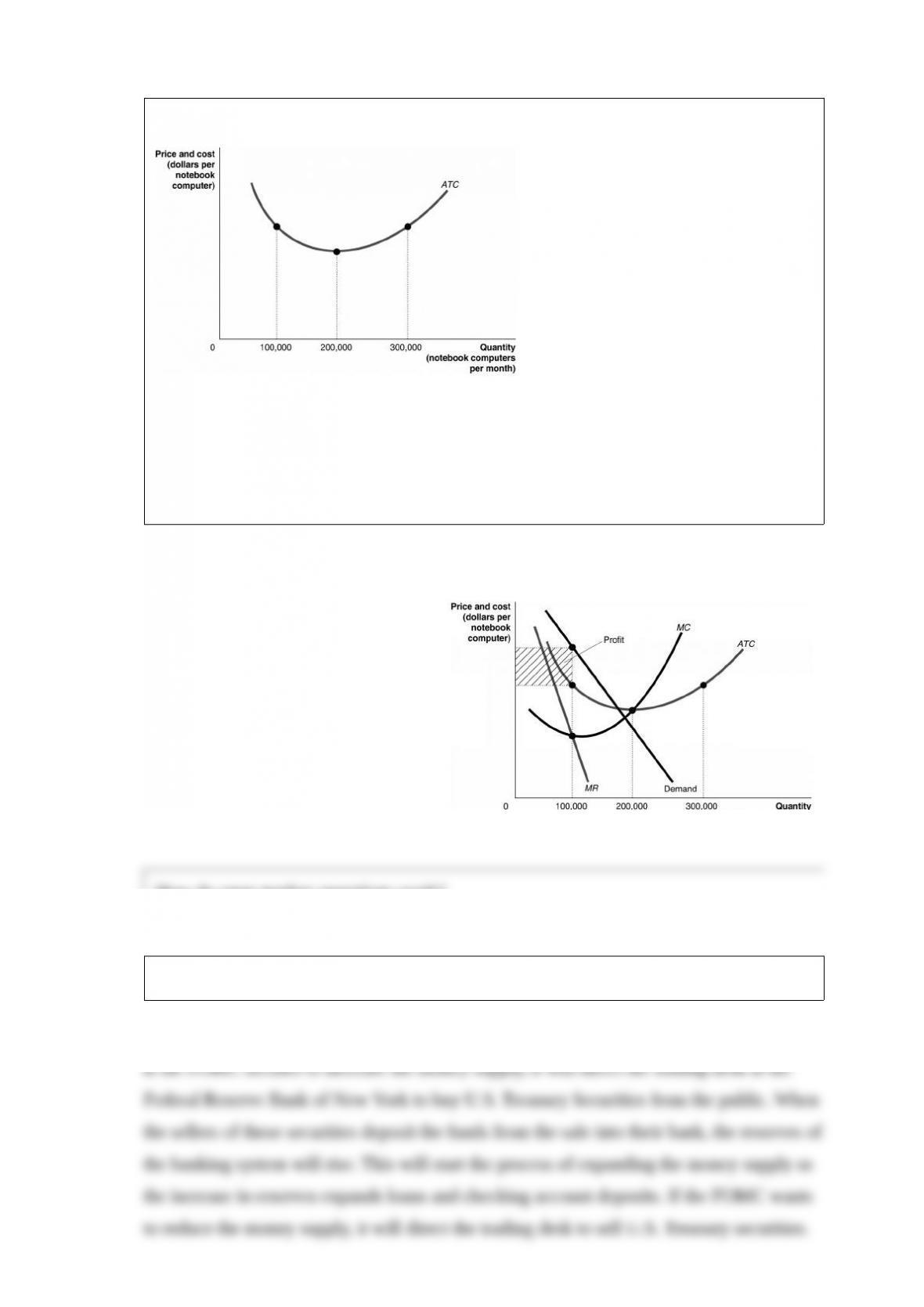
Figure 13-6
Suppose the above graph represents the relationship between the average total cost of
producing notebook computers and the quantity of notebook computers produced by
Dell. On a graph, illustrate the demand, MR, MC, and ATC curves which would
represent Dell maximizing profits at a quantity of 100,000 per month and identify the
area on the graph which represents the profit.
How do open market operations work?
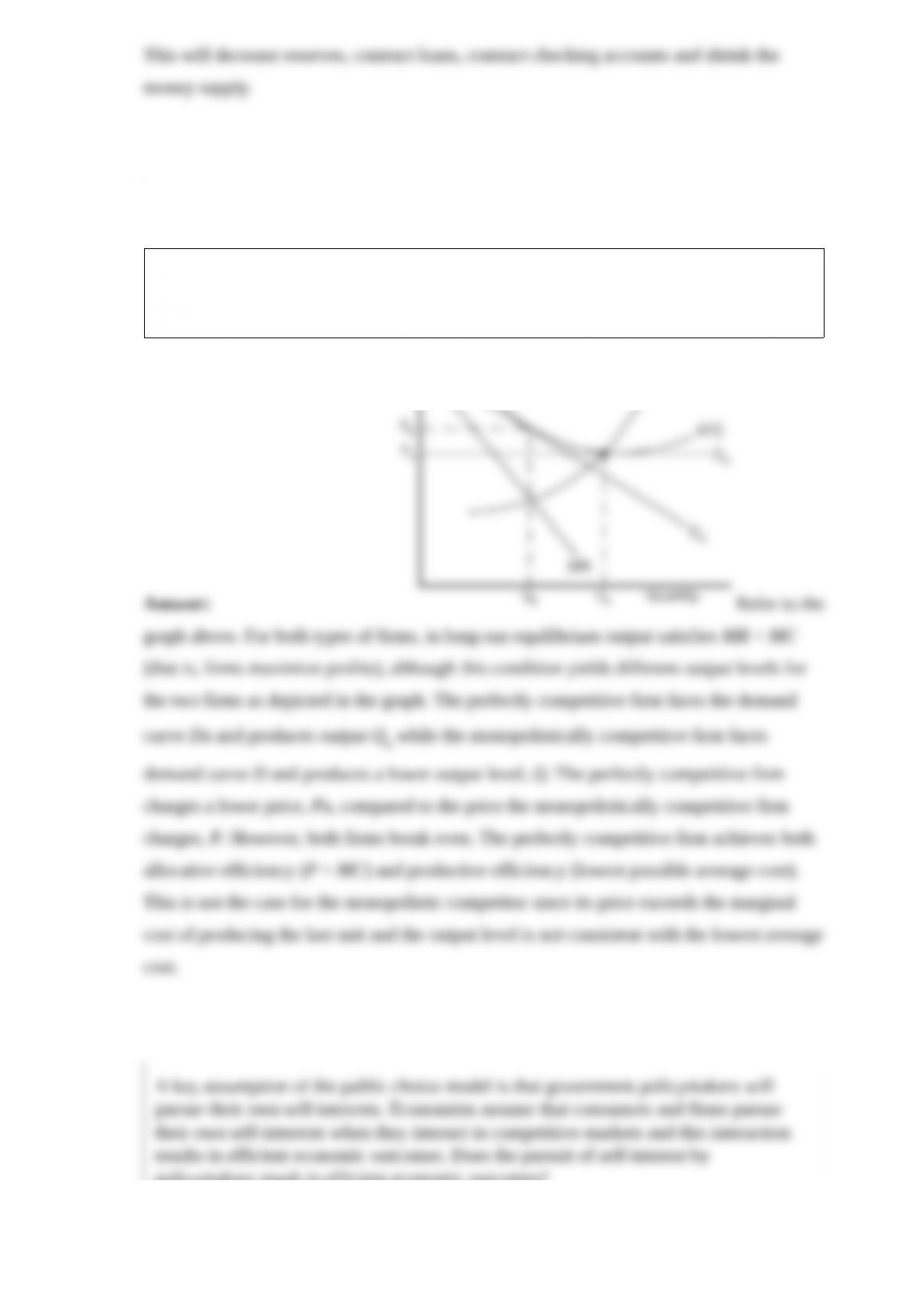
Explain the similarities and differences between the long-run equilibrium for a perfectly
competitive firm and a monopolistically competitive firm. Illustrate your answer with a
graph demonstrating the long run equilibrium for the two types of firms.
A key assumption of the public choice model is that government policymakers will
pursue their own self-interests. Economists assume that consumers and firms pursue
their own self-interests when they interact in competitive markets and this interaction
results in efficient economic outcomes. Does the pursuit of self-interest by
policymakers result in efficient economic outcomes?