
Goods and services produced in other countries and sold to U.S. residents are called
a. extracts.
b. implants.
c. exurbs.
d. imports.
e. exports.
To say that a tax is progressive means that
a. the receipts from the tax are used for research and development.
b. it is a tax on income.
c. the tax affects the distribution of income.
d. the poor pay a smaller proportion of their incomes for the tax than the rich.
e. the tax rate declines with increasing income levels.
The next question is based on the following information:
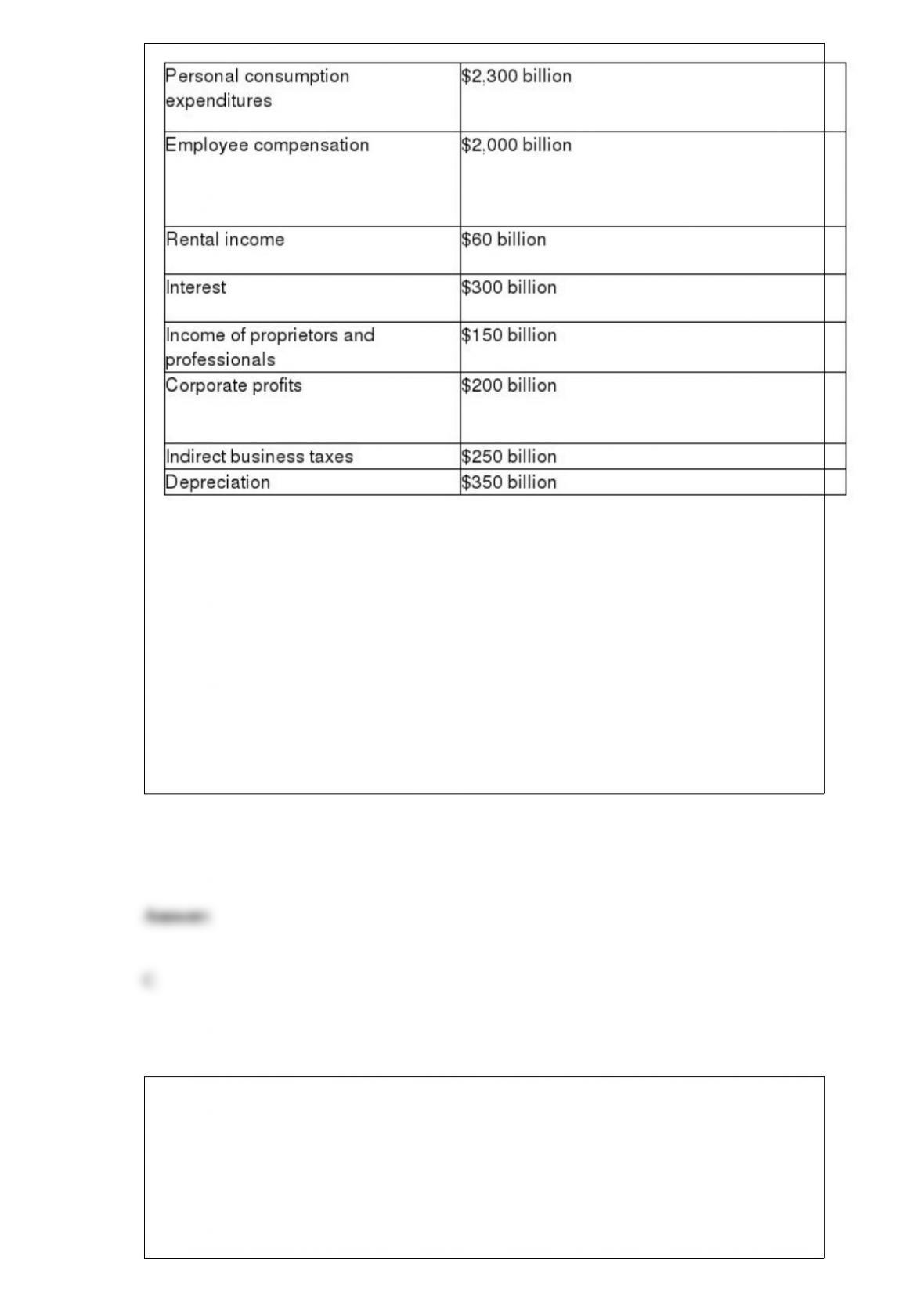
GDP is ________ billion.
a. $2,710
b. $2,960
c. $3,310
d. $3,610
e. $5,610
Monetarists regard the rate of growth of the money supply as the principal determinant
of nominal GDP. By nominal GDP, they mean GDP
a. unadjusted for changes in the price level.
b. measured in constant dollars.
c. excluding the government.
d. divided by the money supply.
e. corrected for the velocity of circulation.
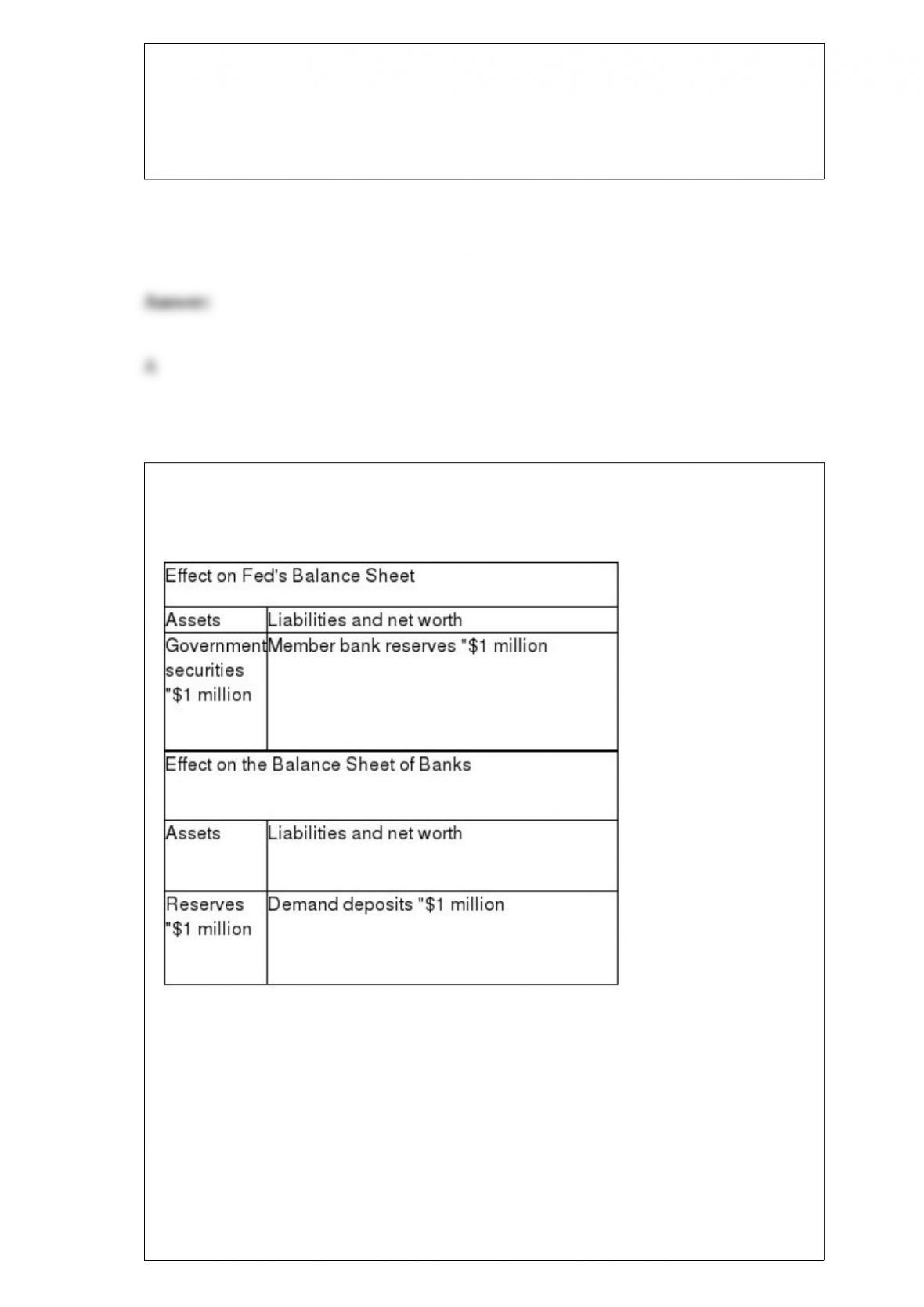
The table below shows the net effect of an open market operation undertaken by the
Fed. Use it to answer the following question.
The Fed can decrease the money supply by
a. selling government securities.
b. raising taxes.
c. lowering reserve requirements.
d. lowering discount rates.

e. decreasing government spending.
The Federal Reserve’s most important tool for controlling the amount of reserves in the
banking system is
a. changing the discount rate.
b. moral suasion.
c. establishing margin requirements.
d. open market operations.
e. buying and selling gold certificates.
Poverty as defined by the Social Security Administration means having an income
a. of less than $12,500.
b. below the nation’s per capita income.
c. in the lowest 10 percent of the population.
d. in the lowest 20 percent of the population.
e. of less than three times the cost of a minimal nutritionally sound food plan.

Fractional-reserve banking depends on the assumption that
a. not all depositors will withdraw their deposits at the same time.
b. most banks will have assets that outweigh liabilities.
c. banks generally make more sound investments than poor investments.
d. at least a portion of the currency, though not all, is backed by gold.
e. the FDIC insures all bank loans up to $100,000.
An increase in the money supply
a. shifts the aggregate demand curve to the left.
b. shifts the aggregate demand curve to the right.
c. shifts the aggregate supply curve to the left.
d. shifts the aggregate supply curve to the right.
e. affects neither the aggregate demand nor the aggregate supply curve, only interest
rates.
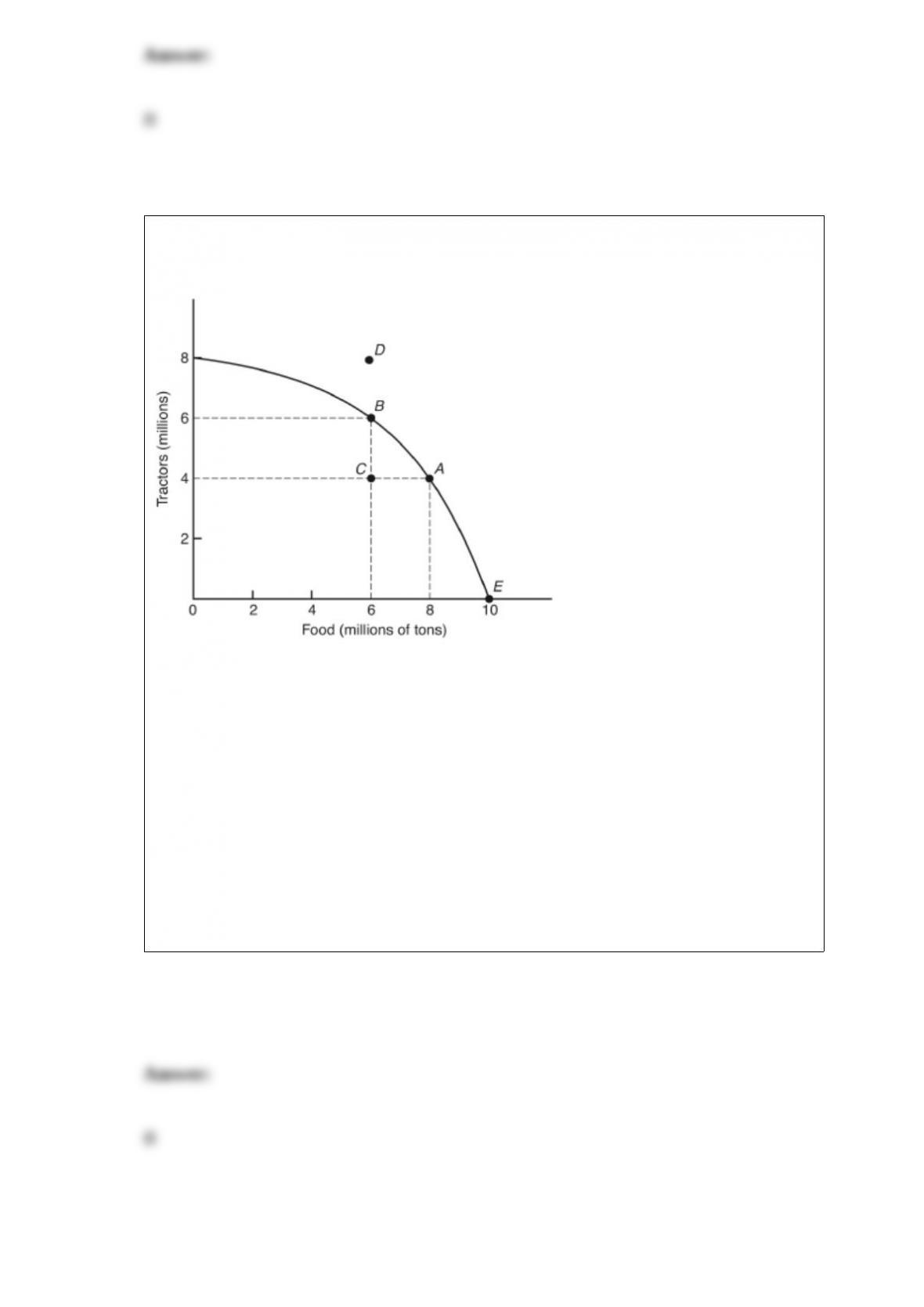
The following questions are based on the following production possibilities curve:
Suppose 4 million tractors wear out each year. If society wishes to push next year’s
production possibilities curve outward, the best point to choose of those shown is
a. A.
b. B.
c. C.
d. D.
e. E.
The average yearly income per family in the United States is about $60,000. To more
meaningfully interpret this figure, we would need information on the
a. output per hour of labor.
b. amount of household consumption expenditures.
c. exchange rate.
d. number of families.
e. distribution of income.
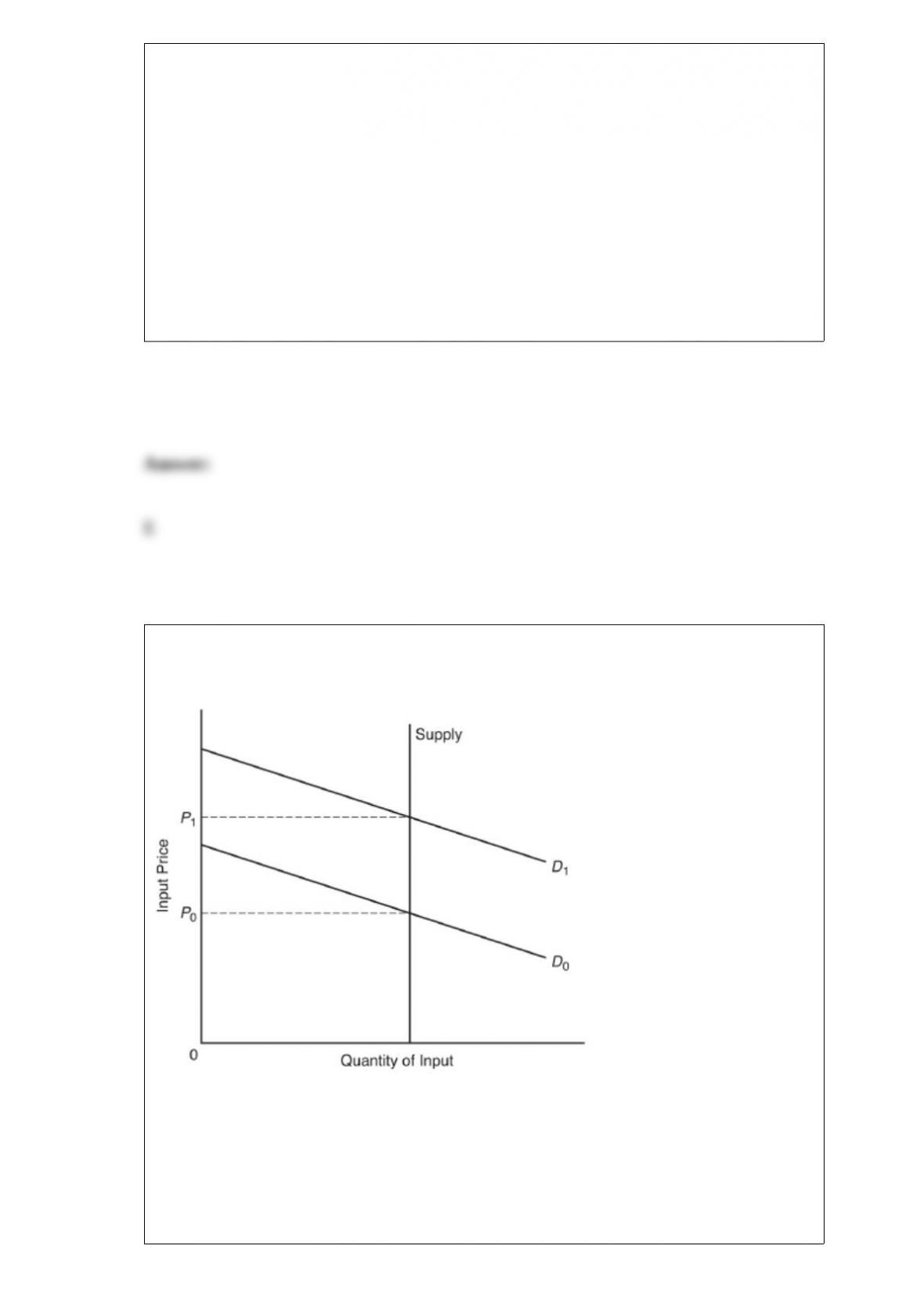
The following questions are based on the following diagram, representing the supply
and demand curves for an input:
The price of this input is called
a. wage.
b. the pure interest rate.

c. profit.
d. rent.
e. a risk premium.
A principal source of air pollution in the United States is
a. motor vehicles.
b. fertilizers, pesticides, and detergents.
c. the steel industry.
d. nuclear reactors.
e. discharges from municipal sewage plants.
The famous confrontation between President Kennedy and the steel industry in 1962
illustrates the
a. general inability of government to control big business effectively.
b. power of moral suasion without the need to use economic incentives.
c. power of presidential pressure in enforcing wage and price guidelines.

d. tendency of major industries to act in the public interest regardless of guidelines.
e. importance of using the antitrust laws to reduce monopoly power.
If the interest rate is 7.5 percent, a dollar received a year from now has a present value
of
a. $1.075.
b. $0.93.
c. $0.875.
d. $0.82.
e. $0.75.
The determinants of investment are
a. the marginal propensity to invest and the savings rate.
b. the level of gross domestic product and the marginal propensity to spend.
c. the profit rate and the equilibrium rate.
d. business expectations and the Dow Jones Industrial Average.

e. the interest rate and the expected rate of return from capital.
Over time the U.S. economy has had
a. fluctuations in growth.
b. full employment without serious inflation.
c. continuous growth in output per person.
d. persistent deflation.
e. steadily increasing unemployment.
The budget policy that sets the government’s budget to attain a socially optimal
combination of unemployment and inflation is likely to
a. be balanced each and every year.
b. cause continual growth in the public debt.
c. have a cyclically adjusted surplus.
d. run surpluses even when unemployment is high.
e. be balanced over the course of the business cycle.

Both Malthus and Ricardo erred in expecting an eventual termination of economic
growth by
a. neglecting the potential for population control.
b. believing that the law of diminishing marginal returns applies solely to land.
c. assuming a constant marginal productivity of labor.
d. neglecting the role of the credit system.
e. underestimating the extent and impact of technological change.
According to real business cycle theory, supply shocks cause
a. changes in both the volume of transactions and the demand for money.
b. changes in the price level but no changes in the unemployment rate.
c. no real changes in the economy, only changes in money, wages, and prices.
d. a shift in the aggregate demand curve but no change in the price level.
e. labor surpluses as firms attempt to increase output, holding wages constant.

An autonomous investment change of $2 billion in the first stage, with a multiplier of 2,
leads to extra income in the third stage of ________ billion.
a. $4
b. $1
c. $0.5
d. $0.25
e. $0
The equilibrium market basket is the one in which the
a. total utilities for each commodity consumed are equal.
b. marginal utility of the last dollar spent on all commodities purchased is the same.
c. marginal utility for each commodity is rising.
d. amount of money allocated to each commodity is proportional to the total utility
received from each commodity.
e. price of each good is equal to its marginal utility.
If, at current exchange rates, $1 equals 0.8333 euros, a German auto that costs 90,000
euros has a dollar price of about
a. $75,000.
b. $83,000.
c. $90,000.
d. $108,000.
e. $111,000.
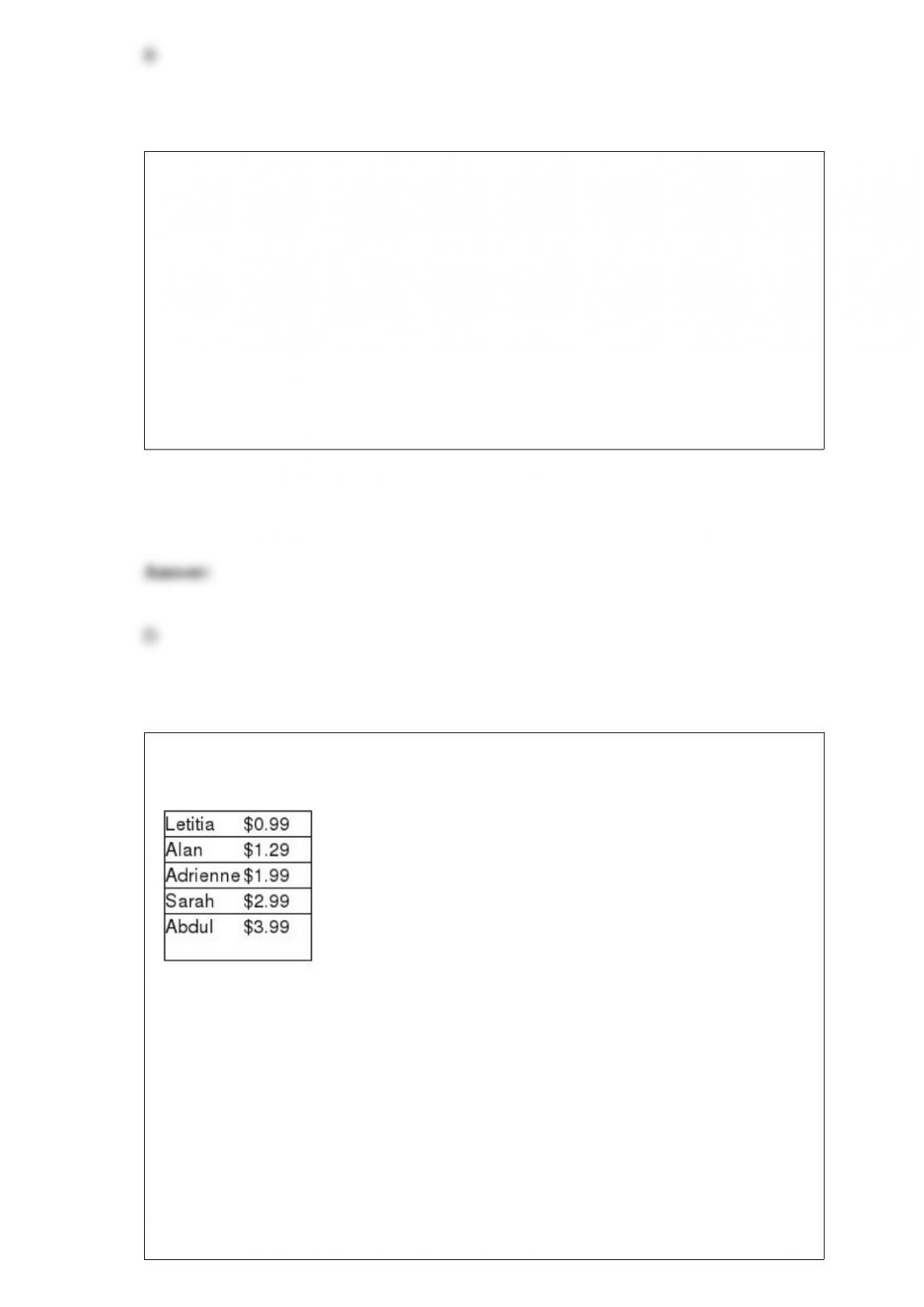
The following questions are based on the following information. Five adolescents are
willing to buy the latest iPhone game at these prices:
If the price of the game is $1.99, the quantity demanded will be
a. one.
b. two.
c. three.
d. four.
e. five.

The most frequently found barriers to entry in oligopoly include
a. the presence of large numbers of rival firms, firms that are price takers, and the
likelihood of normal returns in the long run.
b. an inability to differentiate product, diseconomies of scale, and the need to advertise.
c. mutual interdependence, collusion, and the likelihood of government regulation.
d. the ambiguity of product groups and rising long-run average costs.
e. patents, large initial and continuing financial requirements, and access to basic inputs.
Interest rates
a. help ensure that only those projects with the greatest expected productivity will be
undertaken.
b. are not really needed in a modern planned economy.
c. arise solely because investment projects entail risk.
d. vary directly with the capitalized value of an asset.
e. are synonymous with the concept of expected rates of return.

Which of the following taxes can be related to the benefit principle?
a. personal income tax
b. estate tax
c. gasoline tax
d. corporate income tax
e. inheritance tax
Which of the following best describes the concept of a marginal tax rate?
a. the amount of income divided by the amount of taxes
b. the tax rate divided by total income
c. the change in taxes divided by the amount of taxes
d. the change in taxes divided by the change in income
e. the amount of before-tax income divided by the amount of after-tax income

According to Adam Smith, economic progress results from
a. government ownership of productive resources.
b. a perfectly equal distribution of income in a society.
c. allowing firms to achieve great economic power by monopolizing markets.
d. the division of labor and increased specialization.
e. rapid rates of population growth.
Pollution control policies such as effluent fees
a. lower consumer prices.
b. raise the sales of those firms being taxed.
c. cause the social costs to exceed the private costs.
d. increase the external diseconomies of production.
e. increase firms’ costs of production.

The concept of the natural rate of unemployment
a. states that higher inflationary rates are necessary to substantially reduce its value.
b. is credited to A. W. Phillips.
c. reflects, in part, the willingness of workers to remain voluntarily unemployed rather
than take unattractive or lower-paying jobs.
d. reflects the fact that people are lazy and will not work unless they have to.
e. denotes workers temporarily unemployed as a result of expansionary monetary and
fiscal policies.