
A persistent shortage or surplus of a currency under the Bretton Woods system was
evidence of
A) failure to support the existing fixed exchange rate by central banks.
B) fundamental disequilibrium in the country’s exchange rate.
C) speculation against the currency by speculators in world exchange markets.
D) all of the above
Classifying a good as excludable means
A) that someone can be barred from consuming the good based on race, creed or some
other irrelevant characteristic.
B) that anyone who does not pay for the good cannot consume it.
C) that consumption of the good causes no externalities.
D) that a producer with patent or copyright protection can exclude any other producer
from selling his product.
For many years the Aluminum Company of America (Alcoa) controlled most of the
world’s supply of high quality bauxite, the ore needed to produce aluminum. What type
of entry barrier was responsible for Alcoa’s position in the aluminum industry?
A) ownership of a key input
B) a government-imposed barrier

C) a patent on the manufacture of aluminum
D) economies of scale
China’s exchange rate system from 1994 through 2005 is an example of
A) a floating exchange rate system.
B) a managed float exchange rate system.
C) a fixed exchange rate system.
D) a flexible exchange rate system.
E) the Bretton Woods System.
When deflation occurs,
A) the real interest rate is greater than the nominal interest rate.
B) the nominal interest rate is greater than the real interest rate.
C) the nominal interest rate is equal to the real interest rate and inflation is negative.
D) the nominal interest rate is equal to the real interest rate and inflation is positive.

If, as a person consumes more and more of a good, each additional unit adds less
satisfaction than the previous unit consumed, we are seeing the workings of
A) the law of demand.
B) the law of supply.
C) the law of increasing marginal opportunity cost.
D) the law of diminishing marginal utility.
After having a monopoly in the diamond market for many years, by 2000 the De Beers
company faced competition from other companies. To maintain its market share, De
Beers
A) began buying so-called “blood diamonds” in order to keep these diamonds out of the
control of other diamond companies.
B) adopted a strategy of differentiating its diamonds. Each of its diamonds is now
marked with a microscopic brand.
C) bought diamond mines in Canada and Russia that had been its competitors.
D) lowered the prices of its diamonds to make the market appear less profitable to
potential competitors.

In 2013, health care made up ________ of the U.S. economy
A) about 2 percent
B) roughly 8 percent
C) more than one-sixth
D) almost two-thirds
The difference between GDP and net taxes is
A) personal income.
B) actual investment spending.
C) disposable income.
D) unplanned investment spending.
As a measure of competition in an industry, concentration ratios have several flaws.
One of these flaws is that concentration ratios
A) assume that all industries have low barriers to entry.
B) assume that a ratio less than 40 percent means an industry is perfectly competitive.
C) assume there are only four firms in an industry.
D) are calculated for the national market, even though competition in some industries is
mainly local.
Federal and state governments in the United States pay for ________ of health care
spending.
A) less than 10 percent
B) approximately 34 percent
C) just over half
D) more than 80 percent
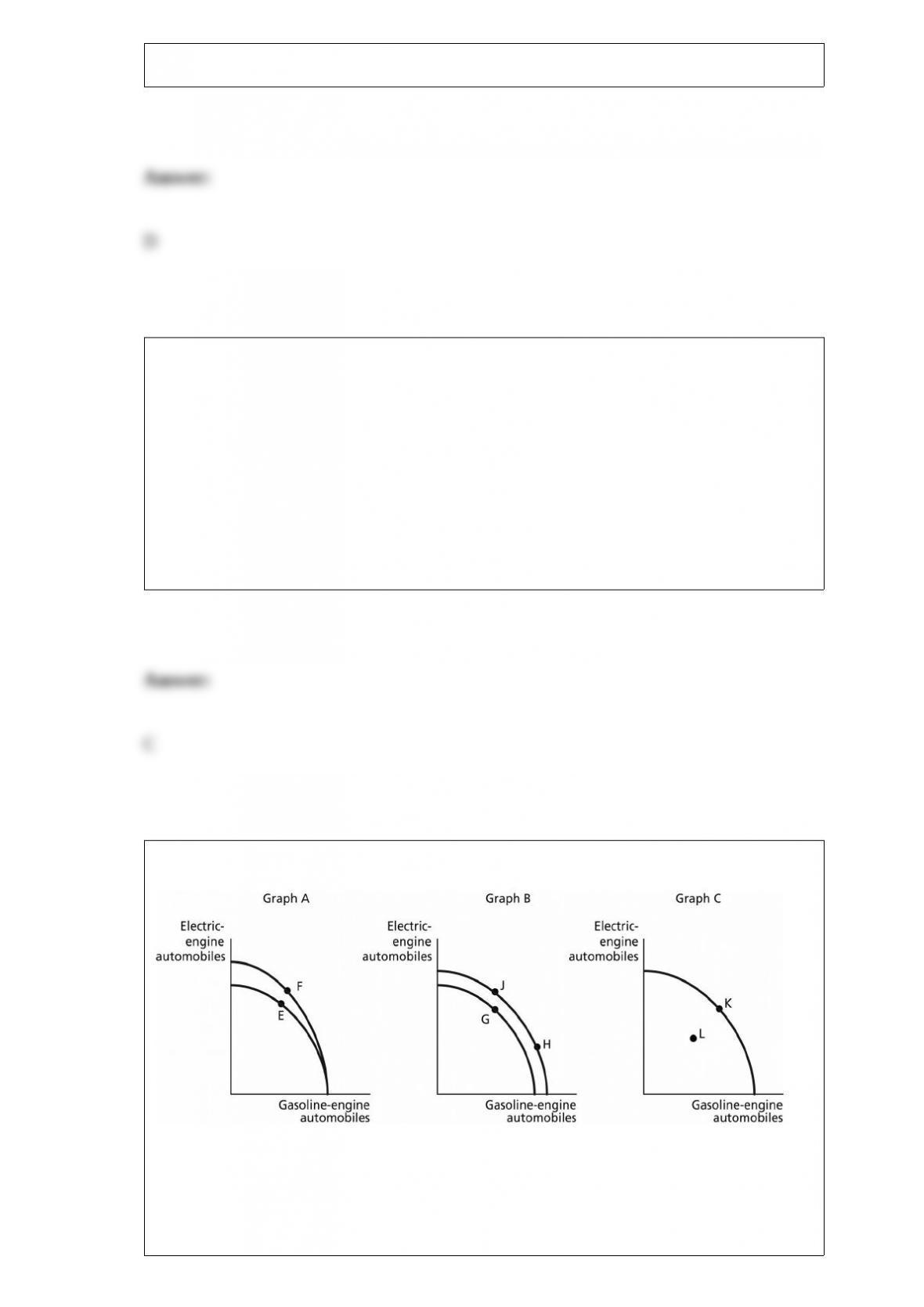
Figure 2-7
Mercedes Benz recently decided to introduce its B-class automobile in the U.S. market,
an electric car that is has designed and developed in a partnership with Tesla Motors.
Assume Mercedes Benz chooses to produce both electric-engine vehicles and
gasoline-engine vehicles. Figure 2-7 shows changes to its production possibilities
frontier in response to new developments and different strategic production decisions.

Assume that in 2014, Mercedes reopened one of its factories after an extensive
remodelling which now allows for the production of both types of vehicles. This is best
represented by the
A) movement from E to F in Graph A.
B) movement from H to J in Graph B.
C) movement from L to K in Graph C.
D) movement from J to G in Graph B.